
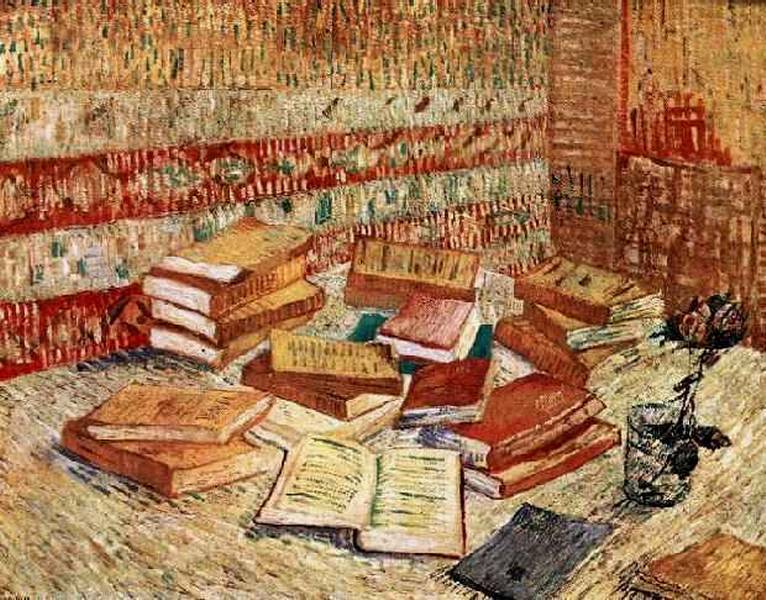
{credit}Still Life with French Novels and a Rose, Vincent Van Gogh (oil, 1887){/credit}
As the literati strive to predict the future of the book, one thing is clear in the here and now: the best of popular science writing is still all about clarity, rigour and brio. This year’s six-book shortlist for the Royal Society Winton Prize for Science Books bristles with that mix.
The Society’s annual prize, now worth £25,000, is awarded to the year’s “outstanding popular science books from around the world”. This half-dozen certainly delves into many worlds — the universe inside the skull, the cosmos of numbers, the subatomic, the gene, and the dynamic interplay between biology and quantum mechanics, and people and planet.
Meet the contenders (in alphabetical order of authors’ surnames).
The Man Who Couldn’t Stop by David Adam (Picador)
Seasoned science journalist (and Nature colleague) Adam’s searing study-cum-memoir, reviewed here, is a twin journey through his own knotted, traumatic experience of obsessive-compulsive disorder, and the evolving science surrounding it. A reflective eye on what Adam calls “our siege mentality”.
Alex Through the Looking-Glass: How Life Reflects Numbers and Numbers Reflect Life by Alex Bellos (Bloomsbury)
The erudite and engaging Bellos, a writer and speaker on mathematics, follows up his bestselling 2010 Alex’s Adventures in Numberland with this equally adroit interweaving of maths history, the peculiarities of day-to-day maths, and the mindscapes of mathematicians. (Why is 24 is better than 31 in the context of anti-dandruff shampoo? You’ll need to read the book.)
Smashing Physics: Inside the World’s Biggest Experiment by Jon Butterworth (Headline)
Butterworth, a particle physicist and CERN insider, here (writes my colleague Jo Baker) gives “a personal account of three years that shook his research field – from the switching on of the Large Hadron Collider at CERN in 2009 to the discovery of the Higgs boson in 2012. In a lucid treatment — part memoir, part primer — he relates the ups, downs and minutiae of everyday life at the particle physics coalface and reflects on the public and political perceptions of science.”
Life’s Greatest Secret: The Story of the Race to Crack the Genetic Code by Matthew Cobb (Profile)
Zoologist Cobb masterfully recontextualises the 1953 discovery of the structure of DNA (reviewed here). One for the shelf bearing seminal early studies by James Watson and Horace Judson, Cobb’s treatment beautifully explicates the contributions of physics, biology and chemistry, and scientists from Oswald Avery to Rosalind Franklin.
Life on the Edge: The Coming of Age of Quantum Biology by Johnjoe Mcfadden and Jim Al-Khalili (Bantam Press)
Al-Khalili (a physicist) and McFadden (a molecular biologist) take on the vexed nexus of quantum weirdness and life itself in this exploration of an emergent field of scientific endeavour (reviewed here). From synthbio to quantum tunnelling inside enzymes, a trip into strange, and strangely compelling, realms of research.
Adventures in the Anthropocene: A Journey to the Heart of the Planet we Made by Gaia Vince (Chatto & Windus)
Writer, broadcaster and former Nature news editor Vince covered six continents over two years to craft this compilation (reviewed here). Bucking the trend to view the environmental challenges of the Anthropocene with terrified or jaundiced eye, she discovered innovators and pioneers working towards new models of adaptation and environmental ‘reverse engineering’. A grand survey of development endeavour through a science writer’s lens.
In looking through this list, it occurred to me anew how popular science writing remains one of the great exemplars of multidisciplinarity. It is the context to the findings — the history, the socioeconomic realities, the psychology of the players and their rivals, the leadup to discovery and the societal implications of its deployment — that reveals the real-world significance of the science.
Scientific storytelling is one of the great artforms of our age. Its roots may stretch back to Mary Somerville’s monumental On the Connexion of the Physical Sciences 181 years ago (reviewed here), but its heyday is now.
The judges of this year’s prize include chair Ian Stewart (mathematician and Royal Society Fellow), Guardian books editor Claire Armitstead, Channel 4 lead anchor Krishnan Guru-Murthy, electronics engineer Jo Shien Ng, science broadcaster and author Adam Rutherford, and novelist Sarah Waters. The winner will be announced at a Royal Society public event on 24 September, hosted by Brian Cox, Royal Society Professor for Public Engagement in Science.
For Nature’s full coverage of science in culture, visit www.nature.com/news/booksandarts.