Last Diamonds: portraits of icebergs

Posted on behalf of Michael White
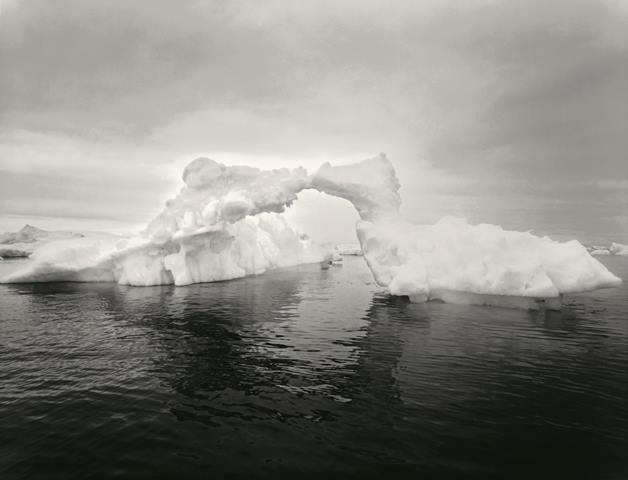
Diamond #4 (Greenland 2015)

Diamond #4 (Greenland 2015) {credit}© Francesco Bosso {/credit}

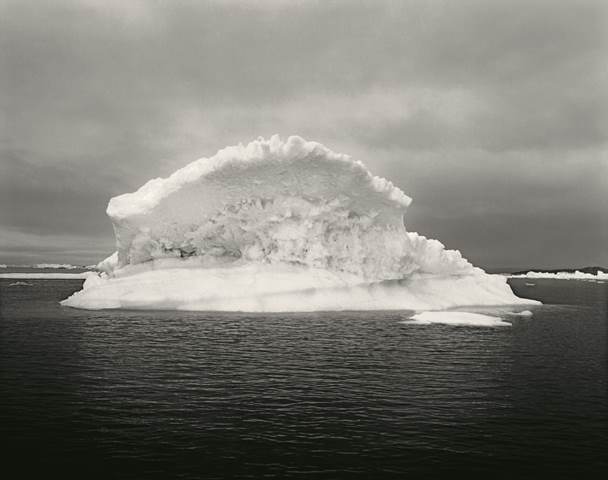
A frozen menagerie of yawning overhangs, rotting underbellies, humanistic curves, tumbled-over organ pipes confronts you.  Francesco Bosso’s Last Diamonds is a glorious, sombre collection of 25 monochrome ‘portraits’ of icebergs off the coast of Greenland, gingerly treading the boundary between art and science. Each plate, created using a traditional analog photographic process, offers haunting insight into the cryosphere, exploring a grey, often cloudy sky, a shimmering jet-black ocean, and an iceberg traversing the intersection.

An encounter with art inevitably sparks questions. Do I like it? What does it mean? And does an understanding of meaning change whether or not I like it? For some, context is all; for postmodernists, comparisons are odious and art should be understood solely on the interaction of viewer with work. Going by the latter school of thought, Bosso’s is an unqualified success.
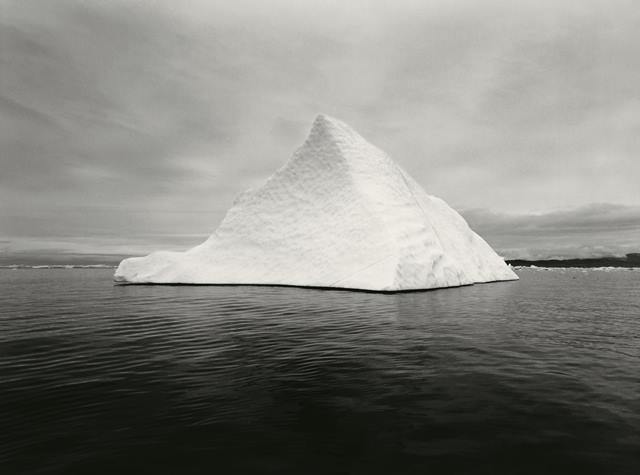
Diamond #2 (Greenland 2015)

Diamond #2 (Greenland 2015){credit}© Francesco Bosso {/credit}

His exploration of light, tone and texture evokes the work of Ansel Adams’ assistant and successor John Sexton. Where Adams was all sweeping vistas, Sexton framed more intimate shots. As with so much great landscape photography, the power of the images emerges in part from the sense of the patience and agility needed to capture a perfectly framed moment from a transient confluence of conditions.

In Diamond #2, the thin black line between iceberg and ocean echoes the sliver of distant land visible. The shared angle between cloud and ice in Diamond #5 suggests an intimate physical linkage. The formality of the images offers an elegant contrast to the turmoil of the active glacial calving fronts where they originated, somewhere out of shot.

What sets Last Diamonds apart from the bulk of landscape photography is the bewildering individuality of the ice. In contrast to the exploration of sculptural form and sheer beauty in photographic collections such as Camille Seaman’s Last Iceberg series (see review here), Bosso’s vision is more subtly varied in tone and light — and somehow, more interiorised.
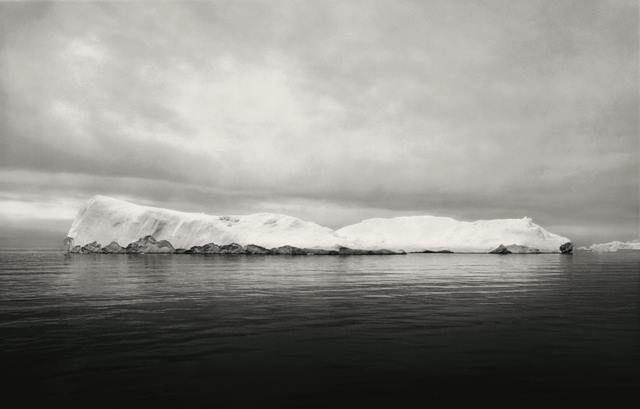
Diamond #5 (Greenland 2015)

Diamond #5 (Greenland 2015){credit}© Francesco Bosso{/credit}

Even more remarkable is the sense of disorientation spawned by a near-complete lack of scale. Humanity is absent, and what whispers of land there are cannot provide much footing. The icebergs could be 2 or 200 metres tall.

Yet this lack of context, so intriguing visually, creates a problem highlighted by the book’s title. The global loss of ice is indisputable. But in the absence of context and Bosso’s description of icebergs as “gems of nature in danger of extinction”, the viewer might conclude that we are bearing witness to the end of icebergs.

This is premature. Even in Greenland, marine-terminating glaciers — which flow to the sea, calving bergs — are unlikely to disappear within several human lifetimes. Iceberg production in Antarctica will continue into the foreseeable future. Jakobshavn Isbrae, where much of Last Diamonds was shot, has long been the poster child for a rapidly disintegrating cryosphere. But it has thickened and advanced in recent years.
Diamond #7 (Greenland 2015)

Diamond #7 (Greenland 2015){credit}© Francesco Bosso {/credit}

Thus, Last Diamonds tends towards over-interpretation, and would have benefited from a more candid summary of cryospheric processes in a warming climate. There are two points to make. First, the calving of icebergs, even monsters such as Antarctica’s A-68, is a natural process that has occurred for millions of years. Tying any one calving or season to our activities is spectacularly difficult. Second, these activities will almost certainly produce radical changes in the extent of ice throughout the planet, if unchecked.

Art is not beholden to the subtle nuances and endless caveats of scientific discourse. Of course, Bosso’s minimalist aesthetic and stark message may be playing for dramatic effect to stimulate discussion around climate change and the cryosphere. More power to that; but the extinctions he hints at are still avoidable.

Michael White is senior editor in physical sciences at Nature. He tweets at @MWClimateSci.


For more on science and culture, see: https://go.nature.com/2CMOwaL.
Illustrated books of 2017: the magnificent eight

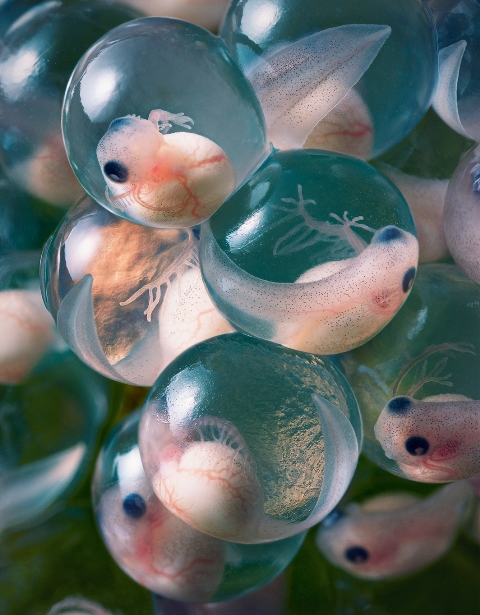
Yellow-eyed tree-frog eggs, from Endangered by Tim Flach, with text by Jonathan Baillie (Abrams).

Yellow-eyed tree-frog eggs, from Endangered by Tim Flach, with text by Jonathan Baillie (Abrams). {credit}© 2017 Tim Flach{/credit}

There’s something about a collection. We seem to harbour an urge to amass and sort as we build menageries, museums, taxonomies. And the illustrated book is a portable simulacrum, a paper cabinet of curiosities, curated for maximum aesthetic punch.

This year, my favourites include coffee-table tomes on the Solar System and early voyages from Europe to Latin America. The rest, as with those I prized most last year, focus on fauna — a reflection of the emphasis on animal intelligence, behaviour, extinction and resurrection in popular-science publishing. Our obsession with Animalia is unstoppable. In some important way, the thread has yet to snap between us and the humans who, 35,000 years ago, layered exquisite images of bison, lion and rhino on the walls of Chauvet cave.

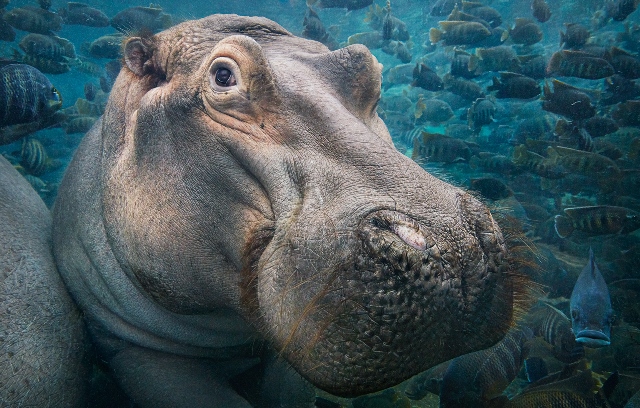
Hippopotamus underwater, from Endangered by Tim Flach, with text by Jonathan Baillie (Abrams).

Hippopotamus underwater, from Endangered by Tim Flach, with text by Jonathan Baillie (Abrams). {credit}© 2017 Tim Flach{/credit}

Among the eight illustrated books that leapt out at me, Endangered (Abrams) won the long jump. On the cover, a crowned sifaka lemur tightly clutches its knees, citrine eyes staring with alien intensity. Inside is a virtuosic gallery of species at the edge: the bulbous topography of a hippo’s face; Mexican free-tailed bats slicing up the sky; a long-range shot of a polar bear curled in snow, white on white. Complementing Tim Flach’s hyper-stylised images are commentary by Jonathan Baillie, the National Geographic Society’s chief scientist, and writer Sam Wells.

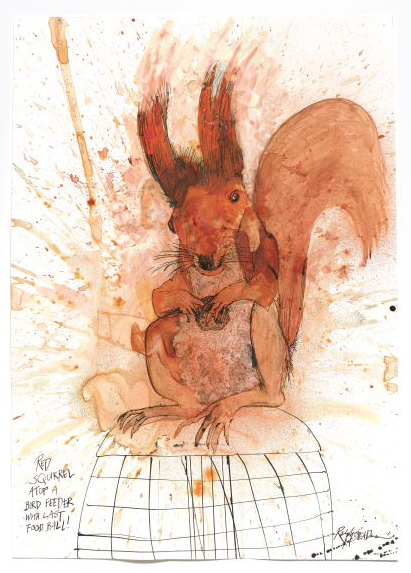
Red squirrel by Ralph Steadman in Critical Critters (Bloomsbury).

Red squirrel by Ralph Steadman in Critical Critters, by Steadman and Ceri Levy (Bloomsbury).{credit}Ralph Steadman and Ceri Levy{/credit}

Biodiversity loss has also gripped self-styled “gonzovationist” and illustrator Ralph Steadman for years, as his 2015 Nextinction showed. Now, in Critical Critters (Bloomsbury), Steadman (with Ceri Levy) pictures another bevy of beasts, exuberantly splatting his way from iconic megafauna such as tigers to dugongs, wombats and a red squirrel in burnt orange, ears aflame. The irrepressible Steadman includes the ‘grunting spiked turt’, a chameleon-like animal that should exist, but doesn’t.

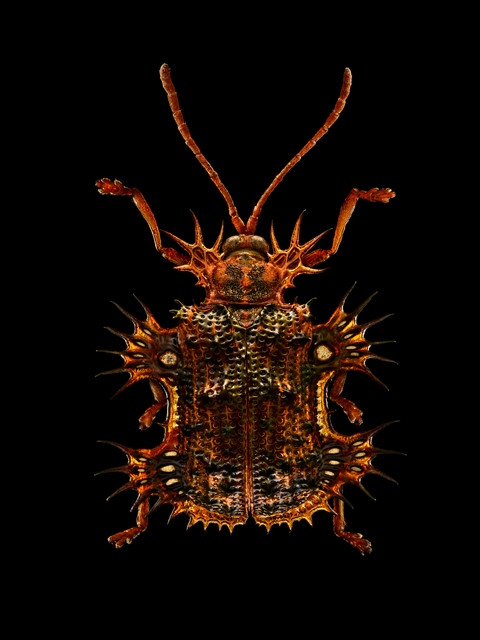
Tortoise beetle, from Microsculpture: Portraits of Insects by Levon Biss (Abrams).

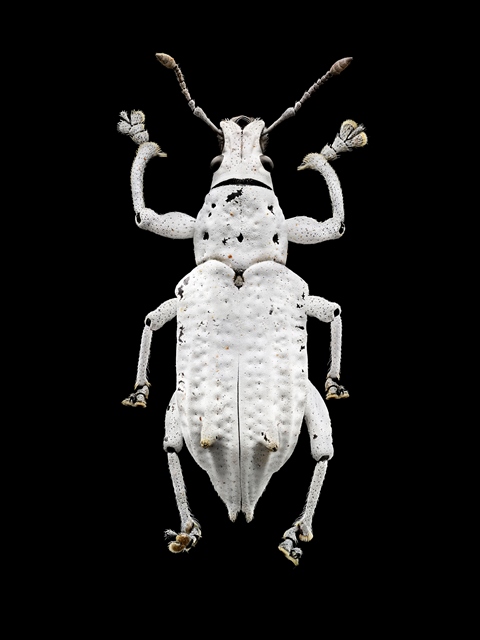
Short-nosed weevil, from Microsculpture: Portraits of Insects by Levon Biss (Abrams).{credit}© Levon Biss{/credit}

Insects that did exist, yet look impossible, feature in Levon Biss’s photographic feat Microsculpture (Abrams). Biss (whose work can also be seen in this film) imaged the world’s oldest insect collection at the Oxford University Museum of Natural History, including specimens bagged by Darwin and Alfred Russel Wallace. Each bravura photograph incorporates some 8,000 separate shots, from the ornate tortoise beetle — a rococo delight — to the ghostly short-nosed weevil.

Tortoise beetle, from Microsculpture: Portraits of Insects by Levon Biss (Abrams).

Tortoise beetle, from Microsculpture: Portraits of Insects by Levon Biss (Abrams).{credit}© Levon Biss{/credit}

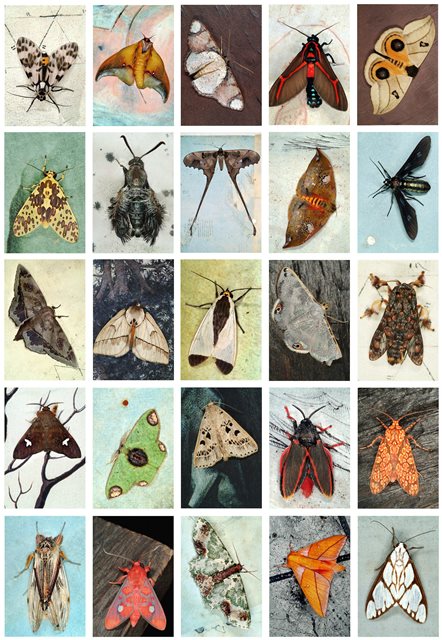
More entomological glory flutters in Mariposas Nocturnas (Princeton University Press), photographer Emmet Gowin’s hard-won homage to South American lepidoptera. From Brazil to Panama and over two decades, Gowin shot over 1,000 species of nocturnal moths alive. Arranged in typologies of 25, they form a morphologically varied, vividly hued patchwork. As Gowin writes, “By loving the minutiae, we find the whole.”

xxx

Index 31, taken in April 2010 in French Guiana, in Mariposas Nocturnas by Emmet Gowin (Princeton University Press){credit}Emmet Gowin{/credit}

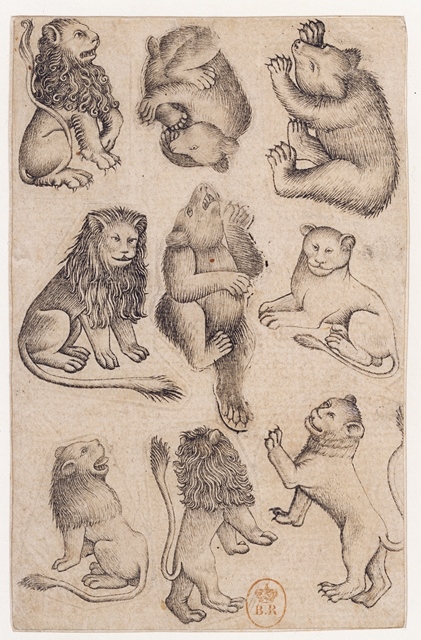
Long before photography, engravers and printers battened upon beasts as evocative subjects for artworks and books — not just bestiaries and early natural-history tomes, but also allegories, illustrated tales and even playing cards. Animal (Bloomsbury) tells that story through powerful, often deeply strange works from the fifteenth to the twentieth centuries, deftly curated by editors Rémi Mathis and Valérie Seuer-Hermel from the National Library of France collection.

Cards with bear and lion symbols by the Master of the Playing Cards, Upper Rhine Valley, 1435-1445. In Animal, edited by

Cards with Bear and Lion Suit Symbols, by the Master of the Playing Cards,1435-1445, in Animal, edited by Rémi Mathis and Valérie Seuer-Hermel (Bloomsbury). Printed on copper plates, these cards were the first examples of engraving on metal seen in Europe.{credit}National Library of France{/credit}

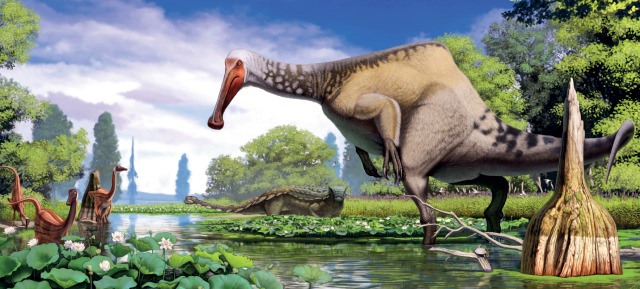
The cutting-edge imaging technologies of today feature in Dinosaur Art II (Titan Books), edited by artist Steve White. This follow-up to the 2012 Dinosaur Art features works of scientific precision and nuanced beauty by 10 top painters, modellers and digital artists. Among many standouts are Sergey Krasovskiy’s oil painting of the giant-jawed, tiny-limbed Pycnonemosaurus nevesi and a digital portrayal of the mysterious duck-billed Deinocheiris mirificus by Andrey Atuchin.

xxxx

The duck-billed dinosaur Deinocheiris mirificus (digital, 2014) by Andrey Atuchin, in Dinosaur Art II, edited by Steve White (Titan Books).{credit}Andrey Atuchin{/credit}

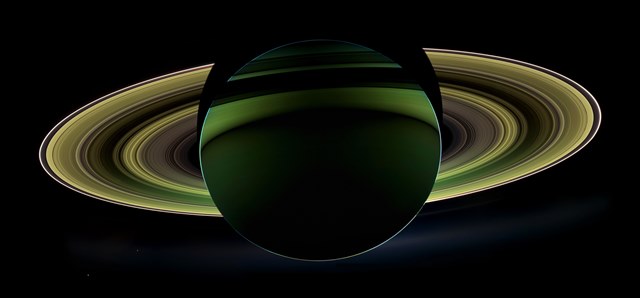
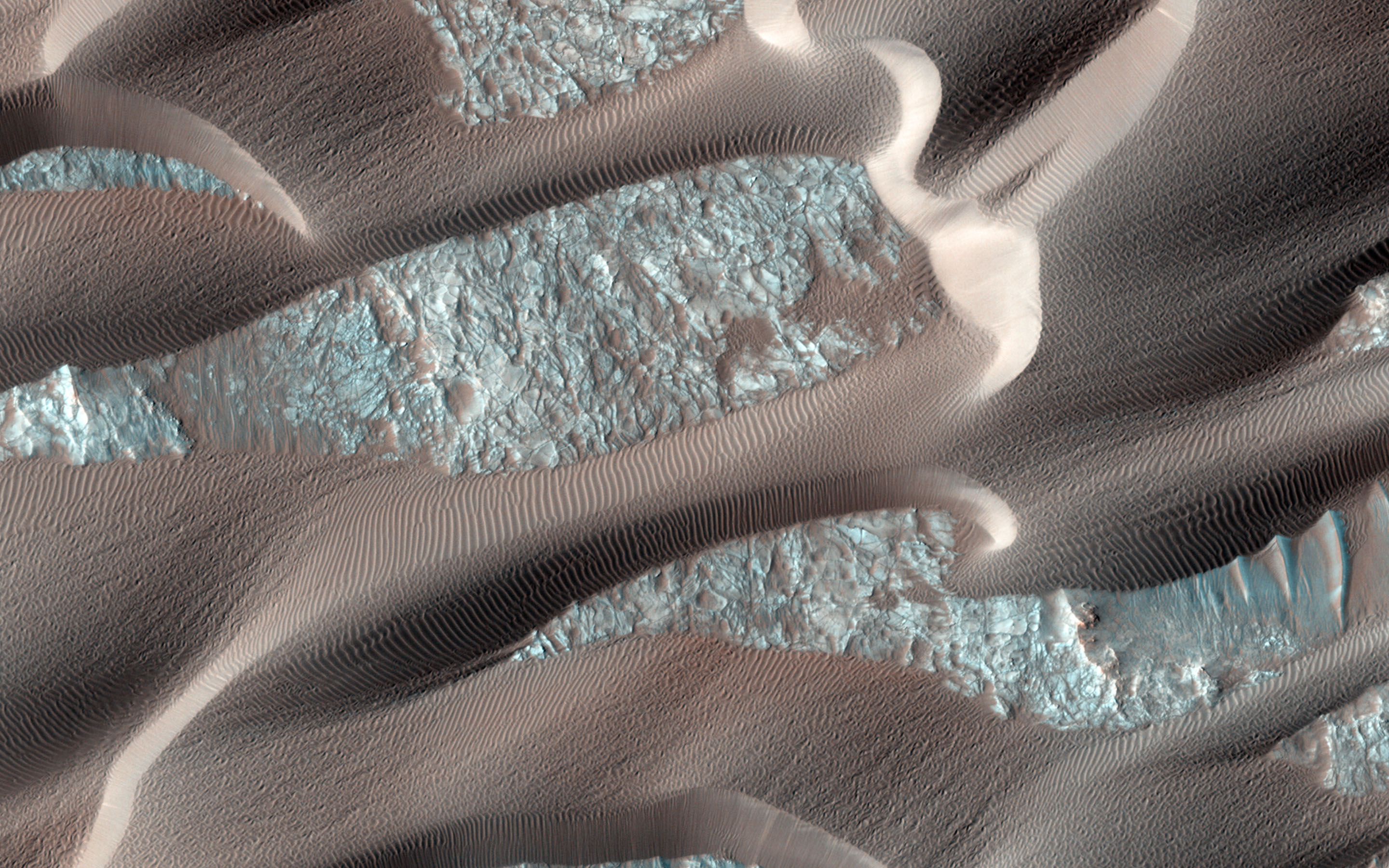
Zooming out from deep time to deep space, The Planets (Chronicle Books) by writer Nirmala Nataraj mines the NASA archives for a thrill-a-minute tour of our cosmic neighbourhood. It’s a handsome array, from the flow of dunes in Mars’s Nili Patera caldera, caught by the HIRISE camera on the Mars Reconnaisance Orbiter, to an opulently hued backlit view of Saturn captured by Cassini’s wide-angle camera.

Dunes patterning Nili Patera caldera on Mars, caught by the HIRISE camera on the Mars Reconnaisance Orbiter. From The Planets (Chronicle Books) by Nirmala Nataraj.

Dunes patterning Nili Patera caldera on Mars, caught by the HIRISE camera on the Mars Reconnaisance Orbiter. From The Planets (Chronicle Books) by Nirmala Nataraj. {credit}NASA, JHUAPL, Carnegie Institution of Washington{/credit}

xxx

A back-lit view of Saturn, captured by Cassini’s camera. From The Planets (Chronicle Books) by Nirmala Nataraj. {credit}NASA, JPL-Caltech, SSI{/credit}

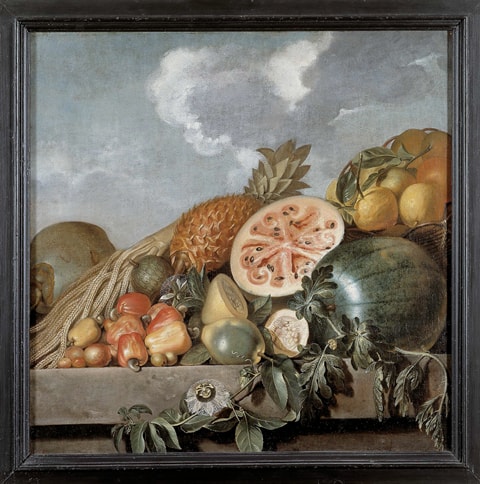
In mapping the Solar System, it’s easy to forget that swathes of Earth were uncharted five centuries ago, and indigenous Americans and Europeans had yet to meet. When they did, starting with Columbus’s 1492 voyage, a “vertiginous transformation” began, reminds historian Daniela Bleichmar in Visual Voyages (Yale University Press). It spelt immeasurable devastation for New World peoples even as their knowledge rewrote the Old World’s book of nature. As this fascinating, sensitively written book attests, this revolution, in turn, kickstarted a frenzy of printing and cartography to frame the barrage of botanical, zoological, anthropological and geographic data.

Fruits, Pineapple and Melon, 1640-50 (oil on canvas) by Albert Eckhout, in Visual Voyages by Daniela Bleichmar, Yale University Press.

Fruits, Pineapple and Melon, 1640-50 (oil on canvas) by Albert Eckhout, in Visual Voyages by Daniela Bleichmar, Yale University Press.{credit}National Museum of Denmark{/credit}

For Nature‘s full coverage of science and culture, see https://go.nature.com/2CMOwaL.
Top 20 books: discovering worlds

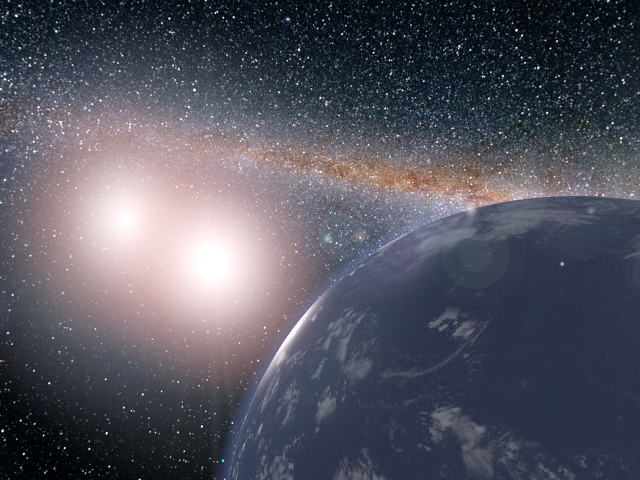
Artist's conception of a hypothetical planet covered in water around the binary star system of Kepler-35A and B.

Artist’s conception of a hypothetical planet covered in water around the binary star system of Kepler-35A and B.{credit}NASA/JPL-Caltech{/credit}

In terms of job satisfaction, discovering worlds must take the Sachertorte. Sibling astronomers William and Caroline Herschel, for instance, rejoiced in a haul that included Uranus, eight comets and several moons gleaned from what William called the “luxuriant garden” of the skies. Their final tally of deep-sky objects, with that of William’s gifted son John, numbered in the thousands. I’m sure their minds would be boggled by today’s exoplaneteering exploits — such as the TRAPPIST-1 system of seven Earth-like planets that fully emerged this year.

In my way, I’m in the business of discovering — and rediscovering — worlds. That they’re between two covers and on sale in your local bookshop is neither here nor there. And the 2017 harvest has been rich. We revisited Jonathan Swift’s 1726 Gulliver’s Travels, for instance — which, Greg Lynall noted in his eye-opening essay, is a journey across an unfamiliar Earth that even features Swift’s accurate prediction of the moons of Mars, 150 years before their detection. (The terra incognita flavour of this year’s events gave all that particular resonance.)

As for the new books sifted from the non-stop stream, as always I entered their portals with the open mind of an explorer. Thus, through Caspar Henderson’s A New Map of Wonders we scope the known cosmos with new eyes. In Hetty Saunders’s My House of Sky we sift the psyche of reclusive nature writer J.A. Baker. And in Jonathan Silvertown’s Dinner with Darwin, we see a plateful of food transformed into a repository of dazzling evolutionary stories.

It has, in short, been an astounding year for those of us engaged in tracking literary planets across the publishing firmament. Here’s my sky survey.

Improbable Destinies, Jonathan Losos. Riverhead. In a “deep, broad, brilliant” study, the biologist explores how evolutionary solutions, morphological to molecular, repeatedly emerge. (Reviewed here.)

A Crack in Creation, Jennifer A. Doudna and Samuel H. Sternberg. Houghton Mifflin. A pivotal player in the CRISPR saga delivers her dispatch from the genome-editing frontline. (Reviewed here.)

Collecting the World, James Delbourgo. Allen Lane. A life of Hans Sloane — medic, Royal Society president, ‘wondermonger’ and collector extraordinaire — is limned by an accomplished historian. (Reviewed here.)

The Death Gap, David Ansell. University of Chicago Press. The social epidemiologist lays bare how ‘structural violence’ in US healthcare fosters disparities in life expectancy. (Reviewed here.)

The Great Leveller, Walter Scheidel. Princeton University Press.  In a magisterial socio-political chronicle, the historian untangles the deeper roots of inequality. (Reviewed here.)

The Imagineers of War, Sharon Weinberger. Knopf.  The defence writer delves into the shadowy history of DARPA, the US agency that forecasts “imagined weapons of the future”. (Reviewed here.)

Miracle Cure, William Rosen. Viking. The accomplished writer’s swansong superbly captures the rise of antibiotics, from the discovery of penicillin on a mouldy cantaloupe to the war on resistance. (Reviewed here.)

The Vaccine Race, Meredith Wadman. Viking. A former Nature journalist tells the convoluted story of human fetal cell line WI-38, still deployed in vaccine research. (Reviewed here.)

Deep Thinking, Garry Kasparov. PublicAffairs. The chess titan revisits his 1997 match against computer Deep Blue in an “impressively researched” history of AI. (Reviewed here.)

The Songs of Trees, David George Haskell. Viking. In a sensory tour de force, a biologist documents the exquisite interconnections of arboreal life. (Reviewed here.)

Rigor Mortis, Richard F. Harris. Basic Books. The science journalist jumps into the deep end of biomedicine’s reproducibility crisis. (Reviewed here.)

Dawn of the New Everything, Jaron Lanier. Bodley Head. The virtual-reality pioneer traces the unconventional trajectory of an extraordinary career. (Reviewed here.)

The Origins of Creativity, E.O. Wilson. Liveright. In exploring the wellsprings of creativity, the ecologist calls for a “third enlightenment” meshing science with the humanities. (Reviewed here.)

Outside the Asylum, Lynn Jones. Weidenfeld & Nicolson. A psychiatrist working in war and disaster zones elucidates both policy implications and the uncommon courage of survivors. (Reviewed here.)

The Quantum Labyrinth, Paul Halpern. Basic Books. A physicist unpicks the intertwined lives of consummate theoreticians and chums Richard Feynman and John Wheeler. (Reviewed here.)

Life 3.0, Max Tegmark. Knopf. The cosmologist peered into possible risks and benefits of evolving AI, from an autonomous-weapons arms race to quark-powered ‘sphalerizers’. (Reviewed here.)

A Mind at Play, Jimmy Soni and Rob Goodman. Simon & Schuster. A journalist and a political theorist vividly portray information theorist — and rocket-powered-Frisbee inventor — Claude Shannon. (Reviewed here.)

Stalin’s Meteorologist, Olivier Rolin. Harvill & Secker. A harrowing account of a Soviet researcher exiled to the Gulag testifies to the endurance of science in the midst of political chaos. (Reviewed here.)

The Darkening Web, Alexander Klimburg. Penguin. The policy expert reports on the new cold war between ‘free Internet’ and ‘cybersovereignty’ forces. (Reviewed here.)

The Seabird’s Cry, Adam Nicolson. William Collins. The environmental writer’s inspired survey of 10 seabird species — albatross to shearwater — is a paean to life at the edge. (Reviewed here.)


For Nature’s full coverage of science in culture, visit www.nature.com/news/booksandarts.

The 30-year-old snowman

Snowman, 1987/2016 (multimedia), by Peter Fischli and David Weiss.

Snowman, 1987/2016 (multimedia), by Peter Fischli and David Weiss.{credit}Peter Fischli and David Weiss © the artists, courtesy Matthew Marks Gallery; photo: Mary Ellen Hawkins, courtesy SFMOMA{/credit}


Posted on behalf of Michael White

It stands there trapped in a frosty cage: a 30-year-old snowman in a state of bliss, its currant-shaped eyes peering out over a lopsided grin in a face dotted with frozen florets.

The glass-fronted aluminum cooler currently sits at the San Francisco Museum of Modern Art. Above the sculpture, entitled simply Snowman, the understorey citizens of a redwood forest sway in the United States’ largest living wall. The tensions are inescapable: snow, a natural process, in a totemic form, in a machined box, surviving on electricity, juxtaposed against an artificial ecosystem. The installation is a brilliant encapsulation of our mixed-up global environment now — from polar melt to green cities.

Snowman was constructed in 1987 by Swiss artistic duo Peter Fischli and David Weiss for the Römerbrücke power plant in Saarbrücken, Germany. Toying with the idea that human enterprise could prolong an inherently transient existence, they crafted a technically fascinating sculpture. Its scaffolding is, as Fischli puts it, a “skinny snowman” constructed from copper. Under controlled humidity and temperature, the snowman grows and shrinks and alters itself – one day the eyes narrower, the next a different twist to the smile. The snow also alters the chamber’s microclimate; technicians adjust the dials to prevent a runaway snowman.

It’s not all fun and games and engineering. The snowman’s remarkable longevity and technical underpinnings provoke reflections on our climate, and the possibility that we too may be forced to control our own environment.

What of the Paris Agreement’s ambitious goal of keeping global warming to no more than 1.5 ⁰C? Doing so, without geoengineering, looks almost impossibly optimistic. With geoengineering, we will become the snowman, our climatic stability reliant on fiddling with dials. Only this time the outcome is uncertain and fraught with ethical dilemmas, ranging from disrupted monsoons to a rain of metallic nanoparticles.

Snowman would perish without electricity, as its intentionally obvious, preposterously long power cord reminds. Yet its built-in grin fizzes with joy. There is, after all, always the next installation. What of our own shrinking cryosphere, much of which is in rapid retreat? Technically, we can probably prevent the loss of the biggest chunks of ice, such as the Greenland and West Antarctic Ice Sheets. But I doubt that we’ll be feeling blissed-out about it.

Michael White is senior editor in physical sciences at Nature. He tweets at @MWClimateSci.

Snowman by Peter Fischli and David Weiss is on view at the San Francisco Museum of Modern Art through March 2018.


For Nature’s full coverage of science in culture, visit www.nature.com/news/booksandarts.

Maths and murals: Leiden’s wall formulae

Posted on behalf of Quirin Schiermeier

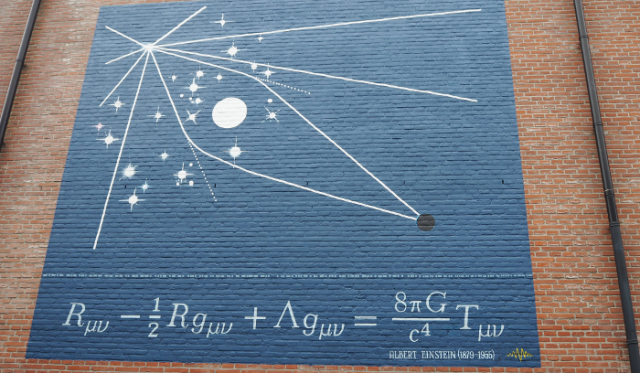
One of Einstein's field equations - part of the Leiden wall formulae project.

One of Einstein’s field equations – part of the Leiden wall formulae project.{credit}Ivo van Vulpen and Sense Jan van der Molen. Photograph by Hielco Kuipers.{/credit}

Albert Einstein’s field equations from his theory of general relativity combine wonderful scientific intuition with the honed concision of poetry. Yet relatively few of the culturally inclined marvel at the shape of a mathematical equation in the way they might at a line from Shakespeare. Now, however, the Dutch university town of Leiden is giving its citizens a chance to try, through iconic formulae by physicists and astronomers painted on walls throughout the city.

The formulae join 100-plus murals of poems, painted by artists over more than two decades as a way of highlighting Leiden’s long connection with the arts, not least as Rembrandt’s birthplace. These celebratory artworks, some in delicate Japanese calligraphy, have become part of an urban aesthetic. But the city is also a crucible for discoveries such as superconductivity, by Heike Kamerlingh Onnes, in 1911.

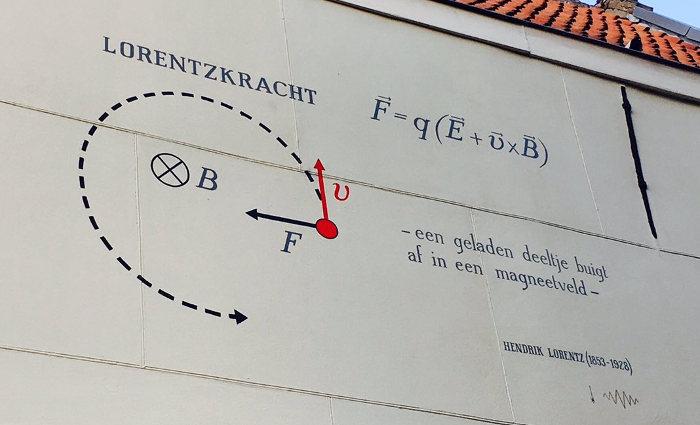
lorentzkracht

The Lorentz force formula.{credit}Ivo van Vulpen and Sense Jan van der Molen. Photograph by Hielco Kuipers.{/credit}

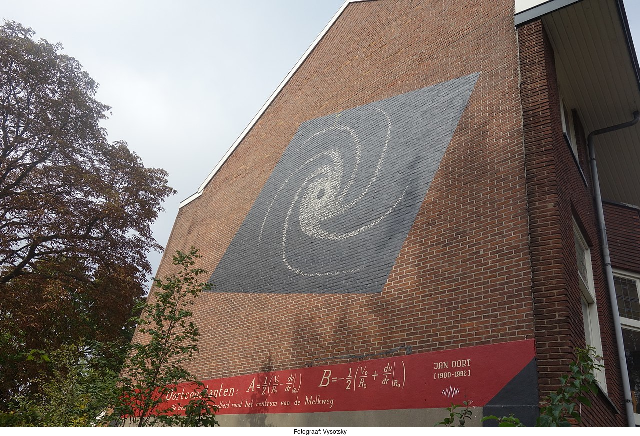
The idea of ‘wall formulae’ arose a few years ago, when physicists Ivo van Vulpen and Sense Jan van der Molen convinced municipal authorities (and house-owners) to embrace the scheme as a way of celebrating science in the city. Dutch artists Jan Willem Bruins and Ben Walenkamp were first in, painting Willebrord Snellius’s law of refraction (Snell’s law), Hendrik Lorentz’s force formula, and Einstein’s field equations. These were unveiled in 2016. Three more – the Oort constants, the Lorentz contraction and electron spin (discovered by Lorentz’s students Samuel Goudsmit and George Uhlenbeck) – are officially unveiled today.

Oort constants.

Oort constants.{credit}Ivo van Vulpen and Sense Jan van der Molen. Photograph by Hielco Kuipers.{/credit}

Van der Molen notes that the equations, like poems, distil realities and are “beautiful to behold and inspiring”. To help convey their meaning to non-mathematicians, the artists add a simple graphical representation of the physical phenomenon described. Thus the Lorentz contraction, which expresses how objects shrink to an observer travelling near speed of light, is illustrated by a circle and a series of ‘squeezed’ ellipses. The Oort constants, which refer to the angular velocity of the Sun around the centre of the Milky Way, are symbolized by a spiral galaxy (with a dot showing the Sun’s position). And to picture Einstein’s field equations – which describe how space is deformed by big objects – we see a ray of starlight’s curved path around a heavy mass, known as gravitational lensing.

By inviting comparison between these and more familiar lines of beauty, Leiden is leading the way in inspiring its citizens about physics and maths on the hoof.

Quirin Schiermeier is a senior reporter for Nature based in Munich.

 The Leiden wall formulae feature on city-centre buildings including the Boerhaave science history museum. Tourists can visit the sites on a leisurely 90-minute walk. Guided tours and an app for smartphones, developed by Leiden physics students involved in a science communication project, will be available by the start of 2018.


For Nature’s full coverage of science in culture, visit www.nature.com/news/booksandarts.

Machines moved by mind

3Q: José Millán

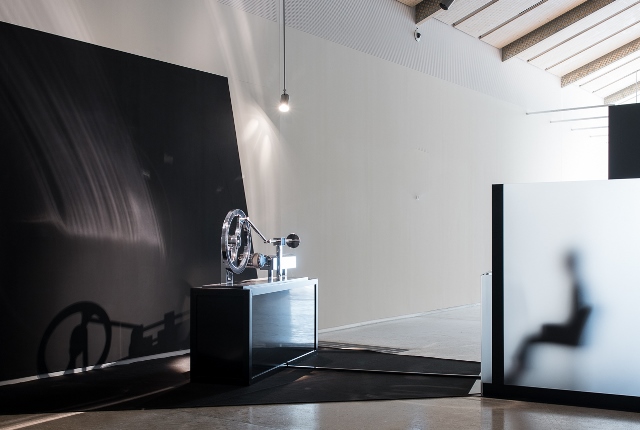
A 'mental worker' (behind screen at right) with Machine 1 at the exhibition Mental Work.

A visitor (behind screen at right) driving Machine 1 using the force of their own thoughts, at the exhibition Mental Work.{credit}© Photography Adrien Baraka / Mental Work{/credit}

At Mental Work, an exhibition at the Swiss Federal Institute of Technology Lausanne ArtLab (EPFL), visitors can drive simple machines using the force of their own thoughts. Probing the rapidly changing relationship between humans and technology, these artworks will also generate vast amounts of data that will be shared with researchers around the world. The show is a collaboration between experimental philosopher Jonathan Keats and EPFL neuroengineer José Millán, who develops brain-machine interfaces (BMIs) to help people with paralysis. Here, Millán talks pistons, probability and the debate over who or what is in control.

What will visitors experience at the show?

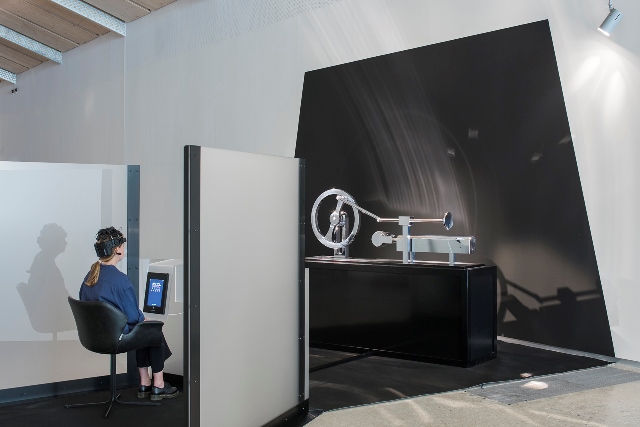
Some will be active participants in three experiments; others will watch them work. The participants, or ‘mental workers’, wear an EEG helmet studded with 19 dry electrodes — which continuously pick up electrical activity in their brains. In the first experiment they sit in front of a 2-metre-long construction (Machine 1) comprising a piston, fly-wheel and horizontal shaft. Using mental imagery, they try to move the piston onto the fly wheel; this starts the wheel turning, driving the shaft through a bolt. The brain-machine interface or BMI that makes this possible is an algorithm that has to be trained to ‘read’ the mind of each driver. The driver instigates the training by making a binary movement of the hand or foot, such as clenching and opening a fist, while simultaneously imagining the piston moving or stopping. The algorithm learns the stop-go instructions from patterns of the data from the electrodes, and converts them into commands for the piston. Because the data are always noisy and variable, the command is based on probability; but we program the piston motor to generate movement only when the probability is high — usually in the 70-90% range.

xxx

Another view of a ‘mental worker’ with Machine 1.{credit}© Photography Adrien Baraka / Mental Work{/credit}

What happens in the other two experiments?

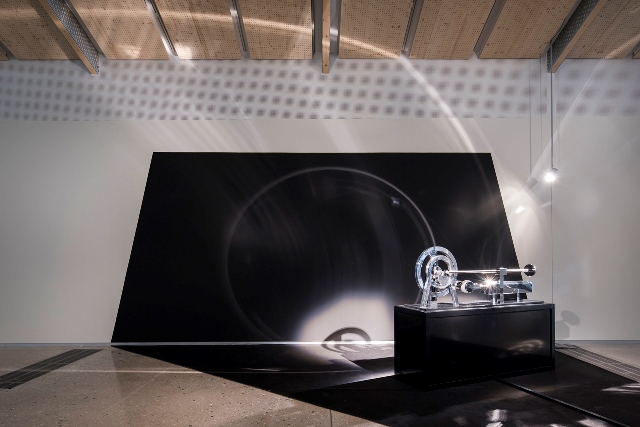
They are more complex, and so are the machines. Participants take the role of either ‘driver’ or ‘supervisor’. Supervisors may change the level of probability through their own mental imagery, so the driver has a harder or easier (but messier) job of getting the machine to work. Or the supervisors may use their mental imagery to instruct the BMI to stop using mental imagery altogether, and switch to a different algorithm that use patterns of alpha waves — the brain-wide oscillations generated when the brain is at rest — to drive movement. In this case, the supervisor also uses mental imagery to instruct the driver to relax and ‘empty’ his or her brain. This is the part I am terrified about! We can get this to work in the lab, but it gets so complicated we don’t know what will happen when it is tested in more open conditions. We’ll also distribute a questionnaire asking participants whether they felt they were controlling the machines or if the machines were controlling them.


xxx

Machine 2, where ‘drivers’ have their threshold adjusted using a brain-machine interface or BMI.{credit}© Photography Adrien Baraka / Mental Work{/credit}

What do you want to emerge from the exhibition?

We are entering a cognitive revolution in which we will increasingly use many different new technologies to tap into or extend the capabilities of our brains. I hope that Mental Work will help generate a societal debate about this. Could brain power be used to carry out real work in the real world? What would that mean for employment? Will machines take control of our minds, or will our minds always have the control of machines? Personally, I am optimistic – I think the future is up to us. But the debate needs to start now. I hope visitors to this show will also enjoy the aesthetics of these artistic machines. Meanwhile, the data will be very valuable scientifically. We will capture and share it with the BMI research community, which is constantly trying to improve interfaces, for example by increasing the probability that brain signals are correctly read. Our experience suggests that many participants improve their performance as they move from one machine to another, and I expect that the research community will also be able to develop better machine-learning techniques for BMI users. At the end of the day what I really want is help BMI users, particularly  people with paralysis, to generate brain signals that are more stable and easier to decode.

Interview by Alison Abbott, senior European correspondent for Nature. She tweets at @alison_c_abbott

 This interview has been edited for length and clarity.

Mental Work runs from 27 October – 31 January 2018. The first two weeks are open for registered participants only, so any visitors wishing to participate as ‘mental workers’ must first sign up on the website mentalwork.net. The show opens to the general public on 13 November. It will subsequently move on to swissnex San Francisco in California. 


For Nature’s full coverage of science in culture, visit www.nature.com/news/booksandarts.

The impossibility of being known

Posted on behalf of Elizabeth Gibney

Scene from Heisenberg: the Uncertainty Principle

A model relationship: Anne-Marie Duff and Kenneth Cranham

Like Copenhagen, Michael Frayn’s 1990s blockbuster, Heisenberg: the Uncertainty Principle is a play that takes as its muse a notion at the heart of quantum physics: that it is impossible to know both the exact position and momentum of a particle at once.  Where Frayn imagined physicists’ rarefied debates, playwright Simon Stephens uses the idea to probe the messy world of relationships.

The one-act work revolves around 42-year-old Georgie (Anne-Marie Duff), a fabulist, and Alex (Kenneth Cranham), a 75-year-old butcher, who meet in a station. The pair forges an unlikely affair that sees them baring their souls over a period of six weeks.

Stephens exploits the uncertainty principle to explore what he sees as a quirk of human interaction. To predict someone’s movements is to not pay attention to them properly, and knowing someone really well makes it more likely that they will surprise you, he said in interviews ahead of the opening. When Stephens learned of the principle though his son’s love of science, it struck him, he says, “that all life is contained within it”.

Georgie name checks Werner Heisenberg as she lays out the principle to Alex to help explain why she is estranged from her son (the only time the theory, or indeed science, is actually mentioned). The urge to find him drives the story forward. There are further parallels: one interpretation of the principle, for example, is that uncertainty in a particle’s momentum comes from the physical process of measuring its position. Similarly, only by learning about each other do Georgie and Alex change the course of their lives. What in other hands could be somewhat contrived is made enjoyable by stellar performances, thoughtful direction by Marianne Elliot and clever staging and music.

Both characters prove surprising in different ways. Georgie is blunt and quixotic. Duff plays the effervescent role masterfully. Alex’s change of tack is much more subtle. He is at first a grumpy man of a certain age – inured to life and happy to be alone. Cranham movingly shows how breaking through the façade can reveal a complex and raw person, with an boyish zest for life.

Though the script is witty and at times insightful, it doesn’t always ring true. For me, the age gap was perpetually jarring. But it’s almost as if the combination is not supposed to be real. Indeed the play has the feel of a textbook problem: a stripped-back model that asks the audience to imagine an unlikely paring of two people, like particles in a box. The feeling is enhanced by the stark set. Designer Bunny Christie has events take place in a minimalist white space that morphs before our eyes as scenes change.

The uncertainty principle is one of only a few ideas in quantum mechanics that is both intuitive and easy to describe, and the play’s reference to it is thankfully not overcooked. The analogies Stephens draws between life and physics aren’t perfect, but as device for exploring interaction – and a way to remind theatre-goers that science can resonate with human experience and creativity – it works.

Elizabeth Gibney is a senior reporter for Nature based in London. She tweets at @lizziegibney.

Heisenberg: The Uncertainty Principle is on at the Wyndham’s Theatre, London, until 6 January 2018.


For Nature’s full coverage of science in culture, visit www.nature.com/news/booksandarts.

Blade Runner 2049: a dystopian masterwork

Posted on behalf of Elizabeth Gibney

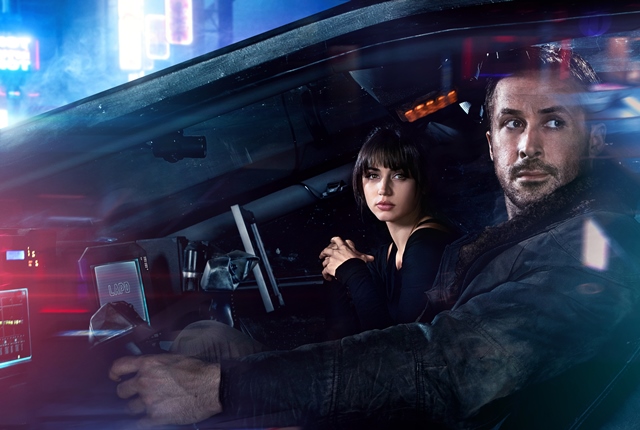
Ryan Gosling as K and Ana d x as Joi in Blade Runner 2049.

Ryan Gosling as K and Ana de Armas as Joi in Blade Runner 2049.{credit}Sony Pictures{/credit}

If director Denis Villeneuve was daunted by creating a sequel to the 1982 cult noir Blade Runner, it doesn’t show. The themes running through his Blade Runner 2049 feel more poignant than ever, the Los Angeles rain falls even harder, and it packs as much of a cinematic punch.

Villeneuve – fresh from his sci-fi success with Arrival in 2016 – has reimagined a world first brought to life by Ridley Scott. Thirty years on, the LA of Blade Runner 2049 is still grimy, bleak and sodden. Neon lights continue to flash and splutter, but now building-high advertisement holograms also shimmer alluringly. Replicants, as the bioengineered humanoids are known, remain enslaved.

The story centres on Officer K (Ryan Gosling), a blade runner — a cop tasked with ‘retiring’ replicants. In the original, loosely based on Philip K. Dick’s novel Do Androids Dream of Electric Sheep?, Harrison Ford plays Rick Deckard, a jaded predecessor of K, whose mission is to hunt down replicants escaped from off-world colonies. His interaction with them eventually prompts questions about the very premise of his job and his very identity. In 2049, replicants are now the bread and butter of the Earth-bound workforce, a new breed engineered by a new corporation. Under orders from his superior Lieutenant Joshi (a condescending but not entirely unsympathetic character, played by the excellent Robin Wright), K must find and terminate the older rogue models still hiding out.

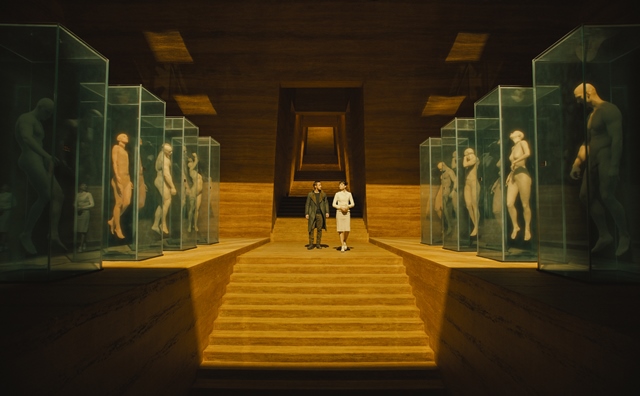
K and xxx (xxx)

K and Luv (Sylvia Hoeks) at the headquarters of the film’s hyper-ambitious bioengineering corporation.{credit}Sony Pictures{/credit}

Where Deckard was burnt-out and moody, K is a stoic and obedient, if lonely, worker – until an investigation brings about a discovery that leads him off course. Gosling does understated very well, shimmering with emotion that only begrudgingly breaks the surface. Ana de Armas is heart-breaking as his unconventional live-in companion; and Sylvia Hoeks makes for a terrifying foe. The dystopian world in which the film is based is rich with remarkable attention to detail. Fans will be thrilled to see Ford pop up for the finale as a grizzled, ageing Deckard.

The original Blade Runner brought to life Dick’s Voight-Kampf test, a form of Turing test designed to catch out androids by probing their biological response to questions that should trigger empathy, an idea that went on to inspire the wider sci-fi genre. In the wake of recent sci-fi successes such as Spike Jonze’s Her (2013), Alex Garland’s Ex-Machina (2014; reviewed here), HBO’s Westworld and the British series Humans, today’s viewers could be forgiven for becoming inured to shows that ask where artificial intelligence ends and humans begin. But Blade Runner 2049 manages to tread fresh ground. K’s modus operandi is a simple iris scan of replicants, but the film finds new ways to probe the question, through themes of morality and identity, and the roles of memory and soul.

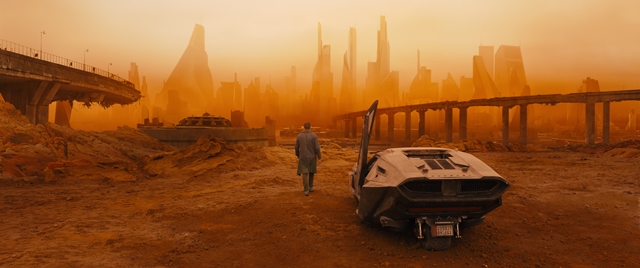
Environmental dystopia figures large in the film.

Environmental dystopia figures large in the film.{credit}Sony Pictures{/credit}

Blade Runner 2049 also burns with an environmental message far more glaring than in the 1982 film. The sequel takes the audience beyond LA to sneak a glimpse at a hellish wreck of a planet. Set in the aftermath of a nuclear war, the symptoms of a species sliding into oblivion are everywhere, with a haywire climate, city-sized rubbish dumps and a sea wall of epic proportions. As noted by Gosling in an interview with Wired: The power of science fiction, and what’s positive about it, is that you’re able to experience the worst-case scenario without actually having to live it.” Villeneuve has brought us a terrifyingly realistic version of civilisation’s possible future.

The film has garnered wide-spread acclaim, and deservedly so. Almost every scene is a visual masterpiece, teasing the viewers with shadows and tricks of the light, as well as breath-taking landscapes. Its haunting score pounds like an irregular heartbeat, reminiscent of the equally powerful soundtrack to 2001: A Space Odyssey. These go a long way to making the film as nail-biting as it is contemplative and spare. But Blade Runner 2049 is ultimately a work of art, and at a whopping 2 hours 43 minute run time, made for people who love cinema, not those after a cheap thrill.

Elizabeth Gibney is a senior reporter on physics for Nature based in London. She tweets at @lizziegibney.

Blade Runner 2049 is on general release.


For Nature’s full coverage of science in culture, visit www.nature.com/news/booksandarts.

Graphic window on a refugee scientist

3Q: Erik Nelson Rodriguez

Mueck 1

{credit}Erik Nelson Rodriguez/NPR{/credit}

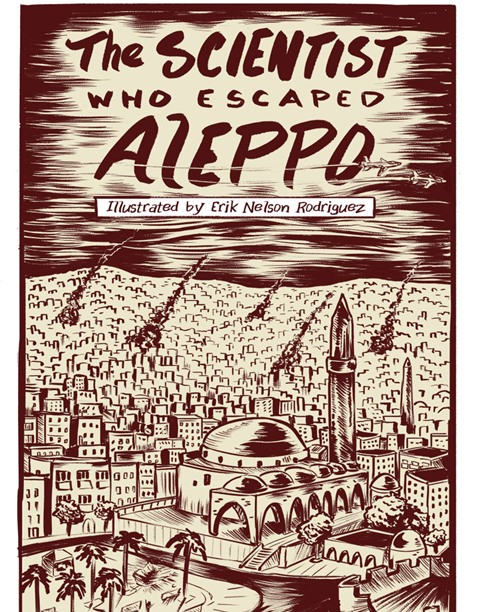
Graphic artist Erik Nelson Rodriguez is an innovative comics journalist. With reporter Darryl Holliday, he began creating nonfiction stories in graphic-novel form at university, covering issues such as gun violence. In 2016, US National Public Radio (NPR) invited Rodriguez to collaborate on an account of Syrian refugee Nedal Said: a trained microbiologist and teacher, Said fled the war in 2013 and is now a researcher in Leipzig. The result, The Scientist Who Escaped Aleppois part of NPR’s special series on refugee scientists: a testament to the ordeals endured, and the extraordinary potential offered, by the refugee community.

What did you learn from working on this project?

I did not know much about the refugee crisis other than data I had researched for news graphics — statistics on people moving through the Mediterranean into Europe. Just seeing the astounding numbers trying to get away from war zones and how many did not make it past the sea affected me. But it wasn’t until I worked with NPR on Nedal Said’s story that I felt the full weight. To look, under a microscope, at the ordeal an individual has to go through to obtain a better life was a heavy lesson. I was shocked by the number of hurdles Nedal faced, whether escaping from detention or sleeping in parks in the frozen rain — and by how long he was away from his family as he travelled to find a new life for them. I also learned that there are programmes to help refugees trained in science. One is the Philipp Schwartz Initiative, a collective effort by Germany’s foreign office and other institutions named in honour of a Jewish scientist who fled Germany in 1933. I was pleased to find countries creating these opportunities for refugees to integrate after their harrowing journeys — especially when refugees are so happy to give back to that society.

Syrian microbiologist and teacher Nedal Said pictured before he fled the war in 2013.

Syrian microbiologist and teacher Nedal Said pictured before he fled the war in 2013.{credit}Erik Nelson Rodriguez/NPR{/credit}

How did you convey Said’s story visually?

NPR provided a timeline of Said’s travels from Turkey to the Balkans to Germany. It gave details about each location, along with interviews describing first-hand experiences. This formed the basis for the storyboard. It was important to me to show Nedal in his work and family life. He was described as always helping others through his scientific knowledge and skills as an educator, so we wanted to display him in those situations. We made sure that his family was highlighted: he was potentially sacrificing his life for them. I researched Aleppo during different periods to see what kind of destruction took place, and created panels featuring tanks, rifles, bullet-ravaged buildings. We re-edited the piece later to help things flow in a vertical comic strip. Aesthetically, I aimed to translate the grittiness and bleakness of the written material. I tried to convey the fear and dread of Said through his facial expressions. I used dark, somewhat sketchy lines to match the story’s tone, but kept a cartoonish quality as a subtle undertone. Working with the editors and researchers was really rewarding.

Said's ordeals as a refugee were legion.

Said’s ordeals as a refugee were legion.{credit}Erik Nelson Rodriguez/NPR{/credit}

How can this kind of storytelling help refugees?

Seeing one individual’s journey to escape war and possible death will, I believe, help the public understand that these are just other people in very different circumstances. Having these stories told in detail with audio and visual representations will hopefully shed more light on how refugees struggle to escape the dark reality of their cities’ destruction. In particular, I hope that the public will understand better that without resources, people escaping war-torn countries do not have the opportunity to develop research, knowledge or a decent life, even if they are well educated. Yet the scientific community could gain from the experience and education of people such as Said, as they can provide original ideas developed thousands of miles away, adding fresh perspectives or processes. I hope visual storytelling can highlight these and other invisible parts of the world to show the public on the other side what they cannot see.

Interview by Leonie Mueck, a former senior physics editor at Nature and now division editor at PLOS ONE. She volunteers for the Cambridge Refugee Resettlement Campaign. She tweets at @LeonieMueck. This interview has been edited for length and clarity.

The Scientist Who Escaped Aleppo — on which Rodriguez worked with editors and researchers Meredith Rizzo, Rebecca Davis, Joe Palca, Madeline Sofia and Andrea Kissack — can be seen here in full. You can find information on future projects by Rodriguez and Holliday on their website.


For Nature’s full coverage of science in culture, visit www.nature.com/news/booksandarts.


Paleoart: painting the deep past

Posted on behalf of Ewen Callaway

cov_paleoart_v11_1703011302_id_1115770The term ‘paleoart’ might make many people think of fading ochre sketches of aurochs and other fearsome Ice Age animals in caves such as Lascaux, in southwestern France. That, however, is Palaeolithic art. Paleoart – graphic depictions of long-gone creatures and environments – is an oft-overlooked genre with roots in the early eighteenth century, when the study of extinct animal fossils took off, and both scientists and the public began to imagine a deep past.

In her striking new coffee-table book, Paleoart, writer and art critic Zoë Lescaze surveys images dating back to the nineteenth century. She ponders why mention of the genre still draws blank looks, concluding that it exists in a netherworld between fine art and natural history illustration, drawing inspiration from both but never fully belonging to either. This outsider status — and the fact that most of the details of its subject matter must be imagined (fossils have only recently begun to reveal the putative colouration of extinct animals) — freed paleoartists. They embraced the aesthetic of their eras, from Impressionism to Art Nouveau, and indulged their own idiosyncrasies, as the following illustrations reveal.


xxx

Duria Antiquior by Henry Thomas De la Beche (watercolour).{credit}Wikimedia Commons{/credit}

Ca. 1830
English geologist Henry Thomas De la Beche is credited with creating the first known depiction of the prehistoric world, Duria Antiquior. The original watercolour was inspired by fossils discovered on the Dorset coast near Lyme Regis, bolstered by a healthy dose of imagination. De la Beche sold lithographs of the work to help his friend, leading fossil hunter Mary Anning, support her family. (Anning was rarely credited by geologists and struggled financially.)


xxx

The Primitive World by Adolphe François Pannemaker (coloured engraving). The image served as the frontispiece for W. F. A. Zimmerman’s Le monde avant la création de l’homme (1857). {credit}Courtesy of Taschen{/credit}

1857
Although early paleoart was inspired by fossils, graphically it had much in common with illustrations of dragons that marked unknown territories in maps (as in, “Here be dragons”). Belgian engraver Adolphe François Pannemaker’s coloured engraving The Primitive World imagines a cataclysmic ancient realm of murky volcanism and nature at war.


xxx

Model-Room at the Crystal Palace by Philip Henry Delamotte.{credit}Courtesy of Taschen{/credit}

1853
Crystal Palace, a park and neighbourhood in southeast London, is famous for its ersatz concrete figures of dinosaurs and other extinct animals, such as the giant ground sloth Megatherium. On the day the attraction opened in June 1854, some 40,000 people arrived, and it was still drawing 2 million a year throughout the nineteenth century. What’s less known is the sculptures’ role in a major cultural and scientific battle. Their creation was overseen by Richard Owen, founder of London’s Natural History Museum and an opponent of evolutionary theory. Specifically, Owen sought to discredit the idea that animals became more complex over time, and instructed the sculptor Benjamin Hawkins to make the concrete beasts more closely resemble modern creatures such as lizards. This illustration, by artist and photographer Philip Henry Delamotte, depicts the ramshackle model room at Crystal Palace where Hawkins prepared his soon-to-be world-famous propaganda.


xxx

Laelaps by Charles R. Knight.{credit}Courtesy of American Museum of Natural History, New York{/credit}

1897
American palaeontology of the late nineteenth century was dominated by Othniel Charles Marsh and Edward Drinker Cope, whose 25-year feud over access to palaeontology sites and the glory accompanying new finds came to be known as the Bone Wars. Artist Charles R. Knight’s Laelaps, which portrays a death duel between two dinosaurs of a genus now known as Dryptosaurus, is widely believed to be a not-so-subtle reference to Cope and Marsh’s mutual enmity.


xxx

Study for the Age of Reptiles by Rudolph Zallinger (tempera).{credit}Courtesy of the Peabody Museum of Natural History, Yale University, New Haven{/credit}

1943
The Age of Reptiles, a fresco in the Great Hall of Yale’s Peabody Museum of Natural History in New Haven, Connecticut, is paleoart’s poor-man’s version of Michelangelo’s Sistine Chapel paintings. Rudolph F. Zallinger spent four years painting the mural, which was completed in 1947, after the Second World War. Lescaze speculates that the dark mood of those times may have seeped into that final work, in comparison with the vivid 3-metre-long study Zallinger had completed in 1943, shown here. The depiction of a Tyrannosaurus rex in the finished piece, she writes, “is like a case of plastic surgery gone wrong: the dinosaur’s skin is pulled taut to the point of losing its expressiveness and realism”. Zallinger was back on form in 1953, when he completed the 18-metre Age of Mammals mural for the museum.


xxx

Tyrannosaurus and Edmontosaurus by Ely Kish (oil).{credit}Eleanor Kish, © Canadian Museum of Nature{/credit}

1976
Ely Kish, an American-born artist who died in 2014, worked at a time when scientists were documenting human-caused destruction such as climate change, biodiversity loss and marine pollution. Mass extinctions, death and violence were a regular theme in her dynamic, dramatic oil paintings, such as Tyrannosaurus and Edmontosaurus.

Ewen Callaway is a senior reporter for Nature based in London. He tweets at @ewencallaway. Paleoart is published by Taschen (2017).


For Nature’s full coverage of science in culture, visit www.nature.com/news/booksandarts.