Paleoart: painting the deep past

Posted on behalf of Ewen Callaway
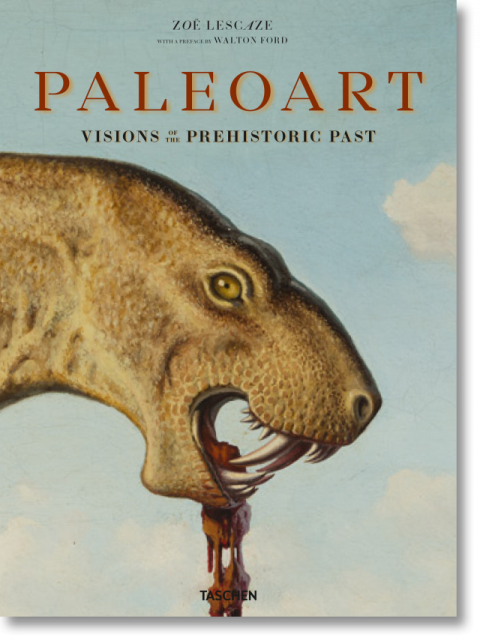
cov_paleoart_v11_1703011302_id_1115770The term ‘paleoart’ might make many people think of fading ochre sketches of aurochs and other fearsome Ice Age animals in caves such as Lascaux, in southwestern France. That, however, is Palaeolithic art. Paleoart – graphic depictions of long-gone creatures and environments – is an oft-overlooked genre with roots in the early eighteenth century, when the study of extinct animal fossils took off, and both scientists and the public began to imagine a deep past.

In her striking new coffee-table book, Paleoart, writer and art critic Zoë Lescaze surveys images dating back to the nineteenth century. She ponders why mention of the genre still draws blank looks, concluding that it exists in a netherworld between fine art and natural history illustration, drawing inspiration from both but never fully belonging to either. This outsider status — and the fact that most of the details of its subject matter must be imagined (fossils have only recently begun to reveal the putative colouration of extinct animals) — freed paleoartists. They embraced the aesthetic of their eras, from Impressionism to Art Nouveau, and indulged their own idiosyncrasies, as the following illustrations reveal.


xxx

Duria Antiquior by Henry Thomas De la Beche (watercolour).{credit}Wikimedia Commons{/credit}

Ca. 1830
English geologist Henry Thomas De la Beche is credited with creating the first known depiction of the prehistoric world, Duria Antiquior. The original watercolour was inspired by fossils discovered on the Dorset coast near Lyme Regis, bolstered by a healthy dose of imagination. De la Beche sold lithographs of the work to help his friend, leading fossil hunter Mary Anning, support her family. (Anning was rarely credited by geologists and struggled financially.)


xxx

The Primitive World by Adolphe François Pannemaker (coloured engraving). The image served as the frontispiece for W. F. A. Zimmerman’s Le monde avant la création de l’homme (1857). {credit}Courtesy of Taschen{/credit}

1857
Although early paleoart was inspired by fossils, graphically it had much in common with illustrations of dragons that marked unknown territories in maps (as in, “Here be dragons”). Belgian engraver Adolphe François Pannemaker’s coloured engraving The Primitive World imagines a cataclysmic ancient realm of murky volcanism and nature at war.


xxx

Model-Room at the Crystal Palace by Philip Henry Delamotte.{credit}Courtesy of Taschen{/credit}

1853
Crystal Palace, a park and neighbourhood in southeast London, is famous for its ersatz concrete figures of dinosaurs and other extinct animals, such as the giant ground sloth Megatherium. On the day the attraction opened in June 1854, some 40,000 people arrived, and it was still drawing 2 million a year throughout the nineteenth century. What’s less known is the sculptures’ role in a major cultural and scientific battle. Their creation was overseen by Richard Owen, founder of London’s Natural History Museum and an opponent of evolutionary theory. Specifically, Owen sought to discredit the idea that animals became more complex over time, and instructed the sculptor Benjamin Hawkins to make the concrete beasts more closely resemble modern creatures such as lizards. This illustration, by artist and photographer Philip Henry Delamotte, depicts the ramshackle model room at Crystal Palace where Hawkins prepared his soon-to-be world-famous propaganda.


xxx

Laelaps by Charles R. Knight.{credit}Courtesy of American Museum of Natural History, New York{/credit}

1897
American palaeontology of the late nineteenth century was dominated by Othniel Charles Marsh and Edward Drinker Cope, whose 25-year feud over access to palaeontology sites and the glory accompanying new finds came to be known as the Bone Wars. Artist Charles R. Knight’s Laelaps, which portrays a death duel between two dinosaurs of a genus now known as Dryptosaurus, is widely believed to be a not-so-subtle reference to Cope and Marsh’s mutual enmity.


xxx

Study for the Age of Reptiles by Rudolph Zallinger (tempera).{credit}Courtesy of the Peabody Museum of Natural History, Yale University, New Haven{/credit}

1943
The Age of Reptiles, a fresco in the Great Hall of Yale’s Peabody Museum of Natural History in New Haven, Connecticut, is paleoart’s poor-man’s version of Michelangelo’s Sistine Chapel paintings. Rudolph F. Zallinger spent four years painting the mural, which was completed in 1947, after the Second World War. Lescaze speculates that the dark mood of those times may have seeped into that final work, in comparison with the vivid 3-metre-long study Zallinger had completed in 1943, shown here. The depiction of a Tyrannosaurus rex in the finished piece, she writes, “is like a case of plastic surgery gone wrong: the dinosaur’s skin is pulled taut to the point of losing its expressiveness and realism”. Zallinger was back on form in 1953, when he completed the 18-metre Age of Mammals mural for the museum.


xxx

Tyrannosaurus and Edmontosaurus by Ely Kish (oil).{credit}Eleanor Kish, © Canadian Museum of Nature{/credit}

1976
Ely Kish, an American-born artist who died in 2014, worked at a time when scientists were documenting human-caused destruction such as climate change, biodiversity loss and marine pollution. Mass extinctions, death and violence were a regular theme in her dynamic, dramatic oil paintings, such as Tyrannosaurus and Edmontosaurus.

Ewen Callaway is a senior reporter for Nature based in London. He tweets at @ewencallaway. Paleoart is published by Taschen (2017).


For Nature’s full coverage of science in culture, visit www.nature.com/news/booksandarts.


Ancient DNA and the rise of ‘celebrity science’

Elizabeth Jones.

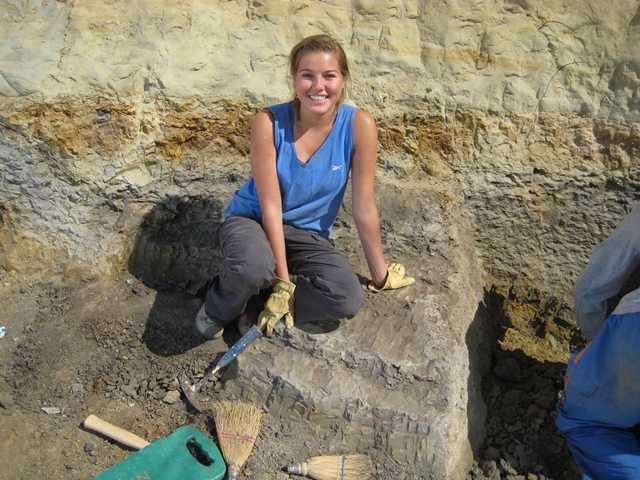
Science historian Elizabeth Jones.

3Q: Elizabeth Jones

Whether it’s about Neanderthal-human interbreeding or the prospect of resurrecting woolly mammoths, the public cannot seem to hear enough about ancient-DNA research. For science historian Elizabeth Jones, ancient DNA offered an opportunity to study the development of a field in the crucible of intense public interest. She defines the phenomenon as “celebrity science”, in which scientists harness attention to generate interest in their work and capture future funding.

What led you to the definition of celebrity science?

As a historian, I used traditional research methods, like looking at professional and popular literature. I’ve gone back to conferences and archives. But one of the main reasons I’ve come up with the idea of celebrity science is from my conversations with scientists working in ancient DNA themselves. Many of them are alive so I can talk to them, but it’s also dangerous territory because their careers could be impacted by what I write. Meanwhile, if you go back to the 1970s and 80s, you see that the interest in ancient DNA was there from the very beginning. My speculation is that this comes from a long history of popularizing certain public-facing fields, such as palaeontology, archaeology and molecular biology. Our fascination with dinosaurs, human history and genetics and DNA as the code of life is documented. When you get these things together, the interest is just explosive.

Jurassic_Park_logo

The Jurassic Park franchise enabled a visual image of what using ancient DNA to bring back extinct species might mean.

How important do you think the Jurassic Park films are to the field?

Steven Spielberg’s 1993 film Jurassic Park had, for the first time, this visual image of what it would mean to use DNA to do something like bring back dinosaurs. That image was used by both researchers and reporters to talk to the public – ‘I’m doing this ancient-DNA research, and it’s kind of like this but not really’. It created a lot of momentum and it influenced press interest. There are some arguments that it influenced publication timing in journals like Nature. Did it influence research? One good example has to do with funding in the United States. Jack Horner, who is a palaeontologist but was also the scientific consultant to the Jurassic Park films, applied to the National Science Foundation in 1993 for money to try to extract DNA from dinosaur bones. Interviewees I talked to who were involved in the project feel the funding was awarded in part because of the public interest in the film at the time. Some researchers think this close connection between science and science fiction was damaging to press and publication expectations about what their research could really do. But a lot of the researchers who work in this field are very attuned to news value. They understand that you have to sell science. That means packaging it in such a way that the consumer wants to read it or learn more about it. They understand that Jurassic Park was an easy entry for communicating to the public what their research can and can’t do.

What changes have you seen in the field since?

Ancient-DNA researchers agree that they have achieved a great sense of credibility in the field of evolutionary biology. You can look at a lot of the work with ancient humans like the Neanderthal genome, for example, that’s really shown the power of ancient DNA. But even the Neanderthal genome was still very much a celebrity kind of study. Svante Pääbo was really active in designing it that way, by issuing press releases, putting a strict deadline on his lab and telling the rest of the world “we’ll sequence the genome in two years’ time”. It’s very much still science in the spotlight, but one that has demonstrated that they can do rigorous research. Next-generation sequencing has allowed researchers to get some high coverage genomes from extinct organisms. There are a few researchers in the ancient-DNA community who are not necessarily pursuing de-extinction, but they’re involved in these conversations. Because they’re respected scientists, they have lent a sense of credibility to the idea that de-extinction might happen. I think researchers in the ancient-DNA community are starting to pay attention to this pursuit in a way they wouldn’t have 15 years ago. As for my own work, I worry that scientists will think I’m saying celebrity science is a sell-out kind of science. Of course there are tensions between science and the spotlight. But ancient-DNA research is a great example of how really rigorous work can coincide with press and public interest.

Interview by Ewen Callaway, a senior reporter for Nature based in London. He tweets at @ewencallaway. 

This interview has been edited for length and clarity.


For Nature’s full coverage of science in culture, visit www.nature.com/news/booksandarts.

Back to the Jurassic

Posted on behalf of Henry Gee

Jurassic World

{credit}Universal studios and Amblin Entertainment Inc.{/credit}

If you have not seen Jurassic Park yet, I envy you. One of the greatest creature features of all time, Steven Spielberg’s tale of human hubris and a dinosaur theme park going horribly wrong is right up there with the original 1933 film King Kong, directed by Merian Cooper. I still remember seeing Jurassic Park for the first time — amazingly, 22 years ago — after which I reviewed it glowingly in Books and Arts.

 I saw Colin Trevorrow’s Jurassic World, the fourth in the franchise, at the very same theatre, only this time in IMAX and in 3D, and with an audience raised in a digital age and with higher expectations. They will not have had the unrepeatable experience of having first looked without preamble on Jurassic Park.

I shall not keep you in suspense: Jurassic World is a winner.

I won’t be spoiling anything to say that the plot is, in essence, the same as the franchise’s first three: Jurassic Park, The Lost World and Jurassic Park III. People travel to an island and meet dinosaurs. Some people are eaten by dinosaurs. Some of the dinosaurs eat one another. The rest of the people escape. Seen one, seen ’em all. Where Jurassic World succeeds is by upping the tooth count while at the same time nodding affectionately to the original in countless ways, large and small, all of which I shall leave it to you to discover.

Saurian resurrection

A reminder: Jurassic Park was set on the fictional Isla Nublar, off Costa Rica, which a wealthy entrepreneur has stocked with genetically engineered dinosaurs. They were brought back from extinction by mining ancient DNA, stitching the DNA together with DNA from modern animals, and, by dint of science-fictional macguffins and machines that go beep, resurrecting Tyrannosaurus rex, Velociraptor and their dentally advantaged chums — which then go on a killing spree. The action of the next two is set on a different island, Isla Sorna, where the spare dinosaurs were kept.

Jurassic World returns us to Isla Nublar. Here, the original Jurassic Park theme park has been revived and is a raging success. This gives the movie an instant lift, as it features the interaction between dinosaurs and a lot more people than the plots of films 2 and 3 allowed. Indeed, the second in the series had to have an ill-fitting appendix in which a transplanted T. rex goes on the rampage, Godzilla-style, in San Diego.

In Jurassic World, though, the dinosaurs are tame. Thousands of tourists see them close up, go canoeing down rivers accompanied by kindly stegosaurs and sauropods, queue for sanitised rides among the emasculated monsters, and watch a Sea World-style display with a leaping mosasaur. There is even a petting zoo — and not even an EVIL petting zoo — where small children can stroke baby dinosaurs that look like refugees from The Land Before Time.

It’s no surprise, then, that the park’s marketing department is on the lookout for more thrills to pique the public’s jaded palate. Dinosaurs are old hat, so they brief the lab to come up with something bigger, fiercer, and with more teeth. And so the lab combines tongue of dog, wool of bat, blindworm’s sting and several other proprietary ingredients to make a wholly invented beast, Indominus rex. It’s important, says marketing, that it has a name that can be pronounced by any four-year-old. Of course it is this creature that is the park’s nemesis.

Firmly featherless

There has been much talk on the dino-web about the antiquated look of the dinosaurs in Jurassic World. When the franchise kicked off in 1993, there was as yet no inkling that many dinosaurs, theropods in particular, had feathers. A modern recreation of a Velociraptor, for example, would have carried more or less abundant plumage. The dinosaurs in Jurassic World, though, remain firmly featherless, as if the discoveries of the past two decades had never been. And that’s exactly as it should be — for three reasons.

First, as palaeontologist and series adviser Jack Horner notes in his recent Q&A, to clothe the dinosaurs in feathers now would break the artistic continuity of the series. In the Jurassic Park ‘universe’, the dinosaurs are 1990s dinosaurs. For dinosaurs to be feathered we’d need a whole new franchise.

Second, nobody is going to thrill at somebody being brutally savaged by enraged poultry.

Third, the dinosaurs in these films aren’t really dinosaurs, but man-made recreations, sewn together with genetic material from other animals to suit human tastes, and whose relationship with the real dinosaurs of the Mesozoic is uncertain. This point is hammered home in an impassioned scene featuring the chief scientist Henry Wu (B. D. Wong) — perhaps significantly, the only character in Jurassic World to have survived from the very first film. These are not dinosaurs. They are dragons, designed to pique the same primal fear of the Worm that storytellers from the ancient Norse to J.R.R.Tolkien to George R. R. Martin know lurks in us all.

Henry Gee is a senior editor at Nature. His latest book is The Accidental Species. He blogs at https://cromercrox.blogspot.co.uk. Listen in to Gee, Nature reporter Ewen Callaway and features editor Rich Monastersky on a Backchat podcast here


For Nature’s full coverage of science in culture, visit www.nature.com/news/booksandarts.