The impossibility of being known

Posted on behalf of Elizabeth Gibney

Scene from Heisenberg: the Uncertainty Principle

A model relationship: Anne-Marie Duff and Kenneth Cranham

Like Copenhagen, Michael Frayn’s 1990s blockbuster, Heisenberg: the Uncertainty Principle is a play that takes as its muse a notion at the heart of quantum physics: that it is impossible to know both the exact position and momentum of a particle at once.  Where Frayn imagined physicists’ rarefied debates, playwright Simon Stephens uses the idea to probe the messy world of relationships.

The one-act work revolves around 42-year-old Georgie (Anne-Marie Duff), a fabulist, and Alex (Kenneth Cranham), a 75-year-old butcher, who meet in a station. The pair forges an unlikely affair that sees them baring their souls over a period of six weeks.

Stephens exploits the uncertainty principle to explore what he sees as a quirk of human interaction. To predict someone’s movements is to not pay attention to them properly, and knowing someone really well makes it more likely that they will surprise you, he said in interviews ahead of the opening. When Stephens learned of the principle though his son’s love of science, it struck him, he says, “that all life is contained within it”.

Georgie name checks Werner Heisenberg as she lays out the principle to Alex to help explain why she is estranged from her son (the only time the theory, or indeed science, is actually mentioned). The urge to find him drives the story forward. There are further parallels: one interpretation of the principle, for example, is that uncertainty in a particle’s momentum comes from the physical process of measuring its position. Similarly, only by learning about each other do Georgie and Alex change the course of their lives. What in other hands could be somewhat contrived is made enjoyable by stellar performances, thoughtful direction by Marianne Elliot and clever staging and music.

Both characters prove surprising in different ways. Georgie is blunt and quixotic. Duff plays the effervescent role masterfully. Alex’s change of tack is much more subtle. He is at first a grumpy man of a certain age – inured to life and happy to be alone. Cranham movingly shows how breaking through the façade can reveal a complex and raw person, with an boyish zest for life.

Though the script is witty and at times insightful, it doesn’t always ring true. For me, the age gap was perpetually jarring. But it’s almost as if the combination is not supposed to be real. Indeed the play has the feel of a textbook problem: a stripped-back model that asks the audience to imagine an unlikely paring of two people, like particles in a box. The feeling is enhanced by the stark set. Designer Bunny Christie has events take place in a minimalist white space that morphs before our eyes as scenes change.

The uncertainty principle is one of only a few ideas in quantum mechanics that is both intuitive and easy to describe, and the play’s reference to it is thankfully not overcooked. The analogies Stephens draws between life and physics aren’t perfect, but as device for exploring interaction – and a way to remind theatre-goers that science can resonate with human experience and creativity – it works.

Elizabeth Gibney is a senior reporter for Nature based in London. She tweets at @lizziegibney.

Heisenberg: The Uncertainty Principle is on at the Wyndham’s Theatre, London, until 6 January 2018.


For Nature’s full coverage of science in culture, visit www.nature.com/news/booksandarts.
CRISPR patent belongs to aliens

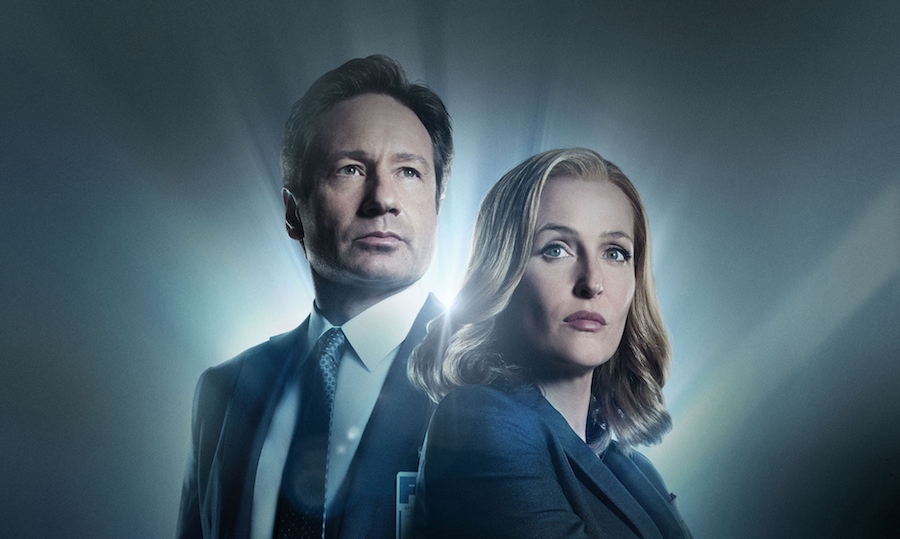
Mulder and Scully are back.

Mulder and Scully are back.{credit}THE X-FILES © 2016 Fox and its related entities. All rights reserved{/credit}

Posted on behalf of Sara Reardon

“Welcome back, you two,” says assistant FBI director to Fox Mulder and Dana Scully. He unlocks the door to Mulder’s old pencil-strewn office. The iconic I WANT TO BELIEVE poster lies crumpled on the floor.

We agree. After nearly 15 years, FOX rebooted the X-Files for a six-episode season that wrapped up last week. The technological advances of the past decade and a half, CRISPR included, gave the writers a raft of new ideas for its supernatural plots. DNA sequencing can be done in hours. People snap pictures of close encounters on their smartphones. Mulder’s ringtone, hilariously, is the X-Files theme song. Now the internet provides a platform for conspiracy theorists and the ill-informed to spread misinformation about the dangers of vaccines, genetically modified crops and gluten. (Spoilers aplenty to follow).

The new season takes full advantage. It opens with an internet personality who has become rich off his conspiracy theory videos. He wants Mulder and Scully to investigate a young woman who claims to have been injected with “alien DNA.” Scully, who was abducted in the show’s second season, finds similar DNA in her own cheek swab.

The scientific dialogue is laughable jargon jazz. But the concepts involve cutting-edge research. Alien DNA, for example, was floated in the first season in 1993, explains the series’ science advisor Anne Simon, a virologist at the University of Maryland. Back then, Mulder & Scully found a bacterium with six different letters in its DNA code rather than the usual four,

Since then, such DNA has actually been made. In 2014, researchers at Scripps Research Institute in La Jolla, California created the first cell that survived with two synthetic bases. These bases expand the number of possible DNA codes by orders of magnitude.

Other advances that the show predicted long ago have also become reality. In the second episode of the new series, the agents investigate a doctor, nicknamed ‘The Founder’, who purportedly studies children with rare genetic diseases – real conditions, cartoonishly amplified for the show. He’s been altering these babies’ DNA.

The title of the episode is Founders’ Mutation. This is a concept in evolutionary biology when an individual’s mutation spreads through all of its descendants, eventually creating a novel group of organisms. Explaining the idea, Scully gives a shoutout to a 2015 paper in Nature Communications, which suggests that most European men descended from just three men.

Indeed it is human genome editing that forms the season’s backbone: a concept that is far more scientifically plausible today than it was in 2001 — or even 2012. The CRISPR/Cas9 system, which makes precise snips in DNA, is revolutionizing agriculture, basic research, and medicine. Two groups of scientists, one at the Broad Institute in Boston and one at the University of California Berkeley, are battling over which owns the technology’s patent.

That patent, Simon jokes, should belong to the aliens.

Alien DNA is an antidote to the Spartan virus (which Simon and the writers invented for the show) that lives in us all, the story goes. Scully and a few other lucky people who have the alien DNA will presumably be able to survive the coming apocalypse. The Spartan virus was created by aliens and integrates into the human genome. For reasons yet to be revealed, a secretive cabal spread the virus through the smallpox vaccine over decades. It entered the germline and was passed on to children who never received the vaccine after 1972 when it stopped being administered.

The virus contains the code for CRISPR and the enzyme Cas9. It spreads through the body and snips at the gene for adenosine deaminase: an enzyme essential for immune function. When the virus is activated through ions spread in aeroplanes’ vapour trails– yes, the chemtrail conspiracy theory — the CRISPR system begins destroying immune systems. Soon, everyone, including Mulder, is dying of simple diseases.

Scully buys some time by making a vaccine from her alien DNA, which she believes encodes a way to inhibit Cas9. The season, as always, ends on a cliffhanger – hospitals overrun with dying people, panic in the streets and traffic stalled on bridges across the Potomac River. We have to wait for next season to find out the purpose of the alien DNA, Simon says.

As someone nearly as obsessed with CRISPR as Mulder is with alien encounters, it’s fun to see Scully and a new protégé geeking out over it and amusing when Scully dramatically intones, “I want you to do a PCR.” The genome-editing-as-bioweapon storyline is intriguing, but it’s unclear where it’s going to make judgement. And, as always, one must look past the made-for-TV compromises: the insta-vaccine for instance.

Simon doubts that the episode will fuel fears of CRISPR. “It’s just a tool,” she says. In fact, when director Chris Carter asked her to create a world-destroying technology, she took care to avoid stoking real fears. GMOs and common vaccines were right out. She settled on the smallpox vaccine because it hasn’t been routinely given since 1972. And relegating vaccination conspiracies to the same level as aliens and chemtrails might even be helpful.

She does hope that the entrance of CRISPR into popular culture will stimulate discussion of its many applications and ethical ramifications, primarily those involving editing humans. “I think we have to be careful about modifying the human germline because we don’t know what we’re doing,” Simon says. The public, not just those who wield the technology, should be crucial players in making such decisions.

For Nature’s full coverage of science in culture, visit www.nature.com/news/booksandarts.

The X-Files is on Channel 5, Mondays at 9pm.
Posted in Uncategorized

Stem-cell fraud makes for box office success

Posted on behalf of David Cyranoski and Soo Bin Park

Fictionalized film follows fabricated findings

Stem cell fraudster faces down the journalist who debunks him in the film sweeping Korean cinemas.

Stem-cell fraudster faces down the journalist who debunks him in the film sweeping Korean cinemas.{credit}Wannabe Fun{/credit}

A movie based on the Woo Suk Hwang cloning scandal drew more than 100,000 viewers on its opening day (2 October) and has been topping box office sales in South Korea since then. With some of the country’s biggest stars, it has made a blockbuster out of a dismal episode in South Korean stem-cell research — and revealed the enduring tension surrounding it.

The movie, Whistleblower, shines a sympathetic light on Woo Suk Hwang, the professor who in 2004 and 2005 claimed to have created stem-cell lines from cloned human embryos. The achievement would have provided a means to make cells genetically identical to a patient’s own, and able to form almost any type of cell in the body. But hopes were shattered when Hwang’s claims turned out to be based on fraudulent data and unethical procurement of eggs. The whistleblower who revealed the fraud says the new movie strays far from reality.

“This topic is sensitive, so I was hesitant when I got the first offer,” said director Yim Soon-rye at the premiere on 16 September in Seoul. “I wanted to portray him [Lee Jang-hwan, Hwang’s character in the film] as a character who faces a very human problem, and to show there is room to understand his actions.”  Although clearly inspired by the real-life events surrounding Hwang and his cloning claims, the film does not aim to be a true representation of events, but a ‘restructured fiction’ created for a movie audience.

The movie broadly traces the scandal as it actually unravelled, tracing the process through which the stem-cell claims were debunked. Some changes are made, apparently for dramatic effect: Snuppy, the Afghan hound produced by cloning in Hwang’s laboratory, was converted into Molly, also an Afghan hound, but one with cancer. When Lee sees the writing on the wall, he is shown going to a Buddhist temple where he rubs Molly’s fur, saying “I came too far … I missed my chance to stop.”

Yim says he wanted the fraudster “to be interpreted multi-dimensionally, rather than as a simple fraud or evil person”.

But rather than the scientists, Yim put the perseverance of the reporter at the centre of the film, and ends up skewing relevant facts, says Young-Joon Ryu, the real whistleblower. Ryu, who had been a key figure in Hwang’s laboratory, says his own contributions and those of online bloggers were credited to the reporter. (The discovery that Hwang had unethically procured eggs, first reported in Nature, was also credited to the reporter.)

The film has refuelled anger in some Hwang supporters who believe, despite evidence to the contrary, that Hwang did have human-cloning capabilities and that the scandal deprived the country of a star scientist. They are back online calling Ryu a betrayer.

Ryu understands that a movie might emphasize “fast action, dramatic conflicts and famous actors” to increase box office revenues. But having suffered through one perversion of the truth as Hwang made his original claims, watching the film he says that he felt was witnessing another.