Behind the Science of Hollywood

MIT Professor Neil Gershenfeld (right) enlightens Jerry Zucker (left) during a Science & Entertainment Exchange Salon at the Zucker's home.

MIT Professor Neil Gershenfeld (right) enlightens Jerry Zucker (left) during a Science & Entertainment Exchange Salon at the Zucker’s home.

There is a moment in the deservedly lauded Breaking Bad when Walt must convince Gus that he and Jesse are indispensable, dramatically asserting “Without us you have nothing.” It is a scene of great suspense and emotion. But not only that, it is a fine example of where good science is used to the narrator’s advantage.

The high-level scientific dialogue sees Walt tout his superior chemical knowledge of protic vs aprotic catalytic hydrogenation and stereospecific reactions yielding enantiomerically pure products. “The dialogue had to be perfect in order to be powerful instead of laughable, and Bryan Cranston’s magnificent delivery was convincing,” explains the show’s scientific advisor, Dr Donna Nelson.

“To a scientist, seeing incorrect science in movies or on TV is like fingernails on a blackboard,” asserts Dr Nelson, who worked on all five series of the hit AMC show. “At best, it breaks one’s focus on the scene and plot. At worst, it spoils the entire show.”

Continue reading

Digital Science Concepts Video Series

Here at Digital Science, the younger sibling of Nature Publishing Group, we are always thinking of what we can do to make the lives of scientific researchers more efficient. In light of this mission, back in July 2012 we launched the first of our Digital Science Concepts videos, Touchless, showcasing our  thinking on the future of science. The video doesn’t actually include any projects we’re developing but, who knows… maybe one day we will! Continue reading

The 5th Imagine Science Film Festival

The 5th Imagine Science Film Festival kicks off this Thursday, November 8, 2012, at the Museum of Moving Image with the U.S. Premiere of The End of Time by Peter Mettler. The feature documentary film takes us on an explorative journey through time, from the particle accelerator at the CERN in Geneva, where scientists seek to probe regions of time we cannot see, to the lava flows in Hawaii.

Continue reading

Science as seen on screen – part IV: Interview with a film-maker

The fourth post in our mini-series on science as seen on screen.

We have considered how science can be seen on the big screen, on television and online, so we thought it could be useful for all those budding science directors to get some useful tips, and who better to ask than someone in the business.
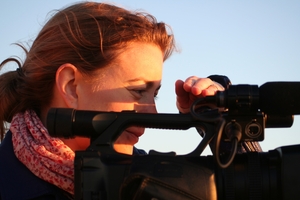
charlotte.JPGCharlotte Stoddart is an online video editor and director. She has been working at Nature for almost 4 years and has directed dozens of science films, including several series about the annual Meeting of Nobel Laureates at Lindau in Germany. Charlotte holds a degree in Natural Sciences from Cambridge, and an MSc in Science Communication from Imperial College.

How do you begin the process of making a science film?

First you need a good idea; for the most part, the films we produce are based on research published in Nature. Our aim is to tell the story of the research in pictures.

From the start, it’s important to think about the audience, the main message of the film, and exactly what you are going to show. We also need to identify the stars of the film.

We work closely with the editors of the paper and the scientists behind the research to find an interesting angle and to make sure the information we have is factually correct.

You have the idea – now what next?

Once we have the idea, the next step is to plan carefully what we want to be seen on the screen. We interview contributors, discussing the film focus in detail, searching for a story to tell; we look for the human angle behind their research. Often we try to dig up interesting, anecdotal stories, those that you wouldn’t read in the journal. We ask the researchers about their lab and the experimental set-up, all the time thinking about what we can film to illustrate the story. We also ask about graphics or animations they may have that could be included in the film.

What things do you need to plan?

Prior to the film shoot, obviously the logistical, practical stuff needs to be planned. We must organise filming dates to fit around our contributors, and in some cases get permission to film on location.

The day before the shoot we check our kit. We make sure we have everything ready, such as the correct lighting equipment, release forms for contributors, spare camera batteries, cable extensions. It’s the little things that count, so we ask ourselves: Does our camera work? Do we have an umbrella in case it rains? Do we have tissues? And have we got enough tapes?

We also write a list of questions to ask our contributors. We use this list as a guide, but we don’t stick to it rigidly; the most interesting answers are often the ones you’re not expecting and you need to be ready to throw away your list and take the interview in another direction.

Planning also varies depending on the film. For instance, for the Lindau series, we spend a long time choosing our contributors. The aim of the Lindau films is to capture on camera a debate between a Nobel laureate and a student, so lots of research goes into finding Laureates and students with overlapping research interests – and also making sure they’ll be able to speak clearly and confidently on camera.

char final.JPG

What are the most important things to take into consideration on a film set?

The filming day is often fun but also long and tiring. Depending on the film, it may just be me on set, in which case I am director, interviewer, and camera/sound man all in one. Being able to multi-task is crucial. At other times there’s a small team of us.

There is an awful lot to think about on a film shoot. First of all, you must listen to background noise in a way you don’t normally. Aeroplanes, for instance, are really noticeable in a film. Indoor air conditioning units are also noisy. You need to be ready to change location or re-record bits if there’s too much background noise. Good quality sound can make or break a film.

Lighting is also important. You have to think about where the natural sunlight is. It’s important that your contributor’s face is lit up and not in shadow. Sometimes we use artificial lighting to achieve this but, where possible, we position them so they’re lit by the natural light coming through a window, for example.

Think about your contributor; it sometimes takes a while for people to warm up and get used to being on camera. As the interviewer, being silently encouraging always helps – lots of eye contact, nods and smiles but no verbal encouragement because usually you don’t want your voice to be recorded. For some it can be an intimidating process; ideally, the contributor will forget the camera is there.

The filming is complete, then what?

The next step is editing the film. Back at the office, first I digitalise the footage, which means transferring it from the camera tapes to the computer. All the video clips must be organised, and all the associated material collected, whether that be pictures, graphics, objects or anything else relevant to the film. I also check we’ve got permission to publish all these materials.

I really enjoy the editing process; working out how to weave the different elements together to tell the story. It’s very creative. I try to find something surprising or particularly emotional to start with – something to draw the viewer into the film.

What else needs to be carried out in the cutting room?

Sometimes we add narration, music and captions to the film. The editing process can take several days. You need to be a bit of a perfectionist; if there’s a glitch in the audio or a bad cut, viewers will probably notice. I like to work early in the morning or at the end of the day when the office is quiet so that I can concentrate.

I try to come up with an overarching theme for the film; something to tie together the text, the music and the story. Music has the ability to alter the mood of a film, so the choice is important. .

After this?

Once I’ve got a rough cut of the film, I show it to my colleagues and also, where appropriate, the editor of the paper. I take on board all the feedback and then go back and make changes accordingly. The last stage is to add Nature branding to the film.

Finally, for those budding science filmmakers, do you have any advice? .

My tips would include a few simple things that can make a film look more professional.

•Make sure you record good audio. If possible, use an external microphone rather than the camera’s built-in mic and use headphones to listen to what you’re recording. Take notice of background noise and if you’re filming outdoors, watch out for the wind.

•Use a tripod. Not everyone has a still hand. Rather than holding the camera and following the action, stay still and shoot the same thing from different angles – then put the shots together to make a sequence. This looks more professional and stops your audience feeling sea-sick (unless you’re deliberately going for a ‘Blair Witch Project’ feel).

•Don’t forget to film the location and your contributor ‘in action’. It’s a common mistake to film plenty of the contributor talking to camera but not enough ‘B-roll’ shots to illustrate what the contributor is talking about. This B-roll is very useful when it comes to editing the film.

•Get close up. When your interviewee gets emotional, zoom in so we can see the emotion in their face. Shoot close-ups of the kit in the lab or the fossils etc. that are the subject of the research.

•Remember, all the viewer sees is what you choose to show them, so don’t be afraid to cut things out in the edit – what they don’t see, they won’t miss!

Science as seen on screen – part I: a brief history

Following on from our posts on science museums, in our latest mini series we will be considering another important scientific learning medium; film and video.

Introduction

The scientific community now has at its disposal multiple ways to turn the wheels of a communication revolution. Film, digitial television, and the Internet are enabling scientists to reach out to people across the world, often providing high quality, factual information for low or no cost, and without geographical limitations. In this post we will explore specifically how television and film are employed to disseminate science.

As we owe the origins of film and television to the scientists and engineers who experimented with technology, it seems only fitting that scientists should utilise these media to help communicate their ideas. Now as technologies for both creating and sharing science films have improved, so has their quality and reach. But where did it all start?

First ever documentary

Film was used to teach science as early as 1903 with the airing of what is widely recognised as the first ever science documentary. Labelled as Cheese Mites, and made by Charles Urban and Francis Martin Duncan, the film was aired at the Alhambra Music Hall in London’s Leicester Square and provided the first glimpse of science on a microscopic level. The film, billed as The Unseen World, also included protoplasm stirring in a sample of Canadian pondweed, as well as short, observational glimpses of other animals, including bees, chameleons, tortoises and toads. It gave an opportunity to those outside the science community to see real science in action.

Take a look at a clip from Cheese Mites in this New Scientist video. Here Tim Boon, curator at the Science Museum, takes a look at some of the earliest science films including the birth of a flower and a juggling fly produced by film-maker Percy Smith

At the time Cheese Mites was aired, the word documentary didn’t exist. It wasn’t until 1926 that, according to popular myth, John Grierson, a Scottish film maker considered the father of British and Canadian documentary film, coined the term to describe a non-fiction film.

The next significant stage for science on screen began in 1922 when a series of nature films produced by British Instructional Films, called Secrets of Nature, was aired. For the following eleven years they produced a total of over 300 nine-minute films. With their beautiful imagery and clever filming techniques, they helped promote a new genre of film, considering the world in a different light. However, these films were not made by professional scientists; they were merely produced by amateur enthusiasts who enjoyed looking at the natural world in new and creative ways. Despite their inexperience, these films set the future stage for the communcation of science in this form.

The public response to these types of films was enthusiastic and, by 1930, the filming of science had become a recognised genre. However, qualified scientists were slow to turn to the cinema to disseminate their knowledge and scientific films aimed at the general public remained relatively uncommon before the Second World War. It wasn’t until the mid-1950s that television began to become a leading medium for science programmes and news items were increasingly explaining the science when relevant. Television soon became the most common medium for science.

New Horizons

Deploying film as a learning tool for science reached new heights in the UK in 1964 with the commissioning of the BBC’s Horizon, which is still running successfully today with a global audience. The first programme was The World of Buckminster Fuller, produced and directed by Ramsay Short, and explored the ideas of inventor Richard Buckminster Fuller. The series proved that television can be a valuable educative tool, not just an entertainment medium. It can be used as an informal science learning landscape, in keeping with the programme’s mission statement:

The aim of Horizon is to provide a platform from which some of the world’s greatest scientists and philosophers can communicate their curiosity, observations and reflections, and infuse into our common knowledge their changing views of the universe.

Things really picked up for science on British television with the commissioning of Channel 4, which began airing in 1982; its aim was to show more factual programmes and in doing so was able to promote science positively. The successful Crucible: Science and Society was one of their ground-breaking science series. The show took advice from some of the world’s greatest scientists, and along with programmes like BBC’s Horizon, helped to pave the way for science on TV today.

Science on TV today

Science can now be found on TV at any time of the day. We have the Discovery Channel, with the more specialised Discovery Science Channel, and the National Geographic Channel, to name a few. These channels often show archive classics, as well as up-to-date material. Most mainstream TV channels have specialist factual departments which commission science programmes, with some long running favourites such as The Sky at Night, which is celebrating its 700th programme this month with a special edition. Horizon is also still going strong, having completed 46 seasons and more than 1000 programmes. There is also a demand for science on screen aimed at the younger generation. Popular interactive children’s science shows, such as Richard Hammond’s Blast Lab, and Brainiac, help to make science accessible as well as entertaining for the young. The Telegraph newspaper recently gave us a breakdown of the top ten classic science programmes. How many do you recognise?

Now the general availability of high definition TV and the more recent advent of 3-D TV improve the audio-visual experience, taking the enjoyment of science on the screen to a new level. Along with film festivals such as The Imagine Science Film Festival held in New York, and Boston’s Science on Screen festival, that help to celebrate the progress of science in the visual media throughout the years, has there ever been a better time to appreciate the wonder of science on our screens?

In the next post we shall consider how science is seen on the internet and look at some of the best websites hosting visual science online.

If you want to read more why not check out Films of Fact by Dr Tim Boon.