Scientific Software Ideas Wanted – 10 Tips to Impress the Catalyst Grant Panel

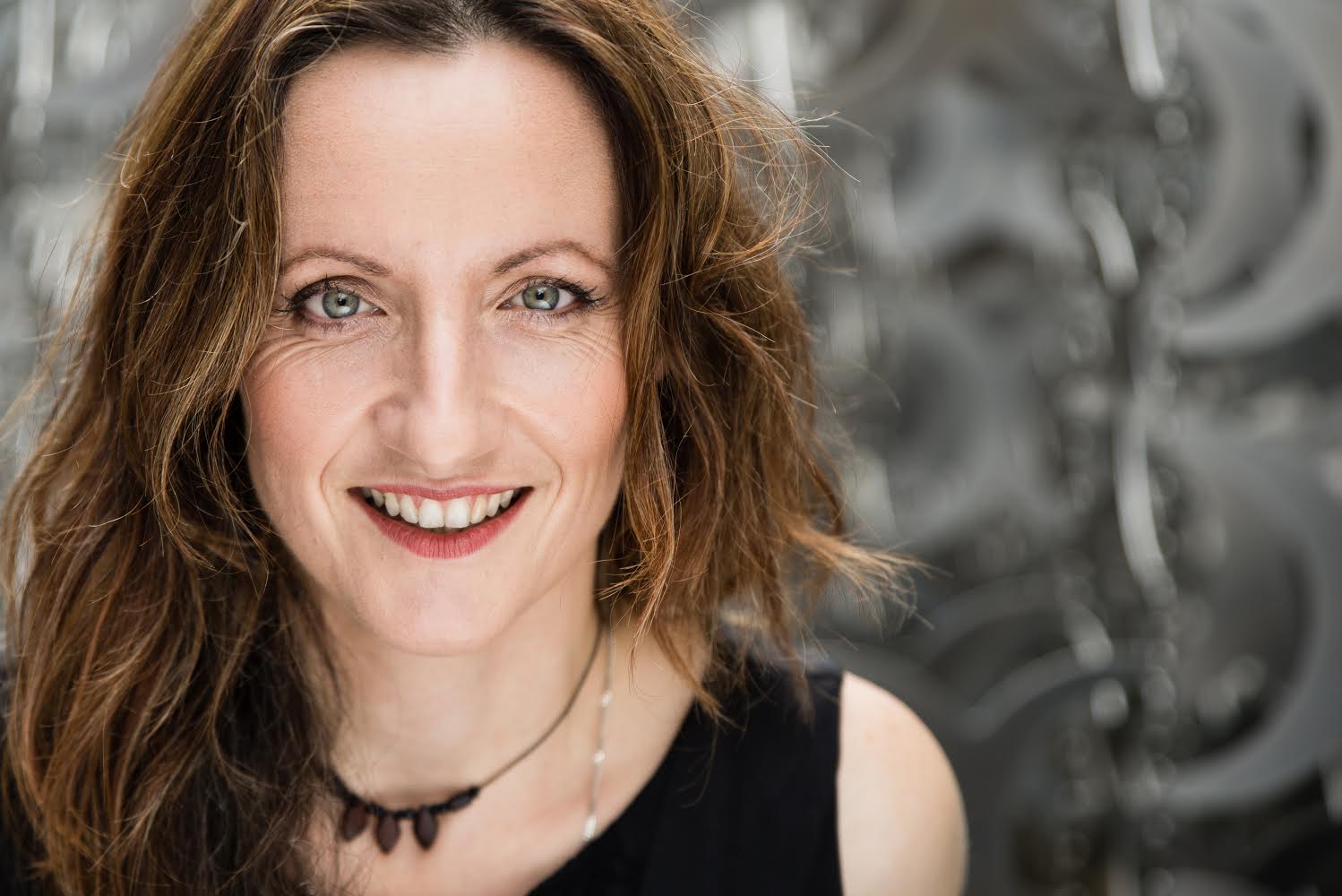
Guest post by Laura Wheeler, Community Manager at Digital Science
Digital Science Catalyst Grant

Whether it’s complying with funder mandates, collaborating with colleagues abroad, or trying to discover the right articles, the list of problems facing researchers is ever-growing.

Fortunately, there are an increasing number of software tools and technologies to solve these problems, allowing researchers to spend more of their time on what they really care about—their research! Many of these tools have sprung from the minds of frustrated academics who identify the need for a solution to a problem, then go ahead and build it themselves.

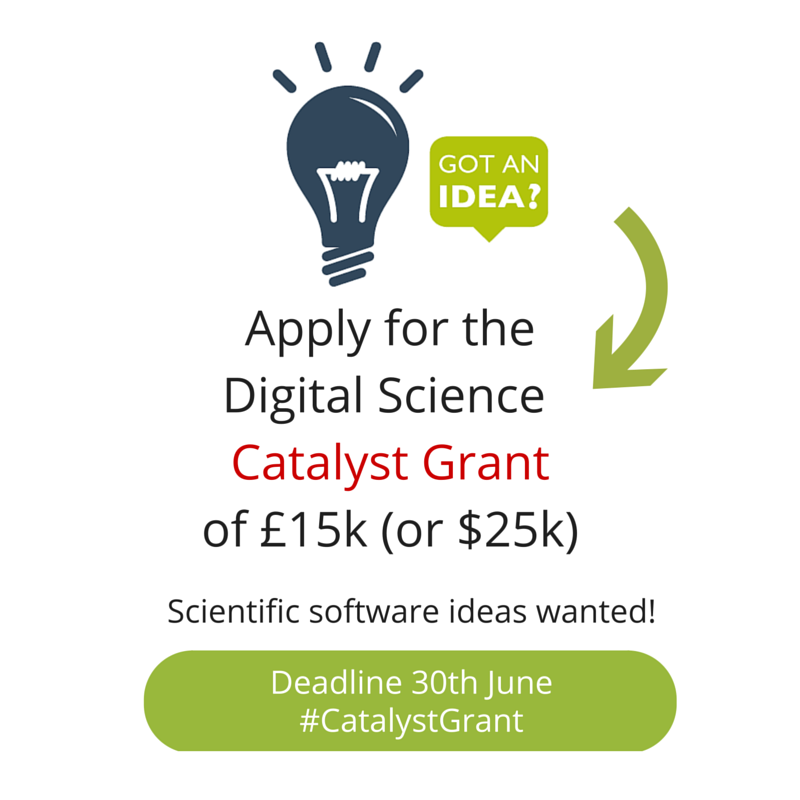
To support researchers to develop these ideas, Digital Science offers Catalyst Grants of up to £15,000 ($25,000), with the aim of supporting original, early-stage software ideas that further scientific research.

Michael Schmidt, a former researcher at Cornell University, was awarded one of our Catalyst Grants for his idea to develop a “robotic scientist” to identify patterns in massive data sets unseen to the human eye. He and his team at Nutonian have set out to map the world’s data sets with the “Data Genome Project”. The goal: to collect one million datasets, analyse them in the cloud, find out what hidden equations lie in them and link them all together.

According to Schmidt, we often take the massive complexity in the world for granted. The sheer scale of a project like Nutonian needed support from other quarters to bring it to fruition. “The Catalyst Grant Program has been instrumental,” he says. “We wouldn’t have been able to do the project without it.”

James Harwood, the founder of Penelope Research, an “automated manuscript scrutiniser”, is another Catalyst Grant recipient. Penelope was born out of his frustration at seeing published research which failed to meet basic research reporting standards.

“I was working in a medical setting, where research was no longer just an abstract thing, it’s very real. All the research that’s done badly is research that’s not helping patients,” says Harwood. “I started to think about how machine reading could be used to improve what’s being published and started talking to publishers to try and find possible solutions.”

In Harwood’s view the Catalyst Grant fills a funding gap for tools and services to improve the research process. Traditional academic funders focus on research itself, rather than the scholarly process, while business investors often struggle to understand the needs of researchers and scholarly publishing.

Do you have a software idea to further scientific research? Apply for our Catalyst Grant by 30 June 2016 to get the resources and funding to make it happen.

To make your application a success, here are top tips we’ve collected from the judging panel on what we’re looking for:

1. Be clear about your idea and concept

There is nothing worse than reading an application that is long and rambling. Be concise about what your idea is and how it works. The total proposal should be no more than 1,500 words. Be sure to include a clear elevator pitch—could you summarise your concept in one tweet?

2. Are you solving a problem in science/research?

What challenge does your idea solve—and is it really a problem? Think, “why should anyone care?” Better yet, offer an explanation of how your idea could benefit scientific research.

3. Sell yourself—what is your story?

Tell us all about your experience and your educational background. Explain why the idea is important to you or how it came to you.

4. Think carefully about your budget

How exactly will you spend the funds? We want to see clear budget breakdowns. You don’t have to apply for the full amount. Be realistic and spend the time researching the costs.

5. We prefer open ideas

As a company, Digital Science lives to invest in ideas that are open, rather than proprietary. Think about how your idea can help the community.

6. Do you have any competitors?

Market research that includes a vigorous look at your competitors is a must. It is easy to say “we have no competitors” but it is probably not true. If your solution really addresses a current problem, how are people getting around it now? If they’re fixing it themselves, then that’s your competitor!

7. Be realistic, but be passionate too

We back people who are pragmatic, but also strongly devoted to their vision. That passion convinces us that you will have the strength to overcome the inevitable failures and challenges that come with building something new.

8. Think about your potential customers

Investigate the market and get to know more about your potential customers. Great products only succeed with a strong understanding of the end user.

9. Check out past winners

Do your research and watch our videos from past winners, and read our blog posts.

10. Spend time on your application

Dedicate time to your application, don’t rush it. We want to see your dedication, and hopefully the time will be worth it in the end!

How Can Hollywood Help? #sciamlearning

This post originally appeared on Digital Science’s Event Blog: https://www.digital-science.com/blog/events/how-can-hollywood-help-sciamlearning/

By Laura Wheeler


On August 4th, I was honored to be invited to the 3rd annual STEM Summit, co-sponsored by Scientific American and Macmillan Education in New York. It proved to be an inspiring day discussing issues around women in STEM and today’s educational landscape.

If you want to see what was discussed during the event, I urge you to check out the active social media hashtag #sciamlearning, or to read Laura Wind’s summary of the Summit here. The hosts, Mariette DiChristina and Susan Winslow, did a phenomenal job at creating an interactive and thought-provoking day with real outputs.

I could pick out many highlights from the discussions, but for the purpose of this blog, I am going to concentrate on just one subject that was touched upon during the day- the role of Hollywood in portraying science:

Should scientists have a role in helping Hollywood portray science and the image of scientists? 

We were fortunate enough to hear from two inspirational scientists, Dr. Jon Sotos and Dr. Donna J. Nelson, the scientific advisors for the hit TV shows House and Breaking Bad. Their session was titled, “Changing The Idea Of Who Is STEM” and focused on how Hollywood can help.

Screen Shot 2015-08-29 at 22.19.47

Jon and Donna

Popular media does have an impact on society and behaviors, but not all examples prove to be accurate. For instance, we were told during the Summit that applications for library cards went up by 500% after “The Fonz” said he was going to the library to pick up girls in the 1970s hit TV show “Happy Days.” It seems that this is actually a popular myth. Nevertheless, the sentiment remains and it’s certainly unsurprising to think that a TV show might have such an impact.

It would be encouraging if the impact of TV could be more positive. In contrast to the Happy Days’ story, an article in The Telegraph featuring Professor Ellis Cashmore, an author on celebrity and media culture, claims the global success of Breaking Bad could be to blame for the surge in crystal meth suggesting that the hit show instantly makes people “curious” about crystal meth. The inevitable question is: to what extent should the popular media be expected to balance its intended creativity and entertainment with its responsibility to society in general?

One recent controversial example is the film “Gravity” which received acclaim for raising the profile of certain areas of science while at the same time enduring criticism for its lack of scientific accuracy. In order to achieve its main aim of providing an exciting and original piece of entertainment, it seems that certain realities had to be sacrificed. In defence of it, Kevin Grazier, the science adviser for the film, reminded its critics that “No one said it was a documentary.” Is this an acceptable excuse? Does the plus side of engaging an audience’s interest in a science themed area make up for the many inaccuracies in the facts?

In contrast, the film Interstellar won praise for its attention to detail in the physics of the piece. It has been heralded as inspirational to young people who can gain real insight into topics such as black holes and wormholes without losing any pleasure in the drama of the story. The director of Interstellar, Christopher Nolan, feels that there is no excuse for getting the science wrong in a dramatic presentation, believing that the facts of science can only add to the audience’s fascination with the vast possibilities of the universe.

It’s clear Hollywood has a responsibility not only to portray science accurately and alongside that, to support the images of women in STEM. We need to have positive images of scientists in popular media and move away from the perpetuating stereotypes. The session concluded that what we need to do is reveal real scientists and women in STEM, while making sure we don’t romanticise and fictionalise them in the process.

One comforting fact, however, is that real scientists are being used to advise the scripts of hit Hollywood shows. Although advice can easily be ignored, explained Donna playfully; pure meth would certainly not be blue – perhaps advice the Breaking Bad directors overlooked? But of course, Walt needed a trademark – now that’s Hollywood!

SpotOn London Is Now Free To Attend! Join us on the 14th & 15th November

We are thrilled to announce that we have decided to make tickets to this year’s SpotOn London free!

Why you may ask?

First and foremost, this is a community event and we want as many people as possible to join us – you make SpotOn what it is.

We are very lucky to have generous hosts in the Wellcome Trust who have donated the venue for the weekend and we have some fantastic sponsors. This has enabled us to cover some of the costs of this event – and Nature Publishing Group have decided to pick up the rest of the tab. We may not be able to do this every year, but this year we are! So we would like to take this opportunity to thank our sponsors and hosts who have enabled us to do this:

Sponsors

BioMed Central is a STM (Science, Technology and Medicine) publisher of 258 peer-reviewed open access journals. The portfolio of journals spans all areas of biology, biomedicine and medicine and includes broad interest titles, such as BMC Biology and BMC Medicine alongside specialist journals, such as Retrovirology and BMC Genomics. All original research articles published by BioMed Central are made freely accessible online immediately upon publication.

PLOS (Public Library of Science) is a nonprofit publisher and advocacy organization with a mission of leading a transformation in scientific and medical research communication.

Frontiers is an academic publisher of peer-reviewed open access scientific journals currently active in science, technology, and medicine.

Hosts

The Wellcome Trust is a global charitable foundation dedicated to achieving extraordinary improvements in human and animal health. Established in 1939, the Wellcome Trust is the largest non-governmental source of funds for biomedical research in the United Kingdom. Their breadth of support includes public engagement, education and the application of research to improve health.
welcome

Digital Science is a technology company serving the needs of scientific research. It offers a range of scientific technology and content solutions, from intelligent knowledge discovery tools to software applications for the laboratory and decision support systems for managers. Digital Science combines world-class technology with a resolute focus on scientists and those who support the research process. We believe passionately that tomorrow’s research will be different – and better – than today’s. Visit www.digital-science.com.

Nature Publishing Group is a leading provider of scientific journals, magazines, products and services. NPG is dedicated to serving the scientific community and the wider scientifically interested general public. Visit www.nature.com. 

What if you have already bought a ticket?

You will be refunded the full ticket price shortly after the conference. If we do it now, your ticket will be cancelled and you’ll have to reapply, which would be a pain!

How to get yourself a ticket

You can get your free ticket for the event here – which includes food and drink throughout the conference.

The final programme is now available here and you can stay tuned online using #solo14 and following @SpotOnLondon on Twitter.

We are also running two exciting fringe events with Pint Of Science and Science Showoff which you can read about here. We hope to see you there!

SpotOn London 2014 Final Programme

This year’s SpotOn London conference will take place at the Wellcome Trust on Friday, 14 November and Saturday, 15 November 2014. This year’s theme is on the challenges of balancing the public and the private in the digital age.

You can now see the final programme for Friday below and here. It includes a day of panels, workshops and keynotes on topics including: sharing sensitive data, measuring social impact, open peer review and the right to be forgotten.

You can click onto the sessions links to be taken to detailed information pages on each event.

Friday

9:00am Registration and Networking
09:40 – 10:00 Welcome and unconference explainer
10.00 – 11:00 Opening panel: who do we trust? #solo14trust
11:00 – 12:00 Sharing sensitive data – Workshop. #solo14sens Measuring social impact – the tools available and whose responsibility is it? Workshop. #solo14alt How to build your profile as a scientist? Workshop. #solo14profile
12:00 – 1:30 LUNCH
1:30- 2:30 Open peer review. Panel #solo14peer
2:30 – 3:00 COFFEE BREAK
3:00 – 4:30 Right to be Forgotten #solo14forget
4:30 – 5:30 Keynote Panel – Social impact and why we should include social impact as part of UK higher assessment. #solo14impact

Saturday

On Saturday, the day will start at 9am and the programme will be crafted by the delegates. The programme will be emailed to delegates on the Friday evening.

This is an exciting change to our Saturday programme – an unconference completely picked and run by the community within this year’s theme. If you are not sure what an unconference is, then check out Martin Fenner’s great explainer post here.

There is a Google doc where you can add your suggested session suggestions. Saturday’s schedule will be formulated on the Friday at the conference, not just by the organisers but a handful of other volunteers too.

If you are only attending on the Saturday and want to run a session, do let us know in advance.

There is still plenty of time to purchase your tickets via our Eventbrite page.

There are two ticket types, a full two-day conference ticket (£60) and a Saturday only ticket (£35) – which includes breakfast, lunch and other refreshments.

As the conference has sold out every year, we recommend buying your ticket as soon as possible to avoid disappointment.

Fringe Events

We’ve got some great fringe events lined up on the evenings of Thursday 13th and Friday 14th November. Tickets to these events will be offered to conference attendees first. You can see all the details of the fringe events here.

Finally, if you want to be kept updated on this year’s event, follow @SpotonLondon and the hashtag #solo14. If you’re not already on our mailing list, or if you have any questions, drop us a line at blogs@nature.com and we’ll happily add you!

Impact Women: Tech Meet Social interview with Servane Mouazan

Servane Mouazan

Servane Mouazan{credit}Amanda Clarke{/credit}

Nature Publishing Group’s sister company Digital Science, alongside Ogunte CIC, the organisation for Women Social Entrepreneurs, are hosting a new Impact Women event, to be held in London on October 13th.

The event will be a healthy, fast-paced mix of peer mentoring, coaching, keynote tips, and of course drinks and nibbles! It’s an opportunity to make women who navigate in this space more visible – but the invite is open to all interested in this arena.

To whet your appetite for this event, to be held in our London office, we thought we would host a Q&A with Ogunte CIC’s founder, Servane Mouazan.

1. Hi Servane, tell us about Ogunte and the type of community you are building.

I believe in impact made by women. I founded Ogunte CIC, [ www.ogunte.com] a pioneering organisation that contributes to “building a better world powered by women”. We have helped thousands of women social entrepreneurs, but also their ecosystem of support providers (incubators, finance providers, media) – to make a positive impact of people and planet, by enabling them to learn, lead, and connect.

Our aim is to make women changemakers genuine household brands in the world and create a ripple effect for good. We created Make a Wave, the first UK incubator for women social entrepreneurs, developed the International Women’s Social Leadership Awards, focusing on the achievements of women-led good businesses. We offer a gender lens on ways to change people’s world.

When I am not running Ogunte, I advise and coach people on Conscious Innovation, helping people to prototype love (yes, love!) through amazing learning experiences.

Continue reading

Imagine not getting the PhD you’d been working towards… #datadramas

What would happen if you lost all of your research data? The loss of scientific data can have a devastating impact on careers. Imagine if you lost all of the research data you’d been diligently collecting for four years. Now imagine the knock-on effect; you wouldn’t get the PhD you’d been working towards and your future career would be impacted. This nightmare situation actually happened to Billy Hinchen. Hear his story. Continue reading

Digital Science Concepts Video Series

Here at Digital Science, the younger sibling of Nature Publishing Group, we are always thinking of what we can do to make the lives of scientific researchers more efficient. In light of this mission, back in July 2012 we launched the first of our Digital Science Concepts videos, Touchless, showcasing our  thinking on the future of science. The video doesn’t actually include any projects we’re developing but, who knows… maybe one day we will! Continue reading

2013 Lindau Video: Science in the developing world

Nature Video presents four debates from the 2013 Nobel Laureate Meeting in Lindau

At this summer’s Lindau Meeting we focused on pressing world problems and how chemistry can help us to solve them. In four films, laureates and students clash over the future of energy production, grapple with drug development, discuss dwindling supplies of metal catalysts and debate science’s role in the developing world. Get a taster in this trailer.

The eager researchers come to the debates with big ideas and high hopes, while the laureates bring a healthy dose of experience. You can find out more in our first film, Fuelling controversy.

In our second film, we look at what role can science play in the developing world. In this film, Nobel Peace Prize winner José Ramos-Horta and Israeli Nobel laureate Dan Shechtman discuss the issue with young researchers from South Africa, India and the US.

Science and politics collide as the group grapple with funding problems, social responsibility and culture. The laureates emphasize that science alone is not enough; researchers must work with industry and government to solve the problems of the developing world. Continue reading

2013 Lindau Video: Fuelling controversy

Nature Video presents four debates from the 2013 Nobel Laureate Meeting in Lindau

At this summer’s Lindau Meeting we focused on pressing world problems and how chemistry can help us to solve them. In four films, laureates and students clash over the future of energy production, grapple with drug development, discuss dwindling supplies of metal catalysts and debate science’s role in the developing world. Get a taster in this trailer.

The eager researchers come to the debates with big ideas and high hopes, while the laureates bring a healthy dose of experience.

In our first film, former US Secretary of Energy Steven Chu injects reality into a debate about biofuels with his inside knowledge of science policy and economics.

Continue reading

Win the best of 2012’s popular science books

PrintWhen the Nature Press Office finishes for the day, it’s usually the time to take a break from thinking about science and how to communicate it to the broadest possible audience.  However, from today onwards Nature’s Head of Press, Alice Henchley, will commute home with her nose stuck in the best of 2012’s popular science books.  Over the coming two months, Alice will be reading and reviewing the runners and riders shortlisted for the 2013 Royal Society Winton Prize for Science Books.

2012 was clearly a vintage year, with contenders ranging from an analysis of the new science of memory to a tour of the blue planet.  The complete list comprises: Continue reading