Posted on behalf of Elizabeth Gibney
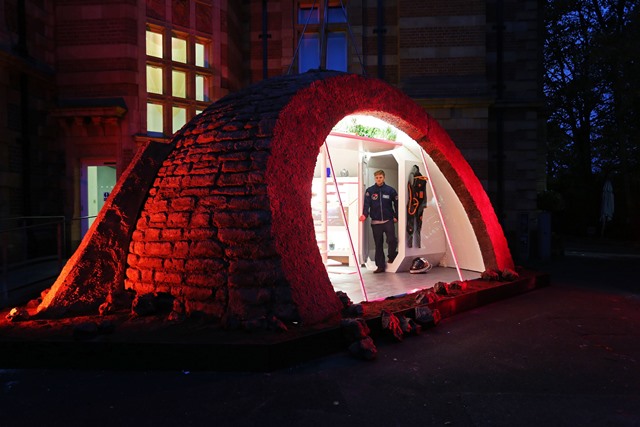
The National Geographic Mars show home at the Royal Observatory Greenwich, London. The habitat is the work of Wild Creations in consultation with observatory astronomers and Stephen Petranek, author of How We’ll Live on Mars.{credit}National Geographic mini-series MARS runs through 19 December{/credit}
A big red igloo with a towering antenna seems a little overblown for a London show home. And so it proves. The object squatting outside the Royal Observatory Greenwich is actually a life-sized mock-up of a Mars habitat, billed as the imaginary dwelling of a second wave of settlers from Earth. That is, those who might live on the Red Planet in their thousands by around 2037, if the ambitious plans of space entrepreneurs such as SpaceX’s Elon Musk bear fruit.
The mock-up, in London this week to 16 November, promotes the National Geographic channel docudrama MARS, by director Ron Howard and Brian Grazer. Launched on 13 November, the mini-series charts the 2033 journey of a fictional first crewed mission to Mars by a blissfully collaborative International Mars Science Foundation, and subsequent attempts to establish a settlement.
As Earth’s second-nearest neighbour after Venus, Mars is widely seen as the best candidate planet for human colonization. But it lacks Earth’s thick atmosphere and global magnetic field, and is extremely inhospitable in myriad other ways. Colonists would need to be protected from temperatures that plummet to -70 degrees Celsius at night at the equator, as well as the high-energy cosmic particles and ultra-violet solar radiation that pummel the planet’s surface.
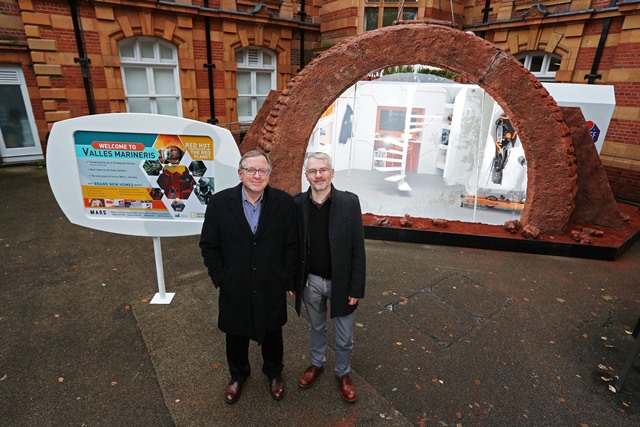
Author Stephen Petranek with Marek Kukula, the Royal Observatory Greenwich public astronomer.{credit}National Geographic mini-series MARS runs through 19 December{/credit}
The Martian igloo, the work of display and model-making company Wild Creations, is a fun way of exploring what constraints the environment would put on design. The walls are a whopping 60 centimetres thick — just an eighth of the almost 5-metre depth they would need to be capable of protecting colonists from the radiation, said Stephen Petranek at the show-home opening. His book How We’ll Live on Mars inspired the series, and he consulted on the show home alongside the observatory’s public astronomer Marek Kukula. Moreover, Petranek notes, it would need to be built of bricks made by microwaving a mixture of polymer granules with Mars’ clay mineral-based soil. And an igloo is just one possible design. The same bricks could easily make bigger structures, even a large Gothic cathedral, he says. Or homes on the Red Planet could be built in the natural underground hollows that once housed lava, or in the side of craters.
Daily life for the 10,000 people Petranek imagines might some day dwell in this kind of shelter does not look appealing. Accessed via an ‘airlock’ stuck into the igloo wall, the dome’s interior is claustrophobically small — just a few paces across. Features would have to include an exercise machine to combat muscle wastage in the low-gravity environment, and an indoor farm. The small potted plants I spot on a mezzanine near the building’s ceiling hardly look substantial enough to sustain a hungry Martian for more than a few weeks — in contrast to the heaps of potatoes ingeniously grown by fictional astronaut Mark Watney (Matt Damon) in Ridley Scott’s 2015 film The Martian. Settlers would also need access to water, which (assuming it is there) may only exist in liquid form dozens of metres down in the planet’s concrete-hard ground.

Artist’s depiction of the show home in situ.{credit}National Geographic{/credit}
The message here seems to be about thinking big to encourage ambition, as with the MARS mini-series. That uses an innovative format: the drama unfolds amid “flashbacks” to interviews with actual scientists and space pioneers, such as Musk. These highlight how real progress often initially involves failure, but also serve to make the dramatised scenes seem even more fictional.
Petranek notes that plans such as Musk’s are “much more realistic than people give them credit for”. And whether or not they succeed, SpaceX is driving all space exploration in the direction of human missions to Mars, he argues. But for now, most planetary scientists still see living there as science fiction, and that’s not just because of unfeasible costs or optimistic technology projections.
Many researchers don’t actually want to send people to the Red Planet yet. It could well have harboured life billions of years ago, and finding that would tell us that life on Earth was not a one-off fluke. NASA, the European Space Agency (ESA) and the China National Space Administration all plan to put rovers on Mars in the 2020s to scour it for ancient life. But while rovers can be carefully sterilised to prevent contamination, sending humans would almost certainly contaminate the planet, and could mean we never find out. From that perspective at least, there is no hurry.
Elizabeth Gibney is a reporter on physics for Nature based in London. She tweets at @LizzieGibney. Listen in to her Nature Podcast talk with Andrew Coates, the planetary scientist working on the ESA’s first Mars rover.
MARS runs through 19 December on the National Geographic channel.
For Nature’s full coverage of science in culture, visit www.nature.com/news/booksandarts.