Am I Making Myself Clear?

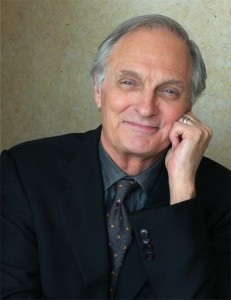
Alan Alda, actor, director, writer, and founding member of the Center for Communicating Science at Stony Brook University, has had a lifelong interest in science. He hosted PBS’ Scientific American Frontiers from 1993 to 2005, an experience he has called “the best thing I ever did in front of a camera.” Considering his career – from M*A*S*H and The West Wing on television to an array of notable movie and theater roles – that’s quite an endorsement. After interviewing hundreds of scientists, Mr. Alda became convinced that many researchers have wonderful stories to tell, but some need help in telling them. Mr. Alda has played an active role in the Center for Communicating Science, starting the Flame Challenge last year, and leading workshops that use improvisational theater games to help scientists communicate more directly and personally. He was co-chair of the 2009 World Science Festival in New York City, hosted the 2010 documentary mini-series The Human Spark, and has written a play about the life of Marie Curie.

I probably learned the best lesson about talking in plain words from my youngest grandson. We were on vacation in the Virgin Islands, walking on a path that led to the strangest tree we had ever seen. The trunk was covered with angry looking thorns. I thought, wow, this is a great chance to talk with Matteo about how this tree might have come to look like this. So, we sat on the ground and had a wonderful exchange of ideas about evolution for 45 minutes. He was only 6 or 7, but he was taking in everything I told him.

The next day he was swimming with his cousin and asked her a question about science. She said, “Why don’t you ask your Grandpa about that?” And Matteo said, “I’m not makin’ that mistake again.” Continue reading
23 and Me CEO Wojcicki on turning 150,000 DNA tests into a research database

23andMe, which started out in 2006 as a “personal genome service,” offers DNA analysis to consumers for $299 over the Internet. Now the California-based company is building a research program with crowdsourced data from its 150,000 customers. Company scientists have published several papers.

Continue reading

PhDelta: Acquiring new skills and improving old ones during your PhD

At August 20th’s SoNYC discussion, which this month is held in collaboration with the New York Academy of Sciences, we’re going to be focusing on science PhDs. Does the current PhD system need revamping to better equip researchers to continue in academia or to pursue other careers after graduating? In our latest series of guest posts on Soapbox Science, we’ll hear from a variety of contributors about how the current system works, where the gaps are, which additional skills they think PhD courses should incorporate and what their personal experiences have been. Follow and join in the conversations online using #PhDelta and share your thoughts in the comment threads on the blog posts too.

Audrey Richard graduated with a PhD in molecular and cell biology a few months ago in France. She owes the little oncolytic virus she was working on for that. She finds herself complaining quite often about her PhD training but in truth, while thinking that it could improve for next students indeed, she enjoyed it very much.

Currently, she’s trying to conclude as nicely as possible everything related to her thesis (well, she’s writing papers) while discovering the joy of sci blogging thanks to nature.com. The months and years to come will hopefully involve a postdoc but most importantly virology. Continue reading

PhDelta: The Road Less Travelled – From PhD to Software Development

At August 20th’s SoNYC discussion, which this month is held in collaboration with the New York Academy of Sciences, we’re going to be focusing on science PhDs. Does the current PhD system need revamping to better equip researchers to continue in academia or to pursue other careers after graduating? In our latest series of guest posts on Soapbox Science, we’ll hear from a variety of contributors about how the current system works, where the gaps are, which additional skills they think PhD courses should incorporate and what their personal experiences have been. Follow and join in the conversations online using #PhDelta and share your thoughts in the comment threads on the blog posts too.

Marcus D. Hanwell is a Technical Lead in the Scientific Computing group at Kitware, Inc. He leads the Open Chemistry project developing open-source tools to for chemistry, bioinformatics and materials science research. He completed an experimental PhD in Physics at the University of Sheffield, a Google Summer of Code developing Avogadro/Kalzium  and a postdoctoral fellowship in combining experimental and computational chemistry at the University of Pittsburgh before moving to Kitware, Inc. in late 2009. He is a member of the Blue Obelisk, blogs here and is active on Google+. He is passionate about open science, open source and making sense of increasingly large scientific data to understand the world around us. Continue reading

PhDelta: Reflections on my PhD – What About Project Management Skills?

At August 20th’s SoNYC discussion, which this month is held in collaboration with the New York Academy of Sciences, we’re going to be focusing on science PhDs. Does the current PhD system need revamping to better equip researchers to continue in academia or to pursue other careers after graduating? In our latest series of guest posts on Soapbox Science, we’ll hear from a variety of contributors about how the current system works, where the gaps are, which additional skills they think PhD courses should incorporate and what their personal experiences have been. Follow and join in the conversations online using #PhDelta and share your thoughts in the comment threads on the blog posts too.

Daniel Tix graduated from the University of Minnesota with a Ph.D. in Plant Biology; the focus of his research was in ecological restoration and plant community dynamics. He is currently working at a consulting firm in Minneapolis, Minnesota, where he specializes in wetland ecology, ecological restoration, and botanical surveys. Dan’s clients are primarily mining and energy companies that are seeking permits for new or on-going projects. Before they can begin a project, he will help them identify the wetlands on their site and determine if protected species will be affected. He identifies these natural features and acquires permits from local, state, and federal agencies if needed. If wetlands are affected by the projects, he will restore wetlands to mitigate lost wetlands. Dan has been working in this field for about 5 years, and before that he planned ecological restoration projects for a non-profit and taught as an adjunct faculty at a local university.  Continue reading

PhDelta: PhD what is it good for? #leavingacademia

At August 20th’s SoNYC discussion, which this month is held in collaboration with the New York Academy of Sciences, we’re going to be focusing on science PhDs. Does the current PhD system need revamping to better equip researchers to continue in academia or to pursue other careers after graduating? In our latest series of guest posts on Soapbox Science, we’ll hear from a variety of contributors about how the current system works, where the gaps are, which additional skills they think PhD courses should incorporate and what their personal experiences have been. Follow and join in the conversations online using #PhDelta and share your thoughts in the comment threads on the blog posts too.

Jerry Nguyen is the Global Health and Science Program Manager at the consulting firm, Edge Business Innovations. He earned his Ph.D. in Neuroscience at Washington University in St. Louis and was a postdoctoral fellow at Columbia University.  Since then, he has been a healthcare management consultant, stay-at-home dad, and a financial analyst. He is currently providing project and alliance management expertise to a global health non-profit.

There I was, standing in front of a packed room, the last words of my thesis presentation hanging in the air. I had just wrapped up five and a half years of intense research into an energetic forty-five minute talk. I was happy, ecstatic, and even a little bit triumphant.

I never thought that just over eight months later I would leave academic research for good. Continue reading

PhDelta: Why I’m Working Toward my Ph.D. at a Museum

At August 20th’s SoNYC discussion, which this month is held in collaboration with the New York Academy of Sciences, we’re going to be focusing on science PhDs. Does the current PhD system need revamping to better equip researchers to continue in academia or to pursue other careers after graduating? In our latest series of guest posts on Soapbox Science, we’ll hear from a variety of contributors about how the current system works, where the gaps are, which additional skills they think PhD courses should incorporate and what their personal experiences have been. Follow and join in the conversations online using #PhDelta and share your thoughts in the comment threads on the blog posts too.

Alejandro Grajales is a third year student in the Richard Gilder Graduate School at the American Museum of Natural History, focusing on the evolution and distribution of marine invertebrates. He obtained both his bachelor’s and master’s degrees from the Universidad de los Andes in Bogota, Colombia. His research as a graduate student focuses on the diversity and evolution of sea anemones (Cnidaria:Actiniaria). His project involves an extensive fieldwork component, including localities in the Sea of Cortez, the Caribbean and Mediterranean seas, and both the Pacific and Atlantic Oceans. Continue reading

PhDelta: Science Communication in the PhD process

At August 20th’s SoNYC discussion, which this month is held in collaboration with the New York Academy of Sciences, we’re going to be focusing on science PhDs. Does the current PhD system need revamping to better equip researchers to continue in academia or to pursue other careers after graduating? In our latest series of guest posts on Soapbox Science, we’ll hear from a variety of contributors about how the current system works, where the gaps are, which additional skills they think PhD courses should incorporate and what their personal experiences have been. Follow and join in the conversations online using #PhDelta and share your thoughts in the comment threads on the blog posts too.

Heather Doran is a final year PhD student in molecular pharmacology at the University of Aberdeen. She is also the founder and editor of Au Science Mag (https://ausm.org.uk), Skeptics in the Pub organiser, science busker and blogger (https://sciencehastheanswer.blogspot.com). She is supposed to be writing her thesis at the minute. When she gets distracted then she is mostly found on twitter @hapsci 

To say that the job market for new PhD graduates is tough is a bit of an understatement. As a new researcher, if you can’t explain why you are useful and what the point of your research is, unfortunately you might find yourself at the bottom of the jobs and grants pile. Continue reading

#PhDelta: Learning on the job

At August 20th’s SoNYC discussion, which this month is held in collaboration with the New York Academy of Sciences, we’re going to be focusing on science PhDs. Does the current PhD system need revamping to better equip researchers to continue in academia or to pursue other careers after graduating? In our latest series of guest posts on Soapbox Science, we’ll hear from a variety of contributors about how the current system works, where the gaps are, which additional skills they think PhD courses should incorporate and what their personal experiences have been. Follow and join in the conversations online using #PhDelta and share your thoughts in the comment threads on the blog posts too.

Amanda is beginning her sixth year as a graduate student in the Astrophysics/Cosmology Theory group at Case Western Reserve University. In September she will begin a NASA Earth and Space Science Fellowship, while also travelling to CERN to work with her advisor, Prof. Glenn D. Starkman. You can find Amanda on Twitter @mandaYoho. Continue reading

PhDelta: My DTC Experience

At August 20th’s SoNYC discussion, which this month is held in collaboration with the New York Academy of Sciences, we’re going to be focusing on science PhDs. Does the current PhD system need revamping to better equip researchers to continue in academia or to pursue other careers after graduating? In our latest series of guest posts on Soapbox Science, we’ll hear from a variety of contributors about how the current system works, where the gaps are, which additional skills they think PhD courses should incorporate and what their personal experiences have been. Follow and join in the conversations online using #PhDelta and share your thoughts in the comment threads on the blog posts too.

Matt Allinson, is a chemistry PhD student at Imperial College London (hybrid photovoltaic devices) and occasional accordion player. You can find him on Twitter @Mattallinson.

I am a first year PhD student at Imperial College London’s Centre for Plastic Electronics, and have had immense benefit from studying in their Doctoral Training Centre (DTC) for 2 years.

The main goal of a DTC is to encourage the collaboration and training of students working on various aspects of an interdisciplinary field. Continue reading