Where to land on a comet?

Philae_candidate_landing_sites

Philae will aim for one of five sites on Comet 67P/Churyumov-Gerasimenko when it lands in November
{credit}ESA/Rosetta/MPS for OSIRIS Team MPS/UPD/LAM/IAA/SSO/INTA/UPM/DASP/IDA{/credit}

Spare a thought for scientists on the European Space Agency (ESA) Rosetta mission, who will spend this weekend dissecting the ins and outs of five patches of land on a comet 440 million kilometres away.

They will be selecting a landing spot for the washing-machine-sized robotic probe Philae. On 11 November they plan to land the 100-kilogramme probe on 67P/Churyumov-Gerasimenko, in what will be the first ever attempt to soft land on a comet.

Picking the site will be a trade-off between scientific interest and operational safety — based largely on data from Rosetta’s instruments that are just weeks old, taken since the spacecraft caught up with its target on 6 August. High-resolution visible range, ultraviolet and temperature maps of the rubber-duck shaped comet, and data on the pressure and density of gas around the nucleus, already make the comet the most studied in history, says Rosetta project scientist at ESA, Matt Taylor.

At a meeting this weekend at the French National Centre for Space Studies (CNES) in Toulouse, scientists will debate the pros and cons of five shortlisted sites, three on the duck’s head and two on its body (see picture), selected last month. None are perfect, says Taylor. “There isn’t a great spot there. We’re going to have to pick the best of what we can achieve.”

Uncertainties in Rosetta’s navigation near the comet, as well as the distance from which it must release Philae, mean that the smallest spot the scientists can specify to land in is an ellipse with an area of 1 square kilometre. To maximize the chances of a safe landing, engineers will want the site to be as flat and smooth as possible, as well as somewhere on the comet that is feasible to reach, given safe orbits for Rosetta.

To thrive once there, Philae will need the spot to have just the right amount of daylight to power the lander’s solar panels and recharge its batteries. This means at least 6 hours per 12.4-hour comet rotation, but constant sunlight will cause the craft to overheat, says Mark McCaughrean, senior science adviser at the ESA directorate of science and robotic exploration.

Scientific interest is also balanced in the landing-site trade-off. Philae is armed with an on-board chemistry laboratory and instruments that allow it, in conjunction with Rosetta, to use radio waves to map the interior of the comet. Scientists will want to land Philae where they can use these instruments to learn the most.

Site A, for example, is scientifically exciting as it gives a view of both the head and body section, between which most of the comet’s gas is being produced.  Site J has advantages for radio mapping the nucleus.  Site B seems to be a safer choice in terms of landing. The wide crater has already been nicknamed “the heliport” because of its flatness, says Stephan Ulamec, Philae lander manager at the German Aerospace Center (DLR).

After examining the case for each, the lander team and Rosetta scientists will announce their favourite, and a backup, in Paris on Monday 15 September at 11 a.m. local time.

Rosetta is currently in orbit just under 30 kilometres from the comet’s surface, caught within its gravitational field. In the coming weeks, depending on the amount of gas and dust the comet releases, Rosetta will try to creep into closer orbits, taking pictures from as low as 10 kilometres, to best prepare for the landing in November.
São Paulo state joins mega-telescope

The Giant Magellan Telescope (GMT) received a boost today when Brazil’s São Paulo Research Foundation (FAPESP) confirmed its plans to join the project. The US$880-million facility, some components of which have already been built, is one of three competing mega-telescopes that will study the skies in the next decade.

Approving plans reported by Nature in February, the richest state in Brazil confirmed on 22 July that it would contribute $40 million towards membership of the GMT, which is managed by a consortium of institutions in the United States, Australia and South Korea.

São Paulo researchers might not be the only ones to benefit. FAPESP scientific director Carlos Henrique de Brito Cruz told Nature’s news team that negotiations between the foundation and the Ministry of Science and Technology of Brazil were “well advanced to share these costs and allow astronomers from all states of Brazil to have access to the telescope”. If that plan goes ahead, the ministry will refund part of the costs to FAPESP.

Although a boon for Brazilian astronomers, the move could raise concerns for advocates of the Extremely Large Telescope (E-ELT), which is being built by the European Southern Observatory (ESO) in Chile. ESO has begun blasting the top off the 3,000-metre peak of Cerro Armazones where the E-ELT will be based, but is reliant on funding from Brazil’s federal government to enter the main construction phase. In 2010 Brazil agreed to contribute €270 million ($371 million) to ESO over a decade, but the deal has yet to be ratified and remains held up in legislative committees.

Some legislators may see the GMT agreement as a cheaper way for Brazil’s astronomers to access a future mega-telescope, even though the ESO deal also allows access to existing observatories in Chile. However Beatrice Barbuy, head of the Astronomical Society of Brazil’s ESO committee, says that the plans are still moving ahead. She adds that they had stalled in recent months owing to the country’s hosting the FIFA World Cup and staff going on winter vacations, but discussions were likely to get underway again in August.

The 25-metre GMT, to be built at the Carnegie Institution for Science’s Las Campanas Observatory in Chile, is scheduled to begin operations in 2020. It is designed to have six times the collecting power of the largest existing observatories and 10 times the resolution of NASA’s Hubble Space Telescope. The agreement is expected to secure São Paulo a 4% stake in the GMT project, guaranteeing 4% of observation time for Brazilian astronomers each year, as well as representation on the consortium’s decision-making board.

The GMT, E-ELT and a third planned next-generation ground-based observatory, the Thirty Meter Telescope, proposed to be built in Mauna Kea in Hawaii, are intended to address similar science questions. Astronomers hope to use the huge light-collecting capacity of the telescopes to explore planets outside our Solar System, study supermassive black holes and galaxy formation and unravel the nature of dark matter and dark energy.

Physicists defend Big Bang wave announcement

Cosmic swirls that were hailed earlier this year as evidence for primordial gravitational waves – ripples in spacetime dating back to the early universe – may turn out to have been caused by dust. But several top physicists are standing by the decision to announce the result back in March, before it had been peer-reviewed.

“I think it’s important to give it at the same time to the scientific community as to the general public,” said Rolf Dieter-Heuer, the director general of Europe’s particle physics Laboratory, CERN.  “We did the same two years ago when we announced the discovery of the Higgs boson.” Not a member of  the BICEP2 team that made the original claim, Dieter-Heuer was speaking to journalists at the International Conference on High Energy Physics (ICHEP) in Valencia, Spain.

When the BICEP2 team first reported that their telescope in the South Pole had detected twists in the polarization of relic light from the Big Bang, known as the cosmic microwave background, the results  seemed to confirm that the baby Universe underwent a period of rapid expansion, a theory known as inflation. But since then, the finding has been scrutinised and challenged by physicists who raised the possibility that grains of dust in the Milky Way – rather than gravitational waves – created the swirling polarization pattern. That culminated in the team last month scaling back their claims when publishing in the peer-reviewed journal Physical Review Letters1

It is something that the European Space Agency’s Planck telescope has the power to answer, said Enrique Martinez, a physicist at the Institute of Physics of Cantabria and a member of the Planck collaboration. He too was speaking at ICHEP, in a huge auditorium packed with delegates who had gathered in the hopes of some resolution on the BICEP2 result. But his talk failed to satisfy the expectant crowd.

Instead he promised that Planck would release results for the part of the sky relevant to the findings within a month, followed by its full dataset in October. He also confirmed that the Planck and BICEP2 teams were in the final stages of forming an agreement to collaborate on a joint, but separate, analysis.

Was BICEP2’s March announcement premature? Speaking alongside Dieter-Heuer, Alan Guth, the cosmologist who first proposed the inflation concept in 1980, said the team’s decision to speak to the press, which they did at the same time as posting a paper to the pre-print server ArXiv, was a natural one to take. “The press wants to know, the referring process is slow, and meanwhile the scientific community would probably find out anyway,” he said.

However, there should have been more caveats and cautionary remarks, he said: “It was almost presented if there was no way the experiment could not be interpreted as they interpreted it to be. When others came to look at it, that seemed no longer to be the case.”

In a talk in which he represented the BICEP2 collaboration, Roger O’Brient, a physicist at Caltech’s Jet Propulsion Laboratory, stressed the effort his team had taken to distinguish the signal from the dust or other causes of polarization. “We actually thought through this for about a year and a half before we published,” he said.

Afterwards, O’Brient told Nature that releasing the paper publicly had actually been good for science, as it had spurred others, sometimes from surprising areas of the scientific community, to examine the results.  “It’s not clear to me that the peer review process on its own in a vacuum would have necessarily caught issues.”

Guth is not giving up on BICEP2. During another talk at the conference, he said there was “reasonable hope” the signal would turn out to be the long sought after gravitational waves. However he also stressed that if the signal turns to dust, it would not cause any problems for his theory – other than from a public relations perspective. “If it turns out to be all dust, that’s not a mark against inflation,” he said.

Germany pulls back from international mega-telescope project

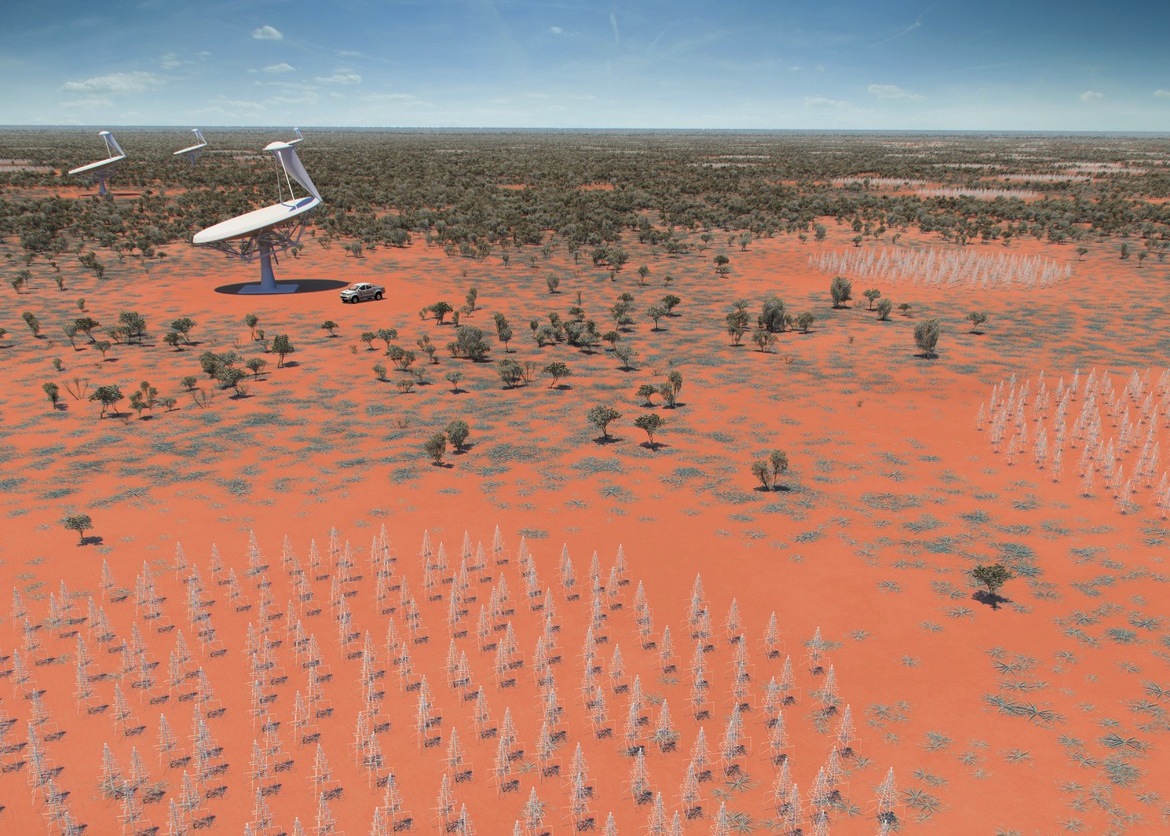
Aus_LF_wideAngle_Ska.screen

Credit: SKA Organisation

Germany’s science funding may look healthy to outsiders, but its research ministry seems to have stretched its cash too thinly. Last week, it decided that helping to fund the world’s biggest radio telescope — to be built in South Africa and Australia by 2024 at a cost of more than €1.5 billion (US$2 billion) — was one international mega-project too many. On 5 June, it said it would pull out of the Square Kilometre Array (SKA), to the dismay of German astronomers, who say that they were not consulted and are hoping to reverse the move.

“It looks like Germany is in danger of derailing one of Africa’s first really big science projects,” says Michael Kramer, the director of the Max Planck Institute for radioastronomy in Bonn. From the SKA’s point of view, however, a loss of German support (which might have amounted to tens of millions of euros to an estimated €650-million first construction phase) would be “disappointing, but not catastrophic”, says Philip Diamond, director-general of the SKA Organization, headquartered in Manchester, UK, which coordinates the efforts of ten supporting nations. Nonetheless, says Diamond, “I and my German colleagues are working hard to do what we can to overturn this decision”.

Continue reading

Kavli Prizes reward cosmic inflation, memory research and imaging

Posted on behalf of Gene Russo.

The 2014 Kavli Prizes, announced today, were shared among nine scientists for their work on the theory of cosmic inflation, for contributions to the field of nano-optics and for the discovery of specialized brain networks for memory and cognition.

The Kavli Foundation has awarded prizes every two years since 2008 in the disciplines of astrophysics, nanotechnology and neuroscience. The prizes are administered in cooperation with the Norwegian Academy of Science and Letters and consists of a cash award of US$1 million, as well as a gold medal.

astro-three

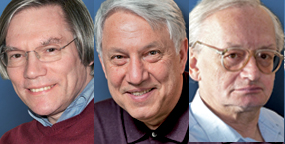
Alan Guth, Andrei Linde and Alexei Starobinsky shared the astrophysics prize.

The prize in astrophysics went to Alan Guth of the Massachusetts Institute of Technology in Cambridge; Andrei Linde of Stanford University in Palo Alto, California; and Alexei Starobinsky of the Landau Institute for Theoretical Physics at the Russian Academy of Sciences near Moscow. The three earned the award for pioneering work on the theory of cosmic inflation, which holds that the Universe underwent a short-lived phase of exponential expansion soon after it came into existence.

Studies of inflation now occupy thousands of theorists. Indeed, recently reported results seemed to suggest that scientists had found the imprint of the Big Bang by examining cosmic microwave background using the BICEP2 telescope; those results, however, have now been called into question.

nano-three

Thomas Ebbesen, Stefan Hell and John Pendry shared the nanotechnology prize.

For the field of nanoscience, the Kavli prizes went to Thomas Ebbesen of the Université Louis Pasteur in Paris; Stefan Hell of the Max Planck Institute for Biophysical Chemistry in Göttingen, Germany; and John Pendry of Imperial College London. The three countered long-held beliefs about the resolution limits of optical imaging and microscopy, showing that light can interact with nanostructures smaller than light’s wavelength. Previous convention had suggested that only details larger than approximately 200 nanometres could be imaged. In a press release, the Kavli Foundation calls this ability to see and image nanoscale objects “a critical prerequisite to further advances in the broader field of nanoscience”.

Ebbesen’s experiments in the late 1990s, which challenged accepted theory of light propagation through small holes, led to new means of increasing the efficiency and spatial focus of photonic devices and the sensitivity of optical sensors. Hell developed a technique that enables imaging at dimensions much smaller than optical wavelengths, including the processes in living cells. Pendry developed a model for the ‘perfect lens’, or superlens, using materials such as silver, gold and copper. Pendry is most famous for developing the concept of an invisibility cloak, which, like perfect lenses is based on the use of ‘metamaterials’ that have a negative index of refraction (see ‘Invisibility cloaks are in sight‘).

neuro-three

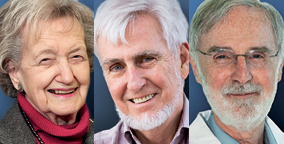
Brenda Milner, John O’Keefe and Marcus Raichle shared the neuroscience prize.

Kavli awarded prizes for neuroscience to Brenda Milner of McGill University in Montreal, Canada; John O’Keefe of University College London; and Marcus Raichle at the Washington University School of Medicine in St Louis, Missouri. Through a variety of research techniques, these neuroscientists elucidated how specialized nerve cells perform different functions and revealed details about brain regions involved in memory. The Kavli announcement notes that memory “defines who we are” and that “loss of memory can have devastating effects on an individual’s personality”.

Milner studied a celebrated patient known as H.M. and others who had incurred brain damage, and found that the medial temporal lobes are necessary for the formation of what is now known as episodic memory. O’Keefe showed that the hippocampus contains neurons that encode an animal’s specific location. And Raichle designed methods for visualizing the brain’s activity.

The Kavli Foundation, based in Oxnard, California, was established in 2000 by Norwegian-born entrepeneur Fred Kavli (1927–2013), and funds more than a dozen Kavli Institutes around the world.

The award ceremony will take place in Oslo on 9 September.

Pictures courtesy of Kavli Foundation (Guth); Linda A. Cicero/Stanford University (Linde); Landau Institute/RAS (Starobinsky); Eirik Furu Baardsen (Ebbesen); Bernd Schuller/Wikimedia Commons (Hell); Mike Finn-Kelcey/Imperial College London (Pendry); Owen Egan/McGill University (Milner); Kavli Foundation (O’Keefe and Raichle).

False alarm of cosmic blast sends astronomers racing to telescopes

UPDATE: A message posted “on behalf of the Swift-XRT team” on NASA’s Gamma-ray Coordinates Network (GCN) system at 8:57 a.m. BST on 28 May says that the astronomers now “do not believe this source to be in outburst”.  Swift team member Kim Page, a nova and γ-ray-burst astronomer at the University of Leicester, UK, told Nature that the source had been initially mistaken for a new outburst, and that its intensity had been overestimated owing to measurement error. Instead, she says, it was a relatively common, persistent X-ray source — possibly a globular cluster — that had previously been catalogued. (See this post from Page’s Leicester colleague Phil Evans.)

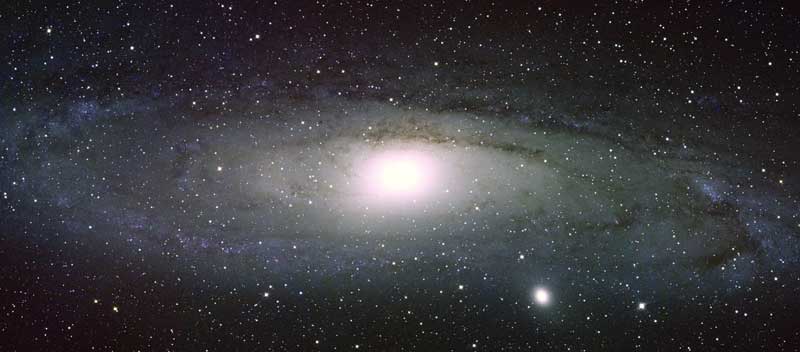
NASA’s Swift satellite has detected a burst of high-energy γ-rays coming from the Andromeda galaxy, the closest large galaxy to the Milky Way. The rare cosmic explosion is likely to deliver a flood of data to astronomers, who are swivelling their telescopes to capture its aftermath.

The Andromeda galaxy. Credit Bill Schoening, Vanessa Harvey/REU program/NOAO/AURA/NSF.

The Andromeda galaxy. Credit Bill Schoening, Vanessa Harvey/REU program/NOAO/AURA/NSF.

Swift watches for γ-ray bursts and, if it detects one, the satellite automatically redirects to try to capture the source. The trigger went off at 9:21 p.m. Universal Time on 27 May; three minutes later, the X-ray telescope aboard Swift was already observing a bright X-ray glow where none had existed before.

News of the event rippled across the astronomical community. Within minutes the Swift data servers had crashed, leaving the official news mirrored in unofficial locations.

The closeness of the blast — just 766,500 parsecs (2.5 million light-years) away, a neighbour in cosmic terms — had astronomers speculating whether neutrino observatories, such as the IceCube detector in Antarctica, might pick up the event.

The burst may have originated when two ultra-dense neutron stars collided. If so, it probably would have generated gravitational waves — ripples in the fabric of space time, predicted by Einstein — zooming across the cosmos. Unfortunately, the machines best suited to detect such gravitational waves are currently offline. The US Laser Interferometer Gravitational-wave Observatory (LIGO) is in the midst of a multi-year, US$200-million upgrade to a more sensitive system. Two weeks ago, astrophysicist Gabriela Gonzalez of Louisiana State University in Baton Rouge speculated on the possibility that a nearby supernova — an exploding star, sometimes connected with γ-ray bursts — could go off during the LIGO upgrade. “My nightmare is that it happens before we turn on,” she said.

Another possibility, says astrophysicist Robert Rutledge of McGill University in Montreal, Canada, is that the blast is an ‘ultra-luminous’ X-ray source, a class of objects less bright than a galaxy heart but more bright than ordinary stars.  If so, then the X-rays are likely to be visible for days to come, rather than half a day as one might expect from a γ-ray burst.

Whatever caused it, the Andromeda blast occurred some 2.5 million years ago. Its energy has been travelling towards us ever since.

US and UK scientists dominate the ‘Hong Kong Nobels’

200px-Shaw_Prize_Medal

The Shaw Prize medal.

The Hong Kong-based Shaw Prize Foundation announced the winners of the annual Shaw Prize today. Three prizes, in astronomy, life science and medicine, and mathematical sciences, each carry US$1 million. This is the eleventh year in which the prizes have been awarded.

The astronomy prize celebrated pioneering measurements of key cosmological features, such as waves originating in the early Universe called baryonic acoustic oscillations, that have furthered our understanding of how galaxies clumped together and how dark energy is distributedDaniel Eisenstein of Harvard University in Cambridge, Massachusetts, took half the prize, and Shaun Cole of Durham University, UK, split the remainder with John Peacock of the University of Edinburgh, UK.

Kazutoshi Mori of Kyoto University in Japan and Peter Walter, a German-born Howard Hughes Medical Institute researcher at the University of California in San Francisco, shared the life-science and medicine prize for discovering a response mechanism that cells use when stressed by an excess of misshapen proteins, known as the unfolded-protein response. Although vital as a quality-control process in maintaining healthy cells, when used for a prolonged period, the mechanism is suspected of having a role in some degenerative diseases, such as Parkinson’s disease, and cancer.

Romanian-born George Lusztig of the Massachusetts Institute of Technology in Cambridge captured the entire mathematical-sciences prize for weaving together mathematical ideas, including representation theory, “to solve old problems and reveal beautiful new connections”.

Run Run Shaw, a media mogul famous for popularizing martial-arts actions who passed away at age 106 this January, established the prize to honour scientists who have recently achieved “significant breakthroughs in academic and scientific research or applications and whose work has resulted in a positive and profound impact on mankind”.

The prizes will be awarded at a ceremony in Hong Kong on 24 September.

Shorter list for gamma-ray telescope sites, but no home yet

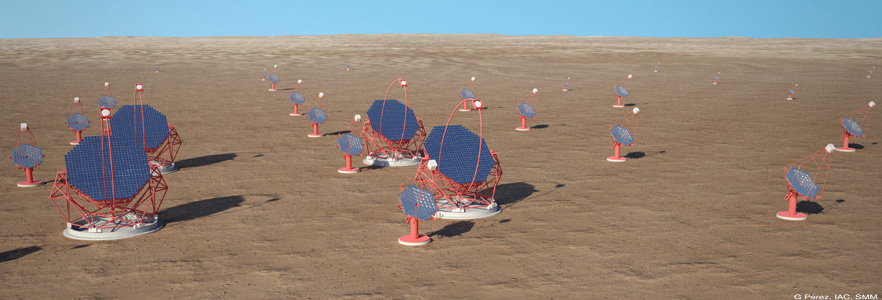
Concept illustration of Cherenkov Telescope Array

Where will the world’s next generation ground-based γ-ray detector, the Cherenkov Telescope Array (CTA), be built? No one yet knows. But a panel of funders have narrowed the field slightly, following a meeting in Munich, Germany, this week.

Scientists had originally hoped to select two sites — a large one in the Southern Hemisphere and a smaller one in the North — by the end of 2013. But the selection process for the €200-million ($276-million) project has taken longer than originally foreseen.

At a meeting on 10 April, representatives from 12 government ministries narrowed the potential southern sites from five to two: Aar, a site in Southern Namibia; and Armazones, in Chile’s Atacama desert. They also picked a reserve site in Argentina.

The committee, a panel of representatives from Argentina, Austria, Brazil, France, Germany, Italy, Namibia, Poland, Spain, South Africa, Switzerland and the United Kingdom, decided that all four possible northern sites — in Mexico, Spain and the United States — needed further analysis. A statement from the board said that a final site decision will happen “as soon as possible”.

If the CTA is built, its two sites will contain around 120 telescopes, which will look for the faint blue light emitted when very-high-energy photons slam into Earth’s atmosphere and create cascades of particles. By triangulating the data from various detectors, astrophysicists hope to piece together the energy and path of such photons. This should help them not only identify the sources of the γ-rays — extreme environments such as supermassive black holes — but also answer fundamental questions about dark matter and quantum gravity.

Like many astronomy projects, the best site for the CTA would be a high-altitude, remote location with clear skies. But the site decision must also take into account environmental risks, such as earthquakes and high winds, and projected operational costs. How much each host country would be prepared to contribute is also a factor.

Last year, an evaluation by representatives of the CTA’s 1,000-strong consortium rated Aar in Southern Namibia as the best southern site, which would contain 99 telescopes spread out over 10 square kilometres. Two sites tied for second: another Namibian site, which already hosts the High Energy Stereoscopic System (HESS) γ-ray telescope; and Armazones, where the European Southern Observatory already has a base and plans to build the European Extremely Large Telescope. The group equally ranked the four contenders for the northern site, which would be a 19-telescope array spread out over one square kilometre. Mexico is already building the High-Altitude Water Cherenkov Observatory (HAWC),  a γ-ray observatory of different type.

Although the consortium’s ranking was based largely on the science case and observing conditions, the latest decisions follows the report of an external site selection committee, which also took into account political and financial factors. Further decisions will rest on detailed negotiations, including host country contributions and tax exemptions at the various sites.

The CTA now aims to pick a final southern site by the end of the year. Board chair Beatrix Vierkorn-Rudolph, of Germany’s Federal Ministry of Education and Research, told Nature it was not yet clear whether the same will be possible for the northern site.