UK launches space weather forecast centre

The UK officially opened its first space weather forecasting centre this week.

Funding for the Met Office Space Weather Operations Centre, based at the organisation’s headquarters in Exeter, was announced by the government late last year.
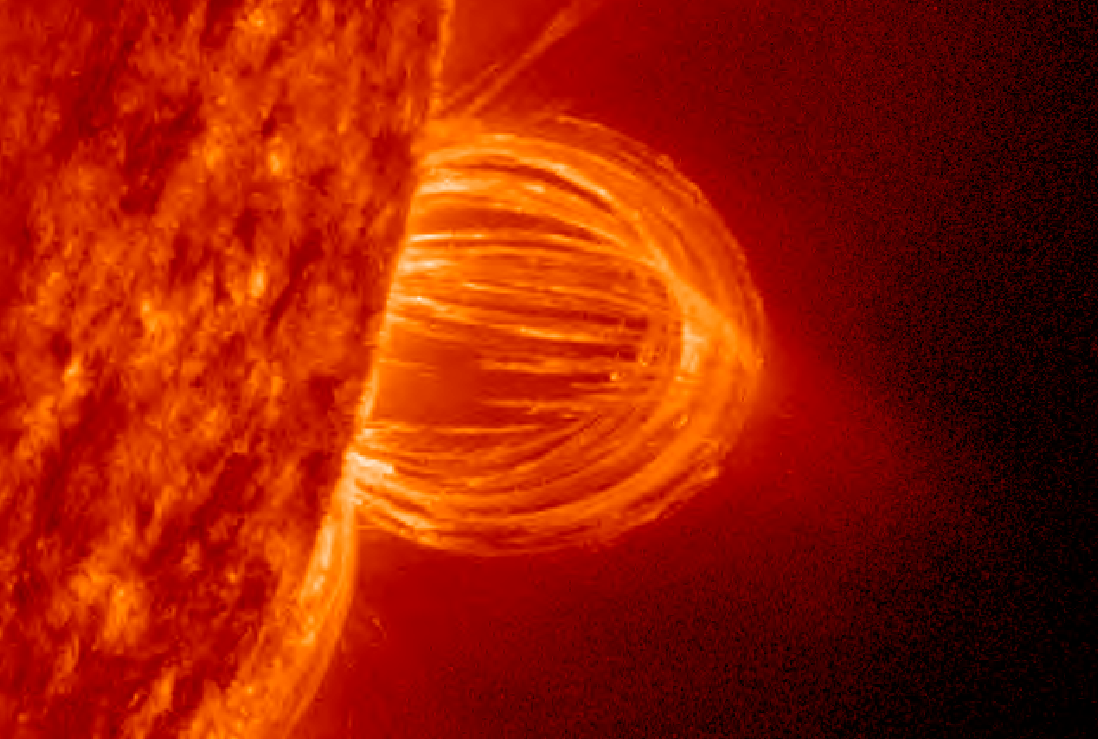
Solar flare July 2012

{credit}NASA/Royal Observatory Belgium/SIDC{/credit}

Since May the centre has been operating 24/7, ahead of its public launch on 8 October. As well as giving early warning of space weather threats to critical infrastructure, such as the National Grid, the Met Office now also provides publicly-available forecasts, published on its website.

‘Space weather’ is a term which covers how radiation and high-energy particles, ejected from magnetic storms in the Sun, interact with Earth’s magnetic field and impact terrestrial technology. Severe space weather can knock out satellite communications and disrupt global positioning systems (GPS) and power grids.

The centre came about following three years of discussion between the Met Office and its US counterpart, the National Oceanic and Atmospheric Administration’s National Weather Service, based in Boulder, Colorado, which was keen to establish a backup for their Space Weather Prediction Center (SWPC).

To determine how soon a solar event will be felt on Earth, forecasters at the SWPC and Met Office will use the same models, based on data from the same spacecraft. But by running the models at slightly different times, forecasters will be able to compare the results and generate a more accurate picture, says Catherine Burnett, space weather programme manager at the Met Office.  The UK’s centre will also use different ground-based data to hone its forecasts for the UK, she adds.

Speaking ahead of the official launch, Laura Furgione, deputy director at NOAA’s National Weather Service, said that accurately predicting and preparing for the impacts from space weather required “a commitment similar to terrestrial weather forecasting and preparedness”.

Where to land on a comet?

Philae_candidate_landing_sites

Philae will aim for one of five sites on Comet 67P/Churyumov-Gerasimenko when it lands in November
{credit}ESA/Rosetta/MPS for OSIRIS Team MPS/UPD/LAM/IAA/SSO/INTA/UPM/DASP/IDA{/credit}

Spare a thought for scientists on the European Space Agency (ESA) Rosetta mission, who will spend this weekend dissecting the ins and outs of five patches of land on a comet 440 million kilometres away.

They will be selecting a landing spot for the washing-machine-sized robotic probe Philae. On 11 November they plan to land the 100-kilogramme probe on 67P/Churyumov-Gerasimenko, in what will be the first ever attempt to soft land on a comet.

Picking the site will be a trade-off between scientific interest and operational safety — based largely on data from Rosetta’s instruments that are just weeks old, taken since the spacecraft caught up with its target on 6 August. High-resolution visible range, ultraviolet and temperature maps of the rubber-duck shaped comet, and data on the pressure and density of gas around the nucleus, already make the comet the most studied in history, says Rosetta project scientist at ESA, Matt Taylor.

At a meeting this weekend at the French National Centre for Space Studies (CNES) in Toulouse, scientists will debate the pros and cons of five shortlisted sites, three on the duck’s head and two on its body (see picture), selected last month. None are perfect, says Taylor. “There isn’t a great spot there. We’re going to have to pick the best of what we can achieve.”

Uncertainties in Rosetta’s navigation near the comet, as well as the distance from which it must release Philae, mean that the smallest spot the scientists can specify to land in is an ellipse with an area of 1 square kilometre. To maximize the chances of a safe landing, engineers will want the site to be as flat and smooth as possible, as well as somewhere on the comet that is feasible to reach, given safe orbits for Rosetta.

To thrive once there, Philae will need the spot to have just the right amount of daylight to power the lander’s solar panels and recharge its batteries. This means at least 6 hours per 12.4-hour comet rotation, but constant sunlight will cause the craft to overheat, says Mark McCaughrean, senior science adviser at the ESA directorate of science and robotic exploration.

Scientific interest is also balanced in the landing-site trade-off. Philae is armed with an on-board chemistry laboratory and instruments that allow it, in conjunction with Rosetta, to use radio waves to map the interior of the comet. Scientists will want to land Philae where they can use these instruments to learn the most.

Site A, for example, is scientifically exciting as it gives a view of both the head and body section, between which most of the comet’s gas is being produced.  Site J has advantages for radio mapping the nucleus.  Site B seems to be a safer choice in terms of landing. The wide crater has already been nicknamed “the heliport” because of its flatness, says Stephan Ulamec, Philae lander manager at the German Aerospace Center (DLR).

After examining the case for each, the lander team and Rosetta scientists will announce their favourite, and a backup, in Paris on Monday 15 September at 11 a.m. local time.

Rosetta is currently in orbit just under 30 kilometres from the comet’s surface, caught within its gravitational field. In the coming weeks, depending on the amount of gas and dust the comet releases, Rosetta will try to creep into closer orbits, taking pictures from as low as 10 kilometres, to best prepare for the landing in November.