Geologists face off over Yukon frontier

Posted on behalf of Alexandra Witze. 

The walls of the Geological Survey of Canada’s Vancouver office are, not surprisingly, plastered with maps. There’s one of the country of Canada, one of the province of British Columbia, and even a circumpolar Arctic map centered on the North Pole.
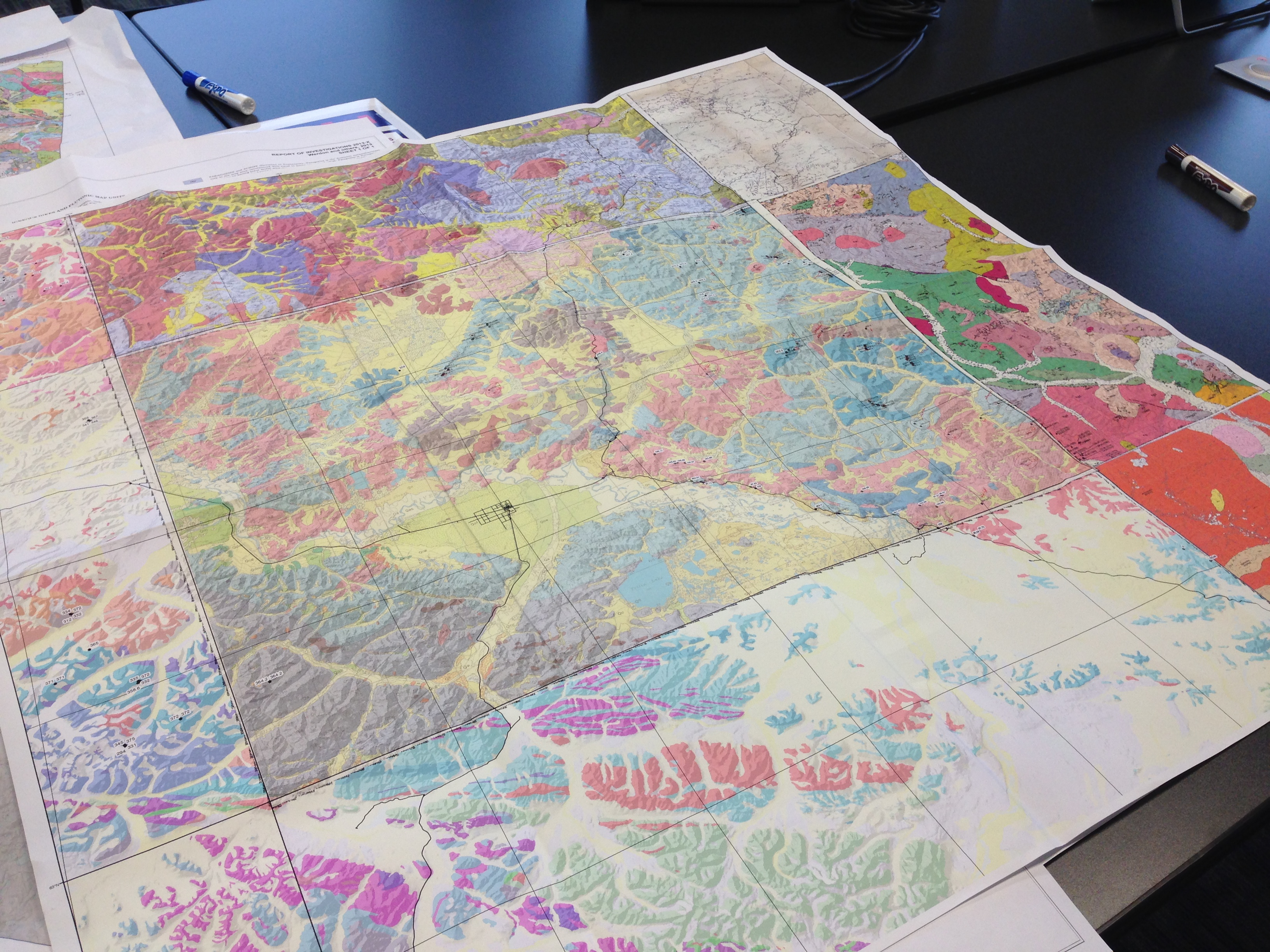
IMG_1626

The Klondike schist of Canada (shown in green) stops at the border with the United States. {credit}Alexandra Witze{/credit}

All display that distinctive rainbow mélange so typical of professional geologic maps. Each major rock formation is represented by its own colour, so that pinks and purples and yellows swirl in great stretches representing mountain ranges, coastal plains, and every conceivable landscape in between.

But lying on the table of the survey’s main conference room is a much more problematic map. It shows part of the far northern boundary between the United States and Canada, along a stretch between Alaska and the Yukon territory. And the two sides, on either side of the international border, do not match.

It’s not a question of Canada using one set of colours for its map and the United States using another. The geology simply does not line up. To the east, Canadian mappers have sketched a formation called the Klondike schist, which is associated with the gold-rich rocks that fueled the Klondike gold rush in the late 1890s. To the west, US maps show nothing like it.

“We don’t know why,” says Jamey Jones, a geologist with the US Geological Survey (USGS) in Anchorage, Alaska. “We have got to figure out why these aren’t matching.”

He and two dozen scientists from both sides of the border — but clad equally in plaid shirts and hiking boots — met in Vancouver on 20 October to try to hammer out the discrepancies. For two hours they compared mapping strategies, laid out who needed to explore what next, and swapped tips about the best ways to get helicopters in the region.

The last frontier

At one level, the differing maps are a relatively minor academic point to sort out. Such glitches are fairly common whenever geologists have to match one ‘quadrangle’ mapped from one era or with one technique against another from a different time. And it’s not unusual for geology to not quite line up across international borders.

But American and Canadian geologists have reconciled their maps along nearly the entire northern stretch where Alaska and the Yukon meet, says Frederic “Ric” Wilson, a geologist with the USGS in Anchorage. This last bit is the only one that does not match — and it may well be because the Canadian maps are four years old, while the American ones are four decades old.

The US maps stretch back to the days of legendary geologist Helen Foster, who mapped large parts of Alaska after making her name as a post-war military geologist in former Japanese territories. “With her, you walked every single ridge,” recalls Wilson. “Every single ridge.”

All that walking produced maps of huge stretches of the remote Alaskan landscape. They include the 1970 quadrangle map now in question, which abuts a much newer Canadian quadrangle to the east. Together the maps span part of a massive geological feature known as the Yukon-Tanana Terrane, a collection of rocks caught up in the mighty smearing crush where the Pacific crustal plate collides against North America.

The Canadian side of the map is in good shape. Prompted in part by intense mining interest, geologists there have mapped the Klondike in modern detail.  “I’m willing to integrate any piece of data that comes in,” says Mo Colpron, a geologist with the Yukon Geological Survey. “If you guys come up with things that affect how our side of the border works, then we can sit down and talk and try to mesh it.”

That leaves the burden of work on the US side, to update the Foster maps. “The reconciliation project is what it’s called,” says Rick Saltus, a geologist with the USGS in Denver, Colorado, who served as meeting emcee. “We’re taking a three-year look at cross-border tectonic connections, because things look a little different from one side to the other.”

This summer, Jones and his colleagues hired a helicopter to take them everywhere the Foster maps ran up against the Klondike formation. “We’ve seen a lot of rocks we didn’t anticipate seeing,” he says. That data will go into the new and improved US maps.

There is, however, only so much scientists can do. Citing border regulations, Jones says, the helicopter pilot was unwilling to take them just a tiny bit over into Canada so they could see the geology on the Yukon side.
Australia puts science in ‘competitiveness’ drive

ian-macfarlane_0

Minister for Industry Ian Macfarlane
{credit}Australian Department of Industry{/credit}

The Australian government has unveiled plans to increase the commercial return on its billions in research funding and to pump more resources into boosting industry-science links.

The government appointed ten experts — five business leaders and five leading researchers — to a ‘Commonwealth Science Council’ to advise on science priorities and to become the “pre-eminent body for advice on science and technology” in Australia, according to the ‘competitiveness agenda’ released on 14 October.

The council will be chaired by Prime Minister Abbott, with Industry Minister Ian Macfarlane as deputy chair. It will replace an existing (and some say moribund) advisory group.

The statement also says that there will be a “sharpening” of incentives for collaboration between research and industry. Five new centres to improve collaboration, and increase the competitiveness of industries including mining, oil and medical technologies, will be set up at a cost of Aus$188.5 million (US$164 million).

The Abbott government has come in for fierce criticism over its perceived lack of support for science, with many government-funded researchers and science agencies facing cut backs (see ‘Australian cuts rile researchers’). Macfarlane has previously said that the competitiveness agenda would show how the government was dealing with these concerns, by setting science at the centre of industry policy.

Australia’s chief scientist Ian Chubb said that the new council would “provide the strategic thinking and direction that a national transformation truly demands” and also welcomed an Aus$12 million investment in science education. “This is about improving the impact, focus and prioritisation of Australia’s investment in science and research,” he said in a statement.

The Australian Academy of Science also welcomed the announcements. Its secretary of science policy Les Field said in a statement: “Anything which aligns science more closely with industry has got to be a big plus, especially when this is an area where Australia traditionally struggles.”

Proposed EU research commissioner answers to Parliament

15399438462_336b4d5e5a_h

Carlos Moedas fielded some 50 questions from members of the European Parliament regarding his nomination to research commissioner.
{credit}© European Union 2014 – European Parliament{/credit}

UPDATE 22 October:  the European Parliament has now approved the new commission with 423 votes in favour, 67 abstentions and 209 votes against. Ahead of the vote, European Commission president Jean-Claude Juncker announced that, in response to concerns expressed by the Parliament, responsibility for medicines and pharmaceuticals would remain with the Directorate-General for Health, rather than move to Directorate-General for Enterprise as originally proposed. Carlos Moedas will begin his five-year term of office on 1 November alongside the rest of the new Commission.

Carlos Moedas, the man designated to be the European Union’s next research commissioner, got his three-hour hearing by the European Parliament today, giving the continent’s scientists their first opportunity to learn about him.

The parliament is this week interrogating all 27 members of the new Commission proposed by its president Jean-Claude Juncker earlier this month. Hearings focus on nominees’ skills and qualifications for their posts, as well as on their commitment to the European Union and personal integrity. The Commission is due to take office next month, but the European Parliament has the right to reject the line-up if the hearings go badly.

Moedas, a 44-year old economist and politician who began his career studying engineering, is a little-known name outside his native Portugal. Neatly turned out at his hearing, he was courteous and proved competent and well-prepared — in addition to switching fluently between English, French, Spanish and Portuguese.

Responding to 50 or so questions, he showed himself knowledgeable on issues ranging from shale gas, to genetically-modified organisms, to antibiotic resistance. He declared himself a strong believer in the value of basic research in driving innovation.

Moedas ticked all the politically correct boxes. He spoke in favour of the sharing of scientific data and intellectual property, and decried the gender gap in research, which he described as a waste of resources.

He cast himself as a dedicated European – the only question he claimed not to be able to answer had been put by a Eurosceptic MEP — and as a consensus-building, goal-oriented team player. He also professed his dedication to implementing the EU’s €80 billion, seven-year Horizon 2020 research programme.

If the parliament approves the Commission line-up, Moedas’s challenge will be to make his mild and rational – and decidedly non-charismatic – approach an effective one.


Nobel laureates call for release of Iranian physicist

Posted on behalf of Michele Catanzaro.

Golfer_UnlockIran_JR_095.jpg

Omid Kokabee (pictured at left) was among 13 Iranian prisoners featured in an exhibition across from the United Nations in New York in February.
{credit}Unlock Iran{/credit}

[Update 14 October: An Iranian court has granted Kokabee a retrial, according to the International Campaign for Human Rights in Iran.]

Eighteen Physics Nobel laureates have signed an open letter addressed to Iranian Supreme Leader Ali Khamenei, calling for the release of Omid Kokabee, a 32-year-old physicist who has spent the last 3 years and 8 months in a Teheran prison.

The letter is a joint initiative by Amnesty International; the Committee of Concerned Scientists (CCS), an international human-rights organization headquartered in New York; and the Committee on the International Freedom of Scientists of the American Physical Society (APS), based in College Park, Maryland.

In January 2011 Kokabee, who at the time was a PhD student at the University of Texas in Austin, was arrested during a visit to his native Iran. He was later sentenced to 10 years of jail on charges of ‘communicating with a hostile government’.

Kokabee denied all charges in an April 2013 open letter, in which he claimed that his jailing was an attempt to pressure him into collaborating with a military research project (see ‘Iranian says he was jailed for refusing to engage in military research‘). Kokabee’s research included work on a type of laser that could be used in nuclear enrichment.

The Nobel laureates’ letter describes the accusations as “spurious charges related to [Kokabee’s] legitimate scholarly ties with academic institutions outside of Iran”. It also urges Khamenei “to exhibit compassion and allow him to return to his studies”.

Eugene Chudnovsky, the co-chair of the Committee of Concerned Scientists, says that the letter’s release has been timed to coincide with Iranian president Hassan Rouhani’s visit at the United Nations (UN) in New York, where on 25 September he addressed the UN General Assembly.

Earlier this month, the CCS has said that Kokabee’s health conditions have worsened, and that he was allegedly being denied medical care.

Kokabee has received sustained support from the international scientific community since Nature first covered his case in the West. In 2013, he was awarded the APS Andrei Sakharov Prize, which recognizes scientists who promote human rights. Amnesty International declared him to be a prisoner of conscience last year.

In March Kokabee submitted a paper to the physics preprint archive, signed from Teheran’s Evin jail. He has also submitted several contributions to local and international optics conferences, among them the 2014 Conference on Lasers and Electro-Optics (CLEO), which took place in June in California. Although some of these papers were accepted, he was allegedly denied permission to leave the jail temporarily to attend any of those conferences.

The Nobel laureates who signed the open letter are Alexei Abrikosov, Nicolaas Bloembergen, Claude Cohen-Tannoudji, Leon Cooper, Andre Geim, Sheldon Glashow, John Hall, Anthony Hewish, Wolfgang Ketterle, Klaus von Klitzing, Toshihide Maskawa, John Mather, Konstantin Novoselov, Arno Penzias, David Politzer, Jack Steinberger, Daniel Tsui and James Cronin.

Economist and lawyer nominated for key science-related EU posts

Untitled

Carlos Moedas
Courtesy EC

UPDATE 22 October:  the European Parliament has approved the new commission with 423 votes in favour, 67 abstentions and 209 votes against. Ahead of the vote, European Commission president Jean-Claude Juncker announced that, in response to concerns expressed by the Parliament, responsibility for medicines and pharmaceuticals would remain with the Directorate-General for Health, rather than move to Directorate-General for Enterprise as originally proposed. Carlos Moedas and Miguel Arias Cañete will begin their five-year term of office on 1 November alongside the rest of the new Commission.

Portuguese economist Carlos Moedas has been nominated as new European Union commissioner for research, science and innovation. Spain’s Miguel Arias Cañete, a lawyer, has been nominated as commissioner for energy and climate change.

Commission president Jean-Claude Junker announced the two nominations, along with those of the 26 other commissioners, on 10 September.

The commission has to be approved by the European Parliament before taking office on 1 November, and this may not be a shoo-in. In 2007 the Parliament exercised this veto right because it disapproved of one proposed commissioner, and the commission president had to submit a new line-up.

Untitled2

Miguel Arias Cañete
Courtesy EC

Arias Cañete’s appointment in particular could prove controversial. Parliament might ask him to prove that he is not sexist — despite his widely publicized comments during a debate earlier this year in which he expressed his difficulty in politically challenging a woman for fear of “cornering” someone defenceless.

The new research commission will oversee the progress of the European Union’s €80-billion (US$103-billion) Horizon 2020 research programme, which launched this year.

Additional reporting by Elizabeth Gibney.


US Department of Energy frees up access to research

The US Department of Energy (DOE) has revealed today how papers from research it funds will become free to read, making it the first federal agency to respond to new standards for open access and data-sharing ordered by the White House 18 months ago.

The plans mean the DOE will be releasing up to 30,000 papers annually from behind paywalls, although the directive from the White House’s Office of Science and Technology Policy (OSTP) says that papers need not be made free until a year after publication. The plans come a week after the DOE’s announcement that its researchers should openly share the data from papers they publish.

Open-access advocates have welcomed the plan but say that it is vague and disappointing on some key points. For example, it seems that ‘free’ manuscripts may not be legally open to bulk downloading, re-distribution and re-use for creative purposes such as text mining, even though the OSTP directive had hinted otherwise.

“The DOE’s plan takes steps towards achieving the goals of the directive, but falls short in some key areas,” says Heather Joseph, executive director of the Scholarly Publishing and Academic Resources Coalition (SPARC) in Washington DC. “We don’t want to end up in a ‘read-only’ world of US science articles,” she adds.

Continue reading

NIH advocates gear up for budget fight

The US National Institutes of Health (NIH) would see its budget worries eased if a long-time political champion gets his way.

Senator Tom Harkin, the Iowa Democrat who leads the Senate panel that oversees the NIH, introduced legislation on 24 July that would ensure that the NIH’s budget never drops below its current US$29.9 billion. The bill also proposes that Congress increase the NIH’s budget by up to 10% for the next two years, and 5% each year for the next five years. By 2021, the agency’s budget would rise to $46.2 billion.

The legislation is unusual in that it sets a minimum level for NIH funding regardless of the government’s total budget for a given year. That approach could pit the NIH against other agencies when money is scarce, a scenario that some agency supporters worry is not so hypothetical. A 2011 law known as the Budget Control Act caps total government spending to 2021 (although the caps have since been relaxed for 2014 and 2015).

The Harkin bill would allow increases for NIH beyond this cap. Some advocacy groups say that NIH is not the only biomedical agency that is in need of a boost. “The painful effects of austerity span beyond NIH across the entire health continuum,”  Emily Holubowich, senior vice-president of the Coalition for Health Funding wrote to Nature. “We support a balanced, comprehensive, permanent solution to end this era of austerity for all public health and core government functions.”

The legislation’s future is uncertain, however. Harkin is retiring at the end of this year, and Congress is working on a schedule shortened by the federal election in November. Lawmakers are not expected to finish work on a funding plan for the 2015 budget year — which begins on 1 October — until after the election.

Scientists praise outgoing UK science minister

david_willetts_national_science_week

An undated picture from davidwilletts.co.uk.

Update: Conservative MP Greg Clark will replace David Willetts as minister for universities and science. 

UK universities and science minister David Willetts resigned from his role on 14 July as part of a cabinet reshuffle.

A replacement has yet to be announced for the popular minister — known as ‘two brains’ because of his reputed intellectual abilities — who has served in the role since 2010. Willetts is reported to also be standing down as member of parliament for Havant at the coming election.

Leading voices from the UK scientific community were quick to praise Willetts.

“David Willetts is one of the UK’s sharpest and most talented politicians; we’ve been extraordinarily privileged to have him as the UK’s science minister for the past four years,” said Imran Khan, chief executive of the British Science Association and former director of the Campaign for Science and Engineering, in a statement.

“We in the science sector like to moan about there not being enough scientists in Parliament, but it was obvious from early on that Willetts — despite not having had much to do with science previously — developed a genuine passion for the subject. You’d be hard-pressed to find many in our sector who have a bad word to say about him,” he added.

Under his watch, science received a static £4.6-billion (US$7.9 billion) budget in 2010’s austere spending review, seen as such a good settlement at the time that it earned the new minister a bouquet of white lilies and roses from one awaiting journalist.

In-depth knowledge of his brief and advocacy for science mean Willetts has remained popular throughout his term. This is despite a rising clamour around the impact of the ‘flat cash’ budget — which inflation is set to erode by an estimated £1 billion by the end of 2015–16 — as well as the instability caused by slashing and rebuilding piecemeal of infrastructure spending.

The president of the Royal Society, Paul Nurse, said in a statement that Willetts had been “an outstanding science minister, respected not only in the UK but throughout the world”.

John Womersley, head of the Science and Technology Facilities Council, one of the government’s main research spending bodies, said he hoped the minister’s departure would not in any way compromise the government’s recent commitment to spend £1.1 billion in capital investment annually, rising with inflation.

Willetts’ personal impacts on science policy in the United Kingdom included a push towards open access, the drafting of a list of ‘eight great technologies’ that became the focus of capital and industry spending, as well as a beefing up of the government’s innovation body, the Technology Strategy Board.

The minister will also be remembered within the higher education sector for raising the cap on student tuition fees to allow most universities to charge £9,000 a year.

The reshuffle has been widely seen as a move by Prime Minister David Cameron to promote a new generation of Conservative politicians, especially women, into senior positions ahead of the 2015 election. Also quitting the cabinet are Tory stalwarts foreign secretary William Hague and justice secretary Kenneth Clarke.

Liz Truss has been appointed as secretary of state for environment, food and rural affairs, and Nicky Morgan has been brought in as secretary of state for education.

NSF bill with dire implications for social sciences moves forward

Posted on behalf of Jessica Morrison.

A key US House of Representatives committee approved legislation on 28 May that recommends steep cuts to US National Science Foundation (NSF) social-science funding and controversial changes to the agency’s grant-making process.

The bill, authored by House Science, Space, and Technology Committee chairman Lamar Smith (Republican, Texas), seeks to reduce funding for NSF’s social, behavioural and economic sciences division by 22% in fiscal year 2014, to US$200 million. For fiscal year 2015, the bill recommends just $150 million.

It would also alter how the agency awards its grants, requiring the NSF to certify that the research that it funds is in the “national interest”.

Those provisions and others that would place new restrictions on NSF’s grant-making have spurred protests from the broader scientific community and concern from the National Science Board, which oversees the NSF. In an unusual 24 April statement, the board said it was concerned that “Congress intends to impose constraints that would compromise NSF’s ability to fulfill its statutory purpose”.

As an ‘authorization bill’, the legislation would not set the NSF’s budget. But it is intended to steer the agency’s priorities and recommend non-binding funding levels for its programmes. In an unusual twist, the authorization bill recommends less for the NSF in 2015 — $7.28 billion — than the $7.4 billion contained in a 2015 funding measure that the House is expected to approve this week.

“I’ve never seen anything like this,” says Michael Lubell, director of public affairs for the American Physical Society in Washington DC. Authorization bills typically offer grand proposals, he notes, while spending bills are considerably more conservative.

The authorization measure’s future prospects are uncertain. It is not clear whether the full House of Representatives will vote on the measure before Congress adjourns for the year. And the Senate committee that oversees the NSF has not introduced an authorization bill of its own. And any proposal from the Democratic-controlled Senate is likely to be quite different from the bill now moving through the Republican-controlled House.

“There’s a big question mark about whether there are enough votes [for the bill] to make it out of the House,” says Wendy Naus, executive director of the Consortium of Social Science Associations in Washington DC. “It doesn’t stand a chance in the Senate.”

WHO postpones decision on destruction of smallpox stocks — again

The stalemate continues over the question of when to destroy the last stocks of the virus that causes smallpox, a killer disease that was eradicated in 1980. One of the World Health Organization’s (WHO) two advisory committees on smallpox supports the stocks’ destruction, and the other opposes it. Last weekend, health ministers of the WHO’s 194 member states again postponed a decision and decided to set up a third WHO smallpox advisory committee in a bid to broker a consensus.

The issue came up again on the agenda of the annual meeting of the World Health Assembly, the WHO’s top decision-making body, which was held in Geneva, Switzerland, from 19 to 24 May. It was last discussed at the 2011 assembly, which reaffirmed that the stocks of the variola virus should be destroyed but deferred to this year’s meeting discussion on any date of destruction.

A central question remains whether research of public-health importance is still needed on the virus, or whether the last stocks should be destroyed to eliminate the threat of an accidental release from the two labs where they are held — at the US Centers for Disease Control and Prevention in Atlanta, Georgia, and the Russian State Research Center of Virology and Biotechnology in Koltsovo, near Novosibirsk.

The final agenda of this year’s meeting, however,  asked ministers only to take note of a WHO update report to the assembly on progress on completing needed research. The WHO’s ‘advisory committee on variola virus research’ (ACVVR), which oversees and approves any research using the stocks, felt that live virus was no longer needed to develop diagnostics and vaccines, but was still needed to develop antiviral drugs. By contrast, its ‘advisory group of independent experts to review the smallpox research programme’ (AGIES) felt that there was no research justification for holding on to the stocks.

Although the ACVVR reached a consensus on antivirals, there was considerable debate about this among its members. Some argued, for example, that with two promising drugs — tecovirimat and brincidofovir — close to licensing, virus stocks were no longer needed. Others felt that the virus should be kept in case these drugs failed to get licensed, requiring the development of other compounds.

The AGIES considered the same issues but swung towards virus being no longer needed to develop antivirals — it also suggested that should a future need arise to develop new drugs, live virus could in any case be recreated from viral DNA. The ACVVR is often perceived as being more focused on research interests, and the AGIES on public-health aspects.

By the time the WHO assembly got to discussion of destruction of smallpox stocks, it was near the end of the last day of the meeting. It quickly became clear that there were sharply divided opinions and no consensus, according to Glenn Thomas, a WHO spokesman. The decision to setup a third expert group is intended to bring together a mix of scientists and public-health and other experts to review all the elements of the debate and take the issue forward, says Thomas.

For the moment, the precise terms of reference of the group, or its composition, have yet to be decided. The latter will be important, as the destruction of the variola stocks is also a political issue. The United State is strongly opposed to destruction of the virus stocks, largely because — like many other developed countries — it wants to pursue research that it believes might help to protect against a bioweapons attack by rogue states or terrorists, who may have access to undeclared stocks (see ‘WHO to decide fate of smallpox stocks‘).

Some scientists are also keen for smallpox research using live virus not to be stopped, but continued and expanded. Two members of the ACVVR, Clarissa Damaso, of the Federal University of Rio de Janeiro in Brazil, and Grant McFadden, of the University of Florida in Gainesville, have argued, for example, that the WHO’s restricting of smallpox research to tightly circumscribed public-health applications has limited fundamental research that could advance public health. In an opinion piece published 1 May in the journal PLoS Pathogens, along with Inger Damon, head of the poxvirus and rabies branch of the Centers for Disease Control and Prevention in Atlanta, Georgia, they argue that: “the research agenda with live variola virus is not yet finished and that significant gaps still remain”.

But the majority of the health ministers of the WHO member states — including those of many poorer countries, who view the risks of an accidental release as outweighing any research benefits — want the stocks of virus destroyed at some point. The question for the WHO assembly is, as always, when? But yet again, it has kicked that can down the road.