A Super SoNYC Birthday

Everyone at last week’s SoNYC event was in a celebratory mood. After we toasted with our festively decorated cupcakes, the floor was turned over to members of the audience to present tools and apps that help them do or communicate science. In addition to the tools and apps presented at the SoNYC event, check out our list of #ToolTales over at Soapbox Science.

Here’s a rundown of last weeks’s presenters:

First up was Richard Wing of Project Bourbon. Frustrated with the lack of clear, effective images and charts to explain scientific ideas, Wing decided to make his own.

Check out their submission to Alan Alda’s flame challenge on their Facebook page.

Project Bourbon is still in its infancy and looking for people to help out with creating content and designing the infrastructure and organization for this future tool. If you’re interested in helping out or in learning more about Project Bourbon, check out their Facebook page or follow them on Twitter: @ProjectBourbon1.

"This should be your home page" - Bora Zivkovic

With all the great science blogs out there and all the blogs out there that don’t have anything at all to do with science, how can one person possibly find the time to sift through them all? As Bora Zivkovic of Scientific American explained, you don’t have to. ScienceSeeker will aggregate posts from science blogs that have been approved and vetted by members of the science blogging community, so you’re sure not to run across someone’s Friday night cat pics.

AstroBetter

Kelle Cruz gave us an intro to her website – Astrobetter – a LifeHacker-esque site geared towards astronomers, but with topics that most scientists would find useful, such as being yourself during an interview, how to speak well in front of others, and whether QR codes are useful for scientific posters.

Pat Gordon and Ashlee Bennett, two graduate students at Columbia University, started Biochemistry Revealed to help scientists explain their research around the Thanksgiving day table. With podcasts and blog posts like “We sequenced the human genome!…now what?” and “Proteins – more than just a good steak”, Biochemistry Revealed is geared toward your average armchair scientists who needs a refresher course in some of the basic concepts of chemistry and biology.

Scienceline is a website featuring the work of NYU students. Rose Eveleth talked about her experience in helping create a Scienceline iPad app. One of the most important things for building an app? Knowing how to use an iPad. Also important was knowing how to differentiate the Scienceline app from the website. For Eveleth, that meant adding special extras and bonus features to the app that the website didn’t have.

The Atavist

The Atavist is an online multimedia magazine that publishes nonfiction stories. However, Olivia Koski gave us the inside scoop into how the Atavist is branching out into becoming a general publishing platform that anyone can use to publish their stories. They are currently looking for beta testers. So, check out their website and see how you can help.

Kendra Snyder, from the American Museum of Natural History, gave us a demonstration of one of the cool apps that AMNH is using to help get people involved and excited about its exhibits. In the app for the exhibit “Beyond Planet Earth”, visitors hold an iPad over icons place throughout the exhibit. The iPad sees the icon through its camera and creates a 3D, interactive image the corresponds to the image, such as the moon, the solar system, and even a lunar elevator.

Contextly

Contextly is a plugin for WordPress created by Ryan Singel of Wired. Contextly helps writers and publishers link their articles to related content.

Science@Columbia

In an attempt to coalesce all the great science being done at Columbia University, Jeff Lancaster created the Tumblr page Science@Columbia. The goal is to build bridges between different departments at Columbia that may otherwise operate independently and provide a cohesive resource for non-Columbia-nites who want to know what kind of science is done there. Check it out for the Secret Science Club events, recently published articles, and current science news.

Musa Akbari, founder of Meritocracy, offered his view of of cloud-reviewed publishing platform. Read Musa’s #ToolTale here to hear more about his idea for Meritocracy.

Science Exchange

What do scientists do when they need an experiment done but don’t have the tools or know-how to do it themselves? Well, as Jeanne Garbarino explained, they can check out Science Exchange, an online science marketplace that connects experiment providers with scientists who need to get experiments done.

Wikipedia

While Wikipedia may not be exactly new, Lane Rasberry, Wikipedian in Residence at Consumer Reports,  presented it in a whole new light. How does a science communicator reach millions of readers, publish on the largest publishing platform in the world, and have your words show up as the #1 hit on Google? Publish on Wikipedia.
Science Online NYC (SoNYC) – Setting the Research Record Straight: Recap

Whose responsibility is it to ensure integrity and honesty in the scientific record, and how have those roles been changing as technology and social media advance?

Those were just a few of the issues discussed at the SoNYC event, “Setting the Research Record Straight” held on Tuesday night at Rockefeller University. In addition to the live lecture, people attended the event via live streaming and joined in on Twitter using the hashtag #SoNYC. You can watch the video of the event here and view our Storify of tweets on Of Schemes and Memes.

The panel consisted of Liz Williams, Executive Editor at the Journal of Cell Biology, John Krueger of the Office of Research Integrity, and Ivan Oransky of Reuters Health and co-founder of the blog RetractionWatch. Much of the night’s discussion focused on image manipulation in scientific manuscripts, primarily because that is one of the easier types of misconduct to detect. In the age of electronic submissions, editors can scan and manipulate images to identify any signs of manipulation.

Liz Williams kicked off the evening with a discussion of how JCB approaches detecting image manipulation. Williams stressed that journals have a responsibility to detect as much manipulation as possible and part of that task consists of creating clear guidelines for authors on what type of manipulations are acceptable and what constitutes as deceptive or fraudulent actions. While almost 50% of authors who submit papers to JCB are asked to remake an image for whatever reason, only 1% of articles are revoked acceptance. This indicates that most unacceptable manipulation is likely due to a misunderstanding of what is and isn’t acceptable and ignorance, or incompetence in the tools used to create and modify images.

John Krueger followed with data from the Office of Research Integrity on the increasing number of retractions over the years. However, the increase in retractions doesn’t necessarily indicate that scientists are slipping or that actual levels of misconduct are increasing. Instead, Krueger speculated that the increasing transparency in science and advances in technology and communication make science more visible to the public and allow the public to scrutinize scientific research like never before. One pervasive theme among the discussions was the idea that a paper is not set in stone upon publication. Rather, it is constantly under “post-publication” review by the public and by other scientists. And when one of those papers is contested and potentially retracted, while the reliability of science isn’t likely to be affected, the perception of science in the public eye can be significantly harmed.

Krueger also followed up on Dr. Williams’ discussion on image manipulation in science. Krueger speculated that as images become more important in communicating scientific research, they not only make science more transparent but also make it easier to detect data manipulation. Another interesting point he brought up was that technology not only makes it technically easier to falsify and manipulate data, but it also removes some of the inherent checks and balances in science. Now, because data collection has in many ways reached a certain level of automation, one person could collect, process, analyze, interpret and potentially manipulate their data without receiving input from other experts on whether each step, from raw data to processed results, was appropriate. Perhaps scientists as a community need to revisit some of these checks and balances and find new ways to vet data during the analysis and interpretation stages.

Ivan Oransky closed the panel presentation by reminding us that, “We are all gatekeepers” (view his slideshow here). Oransky focused on the role of blogs and other “whistleblowers” in detecting dubious research. Blogs, he stated, are getting more aggressive in questioning the scientific literature and journals are starting to take them more seriously. However, as Dr. Krueger asserted, if the data is solid, they will quell any misgivings. Of course, that assumes that scientists hold onto primary data long after it is collected and published, which isn’t always the case.

Like Dr. Krueger, Oransky stressed that, after publication, a paper is still constantly under review. Oransky took that idea one step further, advocating that the communications resulting from that post-publication review, such as additions, disclaimers and concerns about the paper, should be a part of the scientific record. Services such as CrossMark are starting to do this, but it can still be difficult to know by retrieving a paper whether that paper has corrections associated with it or even whether it has been retracted. Oransky mentioned several other resources that have the potential to change the world of science publishing. For example, Nature Precedings, in which scientists can pre-publish manuscripts and data to receive feedback from the scientific community and Altmetrics, which is attempting to redefine the traditional impact factor by considering other types of citations in addition to citations in the peer-reviewed literature when assessing a paper’s impact or importance.

It was implied in most of the discussion that retractions are a result of bad science, whether or not there was an initial intent to deceive. However, as John Krueger pointed out, retractions are a healthy part of the scientific process and a well-written retraction notice can contribute as much, if not more, to the advancement of science than the initial manuscript. And, as Liz Williams put it,

“If the goal is to preserve the integrity of the scientific literature, then retractions are a sign of progress.”


Science Online NYC (SoNYC) 10 – Setting the research record straight

On Thursday evening, we hosted the tenth instalment of the monthly Science Online NYC (SoNYC) discussion series. For this month’s event, the topic for debate was, “Setting the research record straight.”

The internet has enabled the faster and more thorough dissemination of published science, meaning that more eyes than ever are available to check the accuracy, veracity and integrity of the research record. With our enhanced ability to spot plagiarism and image manipulation electronically, it appears that the frequency with which we’ve flagged potentially fraudulent or plagiarized papers has gone up. This panel will look at the trends in retractions and how they relate to real or perceived increases in research misconduct. We hope to discuss what steps publications are taking to deal with the sloppy or fraudulent research practices that sometimes result in retractions, and also what research institutions are doing to investigate and deter such practices. Is the system broken, and what can researchers do to help fix it if it is?

Preparing for the event 

In anticipation of the discussion, we ran a series of guest posts here on Of Schemes and Memes, discussing what steps publications are taking to deal with fraudulent research practices and what is being done to investigate and deter such practices. First we heard from Richard Van Noorden, Assistant News Editor at Nature. He gave us an overview of  what retractions can tell us about setting the research record straight, highlighting some recent high profile cases of retraction, revealing why retraction rates appear to be increasing. We also compiled a Storify from a session at February’s AAAS meeting in Vancouver on Global Challenges to Peer Review which touched on some of the challenges faced by journal editors. Next we heard from Dorothy Clyde (Dot), Senior Editor at Nature Protocols, detailing the role an editor plays in avoiding plagiarism, giving advice to all parties. In our final post, SoNYC panel member Ivan Oransky, executive editor of Reuters Health, explained the concept behind the Retraction Watch blog.

This month’s panel:

  • John Krueger of the Office of Research Integrity.
  • Ivan Oransky, Executive Editor, Reuters Health and one of the people behind the Retraction Watch blog.
  • Liz Williams, Executive Editor, The Journal of Cell Biology.

To read what people on Twitter were saying about the event, check out our Storify of tweets at the bottom of this post.

Blog posts about the 10th #sonyc

Do let us know if you blog about the event and we’ll include a round-up of links here.

  • News Blog: The new gatekeepers: reducing research misconduct.
  • Boston Blog: Boston researchers (with experience) of correcting the scientific record #sonyc
  • NYC Blog: Science Online NYC (SoNYC) – Setting the Research Record Straight: Recap
  • Dana Foundation Blog: Setting the Research Record Straight

Live-streaming and video archiving

We live-stream each SoNYC event to give as many people as possible the chance to take part in the debate. Check out this month’s livestream, or take a look at our archives where you can view the previous meetings.

Finding out more

The next SoNYC will be held on the 2nd May – keep an eye on the SoNYC twitter account for more details and/or watch the #sonyc hashtag.

If you have a suggestion for a future panel or would be interested in sponsoring one of the events, please get in touch.

Upcoming Science Events in New York City 19 – 25 March

Here’s just a sampling of some of the science events going on in New York City this week:

Tuesday, March 20

What: SoNYC–On Setting the Record Straight 

Where: Rockefeller University

When: 7-10 pm

Cost: Free

How: Tickets are still available here. You can also follow the discussion online by watching the hashtag #sonyc, and be sure to check back here on Wednesday for our write-up of the event.

This month’s SoNYC event focuses on checking the accuracy and integrity of the research record. Panelists from the Office of Research Integrity, Reuters Health, and the Journal of Cell Biology will discuss trends in retractions and careless or fraudulent research is dealt with.

What: The American Museum of Natural History 2012 Isaac Asimov Memorial Debate: Faster Than the Speed of Light

Where: The American Museum of American History

When: 7:30-9:30 pm

Cost: Free

How: Tickets for the live lecture are sold out. Call 212-769-5200 for Simulcast tickets

Recent data from the LHC on faster than light neutrinos seemed to cast a shadow of doubt on Einstein’s well-validated Theory of Relativity. New evidence, however, suggests that these experiments may be flawed, and it appears that Einstein’s theory will hold up. Even if the neutrino data prove to be untrue, they have sparked a lot of discussion over how and when scientific data should be communicated and how no theory is too strong to test. This debate, moderated by Neil deGrasse Tyson will include six of the leading physicists in this subject.

Wednesday, March 21

What: Inspiring Women Scientists 2012

Where: The City University of New York (CUNY)

When: 9 am – 5 pm

Cost: Free

How: Registration for this event is closed

This event, held by the Feminist Press and the City University of New York Office of Research highlights several women and several different careers in science with the aim of supporting women students, faculty, and professionals in STEM areas. Check out Under the Microscope for profiles of the panelists and a write up of the event.

What: DNA Fingerprint Workshop

Where: Genspace NYC

When: 6 – 9pm

Cost: $70 Adults, $50 Students

How: Reserve a spot online here

The costs for this event is a bit steep, but it looks really cool. This is a three-hour workshop about DNA fingerprinting that goes into the basics of PCR and primer design. It’s a bit unclear to me whether you get to do any PCR and actually get any information on your own DNA fingerprint, which would be even cooler.

You can also find our calendar of science events in NYC here. Please let us know if there is anything missing.

March’s SoNYC: On setting the research record straight – What retractions tell us.

Richard Van Noorden, Assistant News Editor at Nature, gives us an overview of  what retractions can tell us about setting the research record straight. In his post he highlights some recent high profile cases of retraction, explaining why retraction rates appear to be increasing.

Up until the turn of this century, the research record shows that scientists hardly ever published work that was totally flawed: that is to say, so wrong that it needed to be retracted. Around the millennium, about 30 papers a year were being officially withdrawn; and so the total number of retractions in the scientific literature was admirably low.  In retrospect, suspiciously low. Was the literature ever really that clean?

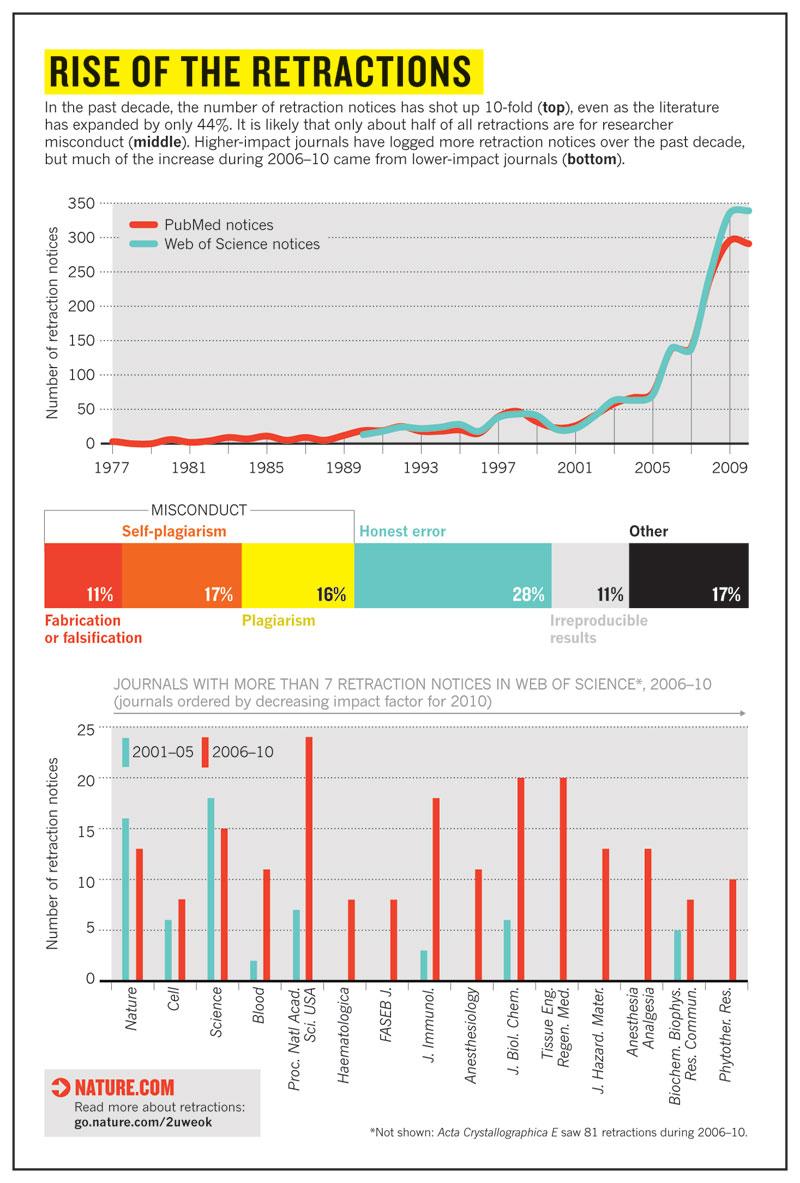
For suddenly, in the last ten years, retractions have shot up, rising ten- fold while the scientific literature expanded only 44%.  A blog, Retraction Watch, has monitored them over the past 18 months. Recent examples include prominent psychologist Diederik Stapel’s fraud  (particularly shocking because Stapel had such a stellar reputation); the dispute over whether or not chronic fatigue syndrome is linked to a virus ; and the scandal in which cancer geneticist Anil Potti’s flawed research led to patients being enrolled in clinical trials based on faulty data. Those are the ones that made headlines – but as Retraction Watch and Neil Saunders’ live feed of retraction notices on PubMed show, rarely a day goes by where a paper is not being withdrawn. The new norm nowadays is to expect hundreds of retractions, and perhaps that number will continue to rise.


The fraction of papers retracted is still utterly miniscule of course – just 0.02%; for retractions, after all, usually imply serious experimental or ethical errors. (According to Thomson Reuters, the number of retractions and corrections together has remained roughly stable at about 0.75% of the literature over the past two decades – but because there are so many, no-one has worked out whether ‘serious’ corrections are rising significantly; the signal is swamped by the myriads of corrections for trivial errors. For more data on who retracts papers, and why, see my blog post ‘The reasons for retraction’).

But as a result of the rise, the retractions system – and, more broadly, the trustworthiness of published research – has started to attract intense debate. Should we trust the science literature less, because more of it is being withdrawn? Or more, because editors and researchers are finding it easier to catch and signal mistakes?

Retractions and trust

The nagging question underlying such trust debates is whether scientific fraud and error are actually rising. From retractions data alone, this question cannot be answered – so people tend to go with their gut reactions. Many commentators opine that today’s ultra-competitive, publish or perish, photoshop-savvy, tenure-obsessed and blockbuster-drug-focused scientific culture is leading to a rise in both fraud and error. On the other hand, others think not; John Iannoidis, who certainly knows a thing or two about erroneous research findings, told me he didn’t think there was a sudden boom in the production of fraudulent or erroneous work, a view shared by the research ethicist Nick Steneck (see my feature, ‘The trouble with retractions’). Science journalist Jonah Lehrer made the same judgement in his blog.

There’s some logic behind this position. Surveys in which scientists report their misconduct all show that self-admissions of fabrication and falsification run into the low single % mark; claims to spot this in others typically reach above 10%; and admissions to a variety of other questionable research practices hit 30% or higher – see studies in the United States, the UK, Germany (PDF in German), and a much-quoted meta-analysis. Therefore errors and frauds are undoubtedly more widespread than the 0.02% retractions (and a few mega-corrections) suggest. It seems reasonable to assume that scientists have been publishing sloppy work – and in a tiny number of cases fraudulent work – for centuries; and that the number of retracted papers vastly undercounts this. Even though the rates of retraction have shot up recently, this tells us little about real rates of fraud and error. (Yet when the Wall Street Journal’s Gautam Naik covered the trend, his article was headlined ‘Mistakes in Scientific Studies Surge’).

Changing norms

The internet and electronic publishing has certainly helped to change retraction norms. It makes it easier to spot mistakes: image manipulation or plagiarism that once might have passed un-noticed now gets picked up by whistleblowers. Just as importantly, the internet allows the easier dissemination of papers among a wider community (including non-scientists). This community effect matters: in the 20th century, a particular group of scientists might have been justified in feeling that since everyone knew a paper was faulty, there was no need to officially signal this with a retraction (unless the signal was to warn others of a scientist’s egregious fraud). That’s increasingly not true: even very old papers can easily be resurrected among communities unfamiliar with how the field has moved on.  All of this means that editors need to change any pre-millennial attitudes to officially retracting or correcting outdated research, and how those changes are signalled on journal websites.

All in all, we should be pleased that journal editors and scientists are apparently more willing to retract. A clear retraction takes guts and hard work from both parties, and there are still many problems with the system that need fixing. As Retraction Watch has pointed out, retractions are often irritatingly opaque, leaving the reader mystified about what went wrong. Journals are inconsistent in their attitudes to retraction. And it isn’t clear that retractions always work as signals to wider readers – although a recent study suggests that annual citations of an article drop 65% after retraction, compared to control articles. The launch of the CrossMark system should further improve our awareness of changes to research papers.

Setting the record straight

More widely, the rise in retractions is welcome because it’s focusing discussion on how we straighten out our research record and promote best practice in the internet era: an age when it seems more important that scientists officially retract or correct erroneous records.

As Retraction Watch’s Ivan Oransky and Adam Marcus said recently, the research paper is not a sacred, never-to-be altered object. (I hope that no scientist ever thought it was). If scientists continue to record their results by publishing a series of research papers that form ‘the literature’, then revisions to this literature can probably only go so far; after all, scientists work by publishing new papers, not obsessively revising and re-linking what they’ve already published. But there’s no doubt that right now we can afford to encourage many more such revisions and to accept that mistakes do happen. There are many honest retractions; while embarrassing, such admissions should be treated differently to fraud.

Straightening out the research record goes far beyond best practice on retractions and corrections. To avoid errors of unconscious bias affecting what gets published, we should encourage the publication of negative results, so that we see the 19 out of 20 hypotheses that failed, not just the one success.  In a similar vein, we should force clinical trials to be registered before they start – though a US effort to attempt just that appears to be off to a poor start. And we should focus on instilling an honest scientific culture; training researchers on what is and isn’t acceptable when it comes to plagiarism (particularly those for whom English is a second or third language); and welcoming oversight institutions like the US Office of Research Integrity, although this is a kind of oversight which the UK science community apparently thinks it can do without.

Such prescriptions are easy to write down; much harder to put into practice. And the more retractions, corrections and negative result publications we encourage, the more perceptions may suggest that the research record is less trustworthy, prone to U-turns and failure. In fact – as we should not fail to point out – it will be more honest and trustworthy, and reflective of how science really works, than ever before.

Science Online NYC (SoNYC) is a monthly discussion series held in New York City where invited panellists and the in-person and online audiences talk about a particular topic related to how science is carried out and communicated online. For this month’s SoNYC the topic for discussion is:  Setting the research record straight. We’re looking at the trends in retractions and how they relate to real or perceived increases in research misconduct.  More details about this month’s SoNYC can be found here.

To complement the event, we’re running a series of guest posts discussing what steps publications are taking to deal with fraudulent research practices and what is being done to investigate and deter such practices. More guest posts coming soon.

March’s SoNYC: On setting the research record straight – Introduction

It’s time to share some details of the latest Science Online NYC (SoNYC). This month’s event will take place on Tuesday 20th March at Rockefeller University from 7pm EST. You can also watch online via our Livestream channel. The topic for discussion is:  Setting the research record straight

The internet has enabled the faster and more thorough dissemination of published science, meaning that more eyes than ever are available to check the accuracy, veracity and integrity of the research record. With our enhanced ability to spot plagiarism and image manipulation electronically, it appears that the frequency with which we’ve flagged potentially fraudulent or plagiarized papers has gone up. This panel will look at the trends in retractions and how they relate to real or perceived increases in research misconduct. We hope to discuss what steps publications are taking to deal with the sloppy or fraudulent research practices that sometimes result in retractions, and also what research institutions are doing to investigate and deter such practices. Is the system broken, and what can researchers do to help fix it if it is?

Panelists:

– John Krueger of the Office of Research Integrity.

– Ivan Oransky, Executive Editor, Reuters Health and one of the people behind the Retraction Watch blog.

– Liz Williams, Executive Editor, The Journal of Cell Biology.

The event is free to attend and includes the opportunity to meet the panelists and other attendees afterwards. If you’d like to follow the online discussion, keep an eye on the #sonyc hashtag or check back here for our write-up and Storify of the online conversations.  There’s also a SoNYC Twitter account and Facebook page where you can find information and do check out our NYC Science Communication events calendar that lists this event and others.

Preparing for the discussion 

To prepare for the upcoming discussion, we’re running a series of guest posts here on Of Schemes and Memes. In our series we will consider examples of research misconduct, look at what publications are doing to prevent fraudulent research and discuss the role of social media in exposing dishonesty.

If you would like to contribute to this series please do get in touch, or leave a comment in the thread.

What role can peer review play in keeping the research record straight?

Last week various representatives from Nature were in Vancouver, B.C for the The American Association for the Advancement of Science meeting, an annual gathering and one of the most widely recognised global science events. The programme included a mix of plenary talks, smaller discussions and scientific exhibits.

One particular discussion, “Accelerating Scientific Progress Through Public Availability of Research Data” touched on some of the issues relevant to March’s SoNYC and addressed a range of questions.  Can peer review can help to detect fraud? How can technology and certain software programmes be used to help? What about fraudulent images? You can find a Storify summary below, collating this online conversation.  Do let us know if we have missed anything and check out the official conference hashtag, #AAASmtg.


February’s SoNYC: On Science and Social Media – This is what a scientist looks like

Science Online NYC (SoNYC) is a monthly discussion series held in New York City where invited panellists talk about a particular topic related to how science is carried out and communicated online. For this month’s SoNYC we’ve teamed up with the American Museum of Natural History (AMNH) for a special event for Social Media Week. We’re looking at how social media can be used to communicate science, with the intention of concentrating on how the experiences can have educational value. More details about this month’s SoNYC can be found here.

To complement the event, we’re running a series of guest posts, recounting experiences where social media has been a key part of an education project. To start the discussions, Dr Alan Cann from Leicester University gave us an academic’s viewpoint on how social media can be used as part of the curriculum. Next we heard from Ben Lillie, co-founder of The Story Collider, revealing how social media can also be used to tell a science story. In our latest instalment we will be taking a look at the, “This is what a scientist looks like” initiative. 

In the previous guest post here, Ben Lillie discussed the #IamScience hashtag which is being used on Twitter by scientists to describe their personal scientific career trajectories and counter the notion that there is only one career path in science.

Then, about three weeks ago, a science writer named Kevin Zelnio tweeted this: And with that, he completely transformed what I thought was possible, and indeed what the point was, of social media. The tweet came from a discussion of how people had started their science careers, and Kevin’s frustration that the path to a scientist was always depicted in one way: go to college, go directly to grad school. Hope it was a top-tier school, then, “Bam! You’re a scientist.”

But can social media really be used to change the way people think?

Putting this to the test is one initiative which has spread across the blogospheretwittersphere and has been snapped up by the media: “This is what a scientist looks like.” Developed by science writer and multimedia specialist Allie Wilkinson, the concept is simple, a Tumblr blog which collates pictures of scientists from all walks of life. Allie explains, “there is no cookie-cutter mold of what a scientist looks like. A scientist can look like you, or can look like me.”

The project aims to challenge the stereotypical view of a scientist, “there is no rule that scientists can’t be multidimensional and can’t have fun.” The inspiration for this project was a blog post by Suzanne Franks, in which she very honestly shared her negative reaction to Science Online 2012 keynote speaker Mireya Mayor, a viewpoint which several other attendees also shared. Those who questioned Mireya as an appropriate choice, did so based upon her physical attractiveness, her past as a NFL cheerleader and the title of her keynote, “The Vain Girl’s Survival Guide to Science and the Media.” Suzanne recognized that her reaction was a sexist dismissal of someone she didn’t even know and made her realize, that despite decades of education and effort to counteract them, the stereotypes still exist. After some introspection, Suzanne said of Mireya:

“The child of Cuban immigrants, the former cheerleader, the person who did not look like a scientist, was also the expert speaking to us that morning. Above all, she was speaking passionately about her science.”

Mireya commented on the post herself, sharing her lifelong battle to be taken seriously as a scientist given her looks and past, and how with each new milestone in her scientific career she thought, ‘This is it, now they’ll take me seriously.’ Yet the reaction persists and even producers for her television show comment on her looks and how to best get her “to look more like a scientist.”

Allie was outraged by the negative reaction to Mireya. “I really find Mireya inspiring, especially after reading her book,” said Allie. “She started college late, made a last-minute decision to be a scientist and then got a PhD…and has done all of these awesome things.” Allie adds, “Sometimes I feel like I’m too old, or don’t have enough lab experience to get a graduate degree in science. But then I think about Mireya.”

Unfortunately, the fact that Mireya does not “look like a scientist” often shadows her scientific achievements. “I do think that because of Mireya’s looks, past and her role as a TV host, people do judge her,” Allie wrote to team member Katie Pratt. “Who says a scientist can’t also be attractive, or personable, or feminine, or funny?” Allie and Katie discussed how the point of Mireya’s keynote wasn’t to focus on her science, but rather to illustrate herself and her unusual path to a career in science.

And thus, the idea for “This is What A Scientist Looks Like” was born. Allie wanted to show the world that anyone can be a scientist. “In the movie Ratatouille, the motto repeated throughout is, ‘anyone can cook’.  Although initially frustrated by this motto, the critic in the movie eventually realizes that not everyone can cook, but a great cook can come from anywhere,” explains Allie. “I want people to realize the same for scientists.  Not everyone can be a scientist, just like not everyone can cook, but a great scientist can be anyone.” Allie hopes that this project will help change stereotypes and inspire kids to realize that they have the potential to be a scientist.

The impact of children encountering real-life scientists was illustrated in a study conducted by Fermilab where seventh graders (aged 12&13) were asked to draw pictures of what they believed a scientist looked like. The results were not surprising: prior to meeting scientists, the students’ drawings matched the cliché of a man in white coat and glasses, clutching a flask of coloured liquid. After meeting scientists, the students’ perceptions changed dramatically:

Image Source: Results from Who’s the Scientist? Picture by seventh grade student Amy 

Allie hopes that her project will have a similar effect.  For further reading you can also check our Soapbox Science guest post by Shreena Patel, Scientific Projects Manager for Exscitec which delves into similar themes.

Dear Science

Stemming from the #IamScience and “This is what a Scientists looks like”  initiative and to tie in with Valentine’s Day, Allie and her team have encouraged scientists to send their very own “Valentine’s Day love letters to science.” You can check out their Pinterest board collecting the love letters received.

These “Dear Science” love letters intend to emphasise that scientists are ‘normal’ people, dealing with the same ups and downs of everyday life, just like everyone else. Here is a snippet from one of the love letters by Ed:

Dear Science,

When I was in elementary school I said I was going to grow up to be a scientist.  Back then we didn’t have Tumblr, so I had to imagine what a scientist looked like.  I believe in my imagination I wore a lab coat and one of those headbands with a shiny disc.  It turns out I can dress like a normal person! 

Only time will tell whether this initiative can really change the way people think. However, if you are a scientist you can certainly help the cause by submitting your picture to the project, joining in the online conversation on Twitter (@LooksLikeSci), or sharing your thoughts on their Facebook page.

February’s SoNYC: On Science and Social Media – MIT Media Lab’s Joi Ito on science, social networking and “the shape of ideas”

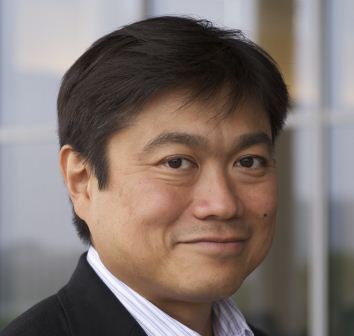
On Monday evening, Joi Ito, Internet pioneer and head of the MIT Media Lab, talked to Nature Boston as part of our coverage of Social Media Week. On Thursday, tune into the live stream of “Beyond a Trend: Enhancing Science Communication with Social Media.” The panel, hosted by American Museum of Natural History (AMNH), is the latest in the monthly series organized by Science Online NYC, aka SoNYC.  

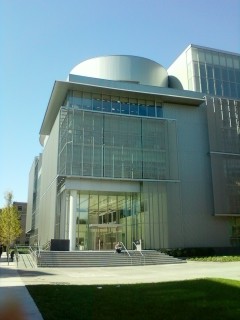
Science, by its nature, is built on a web of traditional social networks. Look at any citation map, C.V. or literature search for a sense of the interactions that drive scientific inquiry. Much of what we know stems from who studied with whom, who worked serendipitouMIT photo by Andy Ryansly in a particular lab and who moved their ideas from one company to another.

“With the so-called social networks we have today, we’ve exploded that,’ says Joi Ito, the Internet pioneer and, now, the director of MIT’s Media Lab.

The burst in electronic interaction is about much more than collaborating over the Internet. Scientists can learn a great deal from social networking about how to generate data, how to test ideas and how think beyond disciplines, Ito said.

In a conversation earlier this week, he offered a hypothetical example of how emerging tools are creating new ways to analyze information generated by online networks. Take data from the history of books, together with trends from search queries and Twitter and connect it all to scientific references, he said.

“Then we get these really rich data sets with which we can understand… the shape of ideas within the context of society.”

He also offered a very concrete example. This spring’s Research Update session – usually open only to the Media Lab’s corporate and philanthropic sponsors — will become a Tweet-up. For the first time, most of the previously private sessions will be live streamed and the lab will solicit input through Twitter.

“The more you get your ideas out there, the more likely you’ll find people to collaborate with,” Ito said.

Ito likes to talk about the Internet as a philosophy of decentralized innovation. In that sense, it is driving a shift in the way scientists collaborate.

“You can see peer review in science and peer review on the Internet converging,” he said.

Traditionally, a researcher will seek confirmation of findings from peers –top experts in a field. The basic ethos of the Internet, Ito said, is that, if you put something online and it survives, it must to be true. Instead of a handful of  experts, “millions of people are going to read it and if you’re wrong,they point it out.”

For researchers accustomed to working with carefully collected data within a clearly defined discipline, that approach may seem chaotic. That’s the point.

“If you have the ability to collect a lot of data and inputs and do an analysis to filter out the noise, then you actually get a really interesting set of answers that has the benefit of having diversity mixed into it,” Ito said. He pointed to Wikipedia as an example.

You also end up with data that tends to be more robust – in the same way the human body is robust. Like the immune system, robust systems tend to be open and a bit messier but they are more adaptable, he said.

“When you have chaotic and fast changing environment, that we do, fitness and robustness are actually important…efficiency and cleanliness less so…But, I’m an Internet guy, so that’s the way I think.”

For more, see the Media Lab’s Social Computing project: The Social Computing group works on models for information processing that work from both angles. We build sociotechnical tools that aim to create substantive human connections as part of the process of data analysis. Our current focus is on developing programming languages for social computation.

February’s SoNYC: On Science and Social Media – #IAmScience and the unexpected tweets

Science Online NYC (SoNYC) is a monthly discussion series held in New York City where invited panellists talk about a particular topic related to how science is carried out and communicated online. For this month’s SoNYC we’ve teamed up with the American Museum of Natural History (AMNH) for a special event for Social Media Week. We’re looking at how social media can be used to communicate science, with the intention of concentrating on how the experiences can have educational value. More details about this month’s SoNYC can be found here.

To complement the event, we’re running a series of guest posts, recounting experiences where social media has been a key part of an education project. To start the discussions, Dr Alan Cann from Leicester University gives us an academic’s viewpoint on how social media can be used as part of the curriculum. In our next instalment, Ben Lille, co-founder of The Story Collider, reveals how social media can also be used to tell a science story.  

I’ve always been what you might call a ‘light’ social media user. A few years ago I started a twitter account, and a year later I had produced seven entire tweets – I was that into it. Years of playing video games had made it clear that your number of followers was how you kept score, but I didn’t know how to play! (Oh yeah, Facebook exists, too.)

So it’s probably unsurprising that I started an organization that features a live experience and longform essays. I’ve always been obsessed with the story of science, the emotional impact on who we are as people: Can knowing about Hubble photos save one from depression? Can new technology change how and who we love? What happens when a neuroscientist’s own father has a stroke?

The Story Collider is an attempt to peer into those questions. Run by Erin Barker, Brian Wecht, and myself, we invite people to tell stories of their personal experience of science, either live on stage — which we recordand podcast— or in essays. Of course, we tweet and post to Facebook, when a new story is published, or an event announced. We’re pretty run-of-the-mill social media users that way. Given my history, I was quite proud of how much we’d done— taking advantage of all the new tools available. We had our content, we tweeted our content, people knew about our content. I figured we were doing it right.

Then, about three weeks ago, a science writer named Kevin Zelnio tweeted this:

And with that, he completely transformed what I thought was possible, and indeed what the point was, of social media.

The tweet came from a discussion of how people had started their science careers, and Kevin’s frustration that the path to a scientist was always depicted in one way: go to college, go directly to grad school. Hope it was a top-tier school, then, “Bam! You’re a scientist.”

But that wasn’t the path Kevin took, and it wasn’t the path most of the people he knew with careers in science took. So he tweeted, and encouraged others to tweet. It struck a chord, and within hours there were hundreds of people tweeting their stories with the hashtag  #IAmScience. I was watching the stream from my office, fascinated, but not sure what to make of it. I tweeted my own and went home.

A couple days later, Erin Barker, the editor and producer of The Story Collider — whose background is in journalism and has no science training — sent me a video produced by Mindy Weisberger with this note:

“Have you seen this? I just watched it and cried and then emailed it to my baby brother. You’re in there!”

I was. The video is a text-animation of some of the tweets, including mine, set to Reckless Kelly’s “Wicked Twisted Road”. It’s simple in concept, easy to make for any video editor, and it brought me to tears a third of the way through.

So here was something that had appeared like magic. It had deeply affected me, a scientist, and Erin, a not-at-all-a-scientist, and it was exactly the kind of thing that we try to create ourselves. Within days, #IAmScience had collected as many stories as we had in a year and a half. Mind you, they’re a lot shorter, and lacking in a certain amount of detail, development, denouement, and other words of the craft, but there they are.

But more importantly than the quantity, is the type of story. These are tales of wrong turns, failed classes, delayed dreams, failed schools, rejection, disabilities, mistaken careers, and as you saw in Kevin’s tweet, much, much more. As science communicators we talk a lot about humanizing science. It doesn’t get much more human than this — but I’ve rarely seen a major science publication touch most of these subjects. And that, of course, is the power of Twitter. Things that would never be published anywhere find a way of bubbling to the surface.

Now, I realized that this is somewhat old-hat and small-peas. Certainly, #IAmScience is no #jan25. But it’s the smallness that’s fascinating: In our normal lives, we tend to be content with thinking of social media as a way to spread our message, to distribute our content, or whatever. It can do vastly more, at scales much smaller than major revolutions — from organizing amateur galaxy hunters to make a major discovery, to organizing small-scale revolutions within the Ivory Tower, to finding stories professional story-hunters missed.

If you want to read the #IAmScience tweets, and the blog posts and more they spawned, there’s a Storyify of the tweets. If you want to hear more about this, and other science and social media topics, come the American Museum of Natural History on Thursday, 6pm, or watch the livestream.

Ben Lillie has a B.A. in physics from Reed College, a Ph.D. in theoretical high-energy physics from Stanford and a certificate in improv comedy from the Upright Citizens Brigade Theater. He left the ivory tower for the wilds of New York’s theater district where he writes, produces, and otherwise brings to light stories about the human side of science. He is Co-founder and director of The Story Collider, where people are invited to share their stories of how science has affected their lives. He is also a Moth StorySLAM champion, and a writer for TED.com.

February’s SoNYC: On Science and Social Media – An Academic’s Viewpoint

Science Online NYC (SoNYC) is a monthly discussion series held in New York City where invited panellists talk about a particular topic related to how science is carried out and communicated online. For this month’s SoNYC we’ve teamed up with the American Museum of Natural History (AMNH) for a special event for Social Media Week. We’re looking at how social media can be used to communicate science, with the intention of concentrating on how the experiences can have educational value. More details of this month’s SoNYC can be found here.

To complement the event, we’re running a series of guest posts, recounting experiences where social media has been a key part of an education project. To start the discussions, Dr Alan Cann from Leicester University gives an academic’s viewpoint on how social media can be used as part of the curriculum. His post considers how the effects of social media usage can be measured and what the future holds for such technology. 

One of the best things about working at a medical school is that we have lots of students and lots of technology, so three years ago we ran a student through our most powerful NMR machine, and this is what we saw:

Attention!
Image Source

Just in case you’ve had a sense of humour bypass, or my Ethics Committee is reading this, we didn’t really – this was one of those Photoshop experiments 😉

Nevertheless, institutional eLearning tools cannot effectively compete with the current generation of social networks for student attention. Yet there are good reasons for educators not to compete online with the attractions of alcohol and sex. In general terms, attention online is in short supply and although we know that Facebook can be a positive tool for education in some circumstances [1], I prefer to sidestep the complications of predominantly social spaces in order to provide some distinction. I try to foster the use of social tools for academic and professional development.

Dissatisfied with the lack of “social” in institutional tools such as virtual learning environments (VLEs), I started down a more outward looking path some years ago. Students log into the university VLE which acts an authentication hub, confirming their identities and providing us with a secure channel for information such as course marks, which, under the terms of the UK Data Protection Act, cannot be trusted to public sites. The university login provides us with an administrative layer but the interaction, and arguably the learning, takes place elsewhere. Although students may download PowerPoint presentations from the VLE, higher thought processes such as analysis and evaluation are associated with actions such as reading current content from RSS feeds on Google Reader and discussing the relevance of shared items to taught courses on Google+. Vital to this approach is the incorporation of student peer networks to amplify staff input [2].

Initially, I focussed on a range of social tools designed to foster student interactions. These included social bookmarking sites such as delicious, social citation tools such as CiteULike and wikis such as WetPaint and Wikispaces. Students were assessed on their use of these sites, but when assessment ceased, we found that very few students continued to use the tools. Some sort of social glue was required to maintain the enthusiasm. Our initial tool-based personal learning environment (PLE) concept rapidly turned into a people-based personal learning network (PLN) approach. As with all effective education, conceptual frameworks, in this case provided by a peer group rather than solely by teaching staff, win out over content alone.

A people-centred approach to peer learning, where academics assume the role of content curator, mentor, and technical support, places communication as a crucial requirement for success. This explains the failure of our initial tool-based approach to encourage students to curate their own information. In comparison with conventional tagging formats, the “just-in-time” attention management of activity stream architecture, where attention is continually refocused by active items returning to the top of the page, provides the reinforcement needed for continued use. Activity streams and the crowd wisdom of a peer network are at the centre of my approach to online learning. All this might seem like dry, academic posturing – but don’t say that to Facebook and Google, who have spent the last three years betting the farm on activity stream architecture.  Starting with the highly influential but now moribund Friendfeed, we were able to demonstrate the effectiveness of this approach in terms of monitoring student engagement [3]. Students engaged in peer to peer discussions around shared resources and personal reflection on their own learning. The patterns of online activity were mapped using graphical tools and were used to inform staff how to guide individual students. Our statistical analysis showed that student contributions to the network could be used to discern student engagement with education in a way which give a far richer picture of online activity than traditional summary statistics such as course or exam marks.

Six months ago, concerned about the sustainability of FriendFeed, I switched our student network to the newly available Google+, and have not looked back. Google+ is conveniently linked to other tools that students use on our course (Google Documents for collaborative writing, Google Reader for RSS feeds), and has fine-grained privacy controls based on the idea of sharing content with user-defined Circles (see: here), which gives users confidence about sharing thoughts and content online. Google+ has proved to be an effective and engaging tool for student feedback [4].  We are currently analysing the structure of student networks on Google+ and looking in depth at usage patterns. If you’re interested in finding our more about this, follow me on Google+ where I post regular updates about my research.

What does the future hold? As connectivity continues to improve, undoubtedly massive open online courses (MOOCs) such as the recent Stanford AI class will keep growing, but the notion that universities will be swept away by organizations such as Udacity and Kahn Academy and abandon qualifications from ancient institutions in favour of free badges and Klout scores is as fanciful now as it was on the barricades of 1968. Eventually our sleeping educational leviathans will rouse themselves and stumble towards the sunlight uplands of enlightenment. Unless Google gets there first of course.

Alan Cann is a senior lecturer in the School of Biological Sciences at the University of Leicester. His interests are science education and exploiting emerging social technologies to enhance the student experience and maximise student and researcher development. He is the author of two highly successful textbooks, has served on the editorial boards of several scientific journals, is creator of MicrobiologyBytes.com, and is Internet Consulting Editor of the Annals of Botany. He has worked as a consultant for numerous educational and scientific institutions, and has published extensively in the area of educational research. More information 


References 

[1] (Junco, R. (2012) The relationship between frequency of Facebook use, participation in Facebook activities, and student engagement (Computers & Education 58(1): 162-171)

[2] (Cann, A.J. & Badge, J. (2011) Reflective Social Portfolios for Feedback and Peer Mentoring. Leicester Research Archive)

[3] (Badge, J.L., Saunders, N.F.W. & Cann, A.J.(2012) Beyond marks: new tools to visualise student engagement via social networks. Research in Learning Technology 20: 16283)

[4] (Cann, A.J. (2012) An efficient and effective system for interactive student feedback using Google+ to enhance an institutional virtual learning environment. Leicester Research Archive)