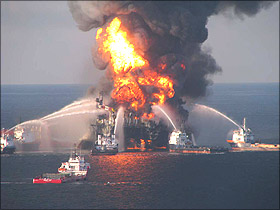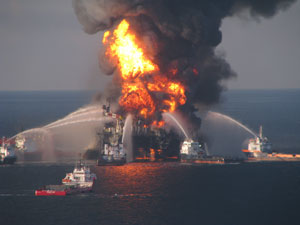
Deepwater Horizon disaster{credit}US Coast Guard{/credit}
Research and recovery efforts linked to the 2010 Deepwater Horizon oil spill received a welcome boost on 15 November as part of a landmark settlement by BP, an oil-and-gas giant based in London, UK.
The National Academy of Sciences received a US$350-million endowment, to be paid over five years, as part of the company’s resolution of criminal charges with the US government. The academy has yet to settle on specific projects, but the new funds will support a 30-year programme to study human health and the environment — including issues related oil spills — in the Gulf Coast region.
“It’s really a terrific opportunity to complete this whole portfolio of research in what’s been a tragic occurrence,” says Barbara Schaal, vice-president of the National Academy of Sciences.
The academy, which typically receives funding from Congress on a project-by-project basis, initially approached their part of the deal with caution, fearing apparent conflicts of interest.
“We need to have freedom of inquiry,” explains Schaal, who helped to clarify the language of the agreement to grant the organization sole control over how the studies will be conducted. “The company will have no say in what how the funds are used.”
Schaal says that some of the money could fund basic ecology research and provide crucial baseline data for monitoring the environmental effects of future disasters.
The $4-billion payment also included a total of $2.394 billion to be paid over five years to the National Fish and Wildlife Foundation, an organization chartered by Congress to develop and fund environmental conservation programmes.
The BP settlement came after months of intense negotiations with the Department of Justice, resulting in the company’s decision to plead guilty to 14 criminal charges relating to the massive oil spill in the Gulf of Mexico.
The 20 April 2010 explosion and sinking of the Deepwater Horizon drilling rig off the southeast coast of Louisiana released about 5 million barrels of oil into the ocean over three months. The oil itself and dispersant chemicals used to treat the spill may have exposed thousands of animals to toxic health effects (see Nature‘s News Special: Deepwater Horizon Disaster).
“All of us at BP deeply regret the tragic loss of life caused by the Deepwater Horizon accident as well as the impact of the spill on the Gulf coast region,” said chief executive Bob Dudley in a statement on the company website.
Included among the 14 charges are those relating to the deaths of 11 workers on the ill-fated drilling rig. After announcing that it would plead guilty to the charges, the company said it would now redirect its legal efforts towards fighting remaining federal, state and private civil claims.
The company’s $4-billion settlement with the Department of Justice set a new US record for the largest criminal fine, previously held by Pfizer, which paid a $1.2-billion penalty for fraudulent pharmaceutical marketing.
“There’s nothing that we can do to bring those loved ones back. On the other hand, this is a vindication that we have shown and the company has admitted that as a result of their actions, people died there unnecessarily,” said US Attorney General Eric Holder in a news conference on 15 November from New Orleans, Louisiana.
Holder also announced criminal charges for three individuals who worked for BP at the time of the disaster.
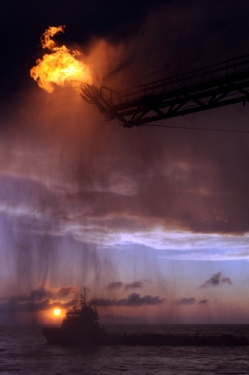 The full catalogue of failures that led to the destruction of the Deepwater Horizon drilling rig and the subsequent oil spill in the Gulf of Mexico have been laid out by a final US government report.
 Earlier this week US Senator David Vitter released his hold on a senior administration official after his demands regarding offshore drilling were met, but the Louisiana Republican has no intention of lifting a similar hold on the White House’s nominee for the position of chief scientist at the National Oceanographic and Atmospheric Administration.
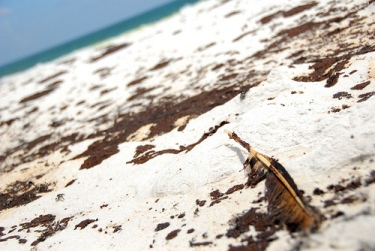 BP’s efforts to clean beaches soiled by the Deepwater Horizon oil spill in some cases spread the oil to previously clean sand. Its method of finding pockets of buried oil and excavating and sieving sand were unproven and of questionable effectiveness, researchers who observed the efforts say in a new paper.
 Environmentalists and politicians are increasingly sounding off about BP and Russia’s state oil company Rosneft teaming up to drill in oil’s new frontier: the Arctic.