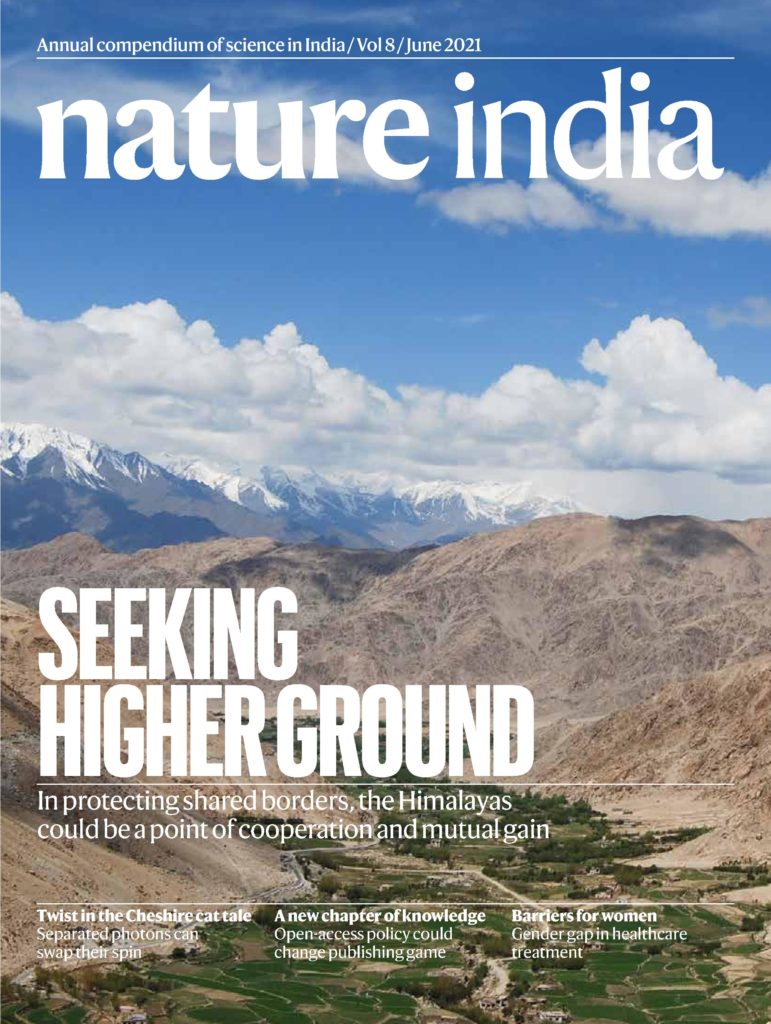
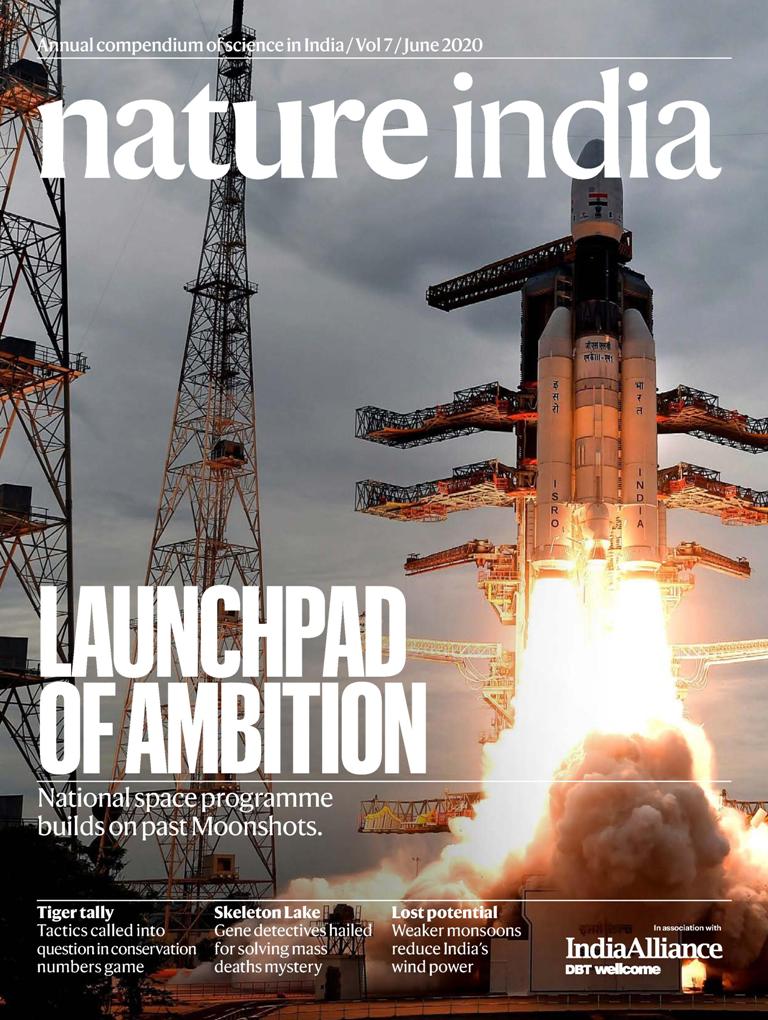
Nature India Annual Volume 2020 is out


Cover image: S. Priyadarshini/ Design: Bharat Bhushan Upadhyay

2020 was defined by the global pandemic. Throughout the long, difficult year, disease and death came in tragic waves, testing the limits of healthcare systems, especially in countries with limited resources. In India, one of the worst affected countries, significant outbreaks continue in 2021.

A positive outcome, however, has been the triumph of science. In record time, scientists rushed to sequence the genome of the virus and its variants, created affordable diagnostic and treatment solutions, and produced multiple vaccine and drug candidates to control the pandemic. We have been covering the pandemic in India and the subcontinent in depth through the lens of science. Besides our regular journalistic coverage, we produced two special issues on the COVID-19 crisis in India – one on how the pandemic was affecting life in a country of 1.3 billion people, and the other on affordable engineering solutions being developed in haste by India’s scientists to confront the virus. In our quest for disseminating trusted information during a global public health emergency, the pages of Nature India were prominently filled with information on SARS-CoV-2 and COVID-19.

Meanwhile, despite challenges thrown up by a series of lockdowns and funding issues, science in other disciplines unrelated to the pandemic has continued to flourish. One criticism of scholarly science publishers and science magazines has been that their overwhelming engagement with the pandemic (public health, medicine, virology and epidemiology) has squeezed out other disciplines of science during 2020. In this annual volume, therefore, we are spotlighting Nature India’s coverage of all sciences, efforts around which quietly continued through 2020.

The biodiverse Himalayan region, straddling the borders of many countries in Asia, including India and China, offers immense potential for collaborative scientific research. However, the inhospitable terrain and geopolitical strife in the region, have created obstacles to a joined-up research climate. Our cover story tells of the growing call by researchers in the two countries to go beyond political differences and make the Himalayan region a hub for scientific collaborations. Migratory birds from across the region coming into India and the need for heronries to protect them are also highlighted in this issue.

The country is weighing the challenges and opportunities of an ambitious ‘one nation one subscription’ policy that aims to make scholarly knowledge freely accessible to everyone in the country. We analyse the merits of this proposed plan.

The pandemic is never far from the immediate consciousness of any of the world’s people, and our annual photo competition on the theme brought inspired images of this era, where masks, sanitation, immunisation, and innovative solutions to health needs are paramount, and the focus of our daily lives

The issue is free to download here. We will soon make all our previous annual volumes free to access.

You will find more on our archival annual issues here: 2019201820172016, 20152014 and 2007-2013.

We hope you enjoy reading the latest volume.
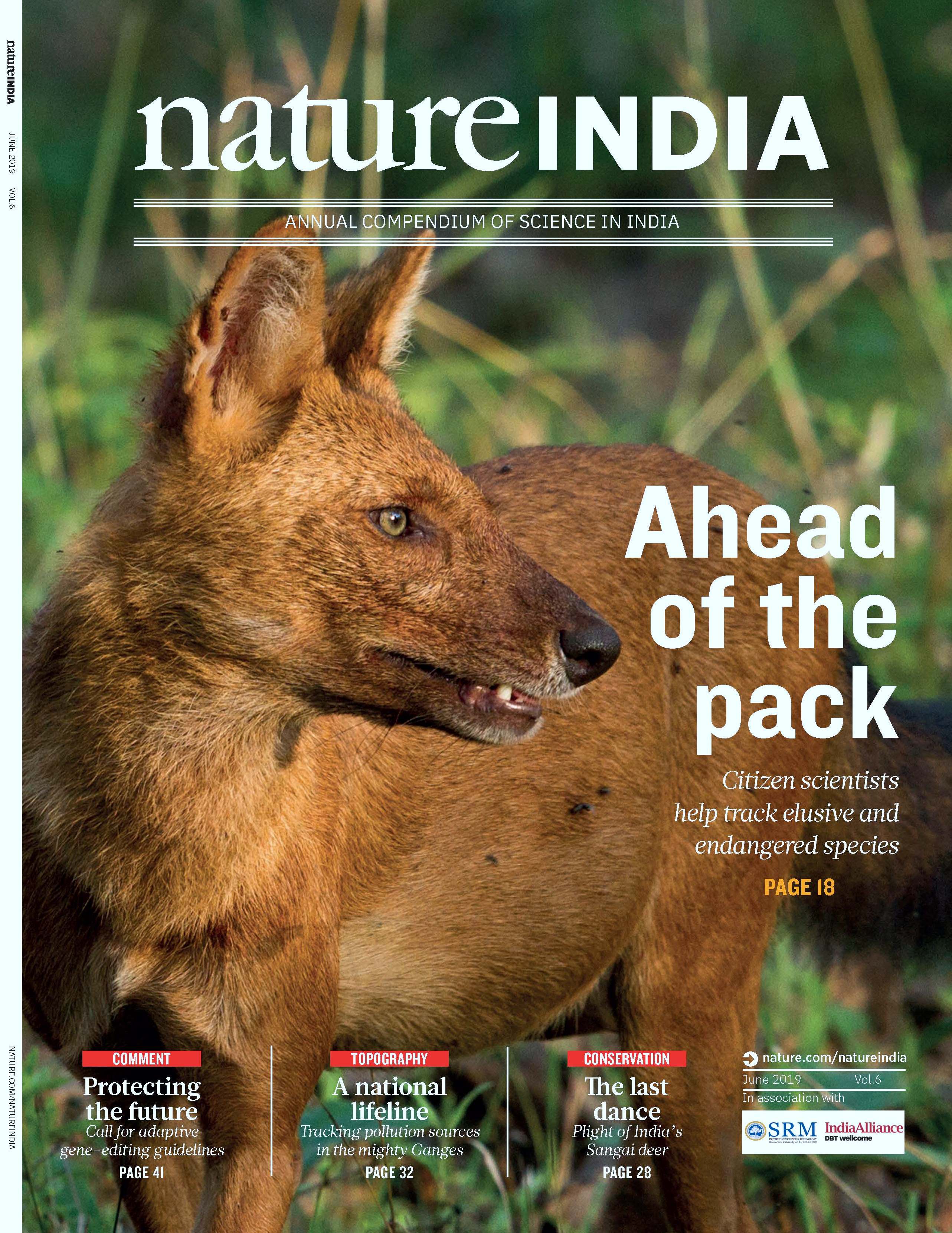
Nature India 2019 annual volume is out

Cover design: Marian Karam

Critics of India’s space programme have, in the past, demanded justification for sending rockets into space while the urgent issues of poverty, unemployment, illiteracy, and poor health cry for attention and funding. India has maintained that her space programme runs on less than a tenth of NASA’s budget, making it one of the most economical in the world and producing development-based benefits for the country’s environment, weather predictions, education, agriculture, and health.

Therefore, it was surprising when India’s ambitious, but unsuccessful, voyage to the far side of the Moon in 2019 did not publicly reignite that discussion. Instead, most of the 1.3 billion-strong nation stood in solidarity with the Indian Space Research Organisation (ISRO) when the Moon lander, Vikram, lost contact with the Earth station and later crash landed. A misty-eyed Prime Minister Narendra Modi consoled a tearful ISRO chief K Sivan. The country grieved, hoping and praying there would be a successful run to the Moon in the coming years.

We capture these tears, tribulations, nail-biting drama, and the science behind India’s shoe-string-budget space programme in this year’s cover story.

Talking of the science-economy relationship, we also analyse in one of our features the direct macro-deliverables from government research funding and look at the best ways in which a resource-poor country such as India can ensure tangible benefits from each rupee spent on scientific research.

Gender issues in science have always been important in India. In this issue, we reflect on why a better balance of men and women in leadership positions could lead to higher profitability in scientific enterprises; and also shine a light on India’s gender-skewed science awards. Two stories, about an anthropologist who made important revelations about indigenous Andamanese tribes, and a biologist working on pheromones of snow leopards and tigers, offer fascinating insights into the lives of pioneering women scientists and their science. We also speak to biologist Chandrima Shaha, the first woman elected president of the 84-year-old Indian National Science Academy (INSA) in January 2020, about her vision for mentoring more women in science.

In 2019, we used the term ‘Day Zero’ for the first time to denote the dystopic water emergency that the world is facing today. That’s the day when a city’s taps dry out and people have to stand in line to collect a daily quota of water. Climate change-triggered extreme heat, drying aquifers and extreme weather events have become the new normal for much of South Asia. We look at what this might mean for children, who will continue to endure the toll of climate change for a long time to come. On a more positive note, we explore how some undaunted farmer citizen scientists are finding new ways of adapting to climate-resilient crops.

The Nature India photo contest themed ‘food’ saw breath-taking entries from across the world that demonstrate the deep links between food, health, environment, nutrition, and happiness of communities. We present some of the top entries.

Nature India annual volumes select the best research highlights, news, features, commentaries and opinion pieces published through the year. Through this thoughtful selection, the editors at Nature Research bring to our readers a ready reference of the latest in India’s science.

We look forward to your feedback.

You will find more on our our archival annual issues here: 20182017, 2016, 20152014 and 2007-2013. To subscribe to the Nature India annual issues, please see here or write to natureindia at nature.com.

Nature India 2018 annual volume is out

The Nature India annual volume 2018 is out now.

The past couple of years have seen some interesting trends in India’s science. There has been a surge in the number of innovation-driven start-ups, and in the use of artificial intelligence in fields as diverse as health and aerospace. What has been most noteworthy, however, is the social aspect of science. More than ever before, the scientific community is standing up against pseudoscience, be it by contesting an unsubstantiated remark by a politician, calling out scientific misconduct, or helping weed out fake and predatory journals published from India.

Another positive social drift slowly gaining ground is the citizen science movement. In this annual issue, we focus attention on the tangible results of some crowd-sourced projects. For a country with more than 1.3 billion people, citizen science may turn out to be an effective tool to connect science with people, appraising them of the rigours of gathering and verifying evidence, and in turn, building a scientific mindset. Used intelligently, citizen science could help find answers to some pressing sustainable development challenges faced by India and much of south Asia.

The other big story that we looked at in 2018 was how Indian scientists have quickly embraced the use of CRISPR Cas-9, the gene splicing tool that became the reason for celebrations and controversies around the world. We report on some key Indian scientific missions that are editing genes related to diseases, especially blood anomalies, unique to the developing world.

On the other side of the disease spectrum, some new red flags were waved in the form of the first report of artemisinin-resistant malaria in India and the ‘good’ microbe bifidobacteria harbouring genes that make it resistant to anti-TB drugs.
Our 2018 photo contest took a comprehensive look at vector-borne diseases. The winning pictures that present a stinging story are featured in the photo section.

Climate is a burning issue for south Asia, quite literally. We analyze how the urban poor will suffer the most in an imminent climate crisis facing most big cities of south Asia. In a series of investigations, we reported how rice farming is impacting the climate more than ever before, why cloning hybrid seeds could benefit rice farmers, how increased dependence on nitrogen fertilizers has made India a nitrogen emission hotspot, and why crop stubble burning is national menace.

A lot has been happening around India’s holy river Ganga (also known as Ganges). Scientists are putting together a 3D map of the mighty river clogged with waste, and its fertile basin, where groundwater is depleting at an alarming rate. Part of our coverage is dedicated to the scientific solutions to these huge challenges faced by India’s largest river.

Nature India annual volumes curate research highlights, news, features, commentaries and opinion pieces published through the year. They are a thoughtful selection designed to give our readers an accessible reference to the latest in India’s science.

As always, we welcome your feedback.

You will find more on our our archival annual issues here: 201720152014 and 2007-2013.  And some more about the content and subscription of these issues here.

Nature India Annual Volume 2017 is out

NI Annual Volume 2017Nature India stepped into its 10th year in 2018. To mark the occasion, we gave a face lift to our annual volume with a new international design, very similar to Nature. A global team of editors and art designers worked across time zones to produce this annual volume.

In February 2008, Nature Research (then called Nature Publishing Group) launched Nature India in an attempt to chronicle the region’s rapidly changing scientific scene and efforts to embrace globalization. In the decade since, Nature India has witnessed and reported the distinctly Indian essence of science. Thanks to India’s enviable scientific stock that gets an additional 100,000 science post-doctorates every year and to a culture of frugal innovation, the website has seen a plethora of interesting stories.

Nature India has reported this evolution — the moments of glory as well as the difficulties — through in-depth commentaries, news and feature articles and research highlights from the country’s many laboratories and research and development organizations. From rural, low-resource settings to state-of-the-art space facilities, from well-equipped labs in burgeoning cities to makeshift mobile labs in remote islands, this journey of covering science in the world’s largest democracy has been pioneering and meaningful.

Besides producing award-winning editorial content, Nature India has evolved as a useful resource for India’s science community with listings of relevant jobs and events, discipline-specific special issues and the Nature
India annual compendia. Responding to the need for effective communication of science by researchers, Nature India also devised a series of science communication and career workshops in partnership with the Wellcome Trust–DBT India Alliance.

A much-awaited event in our annual calendar is the Nature India photo contest, which has not only enriched our archives with stunning science pictures from around the world but also resulted in a roving exhibition that sparks thought-leading conversations around the visual narrative of science.

Through these years, Nature India has broken major investigative science news stories — from the visible impacts of climate change as the sea gobbles up entire islands in the Bay of Bengal (10.1038/nindia.2013.60) to the poor genetic diversity threatening to wipe out the few surviving population of the Kashmir red deer (10.1038/nindia.2015.35); from the intriguing story of a diabetes-free desert tribe of Madhya Pradesh (10.1038/nindia.2015.23) to the resurfacing of a forest virus that killed more than 100 people in the Western Ghats of India (10.1038/nindia.2016.139).

Among the many engaging investigations we undertook in 2017 was one that looked at why Indian scientists coming back from stints abroad turn out to be less productive once they reached home (10.1038/nindia.2017.82) and a retrospective look at a quietly performed hybridization experiment in 1964 that created a litigon, a cross between a lion and a tigon, in a Kolkata zoo (10.1038/nindia.2017.46).

Our annual volumes are put together by a group of editors and eminent scientists, who curate the contents from our coverage through the year. The affiliations and research interests of some people may have changed after publication of these articles. These annual volumes are handy reckoners for anyone who wants to keep abreast with the research highlights of the year, newsmakers, trends in research and development, careers and policy issues.

As Nature India enters another decade, it will continue to bring to you the best coverage on Indian science in exciting new formats, such as podcasts and possibly videos.

You will find more on our our archival annual issues here:20152014 and 2007-2013.  And some more on the content and subscription of these issues here.

Nature India Annual Volume 2016 is out

Our much awaited collection of the year — the Nature India Annual Volume 2016 — is out this week.

In the year gone by (2016), India witnessed events that would go down in the country’s science history. The Indian Space Research Organisation (ISRO) launched 20 satellites on board one single vehicle, a warm-up that was only bettered five times over into a record breaking 104-satellite launch in early 2017.

India’s low-cost space-faring brilliance, bolstering her sense of self-sufficiency, has attracted global attention. It has come with caveats though — the European Union (EU) recognises that with such a mature space programme (and big strides in other areas of scientific research), India can no longer be bracketed together with ‘developing countries’. The EU’s funds for Indian researchers have, therefore, shrunk to a trickle with the premise that India is
now capable of pumping in more funds for collaborative projects with the EU.

This annual volume of Nature India takes a look at the changing landscape of science and research funding in India with a series of articles.

The discovery of gravitational waves marked a high point in theoretical physics last year. It sent ripples of joy for India, which is now all set to implement a multi-institutional Rs 1200 crore astronomy project that will see one advanced LIGO detector from Hanford in Washington being shifted to a site in India. There’s a flurry of activity in India around this international project. We capture that excitement in this issue. Alongside this, India’s leading participation in making the world’s largest radio telescope, the Square Kilometre Array (SKA), in the remote Australian outback makes it to our cover.

In another investigation, we look at the mushrooming of genomic service centres in India, the lack of regulation in the country to cope with the new wave and how even now most genetic conditions remain undiagnosed at birth.

We hop on to the biodiverse Western Ghats of India to report on an ‘evolutionary museum’ of bush frogs, a forest virus that resurfaced after a decade to kill over 120 people, and to inspect why the rice genome is under threat in this unique rice growing valley.

For researchers looking to ward off work blues, a couple of articles offer practical advice on how to overcome research rut and how to make most of conferences.

Our annual volumes strive to be an important addition to the science calendar of India — a must have for anyone interested in keeping abreast with the research highlights of the year, newsmakers, trends in R&D, careers and policy issues. These annual chronicles of the “contemporary history of science in India” are put together by a group of editors and eminent scientists, who handpick the contents from our coverage through the year.

Affiliations and research interests of some people might have changed after publication of these articles. We mention the publication date on top of each article so that they make sense.

Nature India Annual Volume 2015 is out!

Nature India Annual Volume 3 coverLike every year, we bring you the annual compendium of science as we saw it happen in India last year (2015).

The third issue of the Nature India Annual Volume has been an exercise in introspection, what with India’s science and technology allocation continuing to be lukewarm in 2015. The year brought with it a lot of talk of jugaad (frugal innovation) being the hallmark of India’s science — a term that is met with both pride and disappointment among scientists in the country. Some think the phenomenon epitomises the Indian spirit of excelling even in a resource-poor setting while many feel it is time the country took science funding seriously to be counted among the big science faring nations.

Regardless, the year was buzzing with scientific activity making it tough to choose the events that must get into the annual volume. On the cover, we feature the story of the Indian holy basil, which caught the attention of genomic scientists, opening up the possibility of producing umpteen therapeutic molecules. The draft genomes are expected to facilitate identification of not yet identified genes involved in the synthesis of important secondary metabolites in the plant, heavily used in the Indian and Chinese systems of medicine.

The Indian Council of Medical Research got its second woman Director General in 100 years, making for a happy trend to report. In the art-meets-science genre, we featured Minnesota-based dance company Black Label Movement (BLM), which took Bangalore by a storm explaining science to common people through dance.

We looked at two intriguing tribes of India — the Sahariyas of Madhya Pradesh, who are so socio-politically stressed out that their life expectancy might be going down as a result; and the camel-rearing Raikas of Rajasthan, who baffle immunologists with a near zero incidence of diabetes.

During the year, we reported the anger of senior Indian scientists who joined scores of artists, film directors and authors to protest incidents of assault on freedom of expression. Following the April 2015 Nepal earthquake, which shook the region, Nature India also took note of an appeal by Indian scientists to lift the ban on US geophysicist Roger Bilham, who has largely contributed to the current knowledge of earthquakes in the Himalayan region.
Like its predecessors, this annual volume hopes to be an important addition to the science calendar of India — a must have for anyone interested in keeping abreast with the research highlights of the year, newsmakers, trends in R&D, careers and policy issues.

These annual chronicles of the “contemporary history of science in India” are put together by a group of editors and eminent scientists, who handpick the contents from our coverage through the year. Affiliations and research interests of some people might have changed after publication of these articles. We have mentioned the publication date on top of each article so that they make sense.

Like always, we look forward to your feedback to improve our coverage of science in India.

You will find more on our our archival annual issues here: 2014 and 2007-2013.  And some more on the content and subscription of these issues here.

Nature India Special Annual Volume is out!

New PictureIn keeping with the promise of an annual compendium, here’s Nature India‘s second one compiling the big science events from India through 2014.

It has been a delight putting together the second issue of the Nature India Special Annual Volume, primarily because 2014 was full of big science news — India’s space scientists proudly placed the Mars mission in orbit and the country’s biologists made a mark in international proteomics research by mapping the human proteome.

During the year, Nature India also tracked an annual event that is quietly making a mark on the Indian science scene — a new initiative that is helping bring back Indian scientists settled in various parts of the world back to their homeland. Our cover story takes a look at this — the Young Investigators Meet in faraway Boston, Massachusetts. Parallely, we spotted another new pattern — that of foreign scientists trickling in to work in Indian labs.

Though their numbers are still not worth calling it a ‘trend’ of sorts, we thought this time was as good as any to put the sightings on record – a primer that might influence future science policy of this country. Besides our continued focus on climate change, policy issues that made it to our coverage in 2014 were the ban on unproven stem cell therapies — a long-standing cause for concern — and, a new push for genomic medicine in the country’s healthcare system. We also got to hear from the experts on where the legal battle on Genetically Modified crops is headed.

All these made it to our annual compendium, Nature India’s second such, that hopes to be an important addition to the science calendar of India — a must have for anyone interested in keeping abreast with the research highlights of the year, newsmakers, trends in R&D, careers and policy issues.

In the seven years of covering science in the largest democracy of the world, Nature India has closely witnessed some world-class science and scientists changing the face of science in this country. Deservedly, they should go down in history as pioneers of this new scientific boom. Beginning 2014, therefore, Nature India started chronicling what we call “the contemporary history of science in India” through annual compendia like these. For our special volumes, a group of editors and eminent scientists handpick contents from our coverage through the year. Affiliations and research interests of some people might have changed after publication of these articles. We have mentioned the publication date on top of each article so that they make sense.

As always, I welcome readers’ feedback to improve our successive volumes and to do justice to Nature India’s tagline: “All about science in India”.

More on the content and subscription of the issue here. Also, stay tuned for a Nature India Special Issue on “Proteomics Research in India” next week!

[Read about Nature India Special Annual Volume 2007-13 here.]

Coming this week: Nature India Special Annual Print Volume

I have often been asked why a discussion on the history of Indian science doesn’t get past her science icon triad of Bose, Raman and Saha. It is as if the inspiring figures of India’s science are frozen in a time pre-1970s. My usual retort is: this isn’t the case. However, I have to concede that we do not celebrate contemporary science icons the way we revere the work of these greats.

Nature India is all set to change this.

NI spl volIn 2007, the Nature Publishing Group felt the need for an online platform to capture the booming science scene in India. Nature India was born in February 2008 with an archive dating back to May 2007. In seven years of covering science in the largest democracy of the world, Nature India has closely witnessed some world-class science and scientists changing the face of science in this country. Deservedly, they should go down in history as pioneers of this new scientific boom.

Beginning 2014, therefore, Nature India plans to chronicle the contemporary history of science in India through annual compendia. For the first special volume, that has just gone to print, a group of editors and eminent scientists have handpicked contents from our coverage between 2007 and 2013. The subsequent volumes will be annually compiled.

In the introduction to this volume, Mamannamana Vijayan, a highly respected scientist serving the country for 50 years, gives us a peek into India’s science faring history and suggests the way forward.  “In global scientific literature, Nature represents excellence. Nature has also been concerned with science policy, the impact of scientific discoveries and science-related societal issues. True to this tradition, Nature India has addressed these concerns with particular reference to India. The compendium presented in this volume provides an excellent picture of the issues that have been addressed during the past seven years,” he says in the introduction.

Besides featuring what’s right and what’s not with science in India, the annual volumes hope to be an important addition to the science calendar of the country – a must have for anyone interested in keeping abreast with the research highlights of the year, newsmakers, trends in R&D, careers and policy issues.

More on the content and subscription of the issue here.

As always, we welcome readers’ feedback on the special volume and will continue our efforts to to do justice to Nature India’s tagline: “All about science in India”.