Linking the scientific and patent literatures

LENS

The scientific literature and patent literature have for a long time been viewed as two different worlds, with publications in the latter one measure of a researcher’s translational activity. But a much larger cadre of researchers influence inventions beyond those who are named as inventors on patents. Within patent filings there is often an extensive list of citations to the non-patent literature, including peer-reviewed papers, monographs, meetings and more. In a Patent article, Jefferson Osmat and her colleagues have created a tool to mine an open database termed the Lens containing filings from the US Patent and Trademark Office, The European Patent Office, the World Intellectual Property Organization Patent Cooperation Treaty applications and IP Australia for the non-patent literature. This enables an assessment of individual and institutional contributions to the global patent literature.

Andrew Marshall

The Gene Editing Bazaar

scissorsOn February 15, 2017, the US patent authorities ended a legal battle over IP rights between University of California at Berkeley and the Boston-based Broad Institute. According to the long awaited decision, Broad keeps its patents allowing them to own the use of CRISPR-Cas9 gene editing technologies in any eukaryotic organisms (including yeast, plants, animals and humans), while Berkeley’s broader patent application, which allows general use of CRISPR-Cas9 in any type of cell (including bacteria), will proceed before the USPTO. Gene editing – the precise and relatively easy deletion, insertion or modification of particular DNA sequences in the genome – is one of the latest innovations aiming to convert genetic engineering into a real engineering discipline. In the past, precise modifications were hard or almost impossible to achieve, frequently leaving genetic marks and requiring rather expensive and time-consuming processes.

The dream of every synthetic biologist, to edit the DNA letters in the genome as if using word processing software, seems not so far fetched anymore. But helping to make genomes easier to engineer is not the only advantage for scientists and the biotech industry. As it turns out, the gene editing process of CRISPR-Cas9 is distinct enough from traditional genetic engineering so that first applications issued in 2016 in the US, like the non-browning mushroom, escape regulations on genetically modified (GM) crops.  In the US, GM red tape does not apply to plants or fungi because CRISPR/Cas9 does not involve genetic elements from plant pathogens, and the modifications are in principle indistinguishable from a naturally occurring mutation. The potential for covering the tracks of gene editing (for example to avoid royalty payments) has recently caught the attention of the US Intelligence Advanced Research Projects Activity, which is currently “seeking information on potential tools and methods to detect organisms that have been modified using genome editing techniques.”

Other countries are also lagging behind with decisions on regulatory status. In Europe we see varying reactions. For example, Sweden decided that non-regulation was “crystal clear,” but Austrian government reps announced that CRISPR/Cas9 will be treated just like GMOs.

European countries, however, will have to wait at least until 2018 before the European Court of Justice will announce a presumably legally binding decision for EU member states. Until then, gene editing in Europe (and elsewhere) is in a legal limbo, giving the US (again) a head start on developing and innovating novel biotech applications.

Still, technical obsolescence could soon render ownership of CRISPR/Cas9 irrelevant, given related techniques, such as the CRISPR-Cpf1 where IP rights seem less complicated. There might even be a much greater number of CRISPR or related tools that work at least as well or better and that could even be open source/open access. We will see what happens to initiatives like the do-it-yourself CRISPR kit from Josiah Zayner. And a group of do-it-yourself biologists from all over Europe will for the first time join the Genome Hacking Retreat, beginning March 12, in Germany to exchange ideas and develop new applications using gene editing. It’s possible that in the next 10 years we’ll witness the coming of age of free and ubiquitous gene editing tools for everyone.

Markus Schmidt

Doing the Patent Dance Without Knowing the Steps

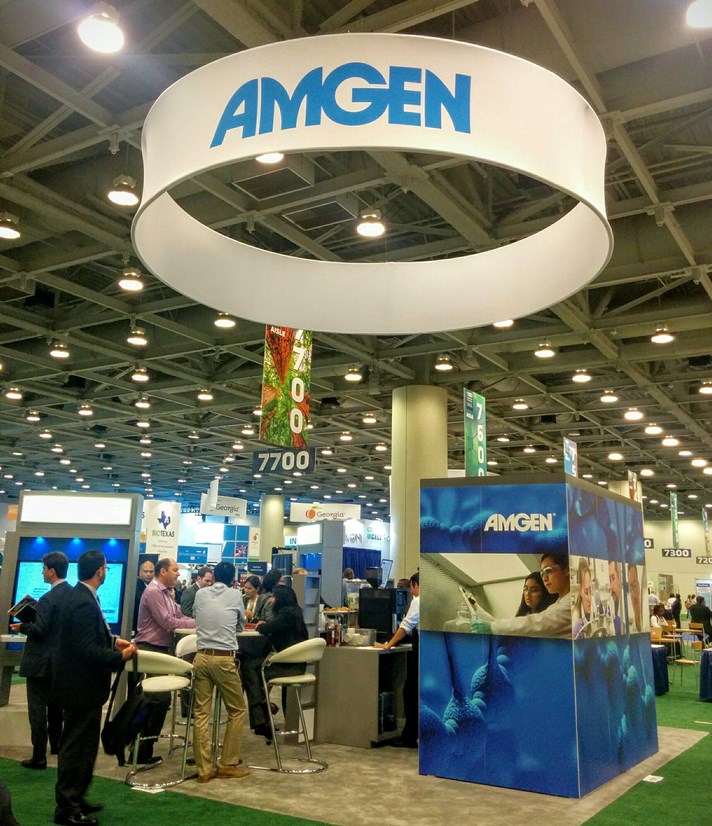
Amgen has been involved in several cases involving biosimilars of its blockbuster drugs.

Amgen’s pavilion at BIO 2016. The company has been involved in several cases involving biosimilars of its blockbuster drugs.

The first day of BIO 2016’s Intellectual Property track featured three sessions that eventually dovetailed into what’s increasingly becoming a thorn in the side of drugmakers: the challenging of drug and biologics patents on multiple fronts and, in theory, without end. In addition to regular patent litigation under the Hatch-Waxman Act, the Patent Trial and Appeal Board (PTAB) formed in late 2012 as part of the America Invents Act gave rise to inter-partes reviews (IPRs) seeking to invalidate patent claims and entire patents. In just over three years, the number of IPRs have increased to the point that the process has come to be seen as a road block for patents. By all accounts, instituting IPR proceedings is good practice: in the first 18 months, PTAB invalidated 16 of the 19 patents it reviewed. Since then the percentage has decreased, though the number of proceedings continues to rise. Patent challengers have included competitor drug companies (most often generics manufacturers) and non-practicing entities (a.k.a. patent trolls) focused on either extracting settlements or shorting stock.

The Biologics Price Competition and Innovation Act (BPCIA) of 2009 defines a process for resolving patent disputes before the launch of a biosimilar product by an exchange of information including a list of patents that may be infringed and responses by the parties – termed the “patent dance.” How patent litigation under Hatch-Waxman and administrative IPR proceedings before the PTAB are affecting the patent dance is currently the question for drugmakers, as we all navigate the uncharted waters of these relatively new processes.

Michael Francisco

A role reversal in biotech patenting

EU_backgroundThe difference in the patenting landscape between the United States and Europe used to be characterized as freewheeling versus cautionary; expansive versus patchwork. Think of Diamond v. Chakrabarty‘s “anything under the sun that is made by man” versus the long battle to finally allow the patenting of stem cells in Europe.

However, the conventional wisdom may be turning around in a big way. In the Tuesday IP track session Antibody Therapeutics: May I Have Them All, the four panelists ran through several theoretical scenarios involving the patentability of therapeutic antibody compounds and methods of use before both the US Patent & Trademark Office and the European Patent Office, as well as the courts who may eventually uphold or invalidate the patents.

The audience was invited to cast their vote on several questions using the MyBIO app, to no great success; we quickly reverted to the more low-tech but highly efficient ‘show-of-hands’ method. Two generally agreed-upon propositions were that: (1) the likelihood of getting a US application approved was dependent on the identity of the patent examiner (cue knowing laughter from the audience), and (2) Europe is starting to present a more streamlined application process, focusing more on the method of “using an antibody to antigen X for the treatment of disease Y” compared to the myriad structural and functional characteristics required by the USPTO.

Panelist Robin Silva, a partner at Morgan Lewis, summed up by advising the audience to continue to claim antibodies “six ways from Sunday and see what sticks.” That might be a harder slog, but in the long run may also be more profitable, both for drug developers and their patent attorneys.

Wednesday’s morning session, Inventions Patentable: Evaluating Proposed Amendments to Section 101 merely reinforced the theme, with panelists discussing how recent US court decisions such as Mayo, Myriad and Alice have in essence replaced the well-understood framework for a “patentable invention”- i.e., novelty, utility, inventiveness- with an “enoughness” test that the USPTO, courts and patent bar are struggling to understand and apply. This has left the US standing alone by excluding from patentability isolated natural products and basic diagnostic methods.

Whether the solution is a legislative fix, regulatory guidance or a change in judicial mindset, it cannot come soon enough to clear the atmosphere of confusion and unpredictability now present.

Michael Francisco

University Life Science Patent Transactions

Pie chart Figure

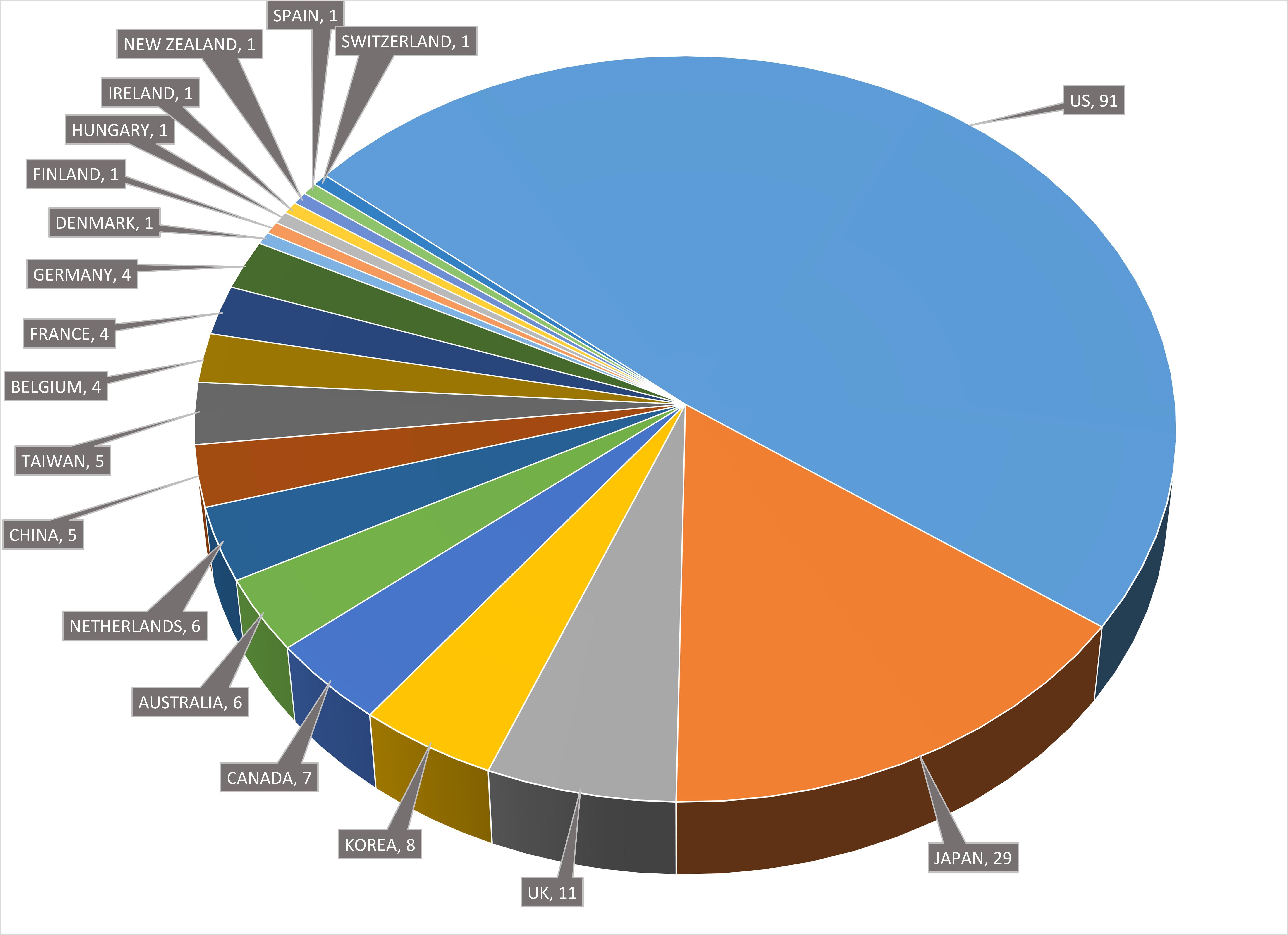
We asked Relecura, which has a web-based IP analytics platform for analyzing and commercializing patents and patent portfolios, to examine patent information on life sciences in 2013, using keywords and patent classification codes. The result: Relecura found 265 life science patent transactions from universities to corporate entities.* Click on the LS data2 link below to see Relecura’s list of the universities most active at assigning patents to corporate entities (Table 1), and the corporations that acquired the most life science patents (Table 2). Relecura also broke out the results by country (Fig. 1)

Relecura points out that while US universities top the list, academic institutions from other geographies, especially those from Japan, were active with patent re-assignments to US corporations. Also, the relatively low number of reassignments could indicate the possibility of corporations accepting licenses instead of insisting that patents be assigned to them. Regardless, New York University, Florida Atlantic University and Ordway Research Institute were quite active in 2013, and the corporate entities list is topped by Sythezyme. The US is far and ahead the leader in life science patent transactions, but Japan is very solidly second.

The hard data behind the tables and figure can be found here.


LS data2

*A few caveats: This  analysis  was  restricted  to  US  patent  applications  where  assignment  transfer  records  are available at the USPTO, and the information was taken from the public domain. It also should be noted that many IP licensing deals are not published or recorded through reassignments, and thus are not included in these data.


A Canadian (un)Curriculum

BDC FigureCanada is known for its hockey, maple syrup, the beaver, Canadian goose and apologetic nature (sorry). But our list of accomplishments doesn’t end there. Canadians are also tenacious innovators in the fields of biomedical science and biotechnology. Trailblazing Nobel Prize winners like Michael Smith (Site Directed Mutagenesis) and Sir Banting and Best (insulin) paved the way for our current luminaries like Tak Mak (T-cell receptor), Eric Brown and Gerry Wright (antibiotic discovery). These avant-gardists have two characteristics in common: creativity and acumen.

In today’s “entrepreneurial university” setting, how do we go about teaching our future graduates these characteristics? How do we bottle biomedical discovery and commercialize it? Curriculum design dictates the establishment of a planned, rigid structure of a program intent on teaching (at) students the wonderful accomplishments of our innovators. This would be wrapped up in a nice, neat package presented at students in the comfort of a classroom. The end product would be a graduate full of fancy knowledge with no creativity, tenacity or grit.

And so we threw out the curriculum design process and set out to create our own (un)curriculum. This was a real, in-your-face, intensive one day think-tank bringing together our stakeholders: the Triple Helix (government, academia, industry) and students. We asked them two questions: What skills do you need to succeed? How can we make it happen?

The outcome was humbling. Our stakeholders exploded with opinions and ideas. The think-tank was abuzz with dialogue and reflection. Amidst the seemingly chaotic milieu, a schema emerged. Dubbed the (un)curriculum, this plan became the backbone of our new Biomedical Discovery and Commercialization (BDC) program.

Pioneering pedagogical learning styles lie at the heart of this (un)curriculum. Our stakeholders identified key skills that make up the ideal graduate students. Among the usual suspects of laboratory and business experience lie surprising gems like learning-to-learn, persistence, grit, optimism, creativity and tacit knowledge transfer. These non-cognitive factors have become the platform on which our courses are built.

Our BDC program is a combined undergraduate Bachelor of Health Sciences program that begins in level III, followed by a fifth year in which candidates complete a non-thesis course-based Master’s degree in Biomedical Discovery and Commercialization. Focus is placed on the “entrepreneurial graduate” by immersing students in biomedical enterprise: from bench to bedside and beyond. The BDC program acts as a hub for collaborative dialogues between the Faculties of Science, Health Science, DeGroote School of Business, industry and community stakeholders. The aim of the BDC program is to produce research-focused graduates with the combined strength of discovery research skills and business acumen.

To celebrate our BDC students’ achievements we will utilize a virtual platform, BDC Dialogues, designed to engage community of practice exchange of ideas. BDC Dialogues is a virtual learning collaborative intended to actively engage undergraduate and graduate BDC students with their community mentors throughout their BDC journey. The community includes faculty members from various faculties (health science, science, business, and engineering), industry stakeholders, clinicians, etc. Tentatively, the BDC Dialogues website will feature:  blog sites allowing for open reflection and discussion; learner-team project showcase; award/competition opportunities that will be sponsored by industry partners; general discussion board and feedback surveys. A yearly summit – BDC ENGAGE – will bring together BDC students with their mentors in a day-long event featuring multiple communication networks designed to celebrate and enhance engagement, while initiating new interfaces with the global community. Our long-term goal is to transcend the BDC community of practice into a global network intent on biomedical discovery and commercialization.

We are very proud of our BDC program. These are simple words, but they are honest and heartfelt. And so, we leave you with one parting thought. When you think of Canada, think of Biomedical Discovery and Commercialization … and Canadian bacon, eh?

Please feel free to contact us if you have any questions.

Felicia Vulcu

Michelle MacDonald


The E is silent

Yote_cropI’ve already mentioned Wake Forest and tech transfer, but the picture above was shot on the University of South Dakota campus here in the US. The university, which has the state’s only medical school and an overall enrollment of more than 10,000, is located in Vermillion, SD. The official mascot is a coyote — though pronounciation of the word in South Dakota drops the long “E” at the end, so it rhymes with “oat.” This is common in western parts of the US, and thus, when rooting on the local team in The Dakota Dome, the correct phrase is “Go Yotes.”

USD is in the beginning stages of a long-term, collaborative project between the neighboring city Sioux Falls, the school and the private sector. It has secured 80 acres of land just outside Sioux Falls and is planning a massive, mixed use academic and residential research park, to be completed over the next 20 years. This is covered in greater detail in the Bioentrepreneur feature article, now live the December issue of Nature Biotechnology, but the school’s expansion is just one part of its attempts to ramp up tech transfer. USD is also in the midst of a $250 million fundraising campaign called Onward. It has already raised more than half of that and is earmarking at least $97 million for future student financial aid.

I visited the campus on a gray, fall day, just before USD’s 2014 Homecoming weekend. The red-stone buildings and long stretches of green grass made the campus seem like some sort of scholarly oasis situated just north of Main Street.

Photographer for these shots is Travis Huggett — his website is here. (Full disclosure: he’s my cousin.)

Brady Huggett

Red

On the USD campus.

Begin

The beginnings of the University of South Dakota Research Park, in Sioux Falls, SD.


Plans

Richard Naser, president of University of South Dakota Resarch Park Inc, examines plans for the completed project.


Changes in University Tech Transfer

Bailey Power Plant

The Bailey Power Plant incorporated into the Innovation Quarter in Winston-Salem, NC. (Source: Wake Forest University)

The December issue of Nature Biotechnology includes a BioE feature article investigating changes in university tech transfer in the US. We started thinking about this topic early in 2014 and spent about six months reporting on it, before taking all that information and trying to mold it into publishable form. The result is that we have more than we were able to fit into the article, and I wanted to pass along some tidbits on Trade Secrets.

One of the schools we looked at is Wake Forest University, located in Winston-Salem, North Carolina. (Full disclosure: I went to Wake Forest for my undergraduate degree.) The school landed in our list of “top 20” schools due to its gross licensing revenue over 2009-2013. As part of reshaping its tech transfer methods, Wake Forest set up an Innovation Quarter downtown, which includes the Wake Forest Biotech Place. Besides being a home for academic research and corporate offices, the Innovation Quarter now holds events. There is a lot of talk about collaboration between arts and sciences in the corporate world today, and lots of assumptions being made about the amazing things that will happen when various groups mingle. Time will tell how that plays out, but either way, the Merge event discussion between a dermatologist and a “tattoo historian” being held at the Innovation Quarter sounds fascinating.

I’ll put up other images from our reporting, and other interesting bits of information from the various schools mentioned in the piece, over the coming days. Article will be out in early December.

Brady Huggett


Blind Technology Transfer: our challenge from the South

braileThe last years have been characterized by an accelerated transforming process of the cultural, economic, political and social dimensions of society. Consequently, new trends have emerged — especially those developed by large and medium size companies — which support a business strategy oriented toward innovation through partnership with external research groups (coming from the scientific and technological system) under a new conceptual framework: the open innovation. This approach has particular relevance in some disciplinary fields such as biotechnology, in which boundaries between basic science and technology have blurred, causing an intense interaction between companies and the university research system.

Specifically, the systemic character of innovation places the problem of knowledge appraisal in the centre of processes. In this way, intellectual property becomes the focus of business strategies in order to improve or maintain their competitiveness. While for scientific and technological organizations, IP represents an effort to control and ensure knowledge transfer from R&D labs, especially in developing countries

In this context, and based on the conception that patents can be necessary but not enough for the applicability of research results, the relevance and appropriateness of analyzing the correspondence between patent development and R&D activities is shown. Furthermore, the problematization of this phenomenon appears as an opportunity to reflect on the relationship between scientific research investment and technology development processes, as well as their connection to innovation.

Concerning Argentina, it has seen its budget for science and technology substantially increase since 2003, and the institutional development of the science and technology system has evolved. Public-private partnerships under the open innovation model are also emerging, incipiently being supported by various public instruments that promote the new Ministry of Science, Technology and Innovation. This set of political actions has affected the field of biotechnology, developing  new businesses and  increasing the number of  patent applications, however, there is no evidence on the relevance of knowledge transfer from the public sector to industry.

As a result, it has become relevant to explore the fate of biotechnology research papers produced in Argentina. To do this, what determines which part of the local R&D is exogenously appropriated and can be measured through the reference of scientific papers in foreign patents is hypothesized.

In our paper, we intended to explain the way in which the flow of scientific and technological knowledge from Quilmes National University (UNQ) toward foreign organizations and companies has been produced, as a case study. The core of the paper proposes the discussion over the appropriation of technological knowledge generated by institutions engaged in scientific and technological research, especially in highly dynamic disciplinary fields such as biotechnology.

Accordingly, the study focuses on reflecting upon the technological value of the knowledge generated. Specifically, this work shows the flow and the appropriation of scientific and technological knowledge developed in UNQ to foreign organizations and companies, whose circulation and diffusion occurred without the university being able to control, prevent or measure it.

Somehow, this sort of ‘liberation’ of knowledge – typical of the academic logic of science – can be understood as an indirect subsidy from the Argentinean public sector to foreign companies. Being this type of phenomena invisible to the political actions of the institution, we may consider them as blind technology transfer processes or just blind leakage of knowledge.

In terms of implementation of innovation policies between the central countries and the developing countries, a center-periphery relationship is established which, among other things, can be verified by observing the flow of knowledge from developing to developed countries.

We also face the problem of reflecting on the need to design new instruments to promote innovation, which, on the one hand, further stimulate local industry connections with the Argentinean scientific and technological subsystem, and, on the other, control, guide and/or streamline this ‘invisible flow’ of knowledge generated. This will require the active participation of other ministries (Health, Agriculture, particularly Industry) to complement and guide the initiatives of the Ministry of Science, Technology and Productive Innovation.

The universities will not be able to solve the lack of an industrial sector demanding research results, but they can be key actors in public policies for their own development. That is why it is imperative to re-signify the role of university technology transfer offices, as it will be desirable to increase the likelihood of research results appropriation. This forces us to think about the institutional significances of invisible technology transfer processes by developing new strategies of knowledge appropriation and appraisal.

Summing up, blurring boundaries between science and technology is a new phenomenon, especially in fields such as biotechnology. The awareness of the flow of scientific knowledge developed at a public university toward foreign companies and organizations becomes the driving force toward improvements in managing technology transfer offices and the development of innovative public policies for solving structural failures caused by industrial underdevelopment.

Darío Codner 

Quilmes National University and Tech Transfer

gapThe Quilmes National University (UNQ) was founded in 1989, 17km south of Buenos Aires City. One of its first courses was a degree in biotechnology, and the university had an early attitude of being willing to entertain several uncoordinated entrepreneurial initiatives coming from both students and faculty. This attitude extended to technology transfer and applied research.

Fairly quickly the university started developing patents, offering consultancy services and creating technology-based firms. By 2004, the UNQ had created an official technology transfer program. This program, presently an Innovation and Technology Transfer Office, was intended to strengthen its core of bio-businesses, processes management and technology transfer abilities. Since then, the UNQ has deepened its efforts to increase awareness of technology transfer issues.

The technology transfer office realized that younger researchers, advanced students and fellowship recipients wanted courses on business topics, wanting to drive themselves towards industry and business. The university understood that it needed to respond to changes in governments, business, and civic life, and it committed to facilitating dialogue between the main actors in tech transfer, and to raising awareness about the relation among biotechnology and businesses.

The university began to encourage meetings between the department of science and technology, with the economy and administration department. This resulted, for the first time, in two disciplines of higher education developing a new postgraduate program: The Biotechnology, Industry and Business executive program.

This program has an online course that mainly aims at deploying knowledge skills, reviewing   the state of the art and trends in biotech business, problem-solving actions in the biotech industry, approaches to main management trends, strategic management and core business ethos, and knowledge transfer. The program meant to the gap between industry and university. It is addressed to candidates coming from biotechnology, business, academic and also manufacturing.

This period of change at UNQ has strengthened the support of students and faculty entrepreneurial initiatives, it has created a technology transfer office and a learning program. The gap between industry and university is getting smaller.

Dario Codner