Ten years of Methods

Our tenth anniversary is an occasion to celebrate methods development!

In our Anniversary Issue, we highlight ten areas of methods development, among many candidates, that have had a lot of impact on biological research over the last decade. We also take the opportunity to look back at the papers we have published in some of these areas. We hope to add similar descriptions for all our ‘top-ten methods’ in coming months.

You can look back at the last ten years of Nature Methods in the following areas here:

Microbial sequencing

Super-resolution microscopy

Optogenetics in neuroscience

Light-sheet imaging

Mass-spectrometry based proteomics

High-throughput sequencing data analysis

Light sheet imaging in Nature Methods

It was only a few months before Nature Methods was launched in October 2004 that Jan Huisken and Ernst Stelzer had published a paper in Science in which they used light sheet microscopy – what they called selective plane illumination microscopy or SPIM – to image fluorescence within transgenic embryos. Simplistically put, this century-old technique achieves optical sectioning by illuminating a sample through its width with a thin sheet of light. In the last decade, Nature Methods has published a steady stream of papers reporting developments in light-sheet imaging. Here are the highlights.

Our very first light-sheet paper was also from the Stelzer group, reporting the use of deconvolution to improve resolution of the technique (Verveer et al, 2007). This was rapidly followed by a paper from Hans-Ulrich Dodt, in which samples such as entire insects or brain tissue were rendered transparent with clearing agents to produce spectacular light-sheet ‘ultramicrographs’ (Dodt et al, 2007). The push to higher resolution continued, with a paper from Albert Diaspro reporting 3D super-resolution imaging within thick samples using light-sheets (Cella Zanacchi et al, 2011). The Stelzer group, meanwhile, improved performance of the technique in larger samples that scatter more light, by combining it with structured illumination (Keller et al, 2010).

Thai Truong, Willy Supatto and Scott Fraser added two photon excitation to light-sheet imaging, thereby doubling the depth and increasing by an order of magnitude the speed at which they could image samples such as developing embryos with each approach alone (Truong et al, 2011); Supatto recently extended this to imaging in multiple colours  (Mahou et al, 2014). And then in 2012, the groups of Phillip Keller and Lars Hufnagel independently reported microscopes that could take take multiple views of a biological sample simultaneously, allowing rapid imaging of entire developing fly embryos at sub-cellular resolution (Tomer et al, 2012; Krzic et al, 2012).

Though light-sheet imaging is perhaps at its most powerful in the imaging of thick samples like embryos or tissue sections, it has been used for substantial performance improvements in cellular imaging as well. In 2011, Eric Betzig’s group used scanned Bessel beams to create thinner light sheets and thus much improved axial resolution, achieving isotropic 3D resolution and rapid imaging within living cells (Planchon et al, 2011). Note also that, as Tom Vettenburg, Kishan Dholakia and colleagues showed,  generating the light sheet using an Airy beam, rather than Gaussian or Bessel beam, yields an even larger field of view without sacrificing contrast and resolution (Vettenburg et al, 2014). Variations on the light-sheet theme have also been developed by the labs of Makio Tokunaga and Sunney Xie for single-molecule imaging within cells (Tokunaga et al, 2008Gebhardt et al, 2013).

In recent years, the excitement around this technology has been palpable, with several papers reporting impressive applications of light-sheet microscopy: it has been used to functionally image the entire fish brain (Ahrens et al, 2013) and the brain of ‘fictively behaving’ fish (Vladimirov et al, 2014), as well as to image the beating fish heart (Mickoleit et al, 2014).

Perhaps not surprisingly, the emphasis in methods development has also been shifting a little. On the one hand, platforms are being developed to make this valuable technique available more widely, for instance via the OpenSPIM or OpenSpinMicroscopy platforms (Pitrone et al, 2013; Gualda et al, 2013). At the same time, analytical tools are necessarily being developed to handle the vast reams of data that a light-sheet experiment generates. The group of Pavel Tomancak reported Bayesian-based deconvolution methods to analyse the large data sets that result from multiview imaging (Preibisch et al, 2014). Phillip Keller and colleagues described computational methods to segment and track nuclei in data sets from light sheet or other imaging, for fast lineaging of developing embryos (Amat et al, 2014). Misha Ahrens and colleagues reported Thunder, a suite of analytical tools built on a platform for distributed computing, enabling the mapping of brain activity in ‘fictively behaving’ zebrafish (Freeman et al, 2014).

It’s fair to say that this venerable method has been thoroughly revived over the past decade. Light-sheet imaging is poised to yield tremendous biological insight. We hope to keep you updated on future developments in Methagora.

A change of leadership at Nature Methods

The former Chief Editor of Nature Methods bids farewell to his cherished scientific journal and welcomes its new Chief.

The first of this month marked my tenth year working for Nature Methods, nearly six of those years as Chief Editor. I joined the Nature Methods’ team as an assistant editor just as the journal was preparing its first issue and quickly became enamored of both the journal and the job. Coming from an engineering background, I always had an affinity for the tools and techniques used by scientists, and working with the researchers developing the next generations of research methods has been an enormous privilege.

The changes that have taken place over the past decade have been remarkable, and for someone who started graduate school pouring polyacrylamide sequencing gels the differences in what budding researchers have at their disposal in the lab are breathtaking. I hope that over the years Nature Methods has played some part in highlighting the importance of research methods development and helping give due credit to those researchers whose work enables so many others to make discoveries that would otherwise be infeasible or impossible.

One of my best memories as an editor is still the excitement of seeing Xiaowei Zhuang’s 2006 Gordon Research Conference poster describing stochastic optical reconstruction microscopy (STORM) and thinking, “What an amazing idea!” The excitement redoubled soon after at the same conference when George Patterson gave his talk on photoactivated localization microscopy (PALM). Little did I know at the time that this would be the start of a long running relationship between Nature Methods and the yet-to-emerge super-resolution microscopy community.

I will sorely miss the interactions I’ve had with the microscopy, biophysics and other communities I worked so closely with during my time at Nature Methods, but I’m confident that the journal will continue to serve these communities much as it has over these last ten years. The experience of developing, editing and publishing the Points of View column on data visualization and Points of Significance column on statistics has also been a highlight of my time at Nature Methods and, as services to authors, I’m glad I will still be involved with these.

In my new role as Head of Editorial Services for Nature Publishing Group and Palgrave Macmillan I will be serving the much broader research community and focused on improving the author (and reviewer) experience before manuscript acceptance. I’ll still be reachable at my old email address and on Twitter where I welcome comments on what can be done to improve the service we offer as a publisher.

I can’t say enough about how touched I am by the sentiments expressed in emails I’ve received from authors and reviewers I’ve worked with over the years. It has been an honor and privilege working with such amazing people and helping to communicate to the wider community your hard work developing important research methods and tools.

Even though I’ve moved on, Nature Methods lies in good hands with its new Chief Editor, Natalie de Souza. Natalie was a manuscript editor at Nature Methods for over seven years and is well placed to build on its past success.

A heartfelt thank-you to all the authors, reviewers, readers and colleagues I’ve worked with over the past ten years. The journal could never have been as successful as it has been without all your contributions.

Help create Nature Methods’ 10 year anniversary cover

Our October 2014 issue will be a celebration of our 10 year anniversary and we want you to help us celebrate by contributing to the creation of the anniversary issue cover.

We are looking for striking original images of the number 10 created by techniques or tools used for basic laboratory research in the biological sciences. This could be fluorescent cells patterned in the shape of a 10, a 10 written using two photon lithography, a DNA Origami-based 10, or 10 written using any number of other methods. The more imaginative the better!

The best image, or images, will be used to create the 10 year anniversary cover for our October issue. We will also post the best submissions, or all of them if there aren’t too many, here on methagora with a short description of how the image was created and by whom. If you use a method you published with us we’ll also highlight that article.

Please no drawn, computer generated, or heavily edited images. Images that work well on a black background may be preferable if the final cover ends up being a composite of several submissions, but we encourage submissions regardless of the background color.

We must receive your submission by August 25, 2014 for us to consider it for the cover. Late submissions will, however, still be considered for posting here on methagora with a description and acknowledgment. Multiple submissions from a single individual are welcome and we’ll highlight as many as possible here on methagora.

Email each image candidate to methods@us.nature.com with your contact information and a short paragraph describing what it is and what research method or tool was used to generate it.

Please spread the word to your colleagues! We want the variety of submissions to be representative of the wide array of techniques that have appeared in our pages over these last ten years.

Let’s give statistics the attention it deserves

This month we launch a new column ‘Points of Significance’ devoted to statistics, a topic of profound importance for biological research, but one that often doesn’t receive the attention it deserves.

For the past three years Nature Methods has been publishing the Points of View column, one page a month dedicated to practical advice for researchers on how to create accessible and accurate visualizations of their data. The response to the column articles has been fantastic and most recently we organized them by topic here on our blog.

Unfortunately, a truth about data visualization is that no matter how good the visualization, if the experiment wasn’t appropriately designed and the data wasn’t analyzed correctly, the resulting visual depiction of the data will be inherently flawed. Nature Methods and the other Nature journals recently made changes to improve data and methods reporting as part of a reproducibility initiative. We feel this is an important first step in improving experimental reproducibility and repeatability, but unfortunately by the time work is submitted for publication it can be difficult to correct shortcomings in experiemntal design and analysis.
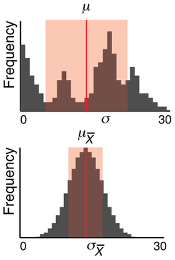
A population distribution and a distribution of sample means.

A population distribution and a distribution of sample means.

In our September issue readers will find a new column, Points of Significance, that we hope will be as useful as the column that preceded it, perhaps more so. Martin Krzywinski, who has been writing the visualization column, is now joined by Naomi Altman, Professor of Statistics at The Pennsylvania State University. Among other things, Naomi will be responsible for ensuring that the information and advice we provide about statistics in every Points of Significance article is accurate.

The column has been expanded from one to two pages and will often have an Excel spreadsheet associated with it. This expansion will help us better communicate information that is less well served by display items. However, as illustrated by the figures in the first article of the column and the accompanying spreadsheet, visual displays will continue to play a vital role due to their strength in providing easily interpretable examples that can often be more readily grasped than mathematical or narrative descriptions.

We will strive to present the material so that each article in the column builds on prior ones. In this spirit the first article discusses populations and sampling, a foundation for nearly all topics to follow. The accompanying spreadsheet allows readers to play around with sampling and see for themselves how often values obtained from samples deviate substantially from the real population. It can be disconcerting to see just how often ‘bad luck’ can give a ‘wrong’ result in one set of measurements while in another set of measurements the ‘right’ result is obtained but statistical measures would suggest that the former is more likely to be ‘correct’ than the latter. This excellently highlights how statistics is unable to tell you if you are right. But this doesn’t suggest statistics has limited value. Instead, readers of scientific articles reporting statistical results need a healthy grasp of the limitations of statistical analysis and users of statistics can always learn ways to improve the power of their analysis.

The “aura of exactitude” that often surrounds statistics is one of the main notions that the Points of Significance column will attempt to dispel, while providing useful pointers on using and evaluating statistical measures. We expect that readers will find the upcoming October Points of Significance article on error bars and confidence intervals with its practical tips on interpreting these graphical elements to be particularly useful almost every time they read a manuscript containing these popular visual representations of uncertainty.

We hope readers enjoy Points of Significance. It is appropriate that the column is debuting during the International Year of Statistics. To allow readership by a wider audience each article will be free to access for a period of one month after it is published.

Update: All Points of Significance articles are now free access and have been collected together on a dedicated page in the nature.com “Statistics for biologists” resource.

For more on statistics, and particularly statistics training, don’t miss this September’s Editorial.

. . . . . . . .

Update: Below is a continuously updated list of the Points of Significance articles.

Importance of being uncertain – September 2013
How samples are used to estimate population statistics and what this means in terms of uncertainty.
Error Bars – October 2013
The use of error bars to represent uncertainty and advice on how to interpret them.
Significance, P values and t-tests – November 2013
Introduction to the concept of statistical significance and the one-sample t-test.
Power and sample size – December 2013
Using statistical power to optimize study design and sample numbers.
Visualizing samples with box plots – February 2014
Introduction to box plots and their use to illustrate the spread and differences of samples.
Comparing samples—part I – March 2014
How to use the two-sample t-test to compare either uncorrelated or correlated samples.
Comparing samples—part II – April 2014
Adjustment and reinterpretation of P values when large numbers of tests are performed.
Nonparametric tests – May 2014
Use of nonparametric tests to robustly compare skewed or ranked data.
Designing comparative experiments – June 2014
The first of a series of columns that tackle experimental design shows how a paired design achieves sensitivity and specificity requirements despite biological and technical variability.
Analysis of variance and blocking – July 2014
Introduction to ANOVA and the importance of blocking in good experimental design to mitigate experimental error and the impact of factors not under study.
Replication – September 2014
Technical replication reveals technical variation while biological replication is required for biological inference.
Nested designs – October 2014
Use the relative noise contribution of each layer in nested experimental designs to optimally allocate experimental resources using ANOVA.
Two-factor designs – December 2014
It is common in biological systems for multiple experimental factors to produce interacting effects on a system. A study design that allows these interactions can increase sensitivity.
Sources of variation – January 2015
To generalize experimental conclusions to a population, it is critical to sample its variation while using experimental control, randomization, blocking and replication to collect replicable and meaningful results.
Split plot design – March 2015
When some experimental factors are harder to vary than others, a split plot design can be efficient for exploring the main (average) effects and interactions of the factors.
Bayes’ theorem – April 2015
Use Bayes’ theorem to combine prior knowledge with observations of a system and make predictions about it.
Bayesian statistics – May 2015
Unlike classical frequentist statistics, Bayesian statistics allows direct inference of the probability that a model is correct and it provides the ability to update this probability as new data is collected.
Sampling distributions and the bootstrap – June 2015
Use the bootstrap method to simulate new samples and assess the precision and bias of sample estimates.
Bayesian networks – September 2015
Model interactions between causes and effects in large networks of causal influences using Bayesian networks, which combine network analysis with Bayesian statistics.
Association, correlation and causation – October 2015
Pairwise dependencies can be characterized using correlation but be aware that correlation only implies association, not causation. Conversely, causation implies association, not correlation.
Simple linear regression – November 2015
Linear regression is a flexible way to predict the values of one variable using the values of the other to find a ‘best line’ through the data points.

Reporting standards to enhance article reproducibility

Beginning May 1st Nature Methods will be requiring authors of manuscripts being sent back to peer review to fill out a checklist to disclose technical and statistical information about their submission.

The May Editorial briefly describes why we are using this checklist and provides some details of what is included. Authors can find the checklist that Nature Methods will be using at https://www.nature.com/nmeth/pdf/sm_checklist.pdf and there is a link to it on the journal homepage. Our checklist is identical to that of most of the other Nature journals except for an added item asking authors to “Identify all custom software or scripts that were required to implement the methodology being described and where in the procedures each was used.” Based on feedback we have received, a missing software or script seems to be the item most often mentioned by people commenting on challenges in reproducing a method we have published. This reporting requirment is an important step in trying to address this deficiency.

We expect that the addition of these reporting requirements will elict some grumbling by authors. But based on the experience of Nature Neuroscience, which has been requiring authors to fill out a methods checklist before even the first round of review, we expect authors will come to appreciate the role it serves.

The checklist is only one part of the efforts the Nature journals are making to improve reproducibility. The other journals are also removing formal limits on the length of the methods section. But since Nature Methods has long had no limits on the length of our Methods section, the checklist is the most prominant change for us and our authors.

The May issue also contains other articles relevant to reproducibility. The Correspondence section has a discussion about analyzing the reproducibility of animal experiments. And the May Technology Feature discusses reproducibility in quantitative PCR, a methodology that has suffered from serious problems in this regard due to poor experimental technique and reporting.

For those not tired of reproducibility at this point Nature also has a Special Focus on Challenges in irreproducible research.

As has been said in the editorials on the subject, this is only a first step toward improving the reproducibility of our published research and we welcome feedback from the community on our efforts.

Return of the Points of View column

Our popular “Points of View” column returns this month after a brief hiatus. Here is a bit of history of the column and an introduction to its new author.

On this day four years ago Sean O’Donoghue contacted Nature Methods about a workshop he was organizing on visualizing biological data. This culminated in a Nature Methods Supplement on Visualizing Biological Data published one year later that coincided with the first VizBi meeting in Heidelberg, Germany.

During this meeting Bang Wong and I hatched the idea of a Nature Methods column that would provide practical advice on the visual presentation of data for researchers. Later that year our August issue featured Bang’s very first Points of View column, “Color coding“. What followed was a labor of love by both Bang and I, with plenty of stress over deadlines, that extended over two years.

The column seemed to fill a need in the community and generated considerable positive feedback, including from authors and reviewers who would sometimes refer to advice from Bang’s columns. At the end of 2012 Bang took a needed break and the column went on hiatus. But in the meantime I had again met someone at a meeting in Germany who was passionately interested in the visual display of data.

The Points of View column returns in our March issue authored by Martin Krzywinski (staff scientist, creator of the visualization software Circos, and former fashion photographer).

I decided we couldn’t let someone with Martin’s varied experiences debut as the new Points of View columnist without learning a bit more about him so I asked our Technology Editor, Vivien Marx, to see what she could dig up.

Martin Krzywinski

Martin Krzywinski

Current mode: Makes cancer research and genome analysis visual.
Introduction to genomics: Built computing infrastructure at Genome Sciences Center
Past activities (incomplete): fashion photography, computer security, particle physics.
Published information graphics (incomplete): Book covers, American Scientist, EMBO Journal, PNAS, The New York Times, Wired, Conde Nast Portfolio.

Alex the rat

Alex the rat

Q: You photographed Alex (2000-2002) and helped her become the poster rat for genome sequencing. For example, she was Genome Research’s rat cover-girl. She frequently rode on your shoulder and seems like a groovy friend.

M.K.: Don’t be fooled by Alex’s visual presentation. She bit me countless times. But what do you expect from a rat? Maybe it is I that never learned.

Q: In addition to photo-shoots with Alex, you have had human fashion models in front of your lens. Fashion is pretty. Why should science be pretty?

Continue reading

Bioimage Informatics

It is no secret that imaging, and microscopy in particular, represents a substantial fraction of the manuscripts published in Nature Methods. Our very first focus issue, in fact, was on fluorescence imaging. When that focus was published in 2005 the term ‘bioimage informatics’ didn’t even exist. Even today, the term isn’t widely used and, unlike many other bioinformaticians, those who work on the development of algorithms and software tools for analysis of biological image data have few dedicated venues for discussing or publishing their work.

But computational techniques are becoming increasingly important in biological imaging and the people developing these tools increasingly see themselves as a distinct community. When we approached the community about publishing a focus issue on bioimage informatics there was an enthusiastic response and the results can be seen in our July issue and focus that went live today.

We hope that biologists using microscopy in their research find the information in the focus useful and that it stimulates them to try some of the tools now available and in development. Many of these tools have functionality designed to encourage community participation and aid in both the creation of new analysis methods and the communication of methods and protocols to other users.

Although these tools and the community developing them have come a long way since Wayne Rasband first released NIH Image, bioimage informatics is still in its relative infancy. As discussed in the focus editorial, algorithm development and usage will become even more important for biological microscopy and will change the way biologists perform and report their research.

New video functionality in online manuscripts

Data in research papers that is best presented in the form of videos gets short shrift compared to data that can be easily presented in figures and tables. Printing of representative video frames is a poor surrogate. Embedding videos in PDFs is possible but rare. Even online, where embedding videos in an HTML page is technologically easy, videos are usually provided only as links in the supplementary information for downloading video files.

This week, Nature Methods published two manuscripts from Keller and colleagues and Hufnagel and colleagues describing improved light-sheet microscopy technology that captures amazing time-lapse 3D images of fluorescently labeled cells in developing Drosophila embryos. To help showcase the beautiful videos containing this data we debuted new video functionality that Nature Publishing Group will be rolling out to other journals over time.

We invite you to watch these videos and let us know what you think about the new streaming video player, or the imaging method used to obtain this data. Some of the videos are very large and will take some time to start if you have a slow Internet connection but we hope that even in these cases you find this to be an improvement.

Of course, we still offer the ability to download the original video files supplied by the authors so you can see them in their original resolution, regardless of the speed of your connection.

Methods and more

This month’s editorial describes recent changes that have been taking place inside the journal, most notably the addition of two new journalistic pieces “The Author File” and “Points of View”. The latter is a new monthly column with tips on how to graphically present scientific data written by Bang Wong. More information about Bang can be found on his website.

As Nature Methods strives to provide more useful and engaging content for our readers we hope you will let us know how we are doing, and what we could do better. We welcome your input and suggestions.