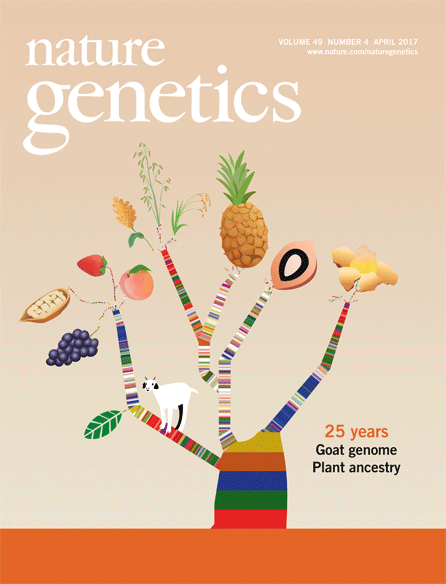
25 years of Nature Genetics


AprilThis April marks the 25th anniversary of the first issue of Nature Genetics, and I think it’s safe to say that the field of genetics has come quite a long way. In 1992, we were still nearly a decade away from the draft human genome sequence, “omics” was not yet a word in common usage, and CRISPR/Cas9 gene editing wasn’t even a pipe dream.

Most of the content in our current issue would have possibly seemed like far-fetched science fiction to geneticists in 1992. Take for instance the new-and-improved domestic goat genome assembly reported on page 643 of this issue, for which multiple, relatively new technologies were employed to create one of the most complete and contiguous genome assemblies to date. However, as the News & Views by Kim Worley exemplifies, science marches on. While the geneticists of the past might have marveled at the possibility of a whole-genome shotgun assembly (indeed, a major advance reported in that first issue was a new technology allowing for automated sequencing of 106kb), Worley refers to the scientists of the present who are “frustrated with the highly fragmented genome sequences available for most species.”

Still, many things have remained the same.

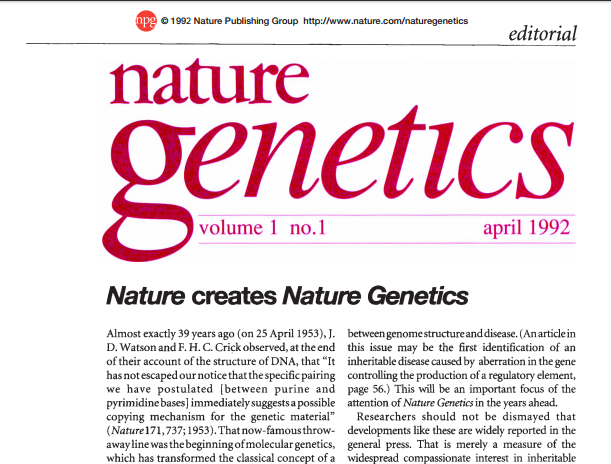
Taking a look back at the very first editorial published in the journal, much of the journal’s mission in 1992 is still applicable to 2017. Take this passage:

“Researchers should not be dismayed that developments like this are widely reported in the general press. That is merely a measure of the widespread compassionate interest in inheritable disease. Who can be but flattered by such public testimony to the importance of a field of research?

“The research community’s interest, rather, is that there should also be a wide general understanding that the identification of an aberrant gene does not imply that there is a cure at hand for the condition for which it is responsible. […] The elucidation of the mechanisms by which genes determine the behaviour of the cells that carry them will be a general preoccupation in the years ahead. Nature Genetics intends to play its part in the publication of this important research, and also of course, in classical genetics that throws light on the human genome.”
NG1992

{credit}doi:10.1038/ng0492-1{/credit}

While there is no denying that important medical advances have been enabled by the identification of disease genes, it is still painfully true that simply finding the gene does not directly lead to a cure on its own. Thus, both the identification of new disease-causing genetic alterations and studies that bring new mechanistic understanding of how a given mutation gives rise to disease are still core to the journal’s scope and aims.

The focus of the journal, as can be seen from this first editorial, was very much on human genetics at the beginning. Model organisms were considered just that, models for human biology. One of the major changes in the journal since that time has been our expansion to genetics (and genomics) more broadly, as represented by the many reference genomes and population genetics studies published for other organisms.

Too many landmarks to count

The editorial published in this month’s issue highlights a few selected articles from our among our more than 5,000 research publications over the years. These are obviously a restricted set of examples, and they are by no means the “best” papers, as such a ranking system would be ill-advised and ultimately useless. But the papers selected cover a wide range (though not all) of the sub-fields represented by the journal. This list includes landmark papers in human genome mapping (Kong et al. 2002) and cataloging of genetic variation (Iafrate et al. 2004); statistical methods that helped drive an entire field of research (Price et al. 2006); Mendelian disease gene discoveries that shed new light on biological mechanisms (Amir et al. 1999); key advances in the field of epigenetics (Heintzman et al. 2007); and advances in crop plant improvement (Ren et al. 2005).

We invite you to take a trip down memory lane and revisit these and other landmark papers from our archives. As a part of the celebration of 25 years of Nature Genetics, the editors will be blogging throughout April to highlight some of our past content.

A brief history of Nature Genetics

Nature Genetics was launched as the first of the Nature Research journals (if we ignore the very brief existence of Nature New Biology and Nature Physical Science in the early 1970s and the earlier version of Nature Biotechnology, Bio/Technology, published first in 1983).

While the history of genetics as field is by far more interesting than the history of a single journal, the occasion of our 25th anniversary has us thinking about our roots. For our 15th anniversary, founding editor Kevin Davies contributed a guest editorial telling the story of how Nature Genetics came about. I highly recommend that you check it out, if you haven’t seen it before.

Another feature of our 15th birthday celebration was the Question of the year. What would you do if the $1,000 genome were a reality today? To read the nearly 50 replies we received from leaders in the field, see the Question of the Year special here: https://go.nature.com/2mTMKBf.

The next 25 years

Just as researchers in 1992 would have been very unlikely able to predict the many breakthroughs that have occurred in genetics over the past 25 years, we have no idea where the next 25 years will take us. The goals will remain the same: to elucidate the mechanisms by which the genetic material produces the many phenotypic variations we see in nature and to identify the causes (and, more hopefully, cures) for human genetic disease.

That said, let’s take a stab at looking toward the future. What do you think will be the next major breakthrough in genetics? What will the field of genetics look like in another 25 years? Tell us below in the comments.

25 years from now, I hope to still be watching as geneticists make some of the greatest discoveries in biology. And I am confident that Nature Genetics will be there, playing its small role in announcing those discoveries to the world.


Highlighting genomes for DNA Day 2016

October 2015 cover

October 2015 cover “Histone butterflies” by Luisa Lente. Inspired by Salvador Dalí.

Today is national DNA day, celebrating the completion of the Human Genome Project in 2003 and the publication of the proposed structure of DNA in 1953 by James Watson and Francis Crick (PDF here).

This year for DNA day, we wanted to highlight papers reporting new genome sequences of organisms from peanuts to Papilio butterflies published in Nature Genetics over the last year. All reference genomes are published open access under a CC-BY licence.  Continue reading

Sex in Science

sex in scienceThis is a guest blog post by Prof. Eleftheria ZegginiEle trained in Biochemistry (BSc) and Immunogenetics (PhD) in Manchester, UK, before undertaking a post doc and subsequently a Wellcome Trust Research Career Development Fellowship in Oxford. She joined the Wellcome Trust Sanger Institute in Hinxton, UK, and is on the Human Genetics Faculty. Ele’s scientific interests focus on the genetics of complex traits, primarily cardiometabolic and musculoskeletal phenotypes, and on addressing relevant statistical genetics issues. She also leads the Wellcome Genome Campus-wide Sex in Science programme (https://www.sanger.ac.uk/workstudy/sexinscience/), which engages a wide base of scientists and drives policy and practice change.

Nature is committed to gender equality in the sciences. For more information, see our 2013 focus on Women in Science and recent Nature commentaries listed below. 

By: Eleftheria Zeggini

Stats and facts

Internationally, women are represented in diminishing proportions as career levels progress and significant numbers of women leave science altogether. Commensurate with societal and cultural shifts, the issues that cause this well-recognised leaky pipeline now affect not only women scientists, but increasingly also men in science. In the UK, women are the underrepresented majority in science, making up ~17% of professors in all science, technology, engineering and mathematics (STEM) disciplines (with some variation across disciplines)1. For example, in the Biological Sciences women make up 58.4% of graduates2 but only 25.1% of professors3. The picture is very similar across Europe and in the US, where women earn 41% of PhDs in STEM fields but make up only 28% of tenure track faculty4. Women are also less likely to receive funding. For example, out of 22 European countries contributing data, 17 reported higher success rates for men5; the same trend is observed in data published by major funders in the UK6,7.There is also a well-documented pay gap. In the UK, women who work full time earn 17% less than men based on mean hourly earnings8; in Europe the official measure of the gender gap covering the entire economy was reported to stand at 25%9.

The case for change 

There are numerous cogent arguments for addressing gender imbalance in science, ranging from fundamentally ensuring fairness and equality of opportunity (the moral case), to the financial and business cases for change. For example, approximately 820,000 science, engineering and technology (SET) professionals will be required in the UK by 202010. This unmet need can only be fulfilled by recruiting and retaining more women in scientific careers11,12. Increasing women’s participation in the UK labour market could be worth between £15 billion and £23 billion (1.3-2.0 per cent of GDP), with STEM accounting for at least £2 billion of this11.

case for changeThe business case is equally compelling. Heterogeneity in groups leads to improved diversity of perspectives, improved organisational performance and efficiency, increased productivity and creativity, better decisions and problem solving. It improves the ability to attract and retain the best talent, increases satisfaction and commitment within the workforce, and produces greater flexibility for organisations to respond to changing trends13,14.

Changing the landscape

Recent years have witnessed a swell of efforts to drive change. In the UK, the Equality Challenge Unit’s Athena SWAN Charter15, launched in 2005, has had a transformative effect16,17. Sally Davies’ inspired move to directly link possession of an Athena SWAN Silver Award to research funding eligibility in 2011 propelled it up the agenda of UK Universities 18. The European Union has been equally active in driving policy and practice reform, and international initiatives are further catalysing change 19,20. There are several strands along which efforts align –they form part of our toolset for changing the landscape.

Raising awareness

The statistics are rather stark when it comes to the paucity of women in scientific leadership positions. It is important to make equality and diversity, not just gender balance, a subject of conversation across all scientists including, crucially, senior management. Regular events such as talks, panel discussions, workshops and debates can help raise awareness across the board and weave this topic into the fabric of workplace discourse.

Catalysing institutional change

Commitment from the higher echelons of organisations is a sine qua non in driving change. Enlightened employers understand that, to be effective, diversity has to be viewed as a strategic resource. For example, embedding gender balance into institutional strategy at the Wellcome Genome Campus in Hinxton, UK has helped achieve significant changes in culture, practice and policy, as evidenced by the recent launch of a returners fellowship21, a workplace nursery scheme, and a carers’ grant through which expenses incurred for caring responsibilities while travelling for work can be claimed22. Organisations can promote flexible working by enhancing the portfolio of relevant policies, making them prominent and easy to implement, by rewarding enlightened managers and colleagues23, and shifting the perceived culture of presenteeism. Transparency in workload allocation models can be key to ensuring fairness across the board 24,25. It is important to be mindful of how policies affect the whole employee base and to be cognisant of the potential disadvantages that established practices may confer, e.g. important meetings held at the end of the day or exclusive networking opportunities. Taken in isolation, these effects may be small, but their cumulative impact is substantial.

Addressing bias and challenging preconceptions

A first step towards tackling unconscious bias involves training for all, not just managers, but the entire workforce. Overt sexism occasionally rears its ugly head, although thankfully in diminishing frequency. Calling out inappropriate behaviour remains important and there are recent examples of concerted reactions, capturing the zero tolerance attitude of our time26. In everyday scientific life there are opportunities to point out instances when opinions are ignored, inappropriate comments are made, contributions are overlooked or double standards are applied27,28. Preconceptions should be challenged, for example the attributes of a good leader no longer follow the aggressive, sometimes despotic paradigm modelled by previous generations.

Promoting role models

The paucity of female role models powers a vicious circle that can be disrupted. Inspirational talks delivered by women and men scientists who have navigated successful careers whilst achieving work-life balance, can be peppered with great advice, relatable anecdotes, valuable insights and reflections. Further action can be taken by redressing the prevalent gender imbalance on conference organising committees and invited speaker lists. Public engagement and press-related activities can help further raise the profile of women researchers and provide role models for the next generation of potential scientists.

Mentoring and sponsoring

Mentoring and networking programmes can help support those at a junction in their careers. Although mentoring is valuable and important, women are typically over-mentored and under-sponsored. Mentors can be helpful in providing thoughtful insights and advice, but the challenge can be finding strategic support in a sponsor. Sponsors are powerfully positioned champions who advocate for their protégé’s career progression. This imbalance can only change through a drastic culture shift.

Increasing the number of women in senior scientific positions

It is well established that the proportion of women applicants for senior roles, e.g. for faculty positions, is low. To ameliorate this, search committees should be tasked to consider the full applicant pool and to proactively encourage suitable women candidates to apply. Recruitment practices can be improved by training shortlisting and interview panels on unconscious bias. For example, studies show that identical CVs are rated more highly when they appear to have a male name attached to them29. Similar considerations apply to committees evaluating grant applications, individual reviews and promotions.

Increased representation on decision-making committees

This can be accomplished by expanding membership criteria to avoid overburdening the typically small number of senior women in any given organisation, for example by including senior non-faculty scientists. This is also accompanied by career development, training and succession planning benefits.

Talent, diversity, opportunity and resource are key structural elements of scientific excellence. It is high time we disrupted historical trends to reinforce these pillars, transform science for everyone and reap the many rewards.

References

  1.  WSC 104 [Scienceogram UK]; WSC 79 [Department for Business, Innovation & Skills (BIS) and the Northern Ireland Assembly] para 6).
  2. HESA Student Record 2013 -2014
  3. HESA Staff Record 2012/13)
  4. https://www.whitehouse.gov/sites/default/files/microsites/ostp/stem_factsheet_2013_07232013.pdf
  5. https://ec.europa.eu/research/science-society/document_library/pdf_06/she-figures-2012_en.pdf
  6. https://blogs.royalsociety.org/in-verba/2014/09/24/gender-balance-among-university-research-fellows/
  7. https://www.wellcome.ac.uk/stellent/groups/corporatesite/@msh_publishing_group/documents/web_document/wtp058642.pdf
  8. https://webarchive.nationalarchives.gov.uk/20100212235759/http:/www.equalities.gov.uk/pdf/297158_WWC_Report_acc.pdf
  9. https://ec.europa.eu/research/science-society/document_library/pdf_06/she_figures_2009_en.pdf
  10. Science and Technology Committee, Seventh Report of Session 2012–13, Educating tomorrow’s engineers: The impact of Government reforms to 14-19 education, HC 665, para 9
  11. WSC 74 [Society of Biology] para 1 – written evidence submitted by Society of Biology
  12. Tapping all our Talents. Women in science, technology, engineering and mathematics: a strategy for Scotland, April 2012, Royal Society of Edinburgh, para 3
  13. Subeliani, D. and Tsogas, G. (2005), “Managing diversity in the Netherlands: a case study of Rabobank”, International Journal of Human Resource Management, Vol. 16, No.5 May; pp 831-851.
  14. Ozbilgin, M. F. and Tatli, A. (2011), “Mapping out the field of equality and diversity: rise of individualism and voluntarism”, Human Relations, Vol. 64, No. 9; pp 1229- 1253.
  15. https://www.ecu.ac.uk/equality-charters/athena-swan/
  16. https://www.ecu.ac.uk/wp-content/uploads/2015/04/Athena-SWAN-Impact-Report-2011-1.pdf
  17. https://www.ecu.ac.uk/wp-content/uploads/external/evaluating-the-effectiveness-and-impact-of-the-athena-swan-charter.pdf
  18. https://www.medschools.ac.uk/SiteCollectionDocuments/Letter_from_Dame_Sally_Davies_-_Women_in_Science.pdf
  19. https://www.gender-net.eu/
  20. https://www2.ed.gov/programs/innovation/index.html
  21. https://www.sanger.ac.uk/workstudy/career/fellowship/
  22. https://www.sanger.ac.uk/workstudy/sexinscience/
  23. https://www.sanger.ac.uk/about/press/2015/150308.html
  24. ‘The management of academic workloads: improving practice in the sector’, Peter and Lucinda Barrett, University of Salford/Leadership Foundation, 2009
  25. ‘Promoting positive gender outcomes in HE through active workload management’, Peter and Lucinda Barrett, University of Salford, 2013
  26. https://www.nature.com/news/specials/women/index.html
  27. https://www.cynthiabulik.com/blog/
  28. https://occamstypewriter.org/athenedonald/
  29. https://www.pnas.org/content/109/41/16474.abstract


More from Nature.com:


Double-blind peer review

Apaga_La_Luz_Y_Verás

{credit} “Apaga La Luz Y Verás” by Blofeldcine – Own work. Licensed under CC BY-SA 3.0 via Wikimedia Commons{/credit}

In this month’s editorialNature Genetics announces a new option available to authors at all monthly Nature Research Journals. Authors will now be able to opt in to double-blind peer review, so that anonymous reviewers will not have access to the authors’ identities. It will be the authors’ responsibility to make sure that their identities are removed from the manuscript. The decision to implement this option was made based on surveys of the scientific community and researcher feedback. What do you think of double-blind peer review? Will you choose this option for your own manuscripts? Why or why not? Let us know in the comments section below.

Mentoring for success in science

Success_imageOn November 14, the Junior Faculty at Karolinska Institutet in Stockholm, together with Nature Genetics, hosted a workshop for early-career researchers about mentoring in the sciences. The goal of the workshop was to identify what postdocs and new faculty members wanted from a potential mentor and how the institute could go about establishing a formal mentoring program. The workshop was a direct result of a previous workshop at KI, also co-organized by Nature Genetics. A commentary about that workshop can be found here.

Formal mentoring programs, while rare, do exist at other institutions. For example, one of the day’s speakers, Pam Ohashi, spoke about the mentorship program at the University of Toronto. Professor Ohashi spoke about the need to convince the institute that mentoring is important and will benefit the institute in the long run. In addition, it is important to provide incentives for mentors, such as including mentoring outcomes in annual performance reviews. In a formal mentoring program, an official within the institute or department (such as the department or division chair) will pair mentors and mentees. Together with the mentee, the mentor should outline an implementation plan so that specific goals can be set and progress toward them monitored. Professor Ohashi also emphasized that mentoring needs to be flexible and tailored to the specific individual. Common questions mentors had for mentees, in her experience, were related to personnel management, how to navigate the promotion process, how to write successful grant applications and what expectations should be set for trainees.

We also heard from two previous recipients of the Nature awards for mentorship in science: Barbara Demeneix and Andrew McMichael. Professor Demeneix also emphasized the point that mentoring should be a part of the career assessment for professors. This is because both the institute and mentor benefit from mentoring, not just the mentee. She also noted that mentors should be mindful of particular difficulties faced by women when mentoring young female colleagues. Professor McMichael pointed out that scientists can have many mentors, both formal and informal, throughout their careers, and that networking (such as at conferences) is crucial especially for identifying potential informal mentors. He also made an important point in that mentees have duties to their mentors, not just the other way around. You shouldn’t only contact your mentor when you need something from them.

The need for incentives for mentors was emphasized by nearly all of the speakers. Although, as one speaker noted, mentoring future scientists is an essential part of the scientific system, professors are busy and may see it only as an added burden. What kind of incentives, and how they might be implemented, was a topic of discussion. 

Telemachus and Mentor in the Odyssey

Telemachus and Mentor in the Odyssey{credit}Wikipedia{/credit}

Another issue discussed was how to maintain a mentoring program once one was established. There should be a specific person in charge of pairing mentors and mentees and making sure that incoming faculty and postdocs are assigned mentors as early as possible. There was also a general consensus that there should be regular meetings between mentors and mentees and that progress of the relationship should be formally evaluated, though what criteria should be used for evaluation was an open question.

Finally, many junior faculty members noted that the number one thing they wanted from a mentor (in addition to general career advice) was access to the mentor’s network. For example, young faculty may not know who is the best person to contact for help with a specific problem, but the mentor (a more established faculty member) will likely be able to point to the right contacts.

Based on the information from the speakers and feedback from participants and department officials present at the workshop, the Junior Faculty will likely implement a pilot program to determine the best model for an institute-wide mentoring program.

Mentorship can be an important part of each stage of an academic career, and we applaud the Junior Faculty for taking this first step toward a formal mentorship program at KI. We look forward to hearing the feedback from the workshop and seeing how the program unfolds.

NIH Common Fund song & video contests

“We want to know whether our future baby’s health is based on genes or the environment.” This is a concern shared by a lot of would-be parents for sure, and is the question posed to Dr. M. Elizabeth Ross at the beginning of this short video. The video, made by the labs of Dr. Ross and Dr. Christopher E. Mason at Weill Cornell Medical College is part of a competition sponsored by the NIH to commemorate the 10th anniversary of the Common Fund.

Logo for the NIH Common Fund 10-Year Commemoration Song & Video Competitions

The video takes a tongue-in-cheek approach to explaining an NIH-funded project investigating the role of epigenetic changes in birth defects. The contest ends tomorrow, May 9, and the results will be determined by the number of “Likes” the videos receive on YouTube.

To vote for this or any of the other amazing videos (and songs), check out the contest page here.