Nature Chemistry’s Altmetric top 10 for 2016

Altmetric recently posted its usual top-100 list and, as usual, there was very little chemistry to be found on it (maybe the reasons behind that should be the subject of a long soul-searching post or editorial, but that’s for another day year). After I had a little moan on Twitter, @nunobimbo asked if we’d post Nature Chemistry‘s top 10 as we did back in 2013. So, here goes… (note: I only considered Articles that appeared in 2016 print issues and these numbers are correct as of Dec 14th, 2016).

––––––––––––––––––––

1. Fast and selective ring-opening polymerizations by alkoxides and thioureas
Xiangyi Zhang, Gavin O. Jones, James L. Hedrick & Robert M. Waymouth

nchem.2574-TOC
(Altmetric score for this list = 694)
(Page views as of the date of this list = 7,746)

––––––––––––––––––––

2. Imaging single-molecule reaction intermediates stabilized by surface dissipation and entropy
Alexander Riss, Alejandro Pérez Paz, Sebastian Wickenburg, Hsin-Zon Tsai, Dimas G. De Oteyza, Aaron J. Bradley, Miguel M. Ugeda, Patrick Gorman, Han Sae Jung, Michael F. Crommie, Angel Rubio & Felix R. Fischer

nchem-TOC-Fischer
(Altmetric score for this list = 447)
(Page views as of the date of this list = 7,553)

––––––––––––––––––––

3. Molecular rectifier composed of DNA with high rectification ratio enabled by intercalation
Cunlan Guo, Kun Wang, Elinor Zerah-Harush, Joseph Hamill, Bin Wang, Yonatan Dubi & Bingqian Xu

nchem.2480-TOC
(Altmetric score for this list = 343)
(Page views as of the date of this list = 4,136)

––––––––––––––––––––

4. Self-assembling biomolecular catalysts for hydrogen production
Paul C. Jordan, Dustin P. Patterson, Kendall N. Saboda, Ethan J. Edwards, Heini M. Miettinen, Gautam Basu, Megan C. Thielges & Trevor Douglas

Douglas_nchem.2416
(Altmetric score for this list = 331)
(Page views as of the date of this list = 8,092)

––––––––––––––––––––

5. A highly stretchable autonomous self-healing elastomer
Cheng-Hui Li, Chao Wang, Christoph Keplinger, Jing-Lin Zuo, Lihua Jin, Yang Sun, Peng Zheng, Yi Cao, Franziska Lissel, Christian Linder, Xiao-Zeng You & Zhenan Bao

nchem-TOC-Bao
(Altmetric score for this list = 285)
(Page views as of the date of this list = 27,427)

––––––––––––––––––––

6. The structural and chemical origin of the oxygen redox activity in layered and cation-disordered Li-excess cathode materials
Dong-Hwa Seo, Jinhyuk Lee, Alexander Urban, Rahul Malik, ShinYoung Kang & Gerbrand Ceder

nchem.2524-TOC
(Altmetric score for this list = 167)
(Page views as of the date of this list = 5,108)

––––––––––––––––––––

7. Neutral zero-valent s-block complexes with strong multiple bonding
Merle Arrowsmith, Holger Braunschweig, Mehmet Ali Celik, Theresa Dellermann, Rian D. Dewhurst, William C. Ewing, Kai Hammond, Thomas Kramer, Ivo Krummenacher, Jan Mies, Krzysztof Radacki & Julia K. Schuster

nchem.2542-TOC
(Altmetric score for this list = 157)
(Page views as of the date of this list = 3,610)

––––––––––––––––––––

8. A supramolecular ruthenium macrocycle with high catalytic activity for water oxidation that mechanistically mimics photosystem II
Marcus Schulze, Valentin Kunz, Peter D. Frischmann & Frank Würthner

nchem.2503-TOC
(Altmetric score for this list = 156)
(Page views as of the date of this list = 6,202)

––––––––––––––––––––

9. Force-induced tautomerization in a single molecule
Janina N. Ladenthin, Thomas Frederiksen, Mats Persson, John C. Sharp, Sylwester Gawinkowski, Jacek Waluk & Takashi Kumagai

nchem.2552-TOC
(Altmetric score for this list = 145)
(Page views as of the date of this list = 4,035)

––––––––––––––––––––

10. Diindeno-fusion of an anthracene as a design strategy for stable organic biradicals
Gabriel E. Rudebusch, José L. Zafra, Kjell Jorner, Kotaro Fukuda, Jonathan L. Marshall, Iratxe Arrechea-Marcos, Guzmán L. Espejo, Rocío Ponce Ortiz, Carlos J. Gómez-García, Lev N. Zakharov, Masayoshi Nakano, Henrik Ottosson, Juan Casado & Michael M. Haley

nchem.2518-TOC
(Altmetric score for this list = 144)
(Page views as of the date of this list = 5,248)

––––––––––––––––––––

(Note: it seems as though the page views on the metrics pages only go up to Dec 2… we’ll maybe have someone look into that…)

Journal journeys: Day 2939, end of an era

After almost 8 years, 2785 new manuscripts (of which I’ve ultimately published almost 300) I’m leaving Nature Chemistry.

I wholeheartedly agree with Neil,  when he said (some 3½ years ago) that it’s been a privilege to work on this journal from the start. I’ve travelled all over the world doing it (including spending a little over 7 years living in Boston (living longer there — with the exception of my family home — than anywhere else in my life).

I’ve attended something in the range of 30–40 conferences in that time and met up with many of the authors, reviewers and readers who are at the heart of what we do — thanks to all of them for making the job so interesting and rewarding. Thanks must also go to the rest of the team; though I’ve been about 3500 miles away for most of that time, it wouldn’t have been half as much fun without them. And thankfully, I’m not going to be going too far as I will move just across the street to take up a new role based here at NPG towers — more on that to come, but if you fancy coming to work with me then check out this job ad and get writing.

There’s a decent chance you’ll still find me around here on the blog — I plan to keep you in the loop with what is going on in my new role.

Steve

Stephen Davey (for one last time, Senior Editor, Nature Chemistry)


Crystal clear data

A change in one of our publication policies had been brewing for a while at the journal — and I’m happy to say that it has now been implemented: we have updated our requirements regarding the crystallographic characterization of small molecules. This is reflected in our guide to authors.

Until now we had been asking authors to provide a standard crystallographic information file (CIF) for each new structure characterized by X-ray diffraction analysis. This file doesn’t represent the complete story though; other experimental and refinement information such as the structure factors (HKL or FCF files) and RES files also exist.

A few years ago, in an article on their website entitled ‘Publication standards for crystal structures’, the International Union of Crystallography (IUCr) recommended that for each newly determined structure, not only should the CIF file be provided, but also the corresponding structure-factor information — this has long been a requirement for the IUCr’s own journals. The structure factors are important for the structure determination and so should be available during the peer-review process, and may also be used by readers interested in the refinement of the structure once the paper has been published.

Endorsing this stance, the Cambridge Structural Database (CSD) has enabled the deposition of structure factors together with the main CIFs, and has also been making crystallographic information increasingly easy to access. One now only needs to be armed with a CCDC number, a CSD code, or the DOI of the paper in which the structure was reported, to acquire the desired crystallographic details (through https://summary.ccdc.cam.ac.uk/structure-summary-form).

We’re happy to have now adopted this practice. We are asking that manuscripts reporting new crystal structures be accompanied by CIF files and associated information about structure factors.

The best — or easiest — way to do so is to use an up-to-date version of SHELXL (2014 or later) which now embeds the HKL and RES files into the generated CIF (other programs may also do this, I’m not sure). If another program has been used, then the CIF and the structure-factor file (in HKL and/or FCF format) can be handled as two separate files.

Our other requirements haven’t changed; we’re still asking that an ORTEP-style illustration of the structure, with probability ellipsoids, appears in the main Supplementary Information. And CIF files — including structure factors — should be run through the IUCr’s free online CheckCIF routine, the output submitted with the manuscript files (these are just used during the reviewing process, we don’t host them with the published paper), and any A- or B-level alerts that come up be explained in the Supplementary Information file.

In due course we host all this crystallographic raw data with the Supplementary Information of the associated paper — see, for example, this recent paper (Nature Chemistry, 6, 1079–1083 (2014) here) — and hope that it proves useful to the crystallographic community.

Nature Chemistry’s 2014 impact factor citation distribution

As pointed out yesterday in a blog post by Stephen Curry (and indeed in at least one previous blog post), some journals publish their citation distributions (this has also been blogged about by Steve Royle too – and probably by many others that I’m not aware of, I’m sure). I’ve been interested in doing this for Nature Chemistry for a while now, but have never quite found the time – but after a brief exchange on Twitter this afternoon, I figured I should run the numbers… (what better way to spend a Friday evening?!).

So, according to Journal Citation Reports (JCR) from Thomson Reuters, the 2014 impact factor (announced in 2015) for Nature Chemistry was 25.325. How do they arrive at this number? Well, they count up how many times articles published in the journal in 2012 and 2013 were cited in 2014 and then divide that total by the number of ‘citable items’ (more on that later) that the journal published in 2012 and 2013. So, according to JCR, 2012/2013 content in Nature Chemistry was cited 6,458 times in 2014 and we published a grand total of 255 citable items in 2012/2013. Divide 6,458 by 255 and you get 25.325. Simple, eh?

Well, no. If you do a Web of Science (All Databases) search for Nature Chemistry for 2012-2013, you find that we actually published 451 items in those 2 years. There were 239 research papers (we call them ‘Articles’), 16 review-type articles (long ones we call ‘Reviews’ and shorter ones we call ‘Perspectives’), as well as Editorials, Commentaries, Research Highlights, News & Views articles and other ‘front-half’ material – all adding up to a total of 451 articles. It is only the Articles, Reviews and Perspectives (255 items) that count as citable items, however. What does this mean? It means that although the bottom half of the impact factor equation described above only includes these article types, citations to any of the journal content (including News & Views, Editorials, Commentaries, etc.) get counted in the top-half of the equation.

If you look at those 451 items in Web of Science, in 2014 they received a total of 6,402 citations (that’s already 56 fewer than the 6,458 used in the JCR impact factor calculation – so those extra 56 must be being pulled in from some other database by JCR). Of those 6,402 citations that are in Web of Science, Articles received 4,852 citations, Reviews/Perspectives received 1,206 citations and all the other front-half articles garnered a total of 344 citations, so the distribution of citations between different content types breaks down like this:

citation_breakdown

Now, just looking at the Articles and Reviews/Perspectives, we have a total of 255 items with 6,058 citations (we’re ignoring those 344 citations to other stuff) in 2014. That gives you an average of 23.8 citations (6,058 divided by 255) per Article/Review/Perspective. Of course, that is an average, and this is where citation distributions come in. If you list the articles in order from most cited to least cited and then plot article number versus citations, you get something that looks like this:

citable_items_decay

The most cited article is a Review (that was published in 2013) with 354 citations in 2014. Article number 2 on the list is a 2013 Perspective with 171 citations in 2014… and then we head to the end of the list where the 253rd, 254th and 255th articles all received 0 citations in 2014. That’s one way of plotting the data, but perhaps not the most useful. Another way to do it is shown below, whereby articles are put in bins defined by the number of citations received in 2014.

citable_items_distrubution

So that the graph is still meaningful, I lumped all of the 100+ citation papers into one bin at the end (a breakdown of what is included in there is shown on the graph). The official 2014 impact factor (25.3) is highlighted, along with the mean number of citations these article types actually received (23.8 – i.e., not inflated by the 344 citations included in the impact factor calculation that were actually cites to other content) as well as the median value too, which is 16. Only 29% of Articles/Reviews/Perspectives (that’s 73 of the 255) received more citations (26 or more) in 2014 than the calculated impact factor of the journal (25.3). The vast majority of articles received fewer citations (no more than 25) than the impact factor.

It’s well known that review-type articles are typically cited more than research papers (in chemistry at least and probably in other subjects too, I imagine) and so I repeated the analysis with just the research papers (the Articles) and left out the Reviews and Perspectives. The article number vs citations plot now looks like this:

articles_decay

The shape looks quite similar to the graph further up this post, but note that the scale on the y-axis is quite different. The highest-cited research paper was cited 151 times in 2014, with the 2nd, 3rd, 4th and 5th-placed Articles receiving 114, 113, 105 and 84 citations, respectively. If we plot the citation distribution, we get the following:

articles_distribution

After removing the Reviews and Perspectives from the equation, the mean number of citations received by just the research papers is now 20.3 rather than 23.8 (a drop of 3.5) and the median has dropped from 16 to 15. Only 61 of the 239 Articles (that’s 26%) received more citations (26 or more) in 2014 than the calculated impact factor of the journal; roughly three-quarters of all research papers received fewer. If you consider 20.3 to be the pure Article ‘impact factor’, this is still a very skewed metric, however. Of the 239 Articles, 86 of them (36%) received 21 or more citations in 2014 and the rest were cited 20 times or fewer.

When the 2015 impact factors get released in 2016, we’ll run the numbers again and compare the data to what’s above to see if anything has changed all that much.

Nature Chemistry’s Altmetric top 10 for 2013

Altmetric has released their 2013 Top 100 papers – journal articles that received the most online attention based on their Altmetric score. For more details behind the list, see this blog post. Nature Chemistry managed to get a whopping zero papers in this top 100, so I figured I’d find out what our Altmetric top 10 is for 2013 so that we don’t feel quite so left out. Remember: an Altmetric score doesn’t say anything about the quality of a paper, it’s just a measure of online buzz (which can result for many different reasons…).

And so, here it is (Altmetric scores for this list were retrieved on 10th December 2013).

1. Quantitative visualization of DNA G-quadruplex structures in human cells
Giulia Biffi, David Tannahill, John McCafferty & Shankar Balasubramanian
(Altmetric score for this list = 411)
(Page views as of the date of this list = 93,831)

2. Self-healing chemistry enables the stable operation of silicon microparticle anodes for high-energy lithium-ion batteries
Chao Wang, Hui Wu, Zheng Chen, Matthew T. McDowell, Yi Cui & Zhenan Bao
(Altmetric score for this list = 204)
(Page views as of the date of this list = 4,629)

3. A grossly warped nanographene and the consequences of multiple odd-membered-ring defects
Katsuaki Kawasumi, Qianyan Zhang, Yasutomo Segawa, Lawrence T. Scott & Kenichiro Itami
(Altmetric score for this list = 123)
(Page views as of the date of this list = 12,692)

4. Optical control of antibacterial activity
Willem A. Velema, Jan Pieter van der Berg, Mickel J. Hansen, Wiktor Szymanski, Arnold J. M. Driessen & Ben L. Feringa
(Altmetric score for this list = 96)
(Page views as of the date of this list = 6,698)

5. A missing link in the transformation from asymmetric to symmetric metallofullerene cages implies a top-down fullerene formation mechanism
Jianyuan Zhang, Faye L. Bowles, Daniel W. Bearden, W. Keith Ray, Tim Fuhrer, Youqing Ye, Caitlyn Dixon, Kim Harich, Richard F. Helm, Marilyn M. Olmstead, Alan L. Balch & Harry C. Dorn
(Altmetric score for this list = 92)
(Page views as of the date of this list = 2,097)

6. Layer-by-layer cell membrane assembly
Sandro Matosevic & Brian M. Paegel
(Altmetric score for this list = 91)
(Page views as of the date of this list = 2,821)

7. Accelerated chemistry in the reaction between the hydroxyl radical and methanol at interstellar temperatures facilitated by tunnelling
Robin J. Shannon, Mark A. Blitz, Andrew Goddard & Dwayne E. Heard
(Altmetric score for this list = 76)
(Page views as of the date of this list = 3,532)

8=. Site-specific positioning of dendritic alkyl chains on DNA cages enables their geometry-dependent self-assembly
Thomas G. W. Edwardson, Karina M. M. Carneiro, Christopher K. McLaughlin, Christopher J. Serpell & Hanadi F. Sleiman
(Altmetric score for this list = 69)
(Page views as of the date of this list = 5,461)

8=. Fluctuating exciton localization in giant π-conjugated spoked-wheel macrocycles
A. Vikas Aggarwal, Alexander Thiessen, Alissa Idelson, Daniel Kalle, Dominik Würsch, Thomas Stangl, Florian Steiner, Stefan-S. Jester, Jan Vogelsang, Sigurd Höger & John M. Lupton
(Altmetric score for this list = 69)
(Page views as of the date of this list = 4,105)

10. The use of elemental sulfur as an alternative feedstock for polymeric materials
Woo Jin Chung, Jared J. Griebel, Eui Tae Kim, Hyunsik Yoon, Adam G. Simmonds, Hyun Jun Ji, Philip T. Dirlam, Richard S. Glass, Jeong Jae Wie, Ngoc A. Nguyen, Brett W. Guralnick, Jungjin Park, Árpád Somogyi, Patrick Theato, Michael E. Mackay, Yung-Eun Sung, Kookheon Char & Jeffrey Pyun
(Altmetric score for this list = 63)
(Page views as of the date of this list = 10,450)

These are the top 10 research Articles. If you include other content from the journal, the list would look very similar, but this Editorial from the April 2013 issue would shoot into the chart at the number 2 position (Altmetric score = 206).

50 things you might not know about Nature Chemistry

On Monday I realized that our May 2013 issue is our 50th issue. To celebrate, we have compiled 50 (hopefully) interesting tidbits of information about the journal that you might not have been aware of. Apologies for the length of this post, but it seemed like cheating to do fewer than 50…

1. The first formal manuscript submission (i.e., made through our online submission system rather than being e-mailed to us before that went live) arrived on the 25th July 2008. It was sent out to three referees and was then, alas, declined for publication on the 5th September 2008.

2. The first Nature Chemistry research Article was published on February 22nd 2009. The corresponding author was Makoto Fujita and the paper was entitled: Minimal nucleotide duplex formation in water through enclathration in self-assembled hosts. According to Web of Science, as of today it has been cited 62 times.

3. We published 471 research Articles (not including review-type articles) in the first 50 issues of Nature Chemistry. On average, that’s just under 9-and-a-half papers per issue.

4. As of today, according to Web of Science our most cited research Article (in fact, our most-cited piece of content bar none) is this paper: New insights into the structure and reduction of graphite oxide by Pulickel Ajayan and co-workers. It has currently been cited 390 times. It was handled by Anne, who is very smug about this!

5. The first 50 issues piled on top of one another reaches the dizzying height of roughly 25 cm. This seems disappointingly small.

6. We spell ‘sulfur’ with an ‘f’ and here’s an Editorial explaining why.

7. While we are on the subject of spelling, I’m going to point out that we use Oxford English spelling. So, for all of you wondering why we put ‘z’s in lots of words that you don’t think we should, hopefully that answers your question. Quite a few authors have pointed out what they think are spelling mistakes to us. We do occasionally make mistakes, but using ‘ize’ words is not one of them.

8. The f-word made its debut in Nature Chemistry in the August 2012 Blogroll column written by Paul Bracher. It’s all DrRubidium‘s fault… Paul blogged about the experience here. The editorial team discussed if we should go ahead and use the word in all its glory and we decided we would (it wasn’t a unanimous decision). But it’s OK, it is in the Oxford English dictionary after all.

9. Every time Michelle Francl sends me a new Thesis article to edit, I have to look something up in the dictionary. Which is great! The two most recent examples were ‘hermeneutic‘ and ‘sequelae‘…

10. Four of the five original editorial team members are pretty big football fans (the one with the round ball for all you North Americans, you know, the one where a ‘ball’ is kicked with a ‘foot’ for the vast majority of the game… hence the name). Bearing that in mind, I was quite pleased that I was able to get a mention to Manchester United in the March 2011 Editorial.

11. In a similar vein, Gav, who is a massive Sunderland AFC fan, managed to get this phrase into the March 2012 Editorial: How dull would our existence be if everything was black and white — that’s a subtle dig at Sunderland’s big rivals (arch nemeses might be a better description…), Newcastle United, who play in black-and-white stripes (Sunderland play in red-and-white stripes).

12. And speaking of Nature Chemistry Editorials, the one that appeared in the April 2013 issue was all about how the journal uses Twitter. What was a little unusual, however, was that it was written as a sequence of 42 tweets, complete with a Douglas Adams reference at the end. We live-tweeted the editorial the day that it was published in the journal.

13. After the expression ‘rise of the internet’ innocently made its way into the first two Editorials published in the journal (April 2009 and May 2009), it became a bit of a running joke to try and squeeze it into subsequent Editorials. It made into the June 2009, July 2009 and September 2009 Editorials. I think we then mostly forgot about it; but the phrase did make a comeback in the Editorials in the August 2011 and September 2011 issues.
tea

{credit}Taken with Stu's trusty iPhone{/credit}

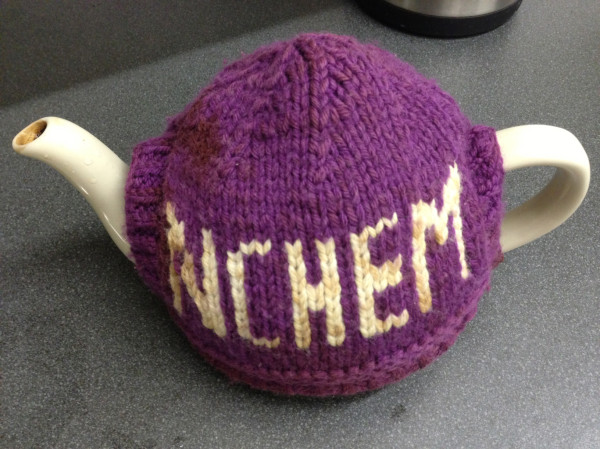
14. Nature Chemistry editors are, for the most part, fuelled by tea. We even have our own tea cosy, knitted by our former editorial assistant, Hollie.

15. There must be something in the water that we use to make the tea — 4 of the 5 original members of the editorial team got married (not to each other) while working on Nature Chemistry.

16. We’re quite particular about what goes on the cover of the journal; we even wrote an Editorial about cover images, outlining our disdain for arbitrary background images. Here’s a short quote: Shimmering oceans, rippling pools, starry skies, breathtaking sunsets and other equally romantic visions are lovely, but please refrain from putting this type of imagery in the background of your cover suggestion unless you have a really good reason to do so…

17. Hand-drawn chemical structures have appeared on four different Nature Chemistry covers (Oct 2009, July 2010, June 2011); including some structures drawn by yours truly (May 2012).

18. Anne has actually appeared on the cover of the journal. Along with many other female chemists, a picture of Anne was used to form the mosaic of Marie Curie that graced the cover of the September 2011 issue.

19. Pictures of all of the founding editors appeared in the Editorial in the very first issue. This turned out to be quite useful for Gav, who used a hardcopy of issue 1 as photo ID during his visit to Salt Lake City for the 2009 Spring ACS meeting. Yes, this is true.

20. We’re fussy about graphical abstracts too — we covered that in an Editorial as well. We have made it on to tocrofl at least a couple of times (here and here) though…

21. We’re big fans of Twitter and currently the journal has just under 73k followers. All of the editors on the team have their own accounts too: me, Steve, Gav, Anne and Russell.

22. Our first tweet from the journal was made at 10:10 in the morning on the 10th March 2009 — here it is.

23. After a lunch-time conversation in the canteen here at Nature Towers, we started to wonder who the greatest chemist of all time was. We held a completely unscientific poll on Twitter and here are the results (spoiler alert: Pauling won). We then wrote in more detail about the question itself in an Editorial.

24. We have (deliberately) printed some text upside down in the hardcopy of the journal. Bruce Gibb‘s first Thesis article included a quiz and so it just seemed like a good idea to print the answers upside down at the end of the article. We didn’t do this in the online version…

25. We don’t do it as much as Angewandte Chemie, but we do occasionally come up with punny titles, especially for research highlights — many of which are based on song titles. Two of my favourites are Ice ice maybe and Come on silene.

26. Each month we need to come up with four cover lines for the journal, based on the papers published in that issue. When all else fails, we turn to The Phrase Finder, RhymeZone and Google News.

27. We held a science writing competition based on the In Your Element feature in the journal as part of the activities associated with the International Year of Chemistry. The Editorial in the December 2011 issue summarizes the results of the competition.

28. We use a real periodic table to keep track of which elements have been (or are in the process of being) covered for the In Your Element section of the journal. Having said that, we haven’t updated it for a while…

29. Talking of periodic tables, the one we published in only the second issue of Nature Chemistry contained two entries for thorium (Th). Oops. Here’s the erratum.

30. That’s probably not our most embarrassing error, however. In the very first issue, we said that the ratio of hydrogen to oxygen in water (you know, that stuff H2O) was 1:2. Erm, no. Here’s the erratum.

31. Another embarrassing error is that we have published a stock image of left-handed DNA. No, not Z-DNA, just a normal DNA helix that happens to be left- rather than right-handed. Oops again. It was in this Thesis article ($).

32. We’ve published a picture of Kate Moss in the journal; albeit her likeness cast in gold. Here’s the statue as it appeared in the The Telegraph — we cropped it somewhat more tastefully for this book review ($) by Andrea Sella

33. Members of the extended editorial team donned Nature Chemistry labcoats and took part in a photoshoot for Dennis Curran’s Thesis article ($) in the December 2012 issue.

34. We’ve probably given away hundreds of those Nature Chemistry-branded labcoats at conferences over the past few years. We have a handful left in the office (good for photoshoots — see point 33!).

35. We’ve even branded a bus with the Nature Chemistry logo!

36. After Neil left us to join the Chemistry World crew, we’ve invited bloggers out there in the wild to write the Blogroll column that appears in the journal each month. So far, we have had: Chemjobber, Paul Bracher, See Arr Oh, BRSM, Ashutosh Jogalekar, Karl D. Collins, Adam Azman, DrFreddy, JessTheChemist, DrRubidium, and Mark Lorch pen the column for us.

37. We’ve been featured on Thomson Reuters’ Science Watch site.

38. We’ve also featured in two April Fools’ blog posts by See Arr Oh at Just like Cooking — here and here.

39. When it turned out that a stock photo of bismuth was going to be far more expensive than simply buying a lump of bismuth and photographing it — we bought a lump of bismuth. And took a photo. And published it in this In Your Element article ($). I still have the bismuth on my desk in the office, but it’s had an accident since we first bought it…

40. So when we needed to illustrate the In Your Element article on selenium, we obviously went out and bought some… brazil nuts. That In Your Element essay can be found here ($).

41. In the name of SCIENCE, the editorial team took a trip to our local liquid nitrogen ice cream parlour. We’ve been back since.

42. While talking about tasty treats, the current Physical Sciences Bake Off Champion (for biscuits — cookies for North Americans) is yours truly — I’m still a synthetic chemist at heart! Find out more about my progress through the competition rounds here.

43. The journal has even published a recipe to make a curry! (From this Thesis article ($) by Bruce Gibb).

44. We celebrated the International Year of Chemistry by publishing a collection of seven Commentary articles about broader issues in chemistry beyond just the science itself. It was meant to be eight Commentaries, but one author dropped out.

45. We’ve published a handful of what we call ‘focus issues’ where we bring together a small number of pieces of content on a similar topic. These include prebiotic chemistry, site-selective reactions, small DNA binders, and protein dynamics.

46. Hannah, who spent a week doing some work experience at Nature Chemistry and other divisions in the company, wrote up her experiences for our blog in (awesome) poem form.

47. When an author has sent us a really good piece for the journal that is just too long for the section it is intended for, we have used our blog to publish the additional material. This includes a fascinating essay by Dan O’Leary on deuterium (and related issues) and a great piece by R. J. Dwayne Miller on molecular motors.

48. Two PHD Comics have appeared in Nature Chemistry, one in this Editorial on posters and the other in this Thesis article ($) by Michelle Francl (which included this comic).

49. So far we have received two impact factors — here are blog posts analysing them.

50. And we’ve even published a cartoon of a chemistry yeti/bigfoot/sasquatch (whatever you want to call it…) in this Thesis article ($) by Michelle Francl on urban legends of chemistry.

Making more of methods

As a synthetic chemist the first thing I usually want to know about a chemical compound is “How did they make it?” and then “How do they know they made it?” However, synthetic procedures and characterization data for compounds are often found lurking in an article’s Methods section or in the depths of the Supplementary Information.

Not any more! We are now testing a new feature for the Nature Chemistry website that displays the procedure for making a chemical compound on its compound information page. Our first example of this can be found in Howard Colquhoun’s article in the August issue of Nature Chemistry which is live online today.

Compound pages – which display lots of other useful information about the structure – are easily accessed by clicking on hyperlinked bold compound numbers in the HTML version of an article. Where the paragraphs of text describing the synthesis and characterization of the compound are provided by an author, they will be displayed under the heading “Synthetic Procedure” on these pages. From the procedure you can view any other structures mentioned by bold number and navigate to their compound pages by hovering or clicking on the hyperlinked numbers respectively. This makes it really easy to follow the chain of the reaction you are interested in.

Following the links at the top of the compound pages you can still jump back to the article to find the full experimental details in the Methods section or Supplementary Information. We also encourage authors to provide us with raw data files – such as CIF files – which can be displayed on the compound pages.

We hope that including synthetic procedures and data on the compound pages makes it faster to browse for what you are looking for. Pulling all this information together in the article HTML will not only feed OSCAR the journal-eating robot, but also make life easier for over-worked lab-rats bench-monkeys post-graduate students.

Have a play and see what you think – this is only at quite an early stage, so any feedback would be gratefully received.

Laura

Laura Croft (Technical Editor, Nature Chemistry)

Making more of methods

As a synthetic chemist the first thing I usually want to know about a chemical compound is “How did they make it?” and then “How do they know they made it?” However, synthetic procedures and characterization data for compounds are often found lurking in an article’s Methods section or in the depths of the Supplementary Information.

Not any more! We are now testing a new feature for the Nature Chemistry website that displays the procedure for making a chemical compound on its compound information page. Our first example of this can be found in Howard Colquhoun’s article in the August issue of Nature Chemistry which is live online today.

Compound pages – which display lots of other useful information about the structure – are easily accessed by clicking on hyperlinked bold compound numbers in the HTML version of an article. Where the paragraphs of text describing the synthesis and characterization of the compound are provided by an author, they will be displayed under the heading “Synthetic Procedure” on these pages. From the procedure you can view any other structures mentioned by bold number and navigate to their compound pages by hovering or clicking on the hyperlinked numbers respectively. This makes it really easy to follow the chain of the reaction you are interested in.

Following the links at the top of the compound pages you can still jump back to the article to find the full experimental details in the Methods section or Supplementary Information. We also encourage authors to provide us with raw data files – such as CIF files – which can be displayed on the compound pages.

We hope that including synthetic procedures and data on the compound pages makes it faster to browse for what you are looking for. Pulling all this information together in the article HTML will not only feed OSCAR the journal-eating robot, but also make life easier for over-worked lab-rats bench-monkeys post-graduate students.

Have a play and see what you think – this is only at quite an early stage, so any feedback would be gratefully received.

Laura

Laura Croft (Technical Editor, Nature Chemistry)

Volume 1 – done!

Today the December issue of Nature Chemistry went live (yes, I know it’s still November and Thanksgiving has not yet arrived for our American cousins, but hey, all the Christmas stuff is already in the shops…!).

Anyway, this represents a fairly significant milestone because it closes out Volume 1 of the journal. Nine issues, lots of pretty covers and some great science to boot! (I guess I’m biased, but you’ll just have to live with that). For those who are fans of metrics, it is these nine issues that will contribute to our first immediacy index (due out in the summer of 2010) and our first impact factor – due one year after that.

But we’re not resting on our laurels, not al all! So begins Volume 2, and the January 2010 issue is not too far from being put to bed as well (short deadlines because of the festive season…). Indeed, two papers from this issue have already been published online in advance of print – with two more following next Sunday.

We will endeavour to continue bringing you the best chemistry from labs around the world in 2010 and hope you enjoy what we have to offer. But now that we can draw a line under Volume 1, for those of you brave enough to leave comments on this post, we’d be keen to hear what you think we’ve got right, what we’ve got wrong – and what your favourite bits were…

Let us know – we’re always looking to improve.

Stuart

Stuart Cantrill (Chief Editor, Nature Chemistry)

Nature Chemistry, volume 1, issue 1

The first issue is now live, and freely available for everyone to read and (hopefully) enjoy.

Stu and Gav are flying off to Salt Lake City as I type for the Spring ACS Meeting. And tomorrow, Anne goes to Tokyo to work there from now on, and will also be visiting the Japanese Chemical Society Meeting starting next week. Feel free to visit the stand at the ACS exposition or to chat to the editors as they make their jetlagged way around!

I shan’t copy and paste the entire table of contents here, but apart from what will be the usual mix of research articles, reviews, news & views and research highlights, there are a few extras that I’ll draw attention to.

Most apt to The Sceptical Chymist is Blogroll – it’s tucked away in a column next to the Research Highlights and is a quick overview of what’s caught our eye in the blogosphere recently. Who knows, one of your posts or comments could be in there…

One of the most exciting things in the first issue is the feature The future of chemistry. We asked eight leading lights to write about what they see as the future of their discipline and it adds up to a very interesting read.

Finally, as is really well outlined by Egon at Chem-bla-ics, lots of the papers contain data-rich ‘compound pages’. In them you can click on a bold compound number to view a full structure, with InChIs, links to PubChem, etc.

But wait, there’s more! Some of the papers have even more than that. If you click on the ‘Show compounds’ link in the right-hand navigation, compound names in the text will appear highlighted. Clicking on them then reveals links to PubChem and ChemSpider. Thanks to everyone who commented on our previous posts – the feedback was listened to.

So there we are! Almost 14 months since Stu became Chief Ed, ~50 weeks after Gav, Steve and I started, ~6 months after Anne started and at the end of our Technical Editor, Laura’s 3rd week, we have an issue. Apparently, we have to do this EVERY MONTH!

Neil

Neil Withers (Associate Editor, Nature Chemistry)