A blind date for peer review

When we ask a potential reviewer if they would be willing to referee a paper for Nature Chemistry, we tell them the title of the paper, who the authors are, and also send along the abstract to help them decide if it is really a paper that they are qualified to referee. If the person agrees to review for us, the manuscript that they have access to includes the names, affiliations and contributions of all of the authors.

Starting in February (the exact date is yet to be confirmed), we will offer authors the option of ‘blinding’ their submitted manuscripts; that is, removing their names and affiliations from the manuscript and supplementary information files such that — if the manuscript is selected for external review — the reviewers will not know who the authors of the paper are, or where they come from. Obviously this means that when we ask someone if they are willing to review for us, they will not be told who the authors are at that stage either (they will only be given the title and abstract of the paper).

It is entirely up to the authors of each paper whether they wish to choose this double-blind option or stick with the single-blind process that we, and many other chemistry journals, use now. Closer to the time when the double-blind option becomes available, we will post instructions on how authors should prepare their manuscripts should they wish them to be evaluated in this way. It’s not just a simple matter of deleting the author list from the start of the manuscript file (don’t forget to check the ‘document properties’ hidden in the depths of a Word menu…).

Some other Nature-branded journals already have double-blind peer review as an option: Nature Geoscience and Nature Climate Change started offering it in the middle of 2013, and Nature Nanotechnology joined the club in late 2014. If you want to find out more, all of those journals have written about the topic of double-blind peer review:

Double-blind peer review (Nature Geoscience Editorial, 2013)
Blind faith (Nature Climate Change Editorial, 2013)
Peer-review variations (Nature Geoscience Editorial, 2014)
Double-blind peer review (Nature Nanotechnology Editorial, 2014)
Double-blind under review (ReadCube link) (Nature Nanotechnology Thesis article by Alastair Brown, 2014)

So, is double-blind peer review for you?
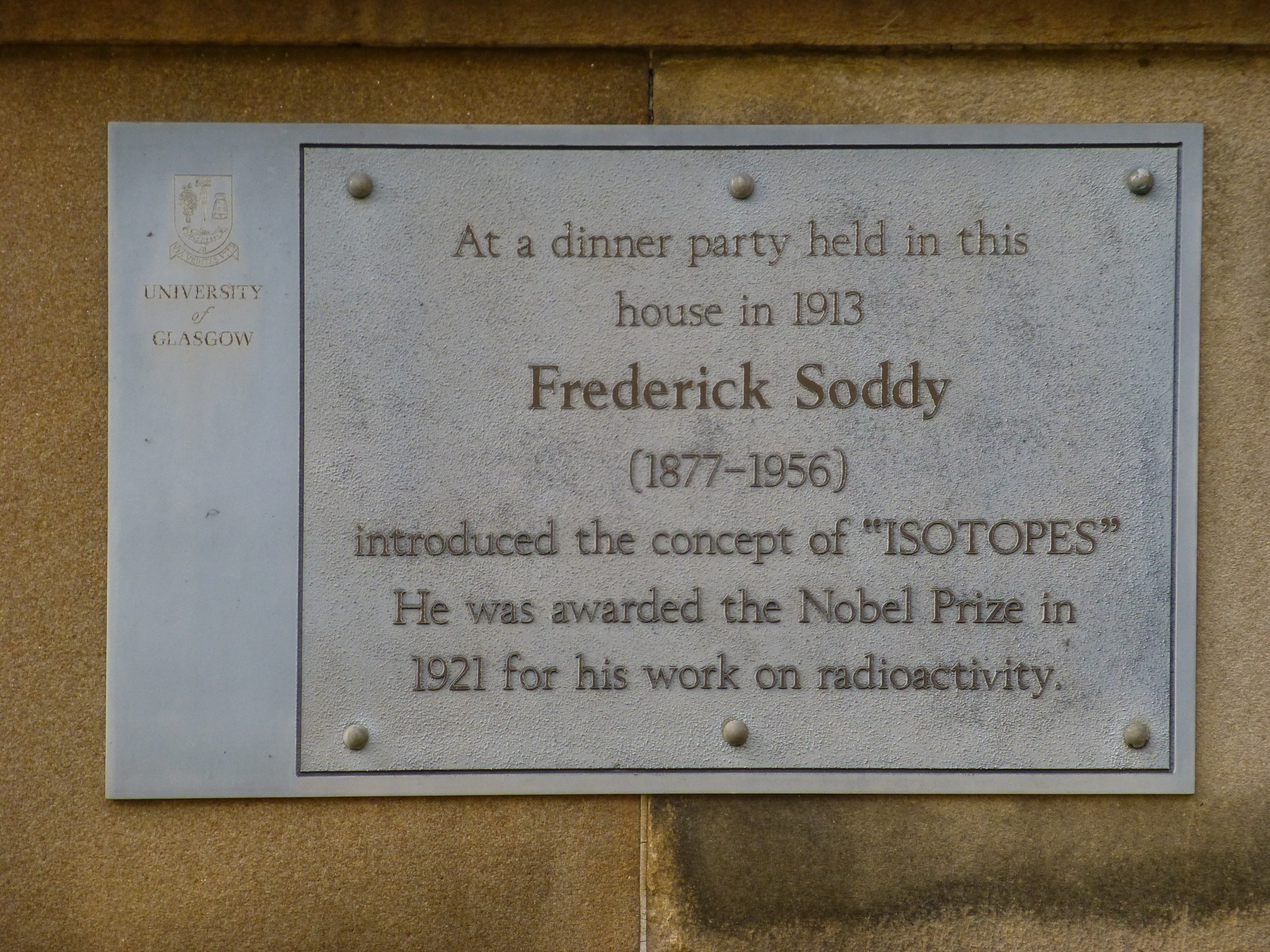
A day of isotopes

This wasn't just a dinner party, this was a defining-moment-in-chemistry dinner party.

This wasn’t just a dinner party, this was a defining-moment-in-science dinner party. (Apologies to M&S){credit}Courtesy of Ross Forgan{/credit}


Today we published a Thesis article in our December issue (subscription required) that commemorates a century of isotopes — following the first use of the term by Frederick Soddy in the pages of Nature in December 1913. Written by Brett F. Thornton and Shawn C. Burdette, the article describes early work by Daniel Strömholm and Theodor Svedberg on radium, that was largely ignored at the time it was published. The story then turns to Soddy:

The evidence of chemically inseparable elements became more undeniable in May 1913 when J. J. Thomson reported that neon seemed to be made of two gases with masses 20 and 22. Nature then published Frederick Soddy’s proposal on 4 December 1913, which hypothesized that isotopes were “chemically identical elements of the same nuclear charge”. The name isotope, from Greek words meaning ‘same place’, had been suggested to Soddy at a dinner party. Soddy’s Nobel Prize speech nine years later summarized the events surrounding the realization of isotopy, and included an apologetic acknowledgement of Strömholm’s and Svedberg’s research. Much of the early work leading to the rationalization of isotopes was based on classical chemistry techniques rather than physics-based methods, and isotopes were put on a solid footing just before Moseley’s X-ray studies firmly established that each element has a unique atomic number.

Later today, I noticed Chemistry World joining the isotope party, publishing a story by Mark Peplow on ‘A century of isotopes‘. Go and read it to learn about isotope day, what we can learn from isotopes in ancient samples of rock and ice, and the development of deuterated drugs (amongst other things) — I highly recommend it.

Finally a plug for two isotope-related pieces of content we’ve published in the past that were written by Dan O’Leary. He penned the In Your Element essay on deuterium and also wrote a companion piece on the blog that went into more detail about Urey and his involvement with deuterium, as well as the infamous Rosenberg spy case (both of these pieces are free to read).

Correcting the record

Nobody likes making mistakes, but we all make them. The important thing is to fix them and here at Nature Chemistry we try to remedy things as swiftly as we can (sometimes it’s easy, sometimes not so). I just want to point out a very recent correction.

Last Thursday @V_Saggiomo sent us this tweet:

about a paper from Jack Szostak that we published on May 19th.

There was indeed a problem and we contacted the author to double check and he clarified for us what the mistake was — all that was needed was a change to the figure legend in question. The correction went live yesterday.

This is not the first time an error has been pointed out to us on Twitter, I’m pretty sure that this correction was triggered by @Marcel_Swart (either by tweet or direct message). I’m sure he’ll correct me if I am wrong!

If you do spot an error in a Nature Chemistry paper that you think needs a correction, let us know and we’ll investigate. If it’s just a minor spelling mistake or similar error then we generally live with those, but if it is something that would affect a reader’s understanding of the work, then a correction would be made.

Happy birthday Robert Boyle!

Apparently today is Robert Boyle‘s 386th birthday. He also happens to be the reason that this blog is called ‘The Sceptical Chymist’. So today, of all days, why not go and have a look at the first ever post on this blog (almost 7 years ago — wow…) explaining a little more about Boyle and his ‘The Sceptical Chymist‘.

PS: the e-mail address listed in that first post no longer works; if you want to contact us, use nchem@nature.com or leave a comment.

Top 10 in 2012

Of those 118 articles published in volume 4 of the journal (as mentioned in the last post), I was curious to see which were the most popular. Based on the ‘page views’ (full-text article views that includes HTML views and PDF downloads) that appear on the associated article-level-metrics pages, here’s the top 10 (you’ll need to be a subscriber to access the articles). Page-view numbers are correct as of December 28th, so apart from #6 and #7 — who can slug it out to see who comes out on top by year’s end — the positions shouldn’t alter too much.

1. Integrated 3D-printed reactionware for chemical synthesis and analysis Cronin et al. MAY issue (20,004 views)

2. Quantifying the chemical beauty of drugs Hopkins et al. FEB issue (16,938 views)

3. A molecular ruthenium catalyst with water-oxidation activity comparable to that of photosystem II Privalov, Llobet, Sun et al. MAY issue (15,430 views)

4. An improved high-performance lithium–air battery Sun, Scrosati et al. JUL issue (14,085 views)

5. A two-dimensional polymer prepared by organic synthesis Sakamoto et al. APR issue (12,712 views)

6. Scalable enantioselective total synthesis of taxanes Baran et al. JAN issue (11,843 views)*

7. Reversible hydrogen storage using CO2 and a proton-switchable iridium catalyst in aqueous media under mild temperatures and pressures Hull, Himeda, Fujita et al. MAY issue (11,842 views)

8. Imparting functionality to a metal–organic framework material by controlled nanoparticle encapsulation Hupp, Huo et al. APR issue (10,490 views)

9. Rapid point-of-care detection of the tuberculosis pathogen using a BlaC-specific fluorogenic probe Rao et al. OCT issue (9,941 views)

10. A synthetic molecular pentafoil knot Leigh et al. JAN issue (9,794 views)*

* these papers were published online in 2011 in advance of print, but page views are only counted from Jan 1, 2012 (that’s where all our article-level-metrics pages start), so actual cumulative page views are most probably much higher (you could probably double them).

The next five on the list also received >9,000 views each, with Baran (#6 above) coming in at #14 with this paper.

Note that when each monthly issue goes live, we make one article free for the month, which may increase the number of page views for that article. Some of these articles above might have been free for a month — I can’t remember which with any degree of certainty. And of course, number of page views doesn’t correlate with how well cited these papers are (or will become), or even necessarily how ‘good’ readers perceive them to be. Moreover, papers published earlier in the year will typically have more page views that those published later in the year — although numbers seem to flatten off for most after a couple of months. Also, we often see a spike in traffic if a paper gets picked up by a high-profile outlet, such as New Scientist or the BBC.

With all that said, people seem to like top-ten lists, however, so here’s ours for volume 4!

Let’s see how the 2013 papers of volume 5 compare…

Happy New Year!

Stuart

Nature Chemistry by the numbers – 2012

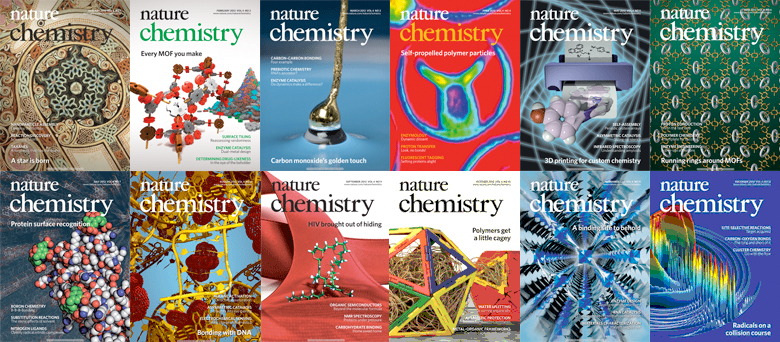
As 2012 is winding down, I thought I’d take a look back at volume 4 of the journal. This isn’t a terribly in-depth analysis, and it’s based on what we’ve published rather than what was submitted, but you might find it a little bit interesting. Here are the covers of the 12 issues that made up the 2012 issues.

What was behind those covers? This:

1052 pages
118 Articles (primary research papers)
67 News & Views articles
54 Research Highlights
12 In Your Element essays
12 Blogroll columns
11 Thesis articles
8 Corrections
5 Books & Arts sections
5 Reviews
4 Editorials
3 Perspectives
3 Correspondences
2 Interviews
1 Addendum
and a partridge in a pear tree*

*OK, I’m kidding about the last one.

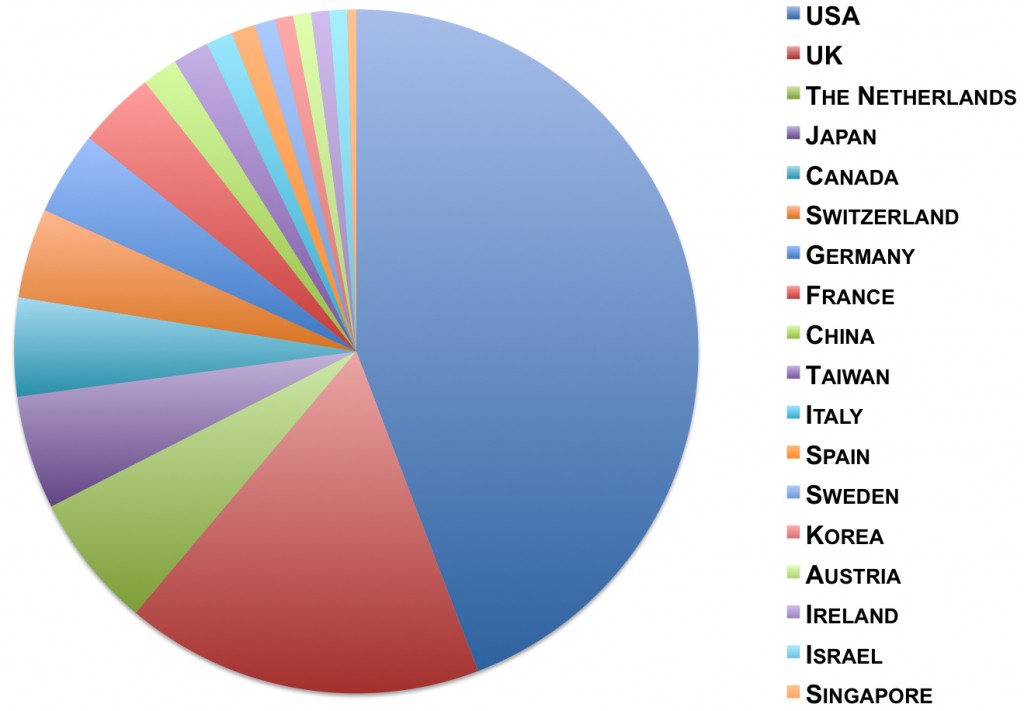
Where did those 118 primary research papers come from? Well, based on the addresses of the corresponding (or co-corresponding) authors, here’s the answer:


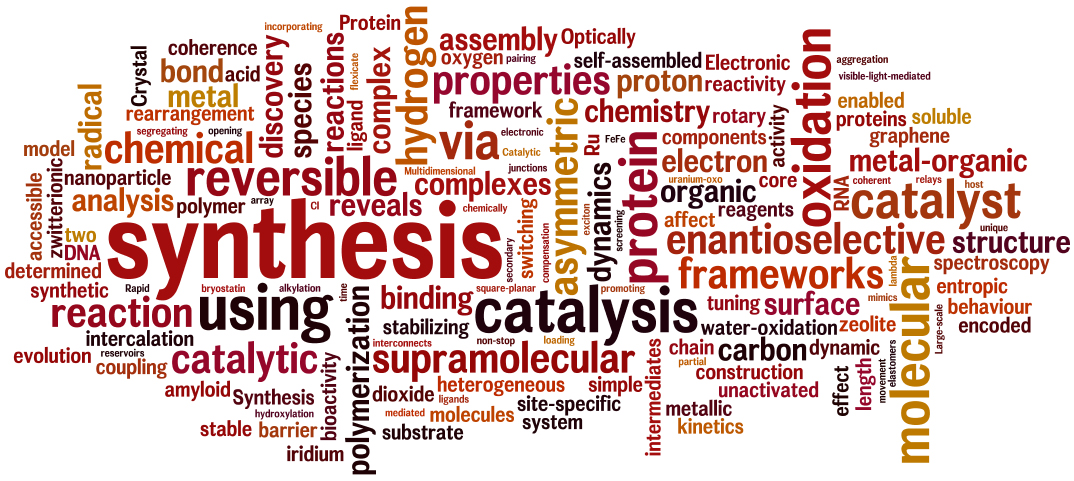
And what were those 118 research papers about? Below is a Wordle made up from the titles of those Articles:


Many thanks to all of our authors, referees and readers for their contributions to the journal in 2012 — best wishes for the holiday season and we’ll see you again in 2013 for volume 5!

Stuart

Chemistry for Christmas

For those of you who haven’t noticed yet, this year’s Christmas Lectures at The Royal Institution are about chemistry! Yay! They are being given by Dr Peter Wothers from the University of Cambridge, who is also one of the authors of my favourite organic chemistry textbook.

Related to this, the RI has a chemistry-themed advent calendar where each day there is a video of someone talking about their favourite element(s). So far, Mark Miodownik (Dec 1), Liz Bonnin (Dec 2), Dara O Briain (Dec 3), Andrea Sella (Dec 4) and Helen Czerski (Dec 5) have revealed their picks. I won’t spoil it by telling you what they chose; go and check out the videos for yourselves!

The trailer for the ‘My favourite element’ videos is embedded below.

Some cunning ChemDraw

You probably wouldn’t expect the Chief Editor of a journal to spend much time using ChemDraw (or maybe you would?) — it’s just that I can’t imagine the editors of too many other chemistry journals (such as the Stangs and Gölitzs of this world) redrawing the structures provided by 75+% of the authors. For my sins, I do. I like to think I’m a bit of a perfectionist when it comes to ChemDraw, although members of my team might use a different word (or two). One of the most challenging papers included structures such as this one.

I considered myself a bit of a ChemDraw expert, but then I saw the video that’s embedded below and had to re-evaluate my world view! It was put together by Pierre Morieux, a postdoc who e-mailed us to let us know about his handiwork. I encourage those of you who are ChemDraw connoisseurs to watch it. If you don’t learn something new, I will be surprised…

The video has also been featured over at In the Pipeline, with — I imagine — a much more extensive comment thread than we’ll probably get here.

A team photo shoot

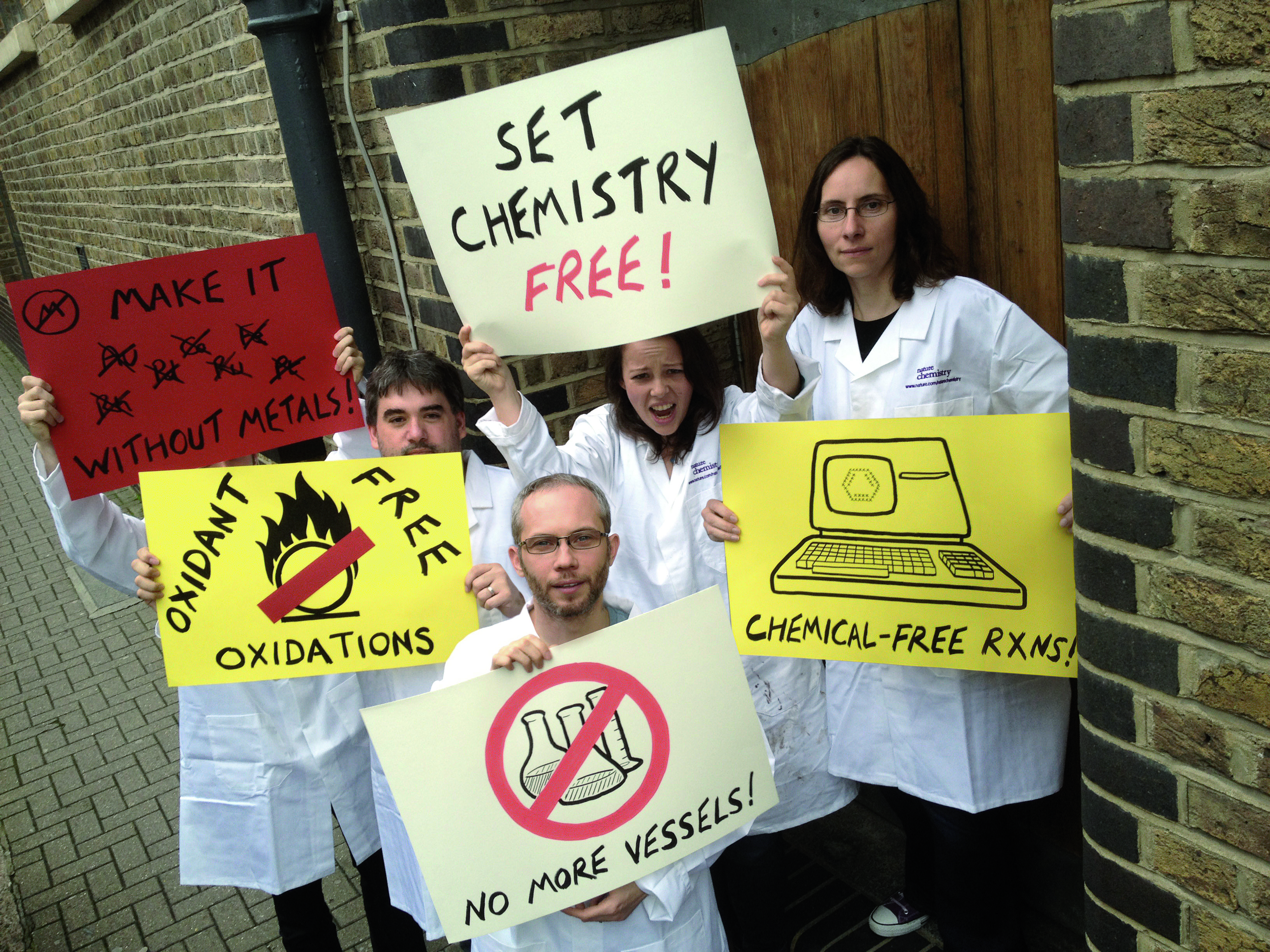
For those of you who haven’t noticed yet, there is a guest Thesis article this month from Dennis Curran — the article is available to subscribers and can be found here. It was not a straightforward essay to illustrate, but in the end we decided to hold our own photo shoot (after making our own protest signs!). The picture features five of us from the Nature Chemistry team — from left-to-right: Russell (associate editor, hiding behind his sign), me, Gavin (senior editor), Rebecca (senior editorial assistant) and Alison (senior production editor). The pic was taken by Alex (art editor), who was balanced precariously on top of a chair or two… missing from the picture are the very perplexed-looking passers-by!

PHOTO: ALEX WING AND STUART CANTRILL

December 2012 issue

Our December issue went live today and I just wanted to highlight a few things here on the blog. The issue includes a focus on site-selective reactions, including an editorial, two Articles — one from the group of Scott Miller and the other from Martin Burke’s group — and a News & Views article from Jacobsen and Tadross looking at those two pieces of research. The editorial is completely free (all of those in Nature journals are) and the other three articles are free to those registered on nature.com. And if you’re not already registered, it is free to do so.

Elsewhere in the issue, we have two Thesis articles; one from our regular columnist Michelle Francl on why chemists like to name things like reactions, theories and equations after people who discovered/developed/derived them, and a guest essay from Dennis Curran, who — with tongue firmly in cheek — welcomes us to a brave new world of organic chemistry where it is more important what isn’t in your reactions than what is. Curran’s article is illustrated with the result of a fun photo shoot featuring homemade protest signs and five of the extended Nature Chemistry team.

The In Your Element article is another of our competition entries, this one about plutonium, and is also free to registered users. Our periodic table has been updated accordingly. The rest of the issue content is available to subscribers, and don’t miss the Review article ($) from Chris Chang and co-workers about reaction-based small-molecule fluorescent probes. As we usually do, we’ll get the Blogroll column, written by Karl D Collins, up here on the blog as soon as we can.


IMAGE: SARANDIS MARINAKIS

COVER DESIGN: ALEX WING