Article-level metrics

You might have noticed one or two excited tweets from us earlier today about this, but if not, here it is again: article-level metrics are now available on 20 journals on nature.com, including us! — the press release is here.

An example of one of our metrics pages can be found here. At the top of the page, there are citation counts from Web of Science, CrossRef and Scopus. Under that are more social metrics, from sources such as Twitter, Facebook, Reddit, Google+, blog posts and news outlets. The box to the right then provides links out to the news and blog coverage. Here’s a screenshot:


Further down the page, you get to see the number of page views and how they change over time. You can mouse-over the data and see the number of views on any given date. There are definitions on each metrics page about what is counted in each section, but basically page views amount to the total of full-text html views and pdf downloads. Here’s the data for the same paper featured in the screenshot above.


You’ll notice an increase in the rate of views just below 2,000 views — interestingly, this corresponds to the paper being published in a monthly issue on that date. The views before that are from the paper being published online in advance of print. For some of our papers, you wouldn’t even notice any transition; the views smoothly increase and the issue date doesn’t have any impact. On the other hand, for some papers (such as this one), going into an issue makes a big difference. I haven’t really thought about why different papers are affected in different ways — so at the moment I have no idea why.
 

And although we can’t link directly to tweets about a paper (complain to Twitter, not to us), you can see the geographical breakdown of them. The paper associated with the screenshots above doesn’t have a lot (see below), but here’s an example of one that does — scroll down to see the map!


Anyway, there you go. We’d be interested to hear what you think about these article-level metrics — comment away!

Stuart

Stuart Cantrill (Chief Editor, Nature Chemistry)

Inside our impact factor

Impact factors mean different things to different people. Some think that they are the worst thing to happen to science. On the other hand, I’ve been told stories of researchers receiving bonus payments in proportion to the impact factors of the journals they publish in – I suppose they don’t feel the same way as the first group (although I imagine this practice reinforces the strength of the opposing view). Irrespective of how you feel about impact factors, they are a measure of something – whether that measure is of any use is a different debate for a different day. What I want to do here is look at how our content is reflected in our latest impact factor – and answer a question that, as editors, we’ve heard quite a few times:

Do review articles inflate impact factors?

Anecdotally, I would say that they do – well, in chemistry publishing at least. If you look at the top three ranked chemistry journals (by impact factor), they are all review journals: #1 Chem. Rev., #2 Chem. Soc. Rev. and #3 Acc. Chem. Res. – they all have impact factors above 20. We are often asked the review-article question specifically in relation to Nature Chemistry but I’ve also heard it proposed on more than one occasion that review articles are the reason why Angewandte Chemie has a higher impact factor that JACS. I’ll leave someone else to run the numbers on those journals, but this is the story for Nature Chemistry.

So, our 2011 impact factor is 20.524.

According to Thomson Reuters’ Journal Citation Reports (JCR), this figure comes from 4618 citations in 2011 to content that we published in 2009 and 2010, divided by the 225 pieces of content that count as ‘citable items’; i.e., 4618/225 = 20.524. Looking at Web of Science (WoS), it seems we actually published a total of 467 items in 2009/2010, but it is only the research and review articles that count as ‘citable items’. In 2009/2010, we published 29 Review articles (some of them are called Perspectives, but they all count as review articles) and 196 research Articles. The other 242 non-citable-items that we published in 2009/2010 include things like News & Views articles, Editorials, Commentaries, Research Highlights, Thesis articles and Features. These 242 articles are not included in the denominator for the 2011 impact factor calculation, but the citations that they received in 2011 do get added to the numerator.

So, to summarize so far, in 2009/2010 we published the following:

196 Articles; 29 Reviews; 242 Other

Now, let’s divide up those 4618 citations in 2011 between the content that actually received them. According to WoS, the number of citations to each category of content above is as follows:

Articles 3172 (69.9%); Reviews 1027 (22.6%); Other 339 (7.5%)

The eagle-eyed amongst you might notice that 3172 + 1027 + 339 = 4538 (not 4618). So, it appears that JCR found 80 citations stuffed down the back of a sofa that weren’t included in WoS. So, let’s assume that the missing citations are divided proportionately between the content types in the same way that the other 4538 are, so that gives total citations for each content type as follows:

Articles 3228 (69.9%); Reviews 1045 (22.6%); Other 345 (7.5%)

So, our actual impact factor is given by:

(3228 + 1045 + 345) / 225 = 20.524

Let’s cut out the Reviews. This takes away 1045 citations and 29 citable items, so the result is:

(3228 + 345) / 196 = 18.230

So, without the review articles, our impact factor drops from 20.5 to 18.2.

You can also remove the citations to ‘Other’ content as well, the result then becomes:

3228 / 196 = 16.470

So, if you want our ‘pure’ impact factor based solely on the research Articles we published in 2009/2010, it’s roughly 16.5. Don’t go comparing this figure to other journals until you’ve done the same sort of calculations to remove citations to non-research content though. To be fair, however, I imagine the vast majority of JACS’ impact factor comes from the research papers (they don’t publish much else, apart from the odd book review or (the sometimes very odd) Perspective…).

As an aside, of the review-type articles we published in 2009/2010, the highest cited in 2011 received 132 citations and the least cited in 2011 received 5 citations. For comparison, of the research Articles we published in 2009/2010, the highest cited in 2011 received 118 citations and the least cited in 2011 received just 1 citation.

What does all of this mean? In the grand scheme of things, not that much. But for Nature Chemistry – and the content we published in 2009/2010 – I can say that review articles did inflate our impact factor relative to what it would be if we hadn’t published any review articles. Whether this is true for all journals that publish both review and research articles, I can’t say. You’d need to run the numbers. My suspicion would be that review articles would have a positive impact in most cases.

Right, those of you who love impact factors, you can go on loving them. Those of you who hate them, you can carry on doing so, although I suspect that you won’t have made it this far down this post.

Stuart

Stuart Cantrill (Chief Editor, Nature Chemistry)

Nature Chemistry 2011 Impact Factor

Just a quick note to say that our 2011 Impact Factor was announced yesterday. I realize some of you don’t care for impact factors and that some of you do. So, for what it is worth, our 2011 score is 20.524, which is up from the 2010 value of 17.927 — that’s an increase of 14.5%. Time permitting, we’ll analyse the number (and what it might mean, if anything) sometime next week here on the blog, just like we did last year.

Stuart

Stuart Cantrill (Chief Editor, Nature Chemistry)

Blogroll: #WhatsInLemiShine

Editor’s note: Now that Neil has left the Nature Chemistry fold to move over to Chemistry World, we have invited bloggers out there in the wild to compose our monthly Blogroll column. First on deck: Chemjobber.

———-

A real-time collaborative determination of an unknown chemical compound, and a graduate student tackles teaching organometallic chemistry

Remember when Paul Docherty of Totally Synthetic live-blogged an attempt to reproduce the reported oxidation of benzylic alcohols with sodium hydride? Adam Azman of Chemistry Blog recently went a step further in both speed and collaboration. During a conversation on Twitter about the identity of the trade-secret dishwasher detergent additive Lemi Shine and its remarkable ability to solubilize hard-water stains, Azman asked what chemists would like to know to identify the active ingredient. Answers from around the world flooded in, requesting both physical property data and instrumental analyses.

The following day, Azman performed wet chemistry to determine the identity of the compound, all while reporting his results on Twitter and taking suggestions for further experiments. Even images of GC-MS traces and NMR spectra (1H and 13C) were posted. The conclusion? Lemi Shine’s active ingredient was citric acid. When asked for comment from Lemi Shine (via Twitter), they responded with a cryptic “Oh so close, but no cigar.” To see if you agree with Azman as to the identity of the active ingredient, go to Chemistry Blog for a summary of the experiments. This episode has also inspired others to tweet experimental chemistry results, all under the hashtag #RealTimeChem.

How are you on the principles of backbonding? Forgotten the details of an open coordination site? Graduate student Michael Evans says that “there is a better way to teach organometallic chemistry.” Towards that end, he’s started The Organometallic Reader, where he posts an in-depth lesson each week. These excellent, readable posts are a good primer for the novice and a nice refresher for the experienced chemist.

Written by Chemjobber who blogs at https://www.chemjobber.com

———-

[As mentioned in this post, we’re posting the monthly blogroll column here on the Sceptical Chymist. This is July’s article]

We’re (still) hiring

As pointed out in this blog post, we’re looking for a new Associate Editor here on the journal.

I’d like to take this opportunity to offer some advice to those of you thinking of applying for the job. This all might sound somewhat obvious, but it is very important (and in your best interests) that you include in your application what we ask for in the job advert.

What we need are:

1. An up-to-date CV.

2. A research highlight in Nature Chemistry style that is approximately 250 words long and is about a recent (and relevant, i.e.. chemistry) paper in the literature. Your research highlight doesn’t have to be about a Nature Chemistry paper.

We do not want you to send anything in lieu of the research highlight, such as Thesis chapters, research papers, or other examples of writing you have done for other purposes in the past. If you want to send other (relevant) examples of your writing to demonstrate your experience/skills, that is fine. Nevertheless, so that we can compare across a relatively level playing field, please ensure that you also send in a research highlight following the instructions provided.

3. A cover letter that explains why you are interested in the position and what your salary expectations are. You might also want to use the cover letter to explain why you think you would be a good fit for the position.

Good luck!

Stuart

Stuart Cantrill (Chief Editor, Nature Chemistry)

We’re hiring!

The founding editorial team at Nature Chemistry was assembled back in 2008 and has stuck together since then, providing a solid foundation for the launch of the journal and its growth in these early years. But it’s time for a change and now Neil is (back) off to the Royal Society of Chemistry to take up the position of Features Editor at Chemistry World. We wish him well (really, we do), but now we need someone to fill his shoes. So, we’re looking for a new Associate Editor here on Nature Chemistry.

Enjoy reading papers and fancy a move away from the bench? Enjoy reading the latest hits in the chemistry literature and would like to write about them for Nature Chemistry? Want to attend conferences to see what the latest and greatest developments are (at least at the conferences where such things are aired)? Want to blog and tweet about cool and creative chemistry (we know a lot of you do that already, but this is part of a job that you get paid to do!)? Well, if the answers to those questions are ‘yes’, have a look at the advert and give it some thought. Applications need to be made through the website, but informal queries can be directed to our journal inbox (you can find the address on our website).

Stuart

Stuart Cantrill (Chief Editor, Nature Chemistry)

Blogroll: For safety’s sake

Learning from a tragedy, and forthright feedback.

Although the death of Sheri Sangji after an accident at UCLA was more than three years ago, it continues to generate interest, especially when news broke that UCLA and her PI Professor Patrick Harran were being charged for felony violations of labour laws. For continuing excellent coverage of this, read C&ENtral Science‘s The Safety Zone by Jyllian Kemsley for example). Kemsley regularly rounds up news and blog discussion about the case, so The Safety Zone is a great place to start finding out what people think about it.

Matt Hartings at ScienceGeist took a different tack to many of the bloggers discussing the specifics of the case, and the possibility that Harran may face jail. Hartings, an assistant professor at American University and thus responsible for training students in the lab, put forward some ideas for how safety training could be improved. Following on from ChemBark’s suggestion of incorporating safety into weekly group meetings, Hartings proposes that these could be held at the start of the week. That way, new reactions could be discussed before they were performed, forcing individual group members to “assess the safety of any new procedure”. Furthermore, everyone else present in the lab “will be made aware of when any hazardous protocols will be in use”. Regardless of personal views on the specific advice, it is good to see lessons being learnt and safety being discussed seriously.

And finally…ratemyprofessor.com is probably already famous — or infamous — among some of our readers, but we recently learnt of BerateMyProfessor. This contains some student evaluations from the anonymous blogger’s “ten years of teaching general and organic chemistry”. There are some forthright views from all those students, especially when it comes to their professor’s ‘attempts’ at humour — and dress sense!

[As mentioned in this post, we’re posting the monthly blogroll column here on the Sceptical Chymist. This is February’s article]

Urey, deuterium, and the Rosenbergs

Posted on behalf of Dan O’Leary. It’s a bit much longer than our usual blog entries, but it is more than worth it. Grab a coffee (or other favourite beverage), sit back, and enjoy — Stuart

— — — — — — — — — — — — — — — — — — — —

This month’s In Your Element essay is entitled ‘The deeds to deuterium’ (subscription req’d). I appreciate Stuart letting me take on the essay, for which he provided such a clever title, and for the opportunity to write this blog post. Many thanks also to Sarah Roh, a Pomona College student who previously fused anime and isotope effects, for the artwork featured in this project.

Now here’s a question: why did the hydrogen isotopes garner names when all others remained numerical? Harold Urey, George Murphy, and Ferdinand Brickwedde published spectroscopic evidence for the mass-2 form of hydrogen in 1932 (ref. 1) and suggested the name deuterium shortly thereafter (ref. 2). They thought a unique name was justified because it would alleviate any formulaic confusion caused by the use of ‘hydrogen two.’ In Cathedrals of Science, Patrick Coffey writes (ref. 3) that Frederick Soddy, who coined the term ‘isotope’ after a suggestion by Margaret Todd, wasn’t even sure that the heavy form of hydrogen met his definition of an isotope. In his view, isotopes had different atomic mass but identical chemical properties. The large mass difference between 1H and 2H gave deuterated substances unique properties relative to their lighter counterparts, thus making their discovery more elemental. Writing in the 1933 pages of Nature (ref. 4), Ernest Rutherford surmised “…the question of a suitable nomenclature is in this case of such general importance to scientific men that it deserves very careful consideration.”

When I started researching the IYE essay, however, I wasn’t much interested in isotopic appellations. I thought that part of the story was old news. At the outset of my research, I was much more intrigued by Harold Urey the person.

While I didn’t know much about him, I had read somewhere that Urey was involved in the Rosenberg espionage case in the 1950s. Chronicling his involvement in that hysteria-induced American tragedy would make for an intriguing essay, I thought, something along the lines of: deuterium & Nobel provide scientist with platform for Cold War political activism. But letters in his archive caused me to change my plan and I instead wrote a piece describing how Urey’s heavy-handed former doctoral advisor played a key role in his decision to name the mass-2 isotope ‘deuterium’. But before we get to that part of the story, indulge me with the activism angle for several more paragraphs.

Urey argued publicly that it made no sense to execute Julius and Ethel Rosenberg, but that was their fate after a brief trial in 1951. The evidence against them and the quality of the atomic secrets they supposedly passed, as known by the public at the time, were disputable. Declassified documents and other information, some made available as recently as 2008, suggests that only Julius was directly involved in delivering classified atomic information to the Soviets. Other conspirators were given prison sentences, but the government’s case against the Rosenbergs came down to a game of chicken in which Ethel could have avoided the electric chair if she testified against her husband. She remained silent, and they were executed within minutes of each other at Sing Sing prison on June 19, 1953.

Urey’s papers (ref. 5) are archived at the University of California at San Diego. An extensive set of documents provide a roadmap of his efforts to galvanize support within the scientific community and speak with the public about the case. The scientist in Urey left an imprint on the record, such as his use of charts to diagram the real and inferred flow of information between the Rosenbergs and Soviet General Consul Anatoli Yakovlev, Klaus Fuchs, Harry Gold, Morton Sobell, and David Greenglass (Ethel Rosenberg’s brother who testified against them at trial and served a 10 year prison term).

Urey even wrote personal appeals to Presidents Truman and Eisenhower to reverse the execution order. When these efforts failed, Urey largely withdrew from the cause and from communists eager to ally themselves with him. Particularly telling is a handwritten draft of a 12 February 1953 telegram (ref. 6) sent to an organizer hoping to use a pre-recorded Urey speech at a Los Angeles rally protesting newly-elected President Eisenhower’s decision not to commute the death sentences: “I believe meeting should be held and do not wish my recording to be used. Case will now be used by communists to embarrass the U.S. (emphasis his) and I do not wish to help them. We can not help the Rosenbergs. (text strikeouts his) Harold C. Urey”

In an unpublished 1970 autobiography (ref. 7), Urey wrote: “I doubted seriously if justice had been done. My own concern was not a matter of communism or capitalism of my country or some other country at all, it was only a question as to whether justice had been done by the courts of the United States. That was my interest entirely. I was not a friend of the Rosenbergs or Sobell.”

Although there is evidence in the archive suggesting Urey regretted his involvement in the Rosenberg case, his spirits were lifted by a letter dated 17 June 1953, which read: “Dear Urey, your intervention in the Rosenberg case has been one my most heartening experiences in the human sphere. With kind greetings and my highest respect, yours, A. Einstein.” Urey responded (ref. 8) on 25 June, saying in part “But your support of my position and your letter have been most heartening to me, for very few scientific people have troubled to consider the case at all.”

So the IYE essay was almost about the deuterium-enabled Urey and his frustrating quest for justice in the Rosenberg case. But the essay could have been about other heavy topics, such as H-bombs and their deuterated fusion cores, prepared by a post-war team led by Ferdinand Brickwedde. Of these devices, Urey — himself a key player in the Manhattan Project — wrote (ref. 7): “I once thought deuterium would be as useful as to be produced in small amounts to be used for trace techniques in chemistry, and turns out to be an important part in the hydrogen bomb. I am sorry that that it is part of such a destructive instrument as that, and I would be awfully glad if it were not.”

I was taking a break from Rosenberg-related material at the UCSD library when I reached for a folder containing letters between Urey and Brickwedde, his collaborator and supplier of hydrogen enriched in the heavy isotope. This correspondence, dated May and June of 1933, surprised me. It revealed that Urey and Brickwedde were all over the place in terms of what to name the ‘the hydrogen.’ Early candidates, beyond ‘iso-hydrogen’, were property-based: Pycnydrogen or pycnogen [pycnos = thick or dense (Greek)], barydrogen, barogen, or barhydrogen [baro/bary/bar = weight, heavy (Greek)]. Urey was favoring pycnogen in the first of these letters (ref. 9).

Brickwedde then suggested a numbers-based system inspired by a colleague: diplogen or diplohydrogen for the heavy form while hydrogen would become haplogen or haplohydrogen [diplous = double (Greek), haplous = single (Greek)]. He anticipated that Urey wouldn’t like those names and wrote “I know you won’t like them when you first hear them but after a few days they don’t sound so bad.”
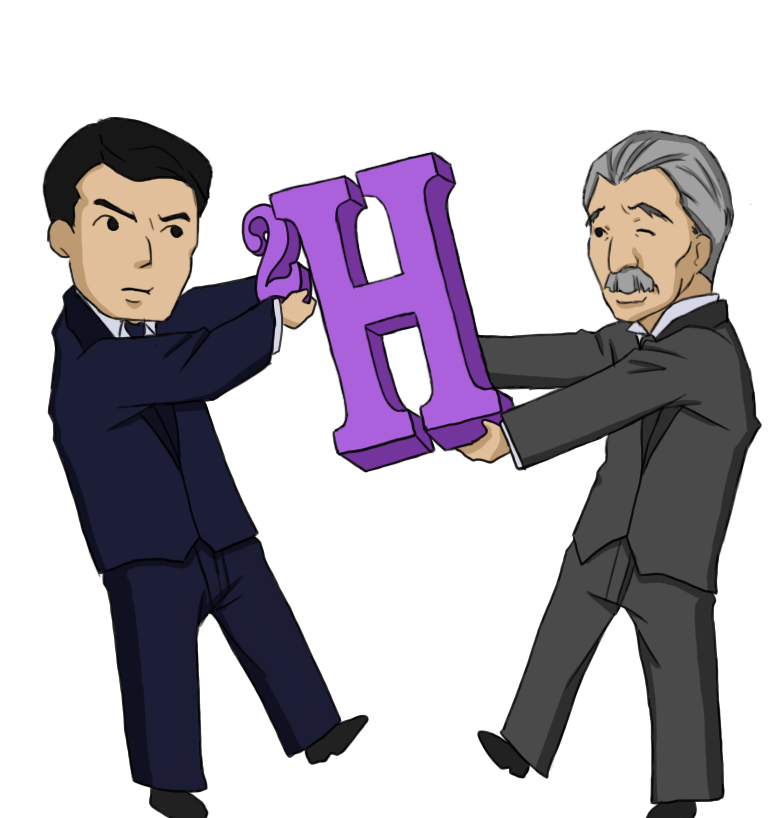
Urey vs. Lewis. Credit: Seo (Sarah) Roh

Where was the name deuterium in these exchanges? Well, if Urey has been considered the naming protagonist then it is only fitting this drama has a deuteragonist. The character of secondary importance was none other than Urey’s doctoral advisor, G.N. Lewis. He was also working on the isotope and had lobbied Urey to name the isotope dygen. Then he changed his mind and suggested the name deuton for the mass-2 nucleus. This suggestion, coupled with Brickwedde’s numerical proposition, seems to have inspired Urey to consider the name deutium and then, after consulting Greek experts at Columbia University, deuterium. These names worked nicely, because they could be bookended by names like protium or proterium and tritium or triterium. Urey and his crew ultimately decided to go with protium, deuterium, and tritium and published these in the Journal of Chemical Physics on 1 July 1933 (ref. 2).

One of my favorite quotes from the exchange is Urey’s prediction (ref. 9) to Brickwedde on 6 June 1933: “As to tritium, it will probably never be needed, for we have proven here that it does not exist to more than one part in five billion of protium, and therefore, I believe it does not exist at all.”

A year or so later, tritium’s existence was discovered in Ernest Rutherford’s deuterated collision experiments. As noted earlier, the Right Honourable Lord Rutherford — who named the proton — also had strong nomenclature opinions and published his preferences in Nature on 23 December 1933: diplon for the nucleus and diplogen for heavy hydrogen (ref. 4). Urey’s names persisted, although it took some time for the matter to settle down. News of the disagreement went as viral as one could imagine in the 1930s, with Time magazine even reporting on the controversy (ref. 10).

A very detailed account of the interactions between Lewis, Urey, and Rutherford was written by physicist Roger Stuewer in 1986 (ref. 11). In addition to the diplon/diplogen possibility, Rutherford had also considered deuteron/deuterogen and dion/diogen as names for the nucleus and the heavy isotope and was discussing names with Lewis before he did with Urey. Stuewer also chronicles a part of the story that was new to me, that Urey apparently lost his temper at a meeting of the American Physical Society on 19 June 1933, where he introduced his soon-to-be published names and received a negative response.

Missing from accounts such as Steuwer’s is what was happening within the Urey camp. It is now clear that it was Lewis who suggested a name based upon the Greek deuteros, and Urey grudgingly says as much in a letter to Brickwedde. Of course, you’ll need to read the IYE essay to see his exact language. The letters in the UCSD archive left me with the impression that some historical accounts need correcting. Coffey’s Cathedrals, for example, accurately portrays Lewis as trying to influence Urey but is incorrect in asserting that Urey “had already decided the isotope’s name.” Then again, Coffey studied correspondence from the Lewis archive at UC Berkeley, and these letters reflect only what Urey wanted Lewis to hear. The Urey–Brickwedde exchange puts the matter in a new light. One can imagine Urey maintaining a poker face in communications with his overstepping former advisor. Stuewer’s article affirms this view by reproducing tracts from the Urey–Lewis correspondence, and in these Urey comes across both polite and blunt.

On 18 May 1933: “As to the name deuton for the hydrogen two nucleus, it is a very suggestive one. My own personal reaction to it, however, is that it is unnecessary [to provide a name for something not a fundamental particle].” And later in the same letter, Urey wrote (ref. 11): “If the California group will not give us a little time and be a little patient, they will force us into publishing a name for this isotope which may not be satisfactory for some reason or another. I would suggest, therefore that the California group use the name hydrogen two provisionally and allow the discoverers of this element to name it when they see fit.”

It’s interesting that the Urey archive at UCSD, as extensive as it is, does not catalogue any Urey–Lewis or Urey–Rutherford correspondence. In their absence, the record is defined by the drafts sent or received by Lewis and Rutherford (ref. 11). Steuwer’s excerpts project Urey as diplomatic once he’s made up his mind to publish his names. After writing a measured letter outlining protium/deuterium/tritium to Lewis on 29 May 1933 he closes with a request to hear Lewis’ opinion of them before publication. Lewis, who by Steuwer’s account had started the naming rush in the first place, answered by saying he felt Urey’s names were “very good” although he would “slightly prefer ‘protium’ and ‘deutium,’ or even ‘protum’ and ‘deutum’… .” But he also realized that he had caused a ruckus and closed with “kindest regards, and apologies for the deuton’… .”To a 20 June Rutherford letter outlining the diplon/diplogen, deuteron/deuterogen , and dion/diogen possibilities, Urey responded on 6 July outlining the names he was publishing and apologized for not reaching out to scientists in Europe regarding the names, citing the rush caused by the Berkeley people. He added that it was “interesting that so many people have thought of very much the same names.”

But there is another snippet (ref. 11) from that 6 July letter that is perhaps most revealing about how Urey felt about the entire nomenclature quagmire. “Protium” and “deuterium,” Urey wrote to Rutherford, were “as good a compromise as we could get.”

In his autobiography written some forty years later, Urey wrote (ref. 7) of Lewis’ presence in the hunt for deuterium: “I have always felt badly about Professor Lewis’ attitude in this matter. I have tried in the years since then, whenever my former students make an important discovery, to help them as much as possible rather than to try to take the subject matter away from them.” In a 1972 children’s book about Urey (ref. 12), written from the autobiography, these sentiments were rephrased as “Urey felt a little hurt at this. In future years, whenever one of his students made an important discovery, he tried to help the student as much as possible, rather than take the subject away from them.”

Urey’s philosophy of support for his students — forged in the early deuterium years — is probably best exemplified by one of his other significant works, the single-authored Science paper by then-graduate student Stanley Miller, whose Miller–Urey experiment opened the field of prebiotic chemistry. Urey has been quoted (ref. 13) as saying “There are a lot of people around who are smarter than me. But I pick only the most important problems.” Indeed, these contributions included a method to determine geological temperatures, the development of the field of cosmochemistry, and providing a leading role in lunar science and exploration. Any one of these accomplishments would have made a scientist’s career. Readers who want to learn more about Harold C. Urey, a remarkable chemist, are encouraged to read his biographical memoir at the US National Academy of Sciences.

DAN O’LEARY is in the Chemistry Department at Pomona College in Claremont, California 91711, USA.
e-mail: doleary@pomona.edu

References

1. Urey, H. C., Brickwedde, F. G. & Murphy, G. M. Phys. Rev. 39, 164–165 (1932). [LINK]
2. Urey, H. C., Murphy, G. M. & Brickwedde, F. G. J. Chem. Phys. 1, 512–513 (1933). [LINK]
3. Coffey, P. Cathedrals of Science: the Personalities and Rivalries That Made Modern Chemistry. Oxford University Press, 2008.
4. Rutherford, Rt Hon. Lord Nature 132, 955–956 (1933). [LINK]
5. Harold Clayton Urey Papers, Mandeville Special Collections Library, University of California, San Diego. An online catalog of the collection can be found here.
6. Rosenberg file, Harold Clayton Urey Papers, Mandeville Special Collections Library, University of California, San Diego.
7. Unpublished autobiography dated 1970, Harold Clayton Urey Papers, Mandeville Special Collections Library, University of California, San Diego.
8. Urey–Einstein correspondence, by date, Harold Clayton Urey Papers, Mandeville Special Collections Library, University of California, San Diego.
9. Urey–Brickwedde correspondence, by date, Harold Clayton Urey Papers, Mandeville Special Collections Library, University of California, San Diego.
10. Science: Deuterium v. Diplogen
11. Stuewer, R. H. Am. J. Phys. 54, 206–218 (1986). [LINK]
12. Silverstein, A., & Silverstein, V. Great Men of Science: Harold Urey, the Man Who Explored From Earth to Moon. John Day Company, 1971.
13. Harold Urey, Scientist, Dies at 87; War foe’s work led to H-bomb

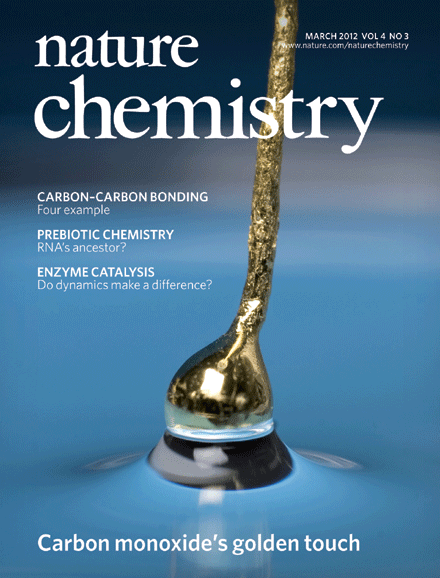
March 2012 issue

If you haven’t already noticed, our March 2012 issue went live today. It’s full of the usual good stuff, including research articles, News & Views pieces, and research highlights. This issue is somewhat special, however, in that it also contains what we call a web focus. What’s that you might ask? Well, it’s a small collection of related articles (grouped together on the web), and in this case it’s about protein dynamics. We have two Perspectives (Good vibrations in enzyme-catalysed reactions and Taking Ockham’s razor to enzyme dynamics and catalysis) that offer differing views on the significance that structural dynamics have on the reactivity of enzymes. To round up the web focus, there is also an editorial: ‘Of polemics and progress‘, that looks at how disagreements in science can have both good and bad sides. There will be a longer blog post on the editorial next week. The content of the focus (the Editorial and both Perspectives) is free to access until March 22. (Actually, all of our editorials are now free, so you’ll be able to read that whenever you like).

The In Your Element article is about deuterium (we haven’t even done plain old protium yet!) and was written by Dan O’Leary (and has a great illustration drawn by Seo (Sarah) Roh). You need to be a subscriber to read the article itself, but we’ll have a longer blog post later this week that adds some backstory to Dan’s essay. It will be a long read, but well worth it.

In the Thesis article: ‘Zen and the art of molecules’, regular columnist Michelle Francl ponders what it is that makes a molecule beautiful. Her top ten comprises: azulene, carvone, ferrocene, ethanol, vanillin, caffeine, penicillin, insulin, snoutane and cubane. You’ll have to read the article (subscribers only, sorry) to find out why she picked each of these, but she concludes by saying that:

In my eyes, elegant molecules are symmetric; unexpected; revelatory of unseen mysteries; have a touch of sabi, a patina of history; a rich set of associations that stimulate our imaginations; useful; logically simple; sometimes whimsical — and sometimes profoundly graceful.

Obviously beauty lies in the eye of the beholder, so while we don’t necessarily expect you to list your top ten, why not leave a comment and tell us what, in your eyes, are the most beautiful molecules… and why you picked them.

And while you’re thinking about pretty molecules, why not go and check out the rest of the March issue.

Stuart

Stuart Cantrill (Chief Editor, Nature Chemistry)


IMAGE: MARC DE HAAN, PARAMACONI RODRIGUEZ, MARC KOPER

COVER DESIGN: ALEX WING

The greatest chemist of all time?

Disclaimer: this was a bit of Twitter-related fun and while it does throw up some interesting observations, this is in no way a properly executed comprehensive survey of ‘the greatest chemist of all time’…

It’s not an easy question, and probably not a fair one either. What do we mean by ‘greatest’ and, for that matter, what do we mean by ‘chemist’? We’re probably only on safe ground with ‘all time’!

This all started over lunch a couple of days ago when the London-based members of the NChem team (myself, Gav and Neil) were having lunch at NPG towers with, amongst others, the chief editor of Nature Nanotechnology (@drpeterrodgers). After the usual football banter had come to an end, somehow we got on to the topic of iconic figures in physics and chemistry.

If you ask physicists to name the greatest of all time in their field, many will choose Einstein or Newton — see this Physics World story (free registration required) and this BBC piece. Of course there are many other great physicists, but ask for just one name and it usually boils down to one of those two. In chemistry, however, we came to the conclusion that there aren’t just one or two names that stand out from the crowd — there’s just a crowd.

To put this to the test, we decided to conduct a wholly arbitrary and definitely unscientific poll on Twitter, asking the simple question — who is the greatest chemist of all time? No qualifiers and no guidelines, other than you can only pick one name. No ranking of multiple individuals and no shared glory. No debate (at this stage) of whether someone would have been classified more as a physicist than a chemist in their time. And the results don’t include retweets of suggestions, unless they specifically indicated that they were additional votes for, rather than just RTs of stuff people found interesting. Many thanks to everyone who responded.

And so, here are the results:

We had 86 votes in total, with a whopping 36 different suggestions of who is the greatest chemist.

The top four places go to: Linus Pauling (16 votes), Dmitri Mendeleev (11), Antoine Lavoisier (7) and Marie Curie (6 votes).

Then we have Robert Burns Woodward (4), Michael Faraday (4) and Gilbert Lewis (3).

Everyone else just got one or two votes — and they are (in no particular order): Amedeo Avogadro (2), Fritz Haber (2), Friedrich Wöhler (1), Alfred Werner (1), Henry Moseley (1), Paul Walden (1), Robert Robinson (1), Ludwig Boltzmann (1), Jacobus Henricus van ’t Hoff (1), Jābir ibn Hayyān (2), E. J. Corey (2), August Kekulé (2), Robert Boyle (1), Walther Nernst (1), Svante Arrhenius (1), Shigeru Terabe (1), James Joule (1), Victor Grignard (1), William Perkin (1), Stanislao Cannizzaro (1), Wallace Carothers (1), Emil Fischer (1), Wilhelm Ostwald (1), Niels Bohr (2), Ryōji Noyori (1), Paracelsus (1), Mother Nature (1), Louis Pasteur (1), Humphry Davy (1).

There are some notable names not mentioned, including Gibbs, Dalton and Priestley.

What does this mean? We’ll consider this more thoroughly in an upcoming editorial, but for now it is clear that even in this small sample size, there are many different chemistry heroes. Sure, Pauling and Mendeleev got a few more votes than the others, but they’re not streaking ahead — and there is a long tail here.

Is this a problem for chemistry — not having a unifying iconic figurehead that we can point to? Maybe, maybe not. But in a year when our subject is being celebrated on the global stage and we take stock of its wider appeal in the world, it’s something to consider (not that we can really do much about it though!). The International Year of Chemistry is rightly celebrating Marie Curie and her contributions to chemistry, and she does well in our little poll, but is one of many names.

Perhaps we should be proud that there are so many names mentioned in response to the question of who is the greatest, it must reflect — in some measure — the diversity and depth of our subject.

Returning again to the question itself — it is not an easy one, because how do you compare the likes of Woodward and Mendeleev, or Pauling and Wöhler. The answers to the question we pose are wholly subjective, but it’s more the whole exercise and breadth of responses that are more enlightening.

We really hope you join the discussion in the comments to this blog post — and please do add your votes for who you think is the greatest chemist of all time.

Stuart

Stuart Cantrill (Chief Editor, Nature Chemistry)