The shortest route to strychnine

Editor’s note: following on from their previous groundbreaking publication on this blog – in which they provided a comprehensive overview of chemical-free consumer products – Drs Goldberg and Chemjobber submitted another manuscript to Nature Chemistry. Despite being summarily rejected by the editor, many (many) months later – and in the wake of some poetic exchanges on Twitter – the manuscript (and cover letter) are now both posted here on the blog with the permission of the authors. In the spirit of the Christmas papers published by the BMJ, consider this (tongue-in-cheek?) comment on synthetic chemistry by Alex and CJ a holiday-season gift to our readers!

––––––––––––––––––––

An expeditious and parsimonious approach to strychnine
Alexander F. G. Goldberg and C.J. Chemjobber

Throughout and following its structural elucidation1-5 strychnine has captured the imagination of synthetic chemists. Beginning with Woodward’s landmark total synthesis, reported in 1954 (ref. 6), this storied molecule has enabled chemists to showcase the state-of-the-art7,8. Advances in the field of organic synthesis over the following decades have culminated in a synthesis as short as six linear steps from commercial materials9. Indeed, each subsequent publication on this strychnine has been a reflection of the leading concepts of the time.

In this vein, we sought in our approach to limit the use of harmful reagents — and harmless reagents — and maximize step economy, atom economy10, redox economy11, word economy12, time economy13, graduate student economy14 and economy15.

Our efforts were initiated and concluded by obtaining commercially available strychnine as a light yellow powder from Sigma-Aldrich. Gratifyingly, all spectral data matched those reported in the literature, and the purity was found, fortuitously, to be as indicated by the vendor.

In summary, we are delighted to have obtained multi-gram quantities of strychnine in the shortest synthetic sequence to date from commercial materials. Future work will likely not be directed toward similar approaches to brucine, cinchonine, and erythropoietin.

Author contributions

A.F.G.G. and C.J.C. contributed equally to the experimental work.

Acknowledgements

We thank Sigma-Aldrich in advance for their sense of humour; A.F.G.G thanks Christine Hansplant for her patience in waiting for this acknowledgement for her contribution to our previous publication.

Affiliations

Stan’s Exchange Secondhand Store, Edmonton, AB.

Competing Financial Interests

A.F.G.G. is handily in the pockets of Big Strychnine.

References

1. Leuchs, H. Über Strychnon und Pseudo-strychnon als Nebenprodukte der Darstellung des Pseudo-strychnins und über weitere Versuche in dessen Reihe. (Teilweise mit Fritz Räck.) (über Strychnos-Alkaloide, 110. Mitteil.) Chem. Ber. 73, 731–739 (1940). [LINK]

2. Briggs, L. H., Openshaw, H. T. & Robinson, R. Strychnine and brucine. Part XLII. Constitution of the neo-series of bases and their oxidation products. J. Chem. Soc. 903 (1946). [LINK]

3. Robinson, R. The constitution of strychnine. Experientia 2, 28–29 (1946). [LINK]

4. Woodward, R. B., Brehm, W. J. & Nelson, A. L. The structure of strychnine J. Am. Chem. Soc. 69, 2250 (1947). [LINK]

5. Woodward, R. B. & Brehm, W. J. The Structure of Strychnine. Formulation of the Neo Bases J. Am. Chem. Soc. 70, 2107–2115 (1948). [LINK]

6. Woodward, R. B., Cava, M. P., Ollis, W. D., Hunger, A., Daeniker, H. U. & Schenker, K. The Total Synthesis of Strychnine. J. Am. Chem. Soc. 76, 4749–4751 (1954). [LINK]

7. Bonjoch, J. & Solé, D. Synthesis of Strychnine. Chem. Rev. 100, 3455–3482 (2000). [LINK]

8. Cannon, J. S. & Overman, L. E. Is There No End to the Total Syntheses of Strychnine? Lessons Learned in Strategy and Tactics in Total Synthesis. Angew. Chem. Int. Ed. 51, 4288–4311 (2012). [LINK]

9. Martin, D. B. C. & Vanderwal, C. D. A synthesis of strychnine by a longest linear sequence of six steps. Chem. Sci. 2, 649–651 (2011). [LINK]

10. Trost, B. M. Atom Economy—A Challenge for Organic Synthesis: Homogeneous Catalysis Leads the Way. Angew. Chem. Int. Ed. 34, 259–281 (1995). [LINK]

11. Burns, N.Z., Baran, P. S. & Hoffmann, R. W. Redox Economy in Organic Synthesis. Angew. Chem. Int. Ed. 48, 2854–2867 (2009). [LINK]

12. Goldberg, A. F. G. & Chemjobber, C. J. A comprehensive overview of chemical-free consumer products. The Sceptical Chymist. [LINK]

13. Hayashi, Y. & Ogasawara, S. Time Economical Synthesis of (–)-Oseltamivir. Org. Lett. 18, 3426–3429 (2016). [LINK]

14. (a) Wang, P., Dong, S., Brailsford, J. A., Iyer, K., Townsend, S. D., Zhang, Q., Hendrickson, R. C., Shieh, J., Moore, M. A. S., Danishefsky, S. J. At Last: Erythropoietin as a Single Glycoform. Angew. Chem. Int. Ed. 51, 11576–11584 (2012) and references therein. [LINK] (b) Nicolaou, K. C., Heretsch, P., Nakamura, T., Rudo, A., Murata, M. Konoki, K. Synthesis and Biological Evaluation of QRSTUVWXYZA’ Domains of Maitotoxin. J. Am. Chem. Soc. 136, 16444–16451 (2014) and references therein. [LINK] (c) Aad, G. et al. (ATLAS Collaboration, CMS Collaboration) Phys. Rev. Lett. 114, 191803 (2015). [LINK]

15. Newhouse, T., Baran, P. S. & Hoffmann, R. W. The economies of synthesis. Chem. Soc. Rev. 38, 3010–3021 (2009). [LINK]

––––––––––––––––––––

Cover letter

Dear Stu,

Please find attached our latest manuscript for your consideration for publication in Tetrahedron Letters or whatever it’s called, entitled “An Expeditious and Parsimonious Approach to Strychnine.” This scalable approach features a broadly-applicable method for accessing complex bioactive natural products, and adheres closely to the principles of green chemistry. For instance, our approach to strychnine was solvent-free and atom-economical, and all raw materials were obtained from renewable sources, which were fully incorporated into the final product. We trust that you will find that traditional green chemistry metrics such as atom economy, effective mass yield and E-factor are second to none.

Furthermore, the future of funding for basic research remains uncertain and subject to the whims of oft closed minded and myopic politicians. Pressing, therefore, is the need for cost-effective methods for obtaining important natural products, especially for the purposes of the biological studies which we all say we’re going to get around to.

Indeed, our zero-step synthesis of strychnine from commercially-available materials is a superb model for efficiency in synthetic chemistry. We are confident that the application of this method to other commercially available natural products will accelerate discovery in our own field, as well as in the fields of chemical biology and analytical chemistry; as the 200th anniversary of strychnine’s isolation approaches, we consider this timely and unparalleled manuscript suitable for the broad scientific audience of your publication.

Thank you in advance for your consideration,
Alexander Goldberg & CJ Chemjobber

Another four bricks in the wall (part III)

Editor’s note: this post written by Brett Thornton and Shawn Burdette is a follow-up piece to the blog post ‘New kids on the p-block‘, the Commentary article ‘Another four bricks in the wall‘ published in the April 2016 issue of Nature Chemistry, and the blog post ‘Another four bricks in the wall (part II)‘.

———————-

Following IUPAC’s announcement of the assignment of discovery priority to elements 113, 115, 117, and 118 on 30 December 2015, the anxious wait began for the announcement of the actual proposed names. The discovery of elements has become increasingly rare, and the simultaneous confirmation and naming of four, though widely expected since the original reports had been around for some time, is almost certainly a once-in-a-lifetime event. IUPAC’s actions are simply the acknowledgement of the discovery honour, which is then followed by the naming of the element.

While waiting to learn what names the research groups in Japan (RIKEN), Russia (JINR), and the United States (ORNL & LLNL) would propose, we surveyed the landscape for what those names might be. As with past discovery announcements, speculation on element names is always rampant. Suggestions came from scientists, media members and the public at large. Proposals referencing figures from pop-culture especially were reported widely. Assuming that the names might be announced quickly, we put together our best predictions for the Sceptical Chymist blog on 26 January 2016 with a panel that also included Philip Ball, Kat Day, and Eric Scerri. We followed this up with a more in-depth Commentary discussing the possible names, published in the April 2016 issue of Nature Chemistry. How sagacious were our 26 January predictions? The first blog post included the names of all four of the elements, albeit on a longer list of 46 possibilities.

‘Moscovium’ was our top prediction, with 4 of our 5 experts guessing this would be the chosen for element 115. Kat was the outlier as she advocated for the longshots based on cultural or mythological sources. Picking moscovium hardly indicates that any of our panelists were blessed with the gift of clairvoyance. The name had been pushed by the Russian JINR group in the past, and they had been very public about their intentions to propose this name. Interestingly however, there seems to have been some information lost in translation when explaining the chosen name to the public. Several news outlets have reported that moscovium was named for the city of Moscow; however, the IUPAC report clearly states that the name is meant to recognize the Moscow region (PDF link here). For those unfamiliar with Russian geography, Moscow is the name of both a city and an oblast (province) that contains the city of Moscow, and the city of Dubna where the JINR is located. Dubna is approximately 130 km (81 miles) north of Moscow on the the northern edge of the Moscow oblast. Conflating the city and oblast of Moscow is the equivalent of saying New York City is the same thing as the entire state of New York.

For element 115, there were also strong indications that the name would refer to Japan in some way. Since RIKEN documents had mentioned the name ‘japonium’, we assigned it the highest odds followed by ‘nipponium’, ‘nihonium’ and ‘rikenium’. Once again 4 out of 5 panelists chose either a traditional pronunciation or the exonym for the nation of Japan. Only Brett correctly picked nihonium, although Eric and Shawn deserve partial credit for chosing ‘nipponium’ since even the Japanese people can’t come to a consensus on how to pronounce the name. Philip’s rationale that ‘japonium’ might better advertise the scientific contribution to the world, may have been trumped by the researchers’ desire to connect with the Japanese people with nihonium. Current and future generations of Japanese students can now look to the periodic table and see a clear emblem of their homeland’s scientific contributions. Although the IUPAC document does not state so explicitly, ‘nipponium’ seems to have been disallowed because of the invalidated discovery of element 43/nipponium (technetium), which appeared on some periodic tables in the early 20th century. The discoverers did note that nihonium also pays homage to Masataka Ogawa, who authored the element 43/nipponium report. Following recent studies, some investigators have postulated that Ogawa actually might have isolated, but misidentified element 75/rhenium before its recognized discovery. Regardless, Ogawa is obviously a revered figure in Japanese science as one of the founding fathers of chemistry in their country.

Without many clues about the possible choices for elements 117 and 118, our list of predictions then got a bit distracted. Wishful thinking may have clouded our judgement somewhat as we proposed many names based on historical chemists, Greek- and Latin-derived names, and even a bit of Slavic and Japanese mythology. As we alluded to in the Commentary, recent naming trends have generally not borrowed heavily from history, mythology, or Greek and Latin. Astatine and technetium, named in 1947, were the last Greek-derived names. Mythology-derived names ended with plutonium.

‘Quercine’ for 117 was Brett’s brainchild, a clever idea that evoked Oak Ridge, Tennessee in a subtle way, while honouring the Latin/Greek source tradition for halogen names. A fusion of both the traditional practices and modern naming trends. We ranked ‘quercine’ somewhat higher than ‘tennessine’/’tennessium’, which Shawn suggested, but at unfavourable odds. In the interim period between the publication of the first blog post and the Commentary, we gravitated toward ‘tennessine’ as a more reasonable guess — it was one of the illustrated elements, along with ‘quercine’, in the commentary. Thankfully, no one (to our knowledge) used our odds to accept wagers. If they had, the unfortunate bookmakers would have been taken to the cleaners by the 750/1 longshot tennessine, which is now the name of element 117.

Historical scientists have fared well in transactinide element naming: Ernest Rutherford, Neils Bohr, Lise Meitner, Glenn Seaborg, Georgy Flerov, and the somewhat unusual choice of Copernicus, who lived centuries before the periodic table was devised, all have been honoured with spots on the periodic table. So we thought there was a chance that one of the obvious historical scientists who had a role in forming the periodic table might earn a spot this time. Our favourites included ghiorsium/ghiorsonine (Albert Ghiorso, co-discoverer of an incredible 12 elements), moselium/moseleyon (for Henry Moseley), or berzelium (for Jacob Berzelius, who with his students discovered or co-discovered 10 elements). From there, we searched for other scientists whose work is associated closely with new element research. Even without any hints from the researchers, we reasoned that Yuri Oganessian, a scientist at JINR, was the most likely scientist to be honored with an element name. The announcement of ‘oganesson’, with the traditional noble gas ‘–on’ suffix, validated that prediction. Notably, the 83-year old Oganessian is only the second living scientist, along with Glenn Seaborg, to have an element named for them.

In the end, we predicted them all, and usually for the right element. As individuals, Philip and Brett each got two right; Philip picked ‘japonium’ instead of nihonium, and ‘ghiorsonine’ instead of tennessine. Brett chose ‘quercine’ rather than tennessine, and ‘moseleyon’ rather than oganesson. Eric had moscovium, and a near-miss with ‘nipponium’ instead of nihonium. Kat, rolled the dice on longshots, ‘octarine’ certainly had a euphonius halogen sound. Shawn? A near-perfect 3.5/4. He predicted moscovium, tennessine, and oganesson. The only miss, ‘nipponium’, the aformentioned variation of nihonium.

What’s next? Well, we look forward to the next time elements are added to the periodic table, but we’re back to the grind of ‘–ium’ suffixed elements for a long, long time now. What names seem left out at this point? As far as scientist-honouring element names go, the continued omission of Ghiroso, Moseley, and Berzelius is striking.

It’s interesting to note that with moscovium, there are now three ‘nationalistic triplets of nation-state/region-city’ on the periodic table, for Russia, the United States, and Germany—all productive element-discovering nations:

nationstateregion

Alternatively, one could include americium/californium/livermorium as a US triplet or germanium/rhenium/darmstadium for Germany. To which we humbly remind the Japanese RIKEN teams, don’t forget about Saitama prefecture and the city of Wako as you return to your particle accelerators! ORNL is also tantalizingly close to a triplet with americium/tennessine, so the obvious city choice from the blog list would be ‘oakridgium’, but they are welcome to steal ‘quercine’ and replace the halogen suffix to name ‘quercium’.

Finally, the choice of Mc as the symbol for moscovium is intriguing, as usually the symbol takes the first unused letter following the initial letter. Mo is already molybdenum, and we speculated that IUPAC would avoid Ms because of the mesyl group, but that didn’t stop the use of Ts for tennessine, despite confusion with tosyl group. So why Mc for moscovium? One possibility is the name of Moscow in cyrillic letters in Russian: Москва.

Another four bricks in the wall (part II)

Editor’s note: this post written by Shawn Burdette and Brett Thornton is a companion piece to the Commentary article ‘Another four bricks in the wall‘ published in the April 2016 issue of Nature Chemistry.

———————-

If discovering and naming new elements was not complex enough, the discoverers must also propose a two-letter symbol. For reasons that are presumably related to adherence to tradition and historical precedent, IUPAC guidelines require two-letter symbols for new elements, with the first letter capitalized and the second lowercase. Although that sounds simple, in reality, finding a suitable symbol for a new element can be nearly as tricky as selecting a name.

Most of the figures for the commentary on the 4 new elements required making educated guesses about what element symbols would correspond with the hypothetical names. Element symbols, like element names, follow an arcane set of rules. Symbols that have been used in the past, but abandoned, may not be reused. Since there are only 114 named elements, some using single-letter symbols, and 26 × 26 = 676 possible two-letter combinations, there initially appears to be lots of available symbols to choose from. Upon further inspection though, problems start to arise.

Part of this symbol problem arises from most element names coming from Indo-European languages, and principally Germanic and Latin languages, which share many common phonemes. Put another way, there are limited numbers of ways to put together letters in English that make sense, and some letters appear far more frequently in element symbols than others – see the chart below:

Letter occurrence frequency in the first 114 assigned element symbols, as of March 2016.

Letter occurrence frequency in the first 114 assigned element symbols as of March 2016.

 
As more and more elements are added to the table, choosing ‘valid’ symbols becomes more difficult. In the case of copernicium, researchers originally proposed the symbol ‘Cp’. As was pointed out in a letter to Nature, Cp previously had been used to denote ‘cassiopium’, a competing name for lutetium in the early 1900s that had appeared on periodic tables. IUPAC ultimately changed the symbol to ‘Cn’ to prevent confusion. Astute readers will recognize that Cp is also used to abbreviate cyclopentadienyl anion, however, none of the IUPAC documents list this as a potential issue. Others have pointed out that Cn was the symbol for ‘coronium’, a widely discussed element in the late 1800s and early 1900s. Coronium, which turned out to be highly ionized iron in the solar spectrum, was never placed on the periodic table. Perhaps the restriction on reusing a symbol need not apply if the element was never assigned a spot.

The illustration for ‘japonium’, our guess for element 113, uses the symbol ‘Ja’. Using the first 2 letters of the proposed name was as an easy derivation because no other element symbol contains the letter ‘J’. If we had guessed ‘nipponium’ however, there would be a dilemma. The single letter ‘N’ is taken by nitrogen. Ni is nickel, Np is neptunium, No is nobelium, so the first combination that is unclaimed is ‘Nn’. There are no double-letter element symbols, so while this might look odd, there are no IUPAC restrictions that would prevent this combination. Alternatively, it would be a clever maneuver to integrate the more familiar exonym ‘Japan’ with the Japanese name for their country and propose Ja as the symbol for nipponium. There is certainly precedence for unmatched chemical symbols. Na and Ag for sodium and silver, from the Latin names natrium and argentum, for instance. However, using symbols from another language has not been applied to newly discovered elements since the early 1800s, unless one counts the long fight over W for tungsten.

In the illustration for ‘moscovium’, a similar problem arises. Mo is molybdenum, so ‘Ms’ would be next in line. Unfortunately, Ms is a common organic chemistry abbreviation for the mesyl functional group (methylsulfonyl), though it’s unclear if this would be an obstacle to the symbol. In the event that organic abbreviations are deemed problematic, ‘Mc’ would be the next choice. Mv was widely used as a symbol for mendelevium before Md was adopted as the official symbol (ref. 1), and therefore would be unlikely.

Likewise, Te is taken by tellurium, so ‘tennessine’ could be ‘Tn’. Until the mid-20th century though, IUPAC defined Tn as the symbol for the 220Rn isotope, a use that persists in current literature. ‘Ts’, the other possible symbol, is the abbreviation in organic chemistry for tosyl groups (p-toluenesulfonyl). This poses a quandary if tennessine is the chosen name for element 117; all the obvious symbols derived from letters in the name might be off limits. If single-letter symbols were resurrected, ‘T’ might work, except tritium uses that letter as a chemical symbol.

There are 14 single-letter symbols (H, B, C, N, O, F, P, S, K, V, Y, I, W, and U). That might suggest that 12 are still available for new elements, but some have already been taken. D and T, as mentioned above, are deuterium and tritium respectively. G was ‘glucinium’, a competing name for beryllium. ‘A’ was an early symbol for argon before it was changed to Ar (ref. 1). When einsteinium was named in the 1950s, the original symbol proposed was ‘E’, but this was changed by IUPAC to Es (ref. 1). ‘M’ is often any generic metal in chemical equations. ‘X’ is any halogen. ‘R’ is an organic functional group. ‘J’ is commonly used for iodine in German-speaking countries. By process of elimination with a 26 letter alphabet, that leaves only L, Q, and Z as unclaimed single-letters.

Ultimately, we guessed Tn for tennessine to agree with the postal code and familiar abbreviation of the state. IUPAC however might prefer Ts because the abbreviation for tosyl is less well-defined by IUPAC than Tn was for thoron.

In the illustration for ‘octarine’, the symbol ‘Oc’ was an easy selection since the only other ‘O’ elements are O (oxygen) and Os (osmium). Although the illustration of scientists doesn’t include symbols, we can still speculate about what might be chosen for these hypothetical element names. ‘Ghiorsium’ could easily claim ‘Gh’ as only germanium (Ge) and gallium (Ga) use the letter ‘G’. For moseleyon, or any element named for Henry Mosley, ‘Ml’ or ‘My’ have to be selected since Mo already belongs to molybdenum, Ms has the complications already discussed for moscovium, and Me is the common abbreviation for methyl. William Ramsay’s namesake ramsayon, would likely use ‘Rm’, ‘Rs’, or ‘Ry’ after passing over the already claimed Ra, which is used by radon. As with japonium, Jo and Jl are theoretically open for ‘joline’ since there are no ‘J’ elements; however, joliotium was suggested for element 102 (now nobelium) with the proposed symbol Jo in the late 1950s, and Jl for element 105 (now dubnium) by IUPAC in 1994. Would a ban on reusing symbols lead to Ji, Jn or Je being preferred?

While symbol speculation might not have the allure of guessing the actual name of an element, the ultimate choice is no less important. The chemical symbol is the ‘face of the franchise’ for each element; though element names may vary between languages, the symbols are universal. The initial encounter with an element for chemistry students is as likely to be the symbol as the name. So perhaps it’s not surprising, that at times, the choice of chemical symbol has been as controversial as the name itself. Well, almost as controversial.

References

1. IUPAC: Commission de Nomenclature de Chimie Inorganique, in ‘Comptes Rendus de la Dix-Neuvième Conférence, Paris’, 1957, p. 93.

The 5th Molecular Sensors and Molecular Logic Gates Meeting

Editor’s note: this is a guest post on behalf of Prof. Tony James.

————————–

We are very excited about the upcoming 5th Molecular Sensors and Molecular Logic Gates (MSMLG) meeting in Bath from July 24th to 28th 2016. The MSMLG Award Lecture will be delivered by inspirational scientist and good friend Eric V. Anslyn. With great ‘Sense and Sensibility’ Eric was the unanimous choice of the Molecular Sensor and Logic Community for the 2016 MSMLG award.

We are delighted that the meeting includes a special conceptual lecture by Sir J. Fraser Stoddart (Sponsored by Chem from Cell Press) a founder of logic in chemistry and inspiration to many of the researchers at the meeting. We will then be treated to an Irish adventure by AP de Silva (Nature Chemistry Lecture) who will shed light and amuse us with his many important research stories based on his Sri Lankan origins a touch of serendipity and driven by friendship.

The meeting will be a true ’round table’ of exciting and delightful research by an unparalleled line-up of scientists from the molecular sensing and logic community. Held at the University of Bath during its 50th Anniversary in the delightful World Heritage City off Bath. For those wishing to attend the meeting registration will remain open till the 18th July 2016. For more information contact Tony James and Dan Pantos (www.msmlg2016.uk, msmlg2016@bath.ac.uk)

New kids on the p-block

Editor’s note: this is a guest blog post from Philip Ball, Shawn Burdette, Kat Day, Eric Scerri and Brett Thornton about those four new elements and what they might/should/could be called. We’d like you to get involved too, so please do comment!

—————————

On December 30, 2015, IUPAC (the International Union of Pure and Applied Chemistry) announced the confirmation of the experiments that produced elements 113, 115, 117, and 118, which completes the 7th row of the periodic table. The corresponding technical reports on the confirmations are available ahead of print online (here and here). The announcement created a great deal of excitement not only in the scientific community but also in the public, and touched off a wave of speculation about what the new elements will be named. IUPAC guidelines authorize the original discoverers to suggest an element name, and revisions to the rules propose several modifications including what form the suffixes of elements in group 17 and 18 should take. After the names have been submitted, IUPAC will sanction the names after a period for public comment. The IUPAC guidelines permit an element to be “named after a mythological concept, a mineral, a place or country, a property or a scientist”.

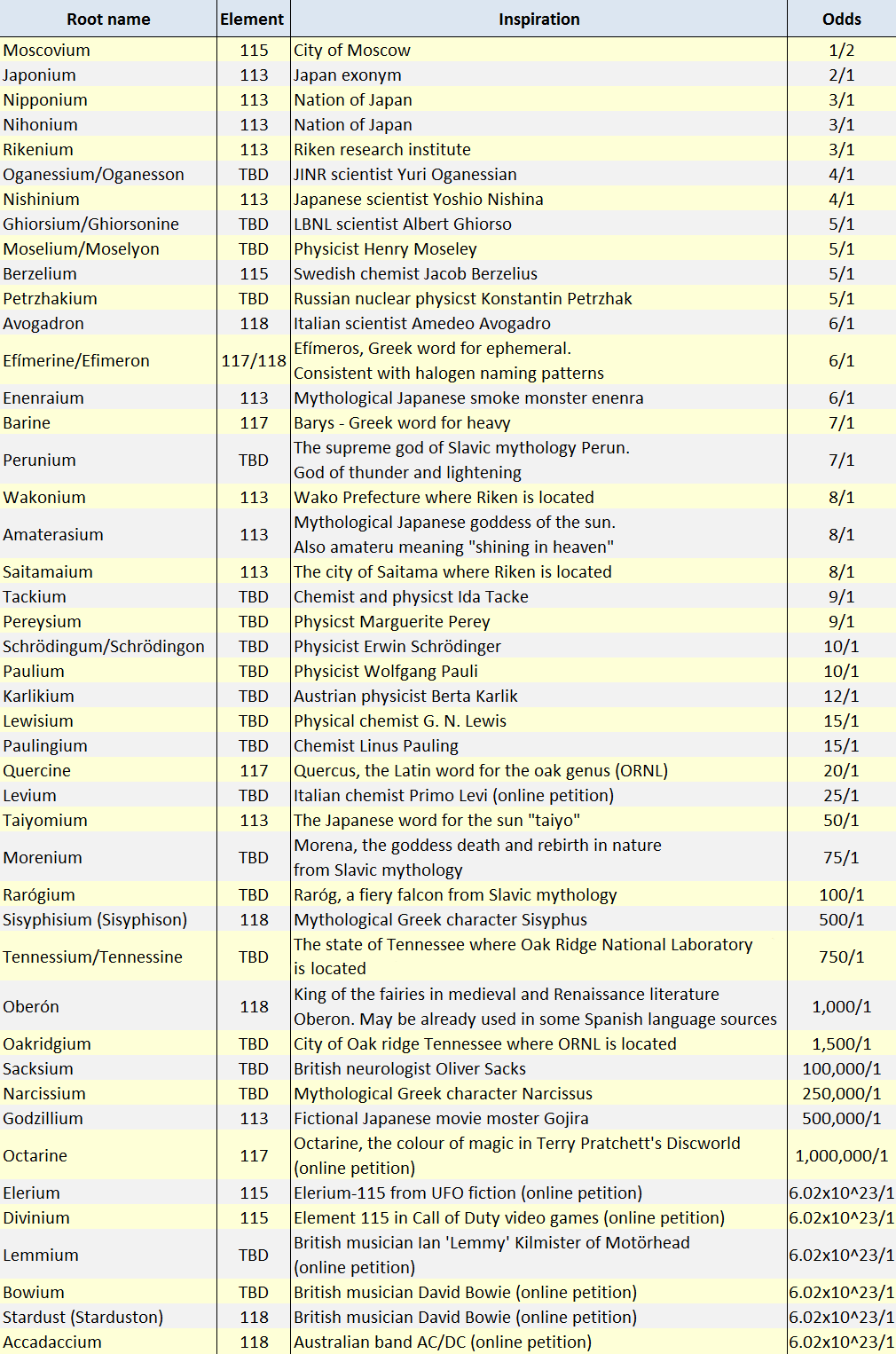
Except for a press release from the Joint Institute for Nuclear Research (JINR) on element 115 (available here) and Riken on element 113 (see page 16 of this pdf document), the research groups have been silent on what names might be submitted for IUPAC approval. Proposals for names have come in from a variety of quarters including several internet petitions on change.org. With all the suggestions and speculation, we thought it would be fun to try and guess what the researchers actually will propose to IUPAC. So we assembled a panel of experts that included freelance science writer Philip Ball, Worcester Polytechnic Institute professor of chemistry and biochemistry Shawn Burdette, chemistry blogger Kat Day, UCLA lecturer and author of several books on the periodic table Eric Scerri, and Stockholm University atmospheric chemistry researcher Brett Thornton. The panel brainstormed a list of ideas consistent with the IUPAC guidelines, as well as historical trends in element nomenclature. The panel also examined the names being put forward elsewhere. The list is compiled below (click on the table for bigger version) and includes odds on the likelihood that each name will be proposed to IUPAC (e.g., 1/2 odds corresponds to a 67% probability and 2/1 odds implies a 33%).

table1full

Based on the proposed names, each member of the panel has made a pick for each of the new elements. If we were actually gambling, picking a longshot name, while less probable would provide a bigger payout if correct. This would be how things work in a typical sports book; however, these picks are being made just for fun (click on the table for bigger version).

table_picks

The process of how the names were selected, the significance of the names, how the odds were determined, and why each panelist made their picks, will be the subject of a Commentary in an upcoming issue of Nature Chemistry. Since we don’t know the timetable on which names will be proposed, we wanted to initiate the project with this post on the Sceptical Chymist. This also gives you the opportunity to make picks of what name the researchers will submit to IUPAC. Did the panel miss a name that the researchers at RIKEN, the JINR, Lawrence Livermore National Laboratory (LLNL) or Oak Ridge National Laboratory (ORNL) might be considering? It has also been suggested that the discovery groups might want to consult with the research teams involved in the experiments that replicated their discoveries. Will they be consulted, and are there other names those researchers might advocate? The discovery team who created copernicium listened to public suggestions, will these research teams? Should they? Give us your picks as well as any suggestions for possibilities we omitted below. Remember IUPAC guidelines require elements to have names derived from mythology, minerals, places, properties or scientists. Make sure to identify yourself so we can credit you in the Commentary if we discuss your ideas.

Avoiding redundant tautologies in scientific writing

This is a guest post from Reuben Hudson at Colby College in response to one of Michelle Francl‘s recent Thesis columns.

—————

Chemists communicate with a lexicon rife with double endendres [ref. 1]. Some of our words take on new meanings after appropriation from general vocabulary and certainly our words cross into the public sphere with a similar alteration of the intended meaning, often resulting in humorous or nonsensical interpretations. Despite our urge for vigorous [ref. 2], concise [refs 3,4], and clearly understandable prose [ref. 5], Michelle Francl [ref. 1] suggests that we not avoid all ambiguous language ‘for it gives chemists a rich set of images to draw on, and as such, we shouldn’t discourage it, for we can’t look for what our language doesn’t let us imagine.’ I agree whole-heartedly with her encouragement to use, when appropriate, single phrases with multiple meanings, and take this opportunity to point out the equally common, seemingly opposite practice in the chemical literature of incorporating multiple, redundant inferences of the same meaning in a single phrase.

Redundancies are a part of quality science. Elegant reproduction can build a compelling argument. Reiteration of a thesis strengthens rhetoric. Unintentionally repeating again the same point, however, is a sign of ineptitude and detracts from effective communication.

Tautologies (redundancies for lack of style) can arise as a result of an incomplete understanding. Such is often the case with bilingual acronyms, where the acronym itself is retained, but the meaning clearly lost in translation, a laughable and excusable miscue. Consider ‘le protocol IP’ from French computer science (internet protocol protocol). Without the crutch of an improper translation, other redundant acronyms become more laughable and less excusable. Biologists first introduced the term, ‘HIV virus’ (human immunodeficiency virus virus), while physicists brought us LASER light (light amplification by stimulated emission of radiation light). Chemists are perhaps the worst when it comes to tautological acronyms. Any student of organic chemistry will remember one of the cornerstone reactions: the SN2 substitution (guess what ‘S’ represents). The CDC coupling reaction (cross dehydrogenative coupling coupling), a new innovation rolled out by green chemists, is a halogen-free means of carbon–carbon bond formation.

To this point, the discussion has ostensibly focused only on redundant acronyms. The careful reader will have also noticed the equally egregious use of tautological phrases within this very post, several of which see frequent use in scientific publications. An innovation is, by definition, something new. It is therefore tautological to say, ‘new innovation.’ An introduction is the first time something is presented. Thus, ‘first introduced’ is redundant for lack of style. Repeat means to say again, so it is superfluous to say, ‘repeat again.’ The title of this post is also tautological.

References

1. Francl, M. Nature Chem. 7, 533–534 (2015). [LINK]
2. Patience, P. A., Patience, G. S., Boffito, D. C. Can. J. Chem. Eng. 93, 2095–2097 (2015). [LINK]
3. Hudson, R. J. Chem. Educ. 90, 1580 (2013). [LINK]
4. Carr, J. M. J. Chem. Educ. 90, 751−754 (2013). [LINK]
5. Stewart, A. F. et al. J. Chem. Educ. doi:10.1021/acs.jchemed.5b00373 (2015). [LINK]

UCLA brings home the BACON

Editor’s note – this is a guest post from Professor Neil Garg at UCLA.

——————-

Notorious for being the ‘weed-out’ course that crushes the hearts and souls of our students, organic chemistry has a bad reputation. To help counter this unfortunate perception, we have recently developed a series of online tutorials that connect organic chemistry to topics in human health and pop culture. We call it B.A.C.O.N. at UCLA (Biology and Chemistry Online Notes and Tutorials) and our students love it.

We would like to make these tutorials accessible to educators and students anywhere in the world at no cost, so we are raising funds for software development with the help of the UCLA Spark crowdfunding campaign starting on May 4.

If any chemists or science enthusiasts would like to help us out in the meantime, you can support us through our Thunderclap page by clicking “Support with Facebook/Twitter/Tumblr”. There is no cost and your support helps to spread awareness.

We would be very grateful if you would be willing to add your support to BACON and its science-education goals!

The top blog posts of 2014

Editor’s note: Jess Breen who blogs at The Organic Solution and Andrew Bissette round up the best blog moments of the year. If your favourite chemistry-related blog post doesn’t appear on the list, leave a comment letting us know what it is.

——————-

Last year we rounded up our ten favourite posts of 2013. This year we’ve ditched the round number, and instead compiled a Bumper Blogroll of topics that chemists have been talking about in 2014.

Science is increasingly interdisciplinary, as reflected in the now-traditional annual argument over whether the winners of the Nobel Prize for Chemistry are actually chemists or not. In this interdisciplinary spirit, we’ve not limited ourselves to chemists, instead drawing on some of the best writing by scientists of all stripes.

Women in science

In September, Science published a story about the top 50 scientists on Twitter. Among many others, Paige Brown Jarreau highlighted the shortage of women on the list, and offered an alternative list filled with fascinating female scientists. The relative absence of chemists on the original list also prompted reflection about how to better capture the imagination of the general public (see here and here).

Food for thought

The anonymity available to bloggers and commenters can be a blessing or a curse, allowing vulnerable people to speak the truth safely or offering malicious individuals a shield to hide behind. In January, Michael Eisen offered a thoughtful dissection of the differences between anonymity and pseudonymity and the ethical questions raised by social media and peer review. Questions of anonymity are not limited to social media, and Mark Lorch shared a story highlighting the importance and limitations of anonymity in peer review.

Organic synthesis

The Baran lab blog, Open Flask, is approaching its second anniversary and continues to share fascinating behind-the-scenes looks at their recent publications. The ever-brilliant BRSMblog has educated us throughout 2014; the highlight for us was a recap of three classic total syntheses. Meanwhile, Brandon Findlay of Chemtips spent the year offering invaluable practical advice to young researchers, such as a guide to bypassing the ‘black tar phase’ of synthesis.

PhD life

During the low-points of a PhD, a blog can offer an outlet for anxiety or a source of reassurance. Tom Phillips shared his struggle with the second-year blues, hopefully providing some comfort to others in the same situation. Via Chemjobber, Chad Jones shared lessons he learned in graduate school about coping with the demands of research. On a happier note, chemists from the University of Groningen shared their PhD experiences through the medium of dance.

Careers

Securing an academic position is hard, and from the outside it can seem almost impossible. Aidan Horner, a neuroscientist, shared his ‘negative CV’ of career and publishing rejections with the world to offer some reassurance to early-career researchers. As Aidan tells us, “you need to keep banging on the door until someone lets you in”. For those who do decide to leave academia, the fear of being seen as a failure can be off-putting. Women in particular may feel a duty to continue in academia to avoid becoming part of the ‘leaky pipeline’. Sci Curious shared at length her positive experience of leaving academia and thoughts on academic culture. Not all graduate students can or should continue in academia, and those who choose a different path should not be seen as failures.

Literature woes

The scientific literature can be a source of fascination or frustration. Dr Freddy shared five things that synthetic chemists hate to see in papers in a post that, remarkably, has a comment section worth reading. Meanwhile, Mike at Amboceptor asked what is the volume of a drop? It turns out that this classic unit is more widespread than one might think. Finally, Sylvain Deville recounted the making of a paper, from the inception of an idea, to the trials and tribulations of gaining the all-important results, to publication in Nature Materials.

Chemophobia

The popular notion that ‘chemicals are bad’, often called chemophobia, is a perennial topic for chemistry bloggers. Renée Webster shared her attempt to engage with a beauty company and asked how she could have done better. Alternatively, Chad Jones suggested that chemists can be too defensive when it comes to chemophobia. We hope these reflective writers will help promote a more nuanced approach to communication from chemistry bloggers.

#Realtimechem

No blog round-up would be complete without reference to #RealTimeChem week. Now in its second year, this is a highlight for the online chemistry community, showcasing some of the best writing and creativity chemists have to offer. Bring on #RealTimeChem week 2015!

Best new blog

Finally, our favourite new blog of the year is Compound Interest, written by Andy Brunning. Andy creates beautiful infographics about all sorts of everyday chemistry, from autumn leaves to xylitol. There is even a chemistry Advent calendar. To top it off, the infographics are available for purchase as full-sized posters for your office, lab, or classroom. Keep it up, Andy!

One ring to bind them all

Editor’s note: the January 2015 issue of Nature Chemistry features a Thesis article ($) from Michelle Francl that looks at chemists’ fascination with benzene. It is illustrated with a range of different representations of benzene and benzene-containing compounds drawn by Michelle’s own fair hand. Here is a short accompanying blog post by Michelle, including a quiz!

I’m teaching the first year course in chemistry this fall, and in addition to making certain my students have a firm grasp on Hess’ law, VSEPR theory, and gases, I’ve been insisting they learn to draw. To think like chemists, I tell them, and to keep from drowning in later organic chemistry lectures, they need to be able to quickly draw chemical structures that other chemists can ‘read’ and to see in their own heads the reality these particular embeddings represent. So we learn the chemical alphabet, wedges and dashes, chairs and boats — and the iconic hexagon.

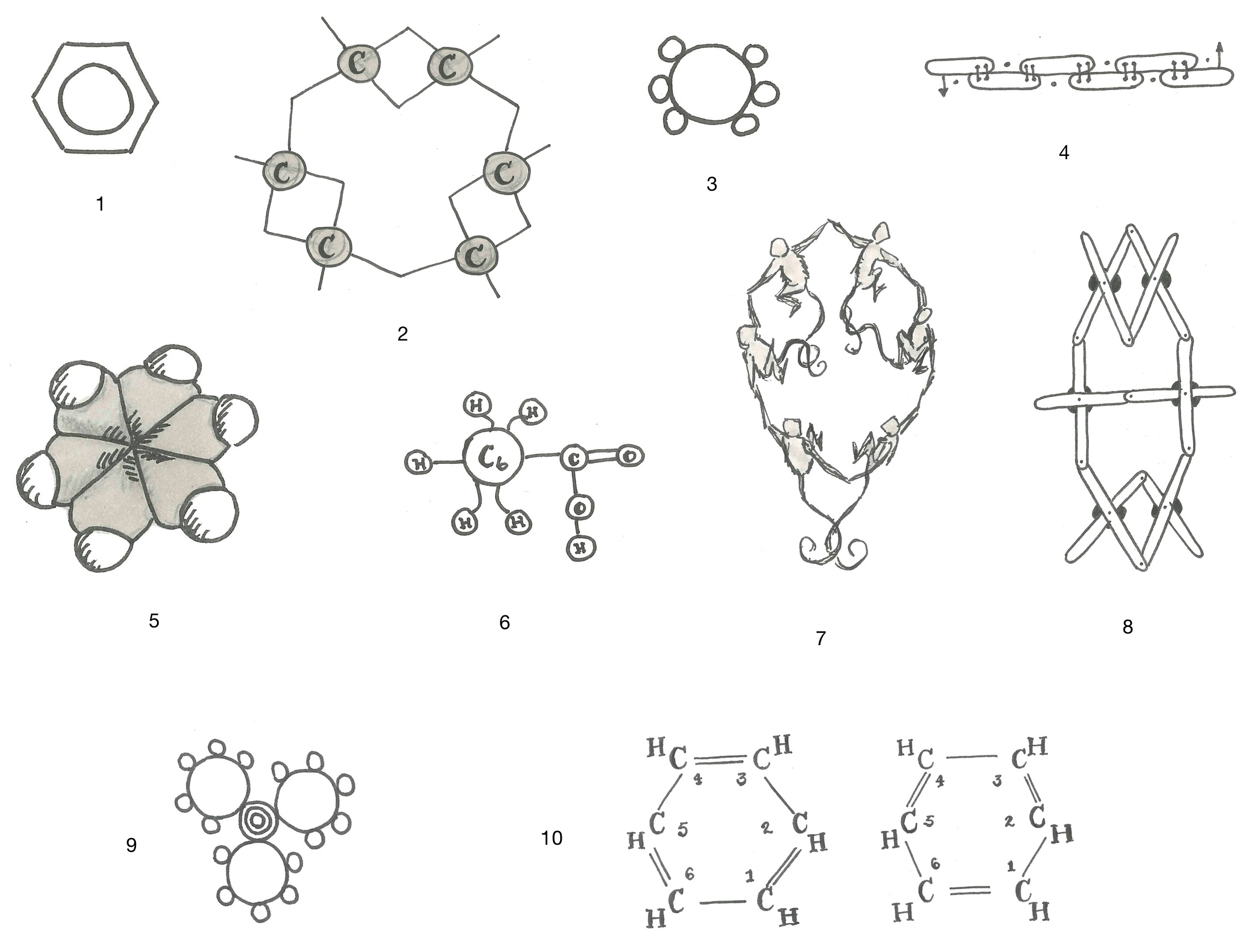
It took chemists more than 100 years after Michael Faraday isolated and characterized benzene to settle on the hexagon with a circle in the center as a convenient way to represent the hexavalent kernel of organic chemistry. I found more than a dozen different representations of benzene in the chemical literature, Kekulé alone used three types, and like the Buddhist wisdom tale of the elephant and the blind men, each attempt brought out a different facet of the structure and bonding. Can you match each of the structures (1-10) with its description (A-J)?

Benzene for blog post

A. Alexander Crum-Brown’s 1866 representation of benzoic acid.
B. From a Liebigs Ann. Chem. paper published by August Kekulé in 1872.
C. Appeared in 1886 in Berichte der Dürstigen Chemischen Gesellschaft (Reports of the Thirsty Chemical Society) a spoof edition of Berichte der Deutschen Chemischen Gesellschaft.
D. From Kekulé’s first paper suggesting that benzene was a circle (published in 1865).
E. From an 1861 pamphlet published by Johann Loschmidt.
F. James Dewar’s contraption for representing molecular structure, illustrating an isomer of benzene, the inspiration for ‘Dewar benzene’. Despite legends to the contrary, Dewar does not suggest the structure in his 1867 paper as an alternate bonding scheme for benzene, the paper is about building the brass pieces to use to make molecular models.
G. From a paper published by Robert Robinson and James Armit in 1925. Armit etched it into the window of his family’s bakery in St. Andrews, Scotland.
H. In August Kekulé’s 1867 Lehrbuch der organischen Chemie (Textbook of Organic Chemistry).
I. A representation of benzene following the style used in a paper published by Cox, Cruickshank and Smith in 1958.
J. Triphenylamine in Loschmidt’s notation (from the same 1861 pamphlet as E).

Editor’s note: post your answers as a comment here, or on Twitter (mentioning @NatureChemistry), in the form 1A, 2B, 3C, 4D, etc… no prizes, apart from kudos and some retweets.

Editor’s note Jan 9th, 2015 – the correct answers are: 1G, 2H, 3E, 4D, 5I, 6A, 7C, 8F, 9J, 10B. The first person to get them all right was Stephen Davey (his second guess in the comments). Steve does, admittedly, work at Nature Chemistry, but before you all groan and roll your eyes, he had no way of finding the answers (that was all between Michelle and myself). You’ll see that Cristiano Zonta also got all the answers right and it is worth noting that his and Steve’s blog comments were both moderated (by me) at the same time, so even though Steve’s comment was first, Cristiano could not have seen these answers before posting his own identical ones (because both blog comments were published at the same time). With 8/10, @fxcoudert and @samofthedamned also get honourable mentions – and thanks to everyone else who played along on Twitter. Apologies if I’ve missed any other high-scoring guesses.

Five years of polling the computational chemistry community

At Nature Chemistry we all love Density Functional Theory and we all love polls – so what could be better than a poll on DFT? Marcel Swart, Matthias Bickelhaupt, and Miquel Duran have, for the last five years, been running a poll to find out which functionals the computational chemistry community like or dislike. The results of the the 2014 poll are now out and we have a guest post from the three of them to explain a little more about it.

I’m sure we’ll be seeing this as a question on Family Fortunes/Family Feud soon: “We asked 100 people to name …. a popular density functional”

Gavin

(Senior Editor, Nature Chemistry)

*******************************

Since 2010 we have been organizing an annual online popularity poll for density functionals where we probe the preferences of the computational chemistry community for their preferred Density Functional Theory (DFT) functionals. It all started with a presentation by Matthias Bickelhaupt (Feb. 2009) that showed the values of various chemical properties calculated using quite a number of different density functionals. Miquel Duran suggested, essentially, ‘averaging’ a number of these values but with appropriate weightings applied that reflected how ‘good’ the employed functionals were. Thus obtaining a ‘consensus’ density functional result. This could then act as a measure of how well the computational chemistry community is doing if compared to state-of-the-art reference data.

In order to get the weightings needed for this procedure, we have held annual online polls where people could indicate their preferences for a number of density functionals. The polls were announced on the Computational Chemistry List (CCL; a mailing list where people can ask for advice about any aspect of computational chemistry), on Twitter, Facebook, blogs, and so on, in order to get the maximum number of participants. The aims of this poll were: (i) to probe the ‘preference of the community’, that is, setting up a ranking of preferred DFT methods; and (ii) provide a compilation of the ‘de facto quality’ that this implies for the ‘average DFT computation’.

The DFT poll has led to, what some might deem to be, a polarization of the field, with some people clearly in favor (e.g. Steven Bachrach, Gernot Frenking, John Perdew, Henry Rzepa), and others clearly against. Especially this year there has been a vivid debate on the CCL mailing list in the days after the poll was announced (CCL June 1st entries, CCL June 2nd entries, CCL June 3rd entries). This may, or may not, be related to the fact that in 2013 we had to disqualify one functional that had fallen victim to a blatant attempt to bias the outcome of the poll. This has not happened again this year (because we switched to another survey provider).

In order to stress the motivation for holding the poll, we as organizers felt we needed to add a statement as well, since we “are simply monitoring what happens in the field of DFT and comment on how the choice of the community differs from (or agrees with) reliable reference data. In that way, we do exactly what should be done, namely ‘drive science through evidence and logic’ or maybe even ‘drive science back to evidence and logic’ (because, against all basic principles of science, the community often just follows blindly a fashion)”. And as one message nicely described: “Yes, it is not scientifically sound, epistemologically correct, platonically unsullied. But at least it is fun. We should appreciate fun in chemistry”.

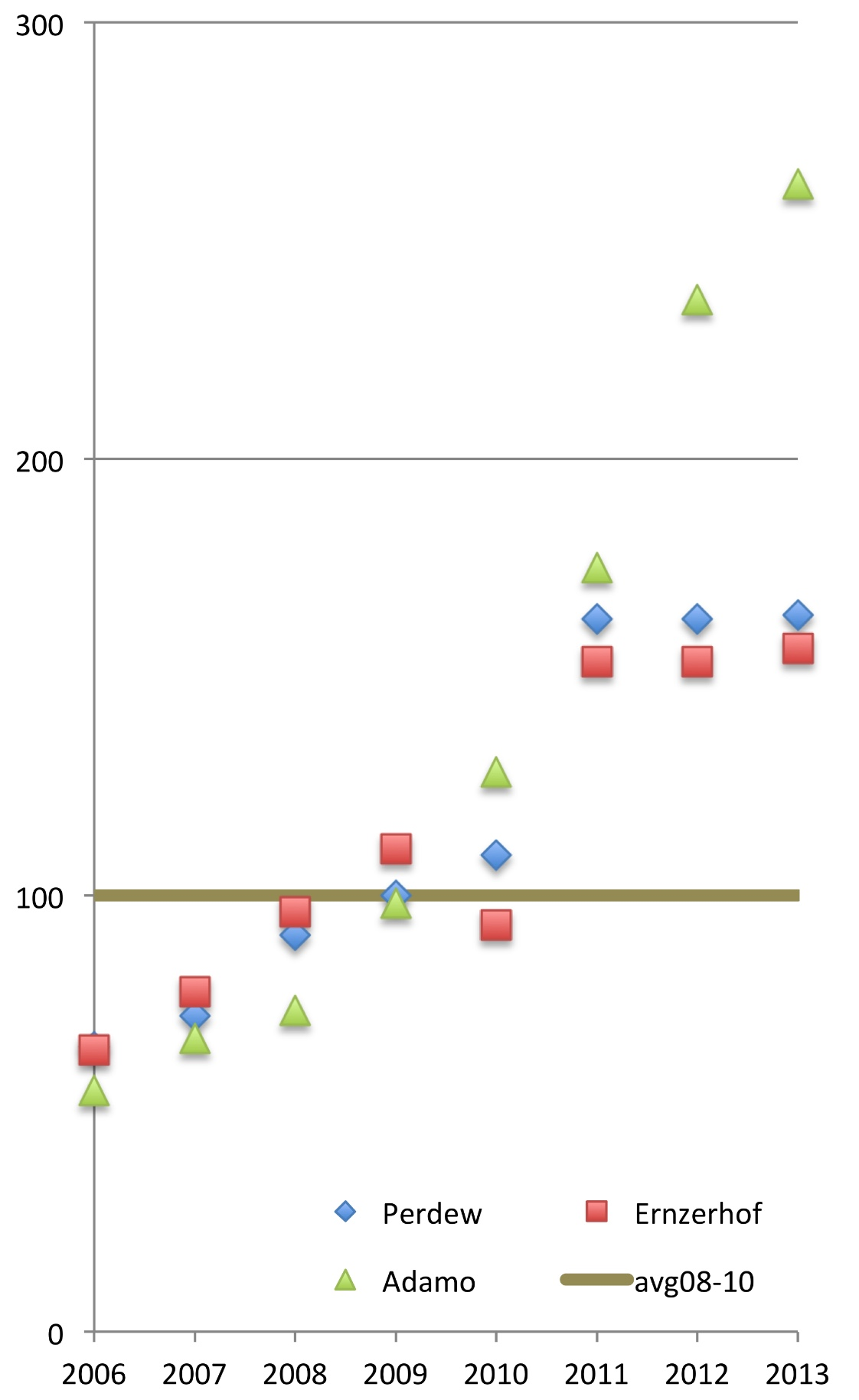
The nice part of the popularity poll is that it opens the field to newbies, who through the poll have a better understanding of which are the most popular functionals within the field  — which can serve as a good starting point for those looking for the best functionals for their given problems. For instance, the rise of the wB97X-D functional is nicely reflected in this year’s results (moving upwards to 4th place after PBE, PBE0 and B3LYP), as was the fact that the winner of the first editions (PBE0) was largely unknown to many people. The years after the first edition (in which it ‘won’), the number of PBE0 citations has increased considerably, by at least 60% (see Figure 1) for the three PBE0 papers (there is the original paper by Perdew and co-workers where they describe the rationale for using 25% Hartree-Fock exchange; and there are two separate papers that introduce the functional as being PBE0, by Ernzerhof and Scuseria, or by Adamo and Barone).

Figure 1. Normalized number of citations for PBE0 papers, before (2006-2010) and after (2011-2013) the first news-item of the DFT poll (100 = average number of citations for 2008-2010 for each of the three papers separately).

Figure 1. Normalized number of citations for PBE0 papers, before (2006-2010) and after (2011-2013) the first news-item of the DFT poll (100 = average number of citations for 2008-2010 for each of the three papers separately).{credit}Courtesy of Marcel Swart{/credit}

Given that this is the fifth edition, we asked several researchers in the field (in Sept. 2014) whether they were in favor or against the DFT poll.

Steven Bachrach: “Please feel free to quote me from the Wiley Interdisciplinary Reviews article [“It would be nice if we could somehow again reach some consensus regarding a uniform standard computational method that experts and non-experts could rely upon for most situations. A challenge I make here to the computational community is to try to reach an accord on establishing a standard methodology. Perhaps a conference could be called where leaders propose their best methods and after discussion, a vote yields a recommendation for the greater user community”] and from CCL [“I also think the poll has value in discerning trends, especially new functionals to appear on the list and ones that have fallen down or off”].

John Perdew: “The DFT popularity poll is somewhat like citation analysis: It measures (but in a different way) how well a functional has been received by a set of readers and users.  There are many reasons why some functionals are received better than others: accuracy, reliability, wide applicability, computational efficiency, well-founded construction, availability in standard codes, reputation of the functional and its authors, historical priority, novelty, and even hype.  The poll has to be seen as measuring all these things, and perhaps more. To the extent that the polled scientists use rational criteria, the results of the poll can point other scientists toward good or interesting functionals”.

Henry Rzepa: “I still think the context of any vote cast is absolutely crucial. Perhaps what the community needs to develop is a public set of conformance test sets of molecules, one for each type of property?”

Andreas Savin: “I must shamefully confess that I do not know about the DFT popularity poll.” (after having received more information): “I will not participate, as this poll is intended for people who apply DFT, and I do little in this direction, but I find it interesting. I am amused to see that B3LYP is not as popular as generally believed, and LDA has such a high rank. How does it compare to the number of citations?”

Gustavo Scuseria: “I am not in favor or against the poll. It is interesting though that we need a contest to determine what is popular and useful. A cacophony of functionals have mushroomed in recent years, and I am very much afraid that uncontrolled approximations and rampant empiricism have taken over DFT”.

An interesting addition was brought forward in the discussions this year by Henry Rzepa (June 1, 2014), who suggested that, in the future, the poll should be extended to enable participants to explain why they like or dislike a given functional. This is a new interesting feature that will be added to next year’s edition: for each functional the participants can indicate for a number of properties whether they love using the functional, or rather dislike it. Rzepa proposed a number of properties (reaction barriers, normal mode analysis, NMR shieldings, etc.), which will be fine-tuned before the polling season opens again on June 1 2015!

Marcel Swart, Matthias Bickelhaupt, and Miquel Duran