Intravenous vaccine for malaria offers robust protection in small clinical trial

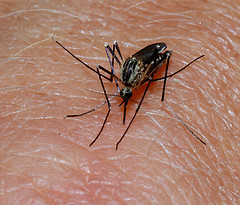
mosquito

Almost half the world’s population lives in areas where malaria infection is a risk, yet no licensed vaccines exist to prevent this red blood cell parasite from causing almost half a million deaths each year. However, in a study published online today in Science, researchers report on a new vaccine that provided remarkable protection against Plasmodium falciparum, considered the deadliest of the four malaria strains.

“With this intravenous vaccine, we are striving to reach the World Health Organization goal of a [malaria] vaccine with 80 percent efficacy by 2025,” Anthony Fauci, director of the US National Institute of Allergy and Infectious Diseases (NIAID), in Bethesda, Maryland, told Nature Medicine. The clinical study was led by Robert Seder, an immunologist at the NIAID Vaccine Research Center, and involved a vaccine developed by Stephen Hoffman and his colleagues at Sanaria, a biotechnology company based in Rockville, Maryland.

Scientists have spent decades trying to block Plasmodium infections at different stages of the parasite’s life cycle—from the sporozoite that migrates out of the mosquito salivary gland and into host liver cells, to the merozoites that invade red blood cells before further developing into reproducing gametocytes.

To date, only one experimental vaccine, called RTS,S or Mosquirix, developed by GlaxoSmithKline Biologicals and the PATH Malaria Vaccine Initiative, with funding from the Bill & Melinda Gates Foundation, has demonstrated a consistent protective effect. It is made with a combination of antigens from part of a sporozoite and a hepatitis B virus surface receptor. Early results suggested that three doses of the vaccine could cut the risk of infection among children aged 5 months to 17 months by half. But last year the results of a phase 3 clinical trial indicated that it offered only about 30–35% protection when given to infants between 6 weeks and 12 weeks of age.

Seder and his colleagues set their sights on developing a vaccine with at least 80% efficacy and also decided to focus on stopping malarial infections at the sporozoite stage—before the parasite ever gets into the red blood cells. The phase 1 clinical trial reported today included a total of 34 adults completing a series of intravenous vaccines at varying doses, with the most promising results at the highest dose levels. Six adults who received five vaccine injections at the highest dose all showed complete protection after they were subsequently infected deliberately with P. falciparum, while six of nine adults who received a series of four of the high-dose vaccines experienced similar protection following the immunization schedule.

Continue reading

Computer program aims to rank vaccine development decisions

WASHINGTON, DC — Aligning the priorities of all stakeholders involved in vaccine development can be a convoluted and thorny process. An international health organization might emphasize a candidate vaccine’s expected health benefits for disadvantaged populations, a government agency might be more focused on its own backyard, and a drug company could be driven by its monetary bottom line. With so many competing interests, what experimental product does it make the most sense for these partners to pursue?

Soon, a mathematical model that’s particularly good at weighing complex alternatives may be able to help. It’s at the heart of a new computer program, called the Strategic Multi-Attribute Ranking Tool (SMART) for Vaccines, that scores potential avenues for vaccine research and development according to the priorities fed into its algorithm. Members of the US Institute of Medicine (IOM) panel behind the new tool, who discussed the algorithm’s prototype at a meeting here on 2 November, hope it will establish a shared vocabulary that will allow everyone working on preventative vaccines for infectious agents to better understand and share their own perspective. “We’re creating a common language for people to talk with, instead of everyone having their own language,” says IOM committee member Charles Phelps, a health economist at the University of Rochester in New York.

In the past, the IOM simply released reports that encouraged vaccine developers to prioritize tackling certain diseases on the basis of the balance of expected health benefits, the costs of developing and administering the vaccine and the projected savings from the preventative medicine. For instance, in the most recent report, published in 2000, the IOM strongly favored targeting influenza, a virus that kills up to 49,000 people each year in the US at a cost of tens of billions of dollars annually to the country’s economy. In contrast, the bacteria responsible for Lyme disease, a far less prevalent pathogen with a smaller economic burden, fell much lower on the priority list.

The IOM had intended for vaccine developers to take its rankings into account when making decisions. However, according to Paul Offit, chief of infectious diseases at the Children’s Hospital of Philadelphia and a co-inventor of the rotavirus vaccine, such lists tended to justify choices that had already been made. “When the IOM puts a list out,” he says, “[vaccine manufacturers] feel that validates what they’ve done.”

With the SMART tool, any organization can generate its own priority rankings, custom-tailored from a list of 29 different vaccine attributes, including the number of premature deaths expected to be prevented from immunization, the availability of other medical interventions and whether the targeted disease has been stigmatized. A vaccine maker could give more weight to economic considerations such as the costs of clinical trials and licenses, say, whereas a defense-related agency could flag diseases that tend to afflict military personnel serving abroad. Out pops a numerical score for each candidate under consideration, thanks to a computational method also used to weigh complicated options for expanding Mexico City’s airport decades ago. Each score is broken down to reveal how much the chosen priorities contributed to the final number.

Continue reading

Malaria vaccine results present infant immunization quandary

{credit}CDC{/credit}

Babies receive a battery of vaccines after they’re born to protect them against dreaded diseases such as tetanus, whooping cough and polio. Public health officials in the developing world had hoped to soon add a malaria (Plasmodium falciparum) vaccine to the childhood immunization schedule to take advantage of the existing vaccine distribution system. However, new results from a trial of the leading candidate—a shot known as RTS,S, or Mosquirix—suggest that the vaccine reduces the risk of malaria by only a third in infants.

Given the low efficacy, some experts are now questioning whether RTS,S would be a useful addition to the childhood vaccination roster. John Lusingu, a malaria researcher at the National Institute for Medical Research in Tanga, Tanzania, and a principal investigator on the trial, points out that children six months and older are most affected by the disease, so it might make sense to administer the vaccine to older children, for whom the vaccine is more protective. But that would probably require an expansion of the routine immunization program to include additional clinic visits, which can be burdensome for health workers and families.

The vaccine’s developers, GlaxoSmithKline (GSK) and the PATH Malaria Vaccine Initiative, plan to push on with the phase 3 trial, which is slated to end in 2014. “This is not a mission we should just walk away from,” Andrew Witty, chief executive of GSK, said in a press conference on 9 November. The London-based company has spent approximately $300 million on RTS,S to date and expects to invest another $200 million before the project is finished.

The study, published last week in the New England Journal of Medicine, included more than 6,500 infants between 6 and 12 weeks old from across seven African countries. The vaccine reduced the risk of clinical episodes of malaria by 31% in this young cohort, a lower level than that found in children vaccinated between 5 and 17 months for whom the vaccine provided up to 56% protection.

Why the vaccine is less effective in infants than it is in toddlers isn’t yet clear, but the research team behind the trial has a number of hypotheses. One complicating factor could be antibodies passed on from the babies’ mothers during pregnancy. These maternal antibodies protect infants from disease, but they can also prevent vaccines from eliciting a strong immune response .

Those same antibodies decay over time, though, so the older group of children would probably have had lower levels of them, says Rick Fairhurst, chief of the malaria pathogenesis and human immunity unit at the US National Institute of Allergy and Infectious Diseases in Rockville, Maryland. The effect could be especially pronounced in areas with the highest burden of malaria. Repeated exposure to the parasite results in higher levels of antibodies in the mothers, which can then be passed on to the children.

Continue reading

(Not so) evil DDT — and goodbye

A new study published Monday in Environmental Health Perspectives revives fears about the pesticide environmentalists everywhere love to hate: DDT. Researchers examined 129 women who were exposed to the pesticide as children and found that the women had a whopping 400% increase in breast cancer risk.

This isn’t the first time the link between breast cancer and DDT has been examined, but previous studies were either inconclusive, questionable or found no link. The difference this time, according to the researchers, is that these baby boomer women were exposed to the pesticide in the 1950s and 60s, before they were 14 years old. The age of exposure has a great deal to do with breast cancer risk, apparently.

I have some doubts about the study because of its size, but even if it is confirmed by other research, it’s important to emphasize that the study was looking at women who were exposed to the pesticide as it was used in the 1940s and 50s, when it was sprayed widely — one might say recklessly — for agricultural purposes. That’s now banned in most parts of the world.

Where it is used, DDT is sprayed indoors, in very small quantities, for malaria control. And in fact, it’s the most powerful tool available against the mosquitoes that spread malaria. That’s why, despite its sketchy reputation, the WHO and others decided to support its use in Africa, as I reported last summer. Studies like this are often misused and misinterpreted. But the consequences of dismissing DDT’s benefits are far too serious to contemplate.

**

On a completely unrelated note, yesterday was my last day as senior news editor at Nature Medicine. As of next week, I’m joining the Simons Foundation, where I’ll be helping to create an online community for autism researchers. It’s been a pleasure contributing to this blog, however infrequently I’ve done it lately. I hope you’ve enjoyed reading it — and will join me on my personal blog, which I hope to have up and running sometime soon.

The malaria dance

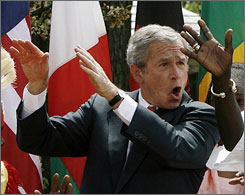
Have you seen this picture?

bush.jpg

That’s President Bush, dancing at a benefit for Malaria Awareness Day. The picture is priceless, but I’ll restrain myself. This is once I can’t fault the administration too much.

In 2005, Bush launched the President’s Malaria Initiative which has, among other things, helped support the use of DDT in many African countries.

Yesterday, Africa Fighting Malaria (AFM), a NGO that helped bring DDT back, scored donor countries on their efforts fighting malaria. On their scorecard, the US ranks above everyone else, getting an impressive B+. Considering most other countries got themselves big, fat Fs that’s really good.

Things weren’t always so rosy, of course. In fact, before AFM and others took the US Agency for International Development to task, the agency was spending about 7% of its budget on actual interventions. the rest went to “other” costs. After Congress intervened, things at USAID have improved dramatically and they’re now working closely with AFM.

But that still leaves all the other donors, who are—litreally—failing in their efforts to fight malaria.

For the purposes of the scorecard, those countries “got an F because they never even responded,” AFM’s Richard Tren told me yesterday at a fundraiser in New York for the NGO.

Maybe it’s time to rustle up pictures of those leaders.