
Posted on behalf of Jeff Tollefson
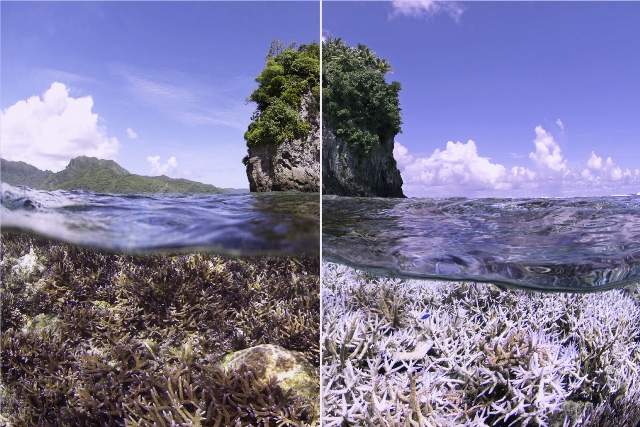
Images shot by the Chasing Coral crew graphically show the progress of the coral bleaching event that began in 2014.{credit}Chasing Coral, courtesy of Netflix{/credit}
First we take the plunge, off the boat and into the blue. Once the bubbles clear, wonders emerge. Guided by the camera, the eye is initially drawn to the obvious: turtles, rays, eels, jellies, fish. But the star of this show is a different kind of animal. The focus shifts, and we see a variety of fabulously intricate and colourful structures, some branched like trees, others spiny and globular. Each edifice in this marine metropolis was erected by corals — master builders now under unprecedented threat.
Director Jeff Orlowski begins his latest documentary, Chasing Coral, with this view of living abundance. Soon enough, we see death. Images of reefs left white and mostly lifeless give way to apocalyptic footage of dead corals, covered in algae and disintegrating in murky waters. Orlowski’s film, which launched on Netflix on 14 July, reveals the shocking reality of the global bleaching event that began in 2014, spurred by human-driven climate change and only now coming to an end.
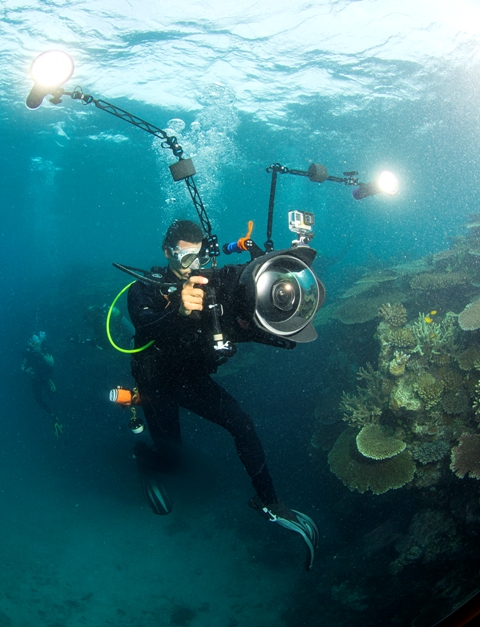
Jeff Orlowski filming corals on the Great Barrier Reef, Australia.{credit}Richard Vevers/Chasing Coral, courtesy of Netflix{/credit}
There are similarities between Chasing Coral and Chasing Ice, Orlowski’s 2012 documentary about melting glaciers, right down to the focus on time-lapse imagery to capture environmental degradation. But where Chasing Ice centres on James Balog, a National Geographic photographer who set up the Extreme Ice Survey to document ice shrinkage, Chasing Coral features, along with leading coral researchers, a curious collection of characters who embark on a technically daunting effort to document the transition from life to illness and death on a coral reef. The result is a fast-paced narrative arc that manages to carry a full-length film about global warming, the ultimate slow-boil.
Orlowski doesn’t hide anything. In fact, he becomes part of his own narrative through that of Richard Vevers, the man driving the project. A former advertising executive turned ocean activist and underwater photographer, Vevers relates how in 2010, he decided to put his talents to better use: saving corals. After seeing Chasing Ice in 2013, he decided to contact Orlowski, who – in an intriguing meta-moment – makes an appearance in the film to talk about the genesis of the project.
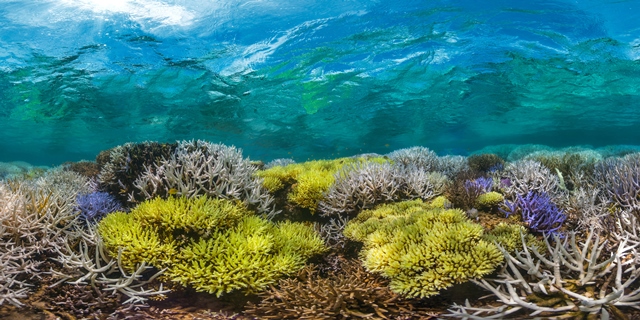
A panoramic view of fluorescing and bleaching corals in New Caledonia in the southwest Pacific, in March 2016.{credit}The Ocean Agency/XL Catlin Seaview Survey{/credit}
To its credit, Chasing Coral goes beyond personalities and crises and gets into the science – as well as the challenge of communicating that science and raising public awareness. “One of the biggest issues with the ocean is that it is completely ‘out of sight, out of mind’,” Vevers says. “And that is an advertising issue.”
The first step the crew faced was acquiring a high-quality camera capable of operating underwater remotely for weeks at a time. Enter View into the Blue, a company based in Boulder, Colorado, that adapted a high-resolution underwater camera – with its own wiper system to keep the domed-glass housing case clean – for the project. Step two: figure out where to deploy the camera. Glaciers are easy to identify and visit, and nearly all of them are melting now. But setting up a time-lapse camera to capture the death of a coral reef due to warm ocean currents requires considerable planning and a measure of serendipity.
Mark Eakin, who heads the US National Oceanic and Atmospheric Administration’s Coral Reef Watch, provided forecasts and guidance on where to deploy. Vevers and the team figured out how to power the camera and retrieve data, but an initial deployment in Hawaii failed: the cameras lost their focus after the first shot. A second try on the southern Great Barrier Reef off Queensland, Australia, saw the warm waters (fortunately) failing to arrive.
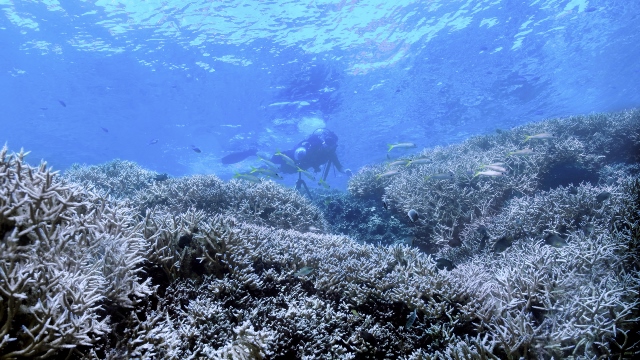
A bleached reef.{credit}Chasing Coral, courtesy of Netflix{/credit}
So the team ditched the automation altogether and moved north to Lizard Island, and on to New Caledonia. Here, they manually photographed dozens of sites each day for 40 days. It worked. At one location after another, we see a rapid decline from vibrant colour and biodiversity to whitening and death. At this point the film switches to the emotional journey of ‘coral nerd’ Zachary Rago. “I’m not even sad that we are leaving, because it’s so miserable here,” Rago says when the job is complete.
Basic science is interwoven throughout. Through coral researchers such as Ruth Gates and Ove Hoegh-Guldberg, we learn about the fascinating lives of corals, which operate as a collective to build and maintain an ecosystem that supports thousands of animals, from clown fish to sharks. We hear about the symbiotic relationship corals have developed with the algae living inside them, which provide their hosts with colour and energy through photosynthesis. And we see what happens when temperatures rise: the algae shut down and corals kick them out.
Chasing Coral also brings home the implications of decades of research. This latest global bleaching event, bolstered by a powerful El Niño in 2015-2016, is the third in recorded history; the first was in 1998. Research suggests that most of the world’s corals could perish within a few decades from rising temperature and ocean acidification without immediate action to halt greenhouse gas emissions.
The film mostly glosses over the scientific endeavour itself, however. After all, Vevers is the executive director of the XL Catlin Seaview Survey, a bonafide research initiative that launched in 2012 to catalogue the world’s corals (as Nature has reported here and here). But it’s a minor point. In the end, the film accomplishes its goals. Nobody knows precisely what an ecological collapse would mean for the oceans, but Chasing Coral makes it abundantly clear that it won’t be pretty. And perhaps that’s enough to inspire action.
Jeff Tollefson is a reporter for Nature based in New York. He tweets at @jefftollef.
For Nature’s full coverage of science in culture, visit www.nature.com/news/booksandarts.


