Blade Runner 2049: a dystopian masterwork

Posted on behalf of Elizabeth Gibney
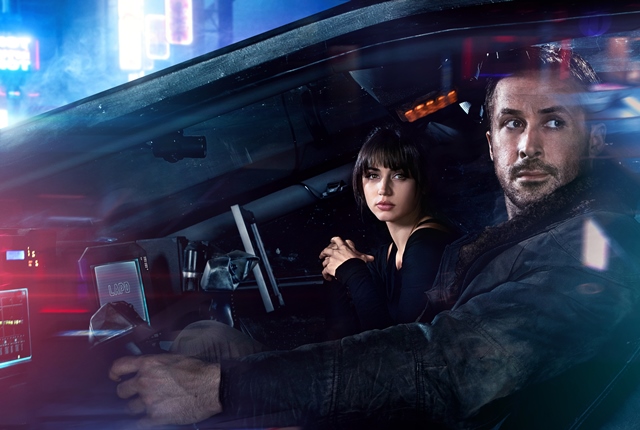
Ryan Gosling as K and Ana d x as Joi in Blade Runner 2049.

Ryan Gosling as K and Ana de Armas as Joi in Blade Runner 2049.{credit}Sony Pictures{/credit}

If director Denis Villeneuve was daunted by creating a sequel to the 1982 cult noir Blade Runner, it doesn’t show. The themes running through his Blade Runner 2049 feel more poignant than ever, the Los Angeles rain falls even harder, and it packs as much of a cinematic punch.

Villeneuve – fresh from his sci-fi success with Arrival in 2016 – has reimagined a world first brought to life by Ridley Scott. Thirty years on, the LA of Blade Runner 2049 is still grimy, bleak and sodden. Neon lights continue to flash and splutter, but now building-high advertisement holograms also shimmer alluringly. Replicants, as the bioengineered humanoids are known, remain enslaved.

The story centres on Officer K (Ryan Gosling), a blade runner — a cop tasked with ‘retiring’ replicants. In the original, loosely based on Philip K. Dick’s novel Do Androids Dream of Electric Sheep?, Harrison Ford plays Rick Deckard, a jaded predecessor of K, whose mission is to hunt down replicants escaped from off-world colonies. His interaction with them eventually prompts questions about the very premise of his job and his very identity. In 2049, replicants are now the bread and butter of the Earth-bound workforce, a new breed engineered by a new corporation. Under orders from his superior Lieutenant Joshi (a condescending but not entirely unsympathetic character, played by the excellent Robin Wright), K must find and terminate the older rogue models still hiding out.
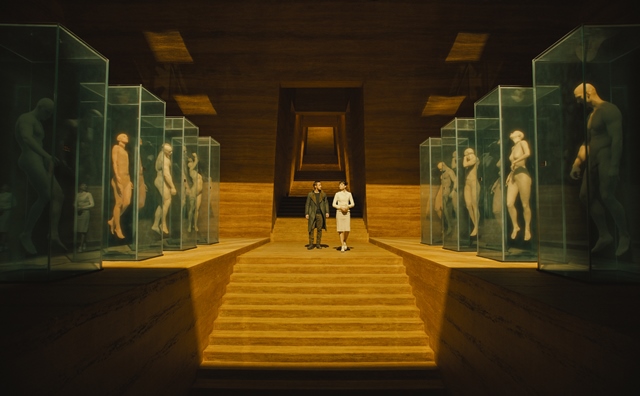
K and xxx (xxx)

K and Luv (Sylvia Hoeks) at the headquarters of the film’s hyper-ambitious bioengineering corporation.{credit}Sony Pictures{/credit}

Where Deckard was burnt-out and moody, K is a stoic and obedient, if lonely, worker – until an investigation brings about a discovery that leads him off course. Gosling does understated very well, shimmering with emotion that only begrudgingly breaks the surface. Ana de Armas is heart-breaking as his unconventional live-in companion; and Sylvia Hoeks makes for a terrifying foe. The dystopian world in which the film is based is rich with remarkable attention to detail. Fans will be thrilled to see Ford pop up for the finale as a grizzled, ageing Deckard.

The original Blade Runner brought to life Dick’s Voight-Kampf test, a form of Turing test designed to catch out androids by probing their biological response to questions that should trigger empathy, an idea that went on to inspire the wider sci-fi genre. In the wake of recent sci-fi successes such as Spike Jonze’s Her (2013), Alex Garland’s Ex-Machina (2014; reviewed here), HBO’s Westworld and the British series Humans, today’s viewers could be forgiven for becoming inured to shows that ask where artificial intelligence ends and humans begin. But Blade Runner 2049 manages to tread fresh ground. K’s modus operandi is a simple iris scan of replicants, but the film finds new ways to probe the question, through themes of morality and identity, and the roles of memory and soul.
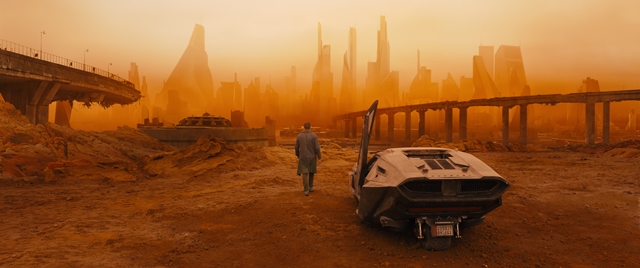
Environmental dystopia figures large in the film.

Environmental dystopia figures large in the film.{credit}Sony Pictures{/credit}

Blade Runner 2049 also burns with an environmental message far more glaring than in the 1982 film. The sequel takes the audience beyond LA to sneak a glimpse at a hellish wreck of a planet. Set in the aftermath of a nuclear war, the symptoms of a species sliding into oblivion are everywhere, with a haywire climate, city-sized rubbish dumps and a sea wall of epic proportions. As noted by Gosling in an interview with Wired: The power of science fiction, and what’s positive about it, is that you’re able to experience the worst-case scenario without actually having to live it.” Villeneuve has brought us a terrifyingly realistic version of civilisation’s possible future.

The film has garnered wide-spread acclaim, and deservedly so. Almost every scene is a visual masterpiece, teasing the viewers with shadows and tricks of the light, as well as breath-taking landscapes. Its haunting score pounds like an irregular heartbeat, reminiscent of the equally powerful soundtrack to 2001: A Space Odyssey. These go a long way to making the film as nail-biting as it is contemplative and spare. But Blade Runner 2049 is ultimately a work of art, and at a whopping 2 hours 43 minute run time, made for people who love cinema, not those after a cheap thrill.

Elizabeth Gibney is a senior reporter on physics for Nature based in London. She tweets at @lizziegibney.

Blade Runner 2049 is on general release.


For Nature’s full coverage of science in culture, visit www.nature.com/news/booksandarts.
Chasing Coral: beauty and destruction

Posted on behalf of Jeff Tollefson

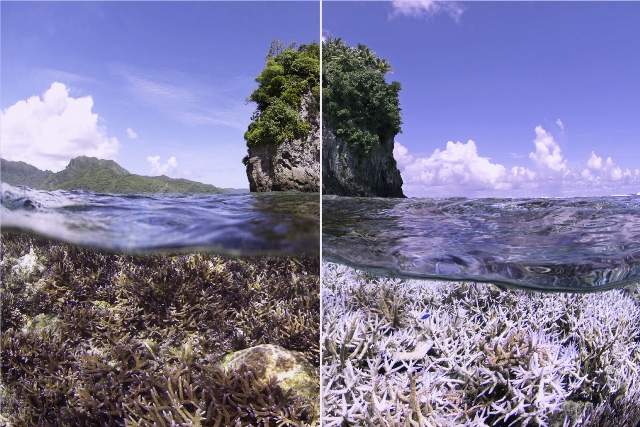
Images shot by the Chasing Coral crew graphically show the progress of the coral bleaching event in xx over xx days.

Images shot by the Chasing Coral crew graphically show the progress of the coral bleaching event that began in 2014.{credit}Chasing Coral, courtesy of Netflix{/credit}

First we take the plunge, off the boat and into the blue. Once the bubbles clear, wonders emerge. Guided by the camera, the eye is initially drawn to the obvious: turtles, rays, eels, jellies, fish. But the star of this show is a different kind of animal. The focus shifts, and we see a variety of fabulously intricate and colourful structures, some branched like trees, others spiny and globular. Each edifice in this marine metropolis was erected by corals — master builders now under unprecedented threat.

Director Jeff Orlowski begins his latest documentary, Chasing Coral, with this view of living abundance. Soon enough, we see death. Images of reefs left white and mostly lifeless give way to apocalyptic footage of dead corals, covered in algae and disintegrating in murky waters. Orlowski’s film, which launched on Netflix on 14 July, reveals the shocking reality of the global bleaching event that began in 2014, spurred by human-driven climate change and only now coming to an end.

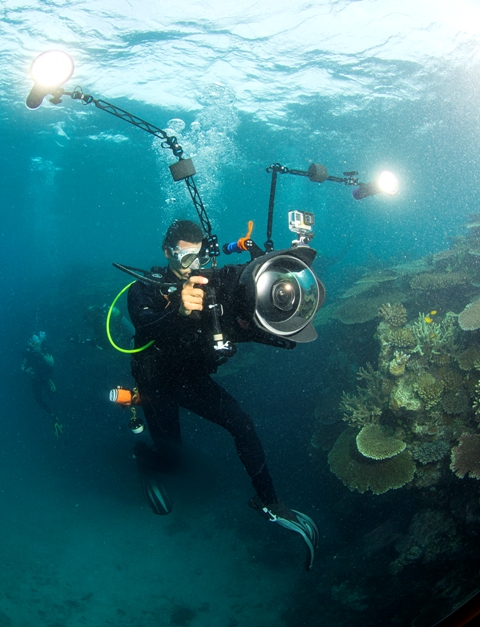
Jeff Orlowski filming corals on the Great Barrier Reef, Australia.

Jeff Orlowski filming corals on the Great Barrier Reef, Australia.{credit}Richard Vevers/Chasing Coral, courtesy of Netflix{/credit}

There are similarities between Chasing Coral and Chasing Ice, Orlowski’s 2012 documentary about melting glaciers, right down to the focus on time-lapse imagery to capture environmental degradation. But where Chasing Ice centres on James Balog, a National Geographic photographer who set up the Extreme Ice Survey to document ice shrinkage, Chasing Coral features, along with leading coral researchers, a curious collection of characters who embark on a technically daunting effort to document the transition from life to illness and death on a coral reef. The result is a fast-paced narrative arc that manages to carry a full-length film about global warming, the ultimate slow-boil.

Orlowski doesn’t hide anything. In fact, he becomes part of his own narrative through that of Richard Vevers, the man driving the project. A former advertising executive turned ocean activist and underwater photographer, Vevers relates how in 2010,  he decided to put his talents to better use: saving corals. After seeing Chasing Ice in 2013, he decided to contact Orlowski, who – in an intriguing meta-moment – makes an appearance in the film to talk about the genesis of the project.

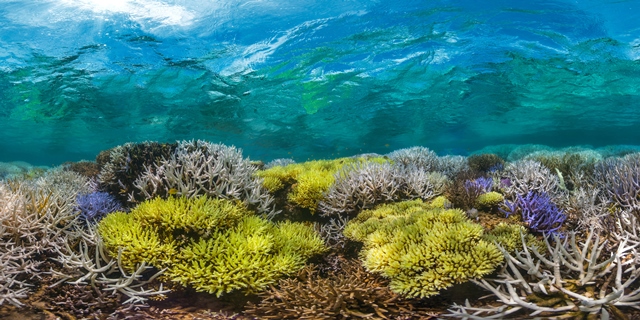
A panoramic view of fluorescing and bleaching corals in New Caledonia in the southwest Pacific, in March 2016.

A panoramic view of fluorescing and bleaching corals in New Caledonia in the southwest Pacific, in March 2016.{credit}The Ocean Agency/XL Catlin Seaview Survey{/credit}

To its credit, Chasing Coral goes beyond personalities and crises and gets into the science – as well as the challenge of communicating that science and raising public awareness. “One of the biggest issues with the ocean is that it is completely ‘out of sight, out of mind’,” Vevers says. “And that is an advertising issue.”

The first step the crew faced was acquiring a high-quality camera capable of operating underwater remotely for weeks at a time. Enter View into the Blue, a company based in Boulder, Colorado, that adapted a high-resolution underwater camera – with its own wiper system to keep the domed-glass housing case clean –  for the project. Step two: figure out where to deploy the camera. Glaciers are easy to identify and visit, and nearly all of them are melting now. But setting up a time-lapse camera to capture the death of a coral reef due to warm ocean currents requires considerable planning and a measure of serendipity.

Mark Eakin, who heads the US National Oceanic and Atmospheric Administration’s Coral Reef Watch, provided forecasts and guidance on where to deploy. Vevers and the team figured out how to power the camera and retrieve data, but an initial deployment in Hawaii failed: the cameras lost their focus after the first shot. A second try on the southern Great Barrier Reef off Queensland, Australia, saw the warm waters (fortunately) failing to arrive.

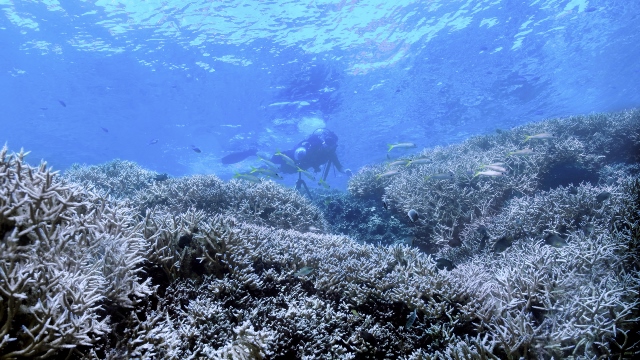
A reef decimated by warm-water currents.

A bleached reef.{credit}Chasing Coral, courtesy of Netflix{/credit}

So the team ditched the automation altogether and moved north to Lizard Island, and on to New Caledonia. Here, they manually photographed dozens of sites each day for 40 days. It worked. At one location after another, we see a rapid decline from vibrant colour and biodiversity to whitening and death. At this point the film switches to the emotional journey of ‘coral nerd’ Zachary Rago. “I’m not even sad that we are leaving, because it’s so miserable here,” Rago says when the job is complete.

Basic science is interwoven throughout. Through coral researchers such as Ruth Gates and Ove Hoegh-Guldberg, we learn about the fascinating lives of corals, which operate as a collective to build and maintain an ecosystem that supports thousands of animals, from clown fish to sharks. We hear about the symbiotic relationship corals have developed with the algae living inside them, which provide their hosts with colour and energy through photosynthesis. And we see what happens when temperatures rise: the algae shut down and corals kick them out.

Chasing Coral also brings home the implications of decades of research. This latest global bleaching event, bolstered by a powerful El Niño in 2015-2016, is the third in recorded history; the first was in 1998. Research suggests that most of the world’s corals could perish within a few decades from rising temperature and ocean acidification without immediate action to halt greenhouse gas emissions.

The film mostly glosses over the scientific endeavour itself, however. After all, Vevers is the executive director of the XL Catlin Seaview Survey, a bonafide research initiative that launched in 2012 to catalogue the world’s corals (as Nature has reported here and here). But it’s a minor point. In the end, the film accomplishes its goals. Nobody knows precisely what an ecological collapse would mean for the oceans, but Chasing Coral makes it abundantly clear that it won’t be pretty. And perhaps that’s enough to inspire action.

Jeff Tollefson is a reporter for Nature based in New York. He tweets at @jefftollef. 


For Nature’s full coverage of science in culture, visit www.nature.com/news/booksandarts.
The Colorado: elegy for an overused river

Posted on behalf of Monya Baker

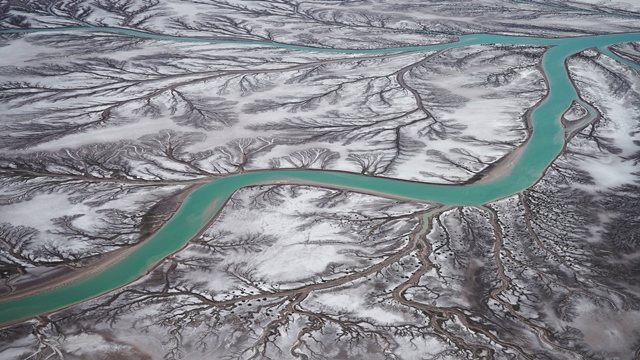
The Colorado River

Tidal waters in the delta region of the Colorado River.{credit}Murat Eyuboglu{/credit}

The Colorado River in the US West proves the adage that you never step into the same river twice. Lined by a vast array of landscapes, communities and industries it has shaped, its waters run variously aqua, navy blue, muddy brown — or not at all. Over its 2,334 kilometres, it sustains some 40 million people, 2 million hectares of farmland and the Hoover Dam. It is also polluted, depleted, diverted.

Now this mighty waterway is celebrated in The Colorado — a music-based documentary that delivers a powerful environmental and social message. Produced by VisionIntoArt, the project brings together several composers including Paola Prestini and live performance ensemble Roomful of Teeth, among others. (See below for the trailer.)

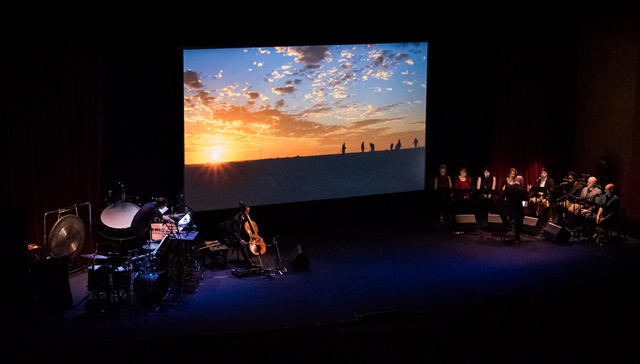
Glenn Kotche and Jeffrey Zeigler performing at the New York premiere of The Colorado.

Glenn Kotche and Jeffrey Zeigler performing at the New York premiere of The Colorado.{credit}Jill Steinberg{/credit}

At a pre-show talk on 22 April at Stanford University in Palo Alto, California, the project’s director Murat Eyuboglu noted that his inspiration was the story of the Salton Sea in California’s Colorado Desert. This huge inland lake was created by accident in 1905, when engineers’ plans for irrigation canals succumbed to the river’s might. Now saltier than the Pacific Ocean, the lake is filled with toxic sludge and hosts acres of deserted lakeshore development, yet is essential habitat for migrating seabirds. “I’ve never seen so much beauty and devastation cohabiting in one place,” said Eyuboglu. That sentiment holds for the film as well.

Eyuboglu’s interest in the Salton Sea led him to contact writer William deBuys, who has chronicled the natural histories of water in the region in books such as Salt Dreams (coauthored with Joan Myers). DeBuys signed on to advise Eyugoblu on the project, then became his co-scriptwriter and lyricist. Filmed over four years (and 20 trips into the river’s drainage basin), their documentary meanders from the artificially fertile fields of Imperial Valley to the artificially parched expanses in the Sonoran Desert as well as the Salton Sea.

Geologist John Wesley Powell, the first to explore the Colorado River for scientific purposes.

Geologist John Wesley Powell, the first to explore the Colorado River for scientific purposes.

The work is divided into nine sections. Each begins with a narrative introduction by actor Mark Rylance, grounded in stories of people who explored, exploited or were exploited by water-fueled power. After the narration stops, we are steeped in stunning cinematography and archival footage.

The first to explore the Colorado for scientific purposes was noted geologist and Civil War veteran John Wesley Powell. (During that conflict Powell, who lost an arm in combat, would instruct his soldiers to watch out for fossils while digging trenches.) On his first, grueling three-month 1869 expedition, Powell recognized that the river had cut through millennia, pronouncing the region “a Book of Revelations in the rock-leaved Bible of geology” that he was determined to read. Mapping the basin, Powell made a coherent case that political units should follow the same boundaries, to balance the needs of those dwelling upstream and downstream at a time when land speculators carved property for their own benefit. That lost opportunity is repeatedly apparent in the film.

Another story is that of David Brower (1912-2000). Founder of environmental organisations including Friends of the Earth and first head of the Sierra Club, Brower successfully fought to stop a dam slated to flood the Dinosaur National Monument in Colorado and Utah. He proposed Glen Canyon as an alternative, despite never having seen it. After mapping Glen Canyon, he realised that burying its magnificent rock “cathedrals in the desert” and thousands of ancient indigenous sites under what is now Powell Lake would go down as the biggest US environmental mistake in history — and admitted his part in it. We see footage of the canyon being dynamited pre-dam, run backwards. Witnessing the canyon walls reform, we feel what has been lost.

In other sections, we see the tons of produce grown in Imperial Valley, irrigated by the river and harvested mainly by farm labourers from Latin America. Finally, we glimpse the nearly bone-dry delta of the Colorado in Mexico. With farms and industries each due a cut of “liquid property”, the water generally fails to reach the sea despite governmental efforts. The delta’s former fecundity is now relegated to the memories of octogenarians.

The Colorado is, for the most part, emotionally and intellectually rich — sometimes too much so. At one point, I missed a series of explanatory texts on screen because I was pondering the source of the sound accompanying them — it was, I eventually realized, the cellist striking his bow alternately on the instrument’s base and a plastic water bottle. Birdsong at the start of one segment is the call of the canyon wren, whose characteristic trill inspires a vocal piece later on. But I would not have recognized either fact without the pre-show talk.

The river is disappearing under the constant demands of civilization, yet is beautiful even in decline. The film closes with a Yuman poem, once description, now wish. “This is my water, my water… It shall flow forever.”

Monya Baker writes and edits for Nature from San Francisco, California. She tweets at Monya_science. The Colorado will travel to Washington DC in March 2018, as part of the Kennedy Center’s inaugural season of Direct Current, a celebration of contemporary culture. View a trailer for The Colorado here. A Nature Q&A with Paola Prestini can be found here.


For Nature’s full coverage of science in culture, visit www.nature.com/news/booksandarts.