
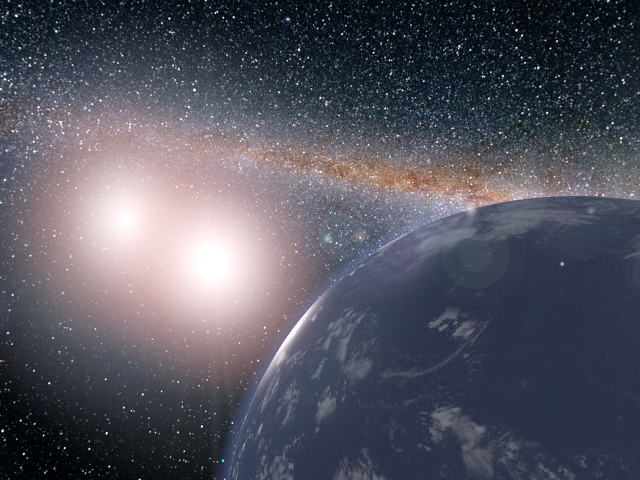
Artist’s conception of a hypothetical planet covered in water around the binary star system of Kepler-35A and B.{credit}NASA/JPL-Caltech{/credit}
In terms of job satisfaction, discovering worlds must take the Sachertorte. Sibling astronomers William and Caroline Herschel, for instance, rejoiced in a haul that included Uranus, eight comets and several moons gleaned from what William called the “luxuriant garden” of the skies. Their final tally of deep-sky objects, with that of William’s gifted son John, numbered in the thousands. I’m sure their minds would be boggled by today’s exoplaneteering exploits — such as the TRAPPIST-1 system of seven Earth-like planets that fully emerged this year.
In my way, I’m in the business of discovering — and rediscovering — worlds. That they’re between two covers and on sale in your local bookshop is neither here nor there. And the 2017 harvest has been rich. We revisited Jonathan Swift’s 1726 Gulliver’s Travels, for instance — which, Greg Lynall noted in his eye-opening essay, is a journey across an unfamiliar Earth that even features Swift’s accurate prediction of the moons of Mars, 150 years before their detection. (The terra incognita flavour of this year’s events gave all that particular resonance.)
As for the new books sifted from the non-stop stream, as always I entered their portals with the open mind of an explorer. Thus, through Caspar Henderson’s A New Map of Wonders we scope the known cosmos with new eyes. In Hetty Saunders’s My House of Sky we sift the psyche of reclusive nature writer J.A. Baker. And in Jonathan Silvertown’s Dinner with Darwin, we see a plateful of food transformed into a repository of dazzling evolutionary stories.
It has, in short, been an astounding year for those of us engaged in tracking literary planets across the publishing firmament. Here’s my sky survey.
Improbable Destinies, Jonathan Losos. Riverhead. In a “deep, broad, brilliant” study, the biologist explores how evolutionary solutions, morphological to molecular, repeatedly emerge. (Reviewed here.)
A Crack in Creation, Jennifer A. Doudna and Samuel H. Sternberg. Houghton Mifflin. A pivotal player in the CRISPR saga delivers her dispatch from the genome-editing frontline. (Reviewed here.)
Collecting the World, James Delbourgo. Allen Lane. A life of Hans Sloane — medic, Royal Society president, ‘wondermonger’ and collector extraordinaire — is limned by an accomplished historian. (Reviewed here.)
The Death Gap, David Ansell. University of Chicago Press. The social epidemiologist lays bare how ‘structural violence’ in US healthcare fosters disparities in life expectancy. (Reviewed here.)
The Great Leveller, Walter Scheidel. Princeton University Press. In a magisterial socio-political chronicle, the historian untangles the deeper roots of inequality. (Reviewed here.)
The Imagineers of War, Sharon Weinberger. Knopf. The defence writer delves into the shadowy history of DARPA, the US agency that forecasts “imagined weapons of the future”. (Reviewed here.)
Miracle Cure, William Rosen. Viking. The accomplished writer’s swansong superbly captures the rise of antibiotics, from the discovery of penicillin on a mouldy cantaloupe to the war on resistance. (Reviewed here.)
The Vaccine Race, Meredith Wadman. Viking. A former Nature journalist tells the convoluted story of human fetal cell line WI-38, still deployed in vaccine research. (Reviewed here.)
Deep Thinking, Garry Kasparov. PublicAffairs. The chess titan revisits his 1997 match against computer Deep Blue in an “impressively researched” history of AI. (Reviewed here.)
The Songs of Trees, David George Haskell. Viking. In a sensory tour de force, a biologist documents the exquisite interconnections of arboreal life. (Reviewed here.)
Rigor Mortis, Richard F. Harris. Basic Books. The science journalist jumps into the deep end of biomedicine’s reproducibility crisis. (Reviewed here.)
Dawn of the New Everything, Jaron Lanier. Bodley Head. The virtual-reality pioneer traces the unconventional trajectory of an extraordinary career. (Reviewed here.)
The Origins of Creativity, E.O. Wilson. Liveright. In exploring the wellsprings of creativity, the ecologist calls for a “third enlightenment” meshing science with the humanities. (Reviewed here.)
Outside the Asylum, Lynn Jones. Weidenfeld & Nicolson. A psychiatrist working in war and disaster zones elucidates both policy implications and the uncommon courage of survivors. (Reviewed here.)
The Quantum Labyrinth, Paul Halpern. Basic Books. A physicist unpicks the intertwined lives of consummate theoreticians and chums Richard Feynman and John Wheeler. (Reviewed here.)
Life 3.0, Max Tegmark. Knopf. The cosmologist peered into possible risks and benefits of evolving AI, from an autonomous-weapons arms race to quark-powered ‘sphalerizers’. (Reviewed here.)
A Mind at Play, Jimmy Soni and Rob Goodman. Simon & Schuster. A journalist and a political theorist vividly portray information theorist — and rocket-powered-Frisbee inventor — Claude Shannon. (Reviewed here.)
Stalin’s Meteorologist, Olivier Rolin. Harvill & Secker. A harrowing account of a Soviet researcher exiled to the Gulag testifies to the endurance of science in the midst of political chaos. (Reviewed here.)
The Darkening Web, Alexander Klimburg. Penguin. The policy expert reports on the new cold war between ‘free Internet’ and ‘cybersovereignty’ forces. (Reviewed here.)
The Seabird’s Cry, Adam Nicolson. William Collins. The environmental writer’s inspired survey of 10 seabird species — albatross to shearwater — is a paean to life at the edge. (Reviewed here.)
For Nature’s full coverage of science in culture, visit www.nature.com/news/booksandarts.


