Nature India Photo Story: Aqua Tales

In our visual storytelling blog series titled the ‘Nature India Photo Story’, we feature artfully told stories that explore the realms of science, wildlife, environment, health or anything else that smells of science.

In today’s photo story, we feature experimental physical chemist Mohammad Tariq from the Faculty of Science and Technology, New University of Lisbon, Caparica, Portugal. The theme of his story is something that touches all life on Earth — water.

Tariq traces his journey with water through ‘Aqua Tales’ — a nuanced narration that looks at water not just as the most bountiful resource of Nature, but also as his passionate research interest, and as the metaphorical wave that keeps propelling him to newer shores.

Water is a complex, wondrous fluid, essential for life on Earth. It is the most abundant chemical in nature. Apart from the interest it generates among scientists and academics, water has been the most important element for the survival of many civilizations that thrived on banks of rivers. Water is also the reason flora and fauna flourish on Earth.

My journey and interaction with various water bodies started from my native town Bijnor in Uttar Pradesh, India. It is in Bijnor that I had the rare privilege of befriending the mighty river Ganga. The deep stream of the river flows throughout the western boundary of Bijnor.


Ganga in Bijnor.


The Ganga flows quiet under this barrage in Bijnor.

My doctoral research at Jamia Millia Islamia University in New Delhi was focused on the characterization of thermophysical properties of liquids and liquid mixtures including aqueous solutions at different concentrations and temperatures. In the final years of PhD, my research interest started to shift towards the properties of a novel
class of exotic salts known as “ionic liquids”. Sea and salt have a long known relationship.

After finishing PhD, I moved for a postdoc assignment to the Institute of Chemical and Biological Technology (acronym ITQB in Portuguese) in Portugal — the land of great explorers and navigators. Apart from its excellent research facilities, what makes ITQB remarkable is its location in the beautiful town of Oeiras, around 17 Kilometers away from the capital of Lisbon. My office faced the Atlantic Ocean. Out of the several interesting projects at ITQB, the most appealing to me was the detailed study of the effect of structurally diverse ionic liquids on the density anomaly of water. This also laid the foundation of my future research.


The beautiful Santo Amaro beach near Oeiras with a scenic view of a very old lighthouse (bugio) situated in the estuary of the Tagus river.


The pavement across the Santo Amaro beach lends itself to a nice stroll.

I got an opportunity to work at the University of Vigo, Spain in 2012, where I witnessed the immense beauty of one of the best and most eco-friendly beaches of the world at Islas Cies — a group of three islands. At the University of Vigo we used the speed of sound and density measurements on solutions of a series of ionic liquids to characterise their self-assembling process in water.

The beautiful Samil beach in Vigo, Spain.


A breathtaking summer sunset at Cies Island, Spain.

After spending almost 6 years in Europe, I moved to Qatar and got introduced to the Persian Gulf. The pleasant view of the corniche in Doha, which brought the shallow water of the Persian Gulf to the middle of the city, was always a sight. An hour’s drive from Doha city took one to the sand dunes and in-land sea (Khor-al-adaid) at the border of the Kingdom of Saudi Arabia and Qatar.

At Qatar University, my passion for the peculiar properties of water continued and I studied a distinct form of structured water known as “gas hydrates”, hydrogen bonded water molecules in which the guest gas molecules are trapped in cavities. Formation of gas hydrates within gas pipelines is a persistent problem faced by the oil and gas industry worldwide, including in Qatar. Gas processing from the deep-sea, where temperatures are low and pressures are high, provides suitable conditions for the formation of gas hydrates.

The inland sea (Khor-al-adaid), Qatar.


In the pursuit of a work-life balance, I moved back to Portugal in 2016 but this time to the other side of the river Tagus where I now work at the New University of Lisbon. The university is situated near Costa da Caparica, a tiny, breathtakingly beautiful coastal town. Here, I am engaged in the in-depth study of clathrate-hydrates, specially the role of hydrogen bonding and water structure in their formation and dissociation.

Juan G Beltran wrote the following in an article in the Journal of  Chemical Thermodynamics (117, 2018) and I think it aptly sums up my passion for hydrates:  “A snowflake is a letter from heaven (U. Nakaya), a diamond is a letter from the depth (F.C. Frank). What then is a gas hydrate?”

The 25th April Bridge on the river Tagus connecting Lisbon to the municipality of Almada, Portugal.


High tides in the coast of Caparica, Portugal, attract many surfers.

During this decade-long scientific journey across cultures, languages and continents, I have observed a change in my research interests. However, they have always centered around the properties of liquids and aqueous solutions. Now I am eagerly waiting to see if water will allow me to settle down or another wave will sail me towards a new destination.

Mohammad Tariq can be contacted at tariq@fct.unl.pt

Nature India Photo Story: The enigmatic sun

In our visual storytelling blog series titled the ‘Nature India Photo Story’, we feature photo stories that explore the realms of science, wildlife, environment, health or anything else that smells of science.

Here’s a photo story and a personal essay by B. Lakshmi Sowjanya on the mystical aura of the sun, arguably the most prominent among all celestial objects.

Sowjanya is a geneticist, a Bio-CARe Woman Scientist, and a postdoctoral researcher at the Indian Institute of Science, Bangalore. Her research interests are in the field of molecular oncology and lipidomics. She is keen on nature photography, and immensely enjoys capturing the Sun, drawing poetic parallels for life from its many hues.

Sun1

{credit}B. Lakshmi Sowjanya{/credit}

The Sun has not only attracted humans forever but also supports all life-sustaining activities on planet Earth. Several cultures around the world worship the Sun. Amazingly enough, the distance between Earth and the Sun is exactly right for life-conditions to flourish. Closer, we would burn; farther away, we would freeze.

In my photography journey, I try to capture glimpses of the Sun through clouds spread across the sky. As I set sight on the warm colours of the setting Sun, I am transported to an enchanted world. It has been an amazing journey so far, shooting the Sun in different colours, shades and moods.

Sun2

Sun6

{credit}B. Lakshmi Sowjanya{/credit}

These photographs were taken at the West Coast of India during winter (October to January) at dusk in Honavar taluk (14° 16′ 48″ N, 74° 26′ 38.04″ E), Uttara Kannada district, Karnataka state. They show the magical play of the clouds, humid weather conditions of the seashore, and the hues of sun rays.

In these photographs I tried to capture how differently we can visualize the Sun in the same season. The climate, atmospheric gases and clouds in the sky could greatly impact the way in which we see the Sun.

Sun4

{credit}B. Lakshmi Sowjanya{/credit}

Even as it signals an end, a sunset promises renewal. With the last rays peeping over the horizon comes the realisation that tomorrow holds endless possibilities. The descending Sun embodies the sheer power of an utterly romantic moment. Just like love at first sight, the sight of the Sun takes my breath away, leaving me speechless. I feel a rush of love and gratitude for Mother Nature.

Sun5

{credit}B. Lakshmi Sowjanya{/credit}

There is science behind these feelings, too. Watching sunsets promotes psychological effects believed to enhance satisfaction in life. Sunsets are a moment to pause in preparation for a new phase of life; a time of renewal, learning, and moving ahead with challenges. Sunsets can be real blessings.

I admire the steadfastness of the sun – an eternal and untiring effort to repeat the daily cycle, day after day, until all energy is spent, bidding us goodbye with a promise to return the next day in all its power and glory.

Sun3

{credit}B. Lakshmi Sowjanya{/credit}

This collection of radiating hues represents some of the most beautiful moments and most wonderful memories of my life. The ‘sweet light’ time, just before the sunset, is perhaps the best time for serial sunset photography. It is during those fleeting moments that the bright and pale shades of red tend to be even more dramatic, enhancing sunset photos and making the colours pop.

You can follow this blog series online with the hashtag #NatureIndphotostory. If you have a photo story to tell, email your high resolution entries with a short narration and a couple of lines about yourself to npgindia@nature.com with the subject line “Nature India Photo Story”. If it appeals to our editorial team, your photo story might get featured on this blog.

Suggested posts:

Nature India Photo Story: Cubanacan the Litigon

Nature India Photo Story: A midnight date

Nature India Photo Story: The kingfisher feeds

Nature India Photo Contest

Nature India Photo Story: Cubanacan the Litigon

In our visual storytelling blog series titled the ‘Nature India Photo Story’, we feature photo stories that explore the realms of science, wildlife, environment, health or anything else that smells of science.

The third in this series is a photo story and commentary by Karl Shuker and Shubhobroto Ghosh, about the rediscovery of a litigon’s image amid the hybridisation debate, which Nature India has previously covered in-depth here.

On 22 May 2017, Karl Shuker, author and cryptozoologist in England, discovered this long lost photograph of an extraordinary hybrid cat. Cubanacan, the progeny of a lion and a tigon [tiger x lioness] was born at the Alipore Zoo in Kolkata, India, on 7 March 1979, and was the only surviving cub of his litter of three.

Cubanacan as portrayed in the 1985 Guinness Book of Records.

Cubanacan as portrayed in the 1985 Guinness Book of Records.{credit}Alipore Zoo, Kolkata{/credit}


Alipore Zoo had embarked on a fifteen-year endeavour to hybridise lions and tigers, an effort that created Cubanacan’s tigon mother, Rudrani, and her sister, Rangini, several years earlier. A pioneering scientific success for India, and even the rest of the world, Cubanacan was widely regarded as the first litigon born in the world.

A depiction of Cubanacan’s tigon mother, Rudrani, approaching his lion father, Devabrata. From 100 Years of Calcutta Zoo (1875-1975).

A depiction of Cubanacan’s tigon mother, Rudrani, approaching his lion father, Devabrata. From 100 Years of Calcutta Zoo (1875-1975).{credit} The Centenary Celebration Committee, Zoological Garden, Alipore, Calcutta (1975){/credit}


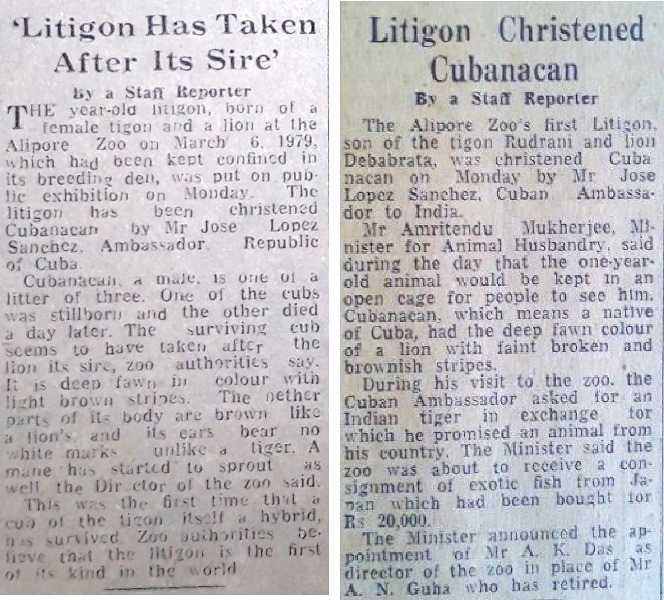
A captioned photograph of the litigon Cubanacan, published in The Statesman, Calcutta (now Kolkata) on 12 March 1980.

A captioned photograph of the litigon Cubanacan, published in The Statesman, Calcutta (now Kolkata) on 12 March 1980.

However, a record from 1943 indicates a successful mating between a fifteen-year-old lion-tiger and a lion at the Munich Hellabrunn Zoo to produce a female cub. Even so, Cubanacan’s remarkable genetic makeup sparked interest and enthusiasm in India and around the globe. The fascination with hybrid cats continued as Rudrani produced four more litigons in subsequent years.

There is now evidence that these experiments were led by a scientific quest to determine if hybrids could be fertile, a question that struck at the heart of the notion of biological species. At the time, the very definition of species hinged on reproductive isolation.  Though probing at a research question, concerns surfaced about artificially creating animals not found in the wild as freaks for public curiosity. There were also claims of animal cruelty during the process, an allegation that has come to the forefront in the current effort to ban cross breeding of big cats in the United States.

In the weeks following his birth, The Statesman ran articles about Cubanacan.

In the weeks following his birth, The Statesman ran articles about Cubanacan.

In the midst of this controversy, hybrids still command ample public attention. The 2017 Guinness World Records (formerly the Guinness Book of Records) ranked, Hercules, a liger [lion x tigress] at the Myrtle Beach Safari in South Carolina, the world’s largest big cat.

Cubanacan was also once the world’s largest big cat, who, according to Guinness in 1985, weighed 363 kg (800 pounds), stood 1.32 m (4.4 inches) at the shoulder and measured 3.5 m (11.6 inches) in length. Given the aversion to hybridisation and the subsequent 1985 ban on cross breeding big cats in India, it appears that Cubanacan’s memory was purposely forgotten.

Unspecified photographs of a tigon and a litigon, published in the Guidebook to Calcutta Zoo, A Dunlop Presentation, with legends whitened. Presumably, this was an effort to prevent proper identification of the taxa in the years after cross breeding became illegal. Exact publisher & publication date unknown, but circumstantially the photographs date to between 1992 and 1995.

Unspecified photographs of a tigon and a litigon, published in the Guidebook to Calcutta Zoo, A Dunlop Presentation, with legends whitened. Presumably, this was an effort to prevent proper identification of the taxa in the years after cross breeding became illegal. Exact publisher & publication date unknown, but circumstantially the photographs date to between 1992 and 1995.

The hybridisation debate in biology is important. So is the current proposal on banning big cat hybridisation in the US, and it is in the light of this controversy that Cubanacan’s photograph is being preserved for posterity as a valuable item in wildlife history, best viewed without value judgement.

Karl Shuker is a British zoologist, cryptozoologist and author. He currently lives in the Midlands, England, where he works as a zoological consultant and writer. He is a Scientific Fellow of the Zoological Society of London and a Fellow of the Royal Entomological Society. His books include Mystery Cats of the World (1989), The Lost Ark: New and Rediscovered Animals of the 20th Century (1993; expanded in 2002 as The New Zoo), and In Search of Prehistoric Survivors (1995), as well as two worldwide bestsellers – Dragons: A Natural History (1995; reissued in 2006), and The Unexplained (1996; reissued in 2002).

Shubhobroto Ghosh is Wildlife Project Manager of World Animal Protection in India and the author of the “Indian Zoo Inquiry,” a white paper review of conditions in Indian Zoos, and the book Dreaming in Calcutta and Channel Islands (2015).

[The authors are grateful to Dr Ashish Kumar Samanta and Ms Piyali Chattopadhyay Sinha, Director and Deputy Director of Alipore Zoo, for allowing the use of the Cubanacan photograph published in the Guinness Book of Records in 1985, in this photo story.]

You can follow this blog series online with the hashtag #NatureIndphotostory. If you have a photo story to tell, email your high resolution entries with a short narration and a couple of lines about yourself to npgindia@nature.com with the subject line “Nature India Photo Story”. If it appeals to our editorial team, your photo story might get featured on this blog.


Suggested posts

Nature India Photo Story: A midnight date

Nature India Photo Story: The kingfisher feeds

Nature India Photo Contest

Nature India Photo Story: A midnight date

In our visual storytelling blog series titled the ‘Nature India Photo Story‘, we feature photo stories that explore the realms of science, wildlife, environment, health or anything else that smells of science.

The second in the series is a photo story by Owais Rashid Hakiem, a PhD student at the National Institute of Immunology in Delhi, and one of the shortlisted participants at our ‘Visualising Science‘ workshop. Owais, a masters in biotechnology from the University of Kashmir, took to photography in the picturesque capital of Kashmir. “Once I bunked a chemistry tuition class to walk along the Mughal-era road in the middle of Dal Lake in Srinagar, and captured fauna on my camera — that was my first attempt at photography. Although I failed to develop the film roll since the police snatched that roll away — it’s high security zone.”

“I spent most of my childhood on the banks of Dal Lake, playing with fishes and frogs, sometimes dissecting them out of curiousity. Catching flies to feed spiders and rescuing kittens from the naughty boys in the neighbourhood was the kind of things one specialised in,” he says.

Owais continues to click whenever outside the laboratory, where he studies the “regulation of heat shock proteins in Mycobacterium tuberculosis“. Read his photo story to get a glimpse of one such out-of-the-lab encounter.

A midnight date

By Owais Rashid Hakiem

It was a little after midnight. I was returning to my hostel room at the National Institute of Immunology (NII) in Delhi from the laboratory — my usual nocturnal stroll. NII is nestled in the lap of the Aravali hills. The night was abuzz like always with insect songs — known and unknown — emanating from the crevices of sundry vegetation.

But that night, I also heard a different sound as I went past a tree — it was a distinct and robust chirwak-chirwak. I looked up and aimed my mobile phone in the direction of this sound to click pictures. Who was this new arrival in the campus? The phone camera could only capture two faint spots resembling eyes. Curious, I rushed back to the laboratory to grab my DSLR camera to click some more.

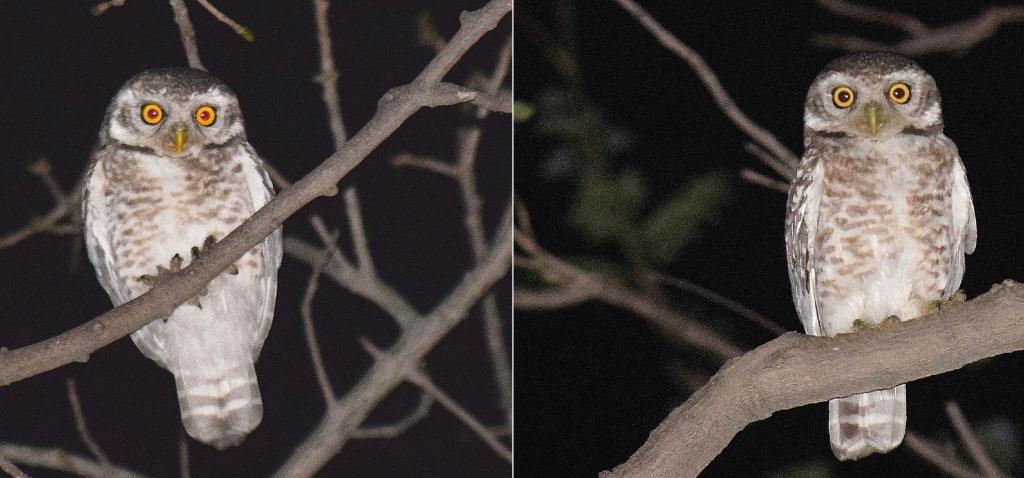
I was in for a pleasant surprise — it was an owlet perched high on a tree, looking back at me in various degrees of bewilderment.

The spotted owlet

The spotted owlet{credit}Owais Rashid Hakiem{/credit}

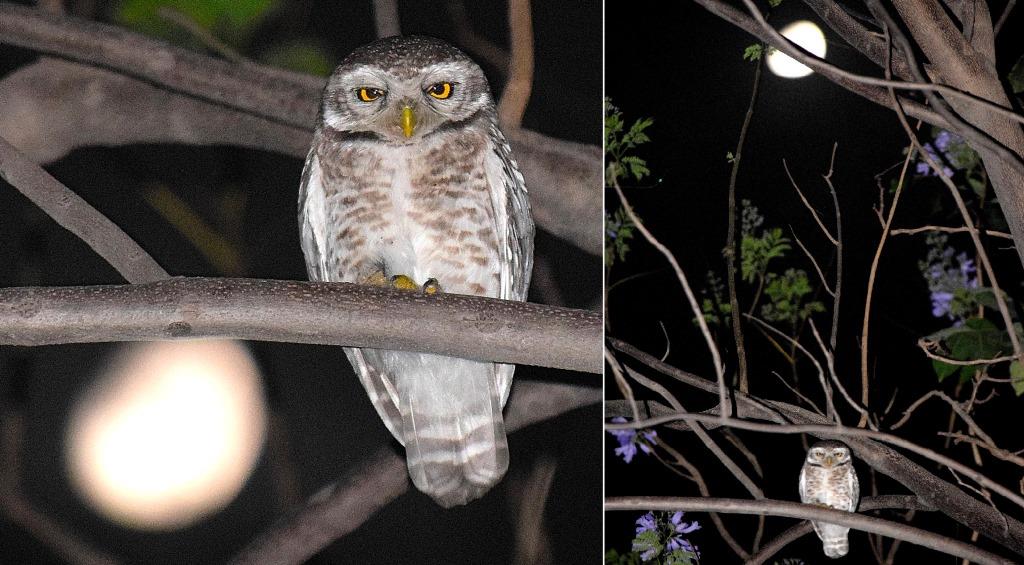
And in a while the owlet hopped, skipped and set itself up against the moon, as if offering me the perfect backdrop to shoot.

Sptted owlet

{credit} Owais Rashid Hakiem{/credit}

The exciting encounter in the dead of the night with a species that generally shies away from direct interaction with humans during the day left me craving for more.

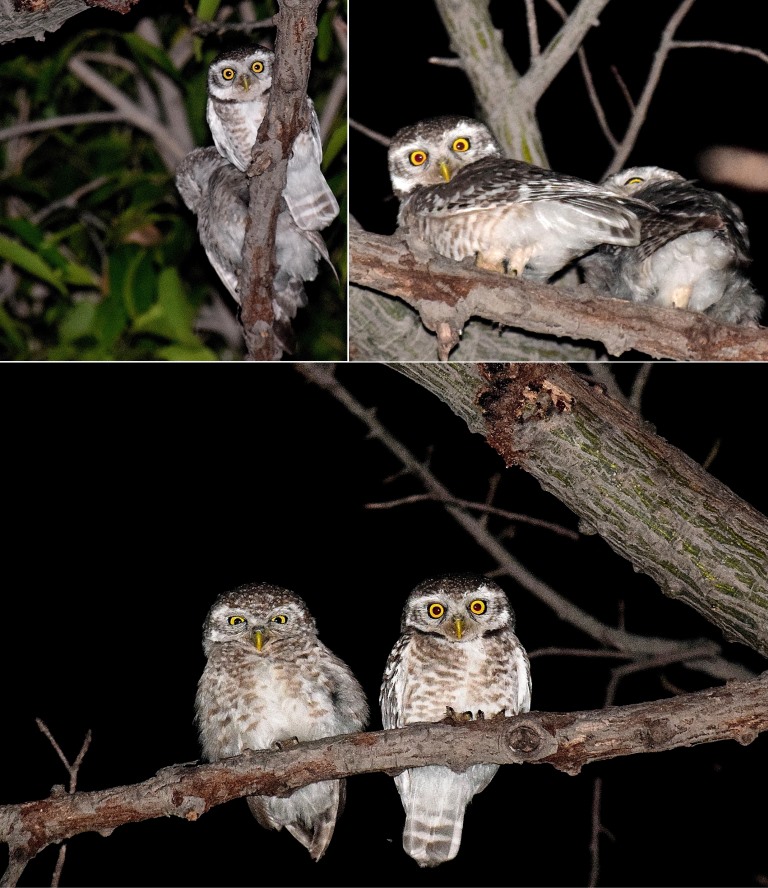
And as I fiddled with my camera settings to capture that perfect one, I was in for another surprise — the owlet had company! I captured two of these lovely creatures enjoying a clear night, seemingly amazed at this unexpected intervention.

The spotted owlet duo

The spotted owlet duo{credit}Owais Rashid Hakiem{/credit}

The spotted owlet Athene brama indica is a small bird (growing up to 8.3 inches tall) that breeds in the northern drier tropics of Asia. Commonly found in farmlands and human habitations, it makes nests in tree holes. It’s got white abdominal feathers with brown streaks, the rest of the body is greyish brown. Athene brama indica is paler than other owl cousins but is nocturnal like them, feeding on insects and rodents. So it’s nests near human population may show higher breeding success as more rodents become available.

The bird’s got a harsh and loud call, a churring and chuckling that goes chirurr-chirurr-chirurr and ends with a chirwak-chirwak. That call was my invitation to this unforgettable nightly rendezvous.

You can follow this blog series online with the hashtag #NatureIndphotostory. If you have a photo story to tell, email your high resolution entries with a short narration and a couple of lines about yourself to npgindia@nature.com with the subject line “Nature India Photo Story”. If it appeals to our editorial team, your photo story might get featured on this blog.

Suggested posts

Nature India Photo Story: The kingfisher feeds

Nature India Photo Contest

Nature India Photo Story: The kingfisher feeds

Chuffed with the response to the annual Nature India Photo Contests (1, 2, 3), and humbled with the number of requests we get to publish photo stories, we are happy to start a blog series called the ‘Nature India Photo Story‘. The series will accept photo stories that explore the realms of science, wildlife, environment, health or anything that smells science.

For our inaugural post in the series, we feature Deepak Sahu, one of the winners of the Nature India Photo Contest 2016. Deepak, a Bhubaneswar-based IT professional with a passion for photography and travel has captured intricate details of the feeding behaviour of kingfishers in a series of telling pictures.

The kingfisher feeds

By Deepak Sahu

Kingfishers generally hunt by sitting on a high perch and keeping a watch on the surroundings for potential prey. They usually chose a perch around lakes, ponds, rivers and even farming fields. Once a kingfisher spots a prey, it swoops down and seizes it in its bill to return to the same perch or another one nearby.

Kingfishers not only eat fish but a wide range of foods. These may include invertebrates like worms, centipedes (above), insects (below), molluscs and crustaceans. They also eat vertebrates like amphibians, reptiles and mammals.

When they catch a fish, they casually toss fish into the air to reposition it for swallowing head first. They sometimes beat big fish to break their spine, which might otherwise cause harm to the bird when swallowing.

In this picture sequence (clockwise from left) a white-throated kingfisher is shown tossing its kill and then swallowing it.

1

{credit}Deepak Sahu{/credit}

I shot these pictures at Kanjia Lake near the State Botanical Gardens, Bhubaneswar, Odisha. I visit the place frequently for its rich faunal activity. One can see many species of birds like cormorants and ducks during the winter migration time, kingfishers, jacana, moorhens, peafowl and animals like snakes, langurs, mongoose and monitor lizard.

Wildlife and nature photography has helped me admire raw nature. It gives me an immense sense of unwinding and peace. It has also increased my knowledge about animal behaviour and their habitats. Wildlife photography has allowed me to explore a lot of new places and see wild animals I thought never existed.

I try to capture moments which I may never see again. Photographs immortalise those moments and also bring awareness towards conservation of many wild species.

You can follow this blog series online with the hashtag #NatureIndphotostory. If you have a photo story to tell, email your high resolution entries with a short narration and a couple of lines about yourself to npgindia@nature.com with the subject line “Nature India Photo Story”. If it appeals to our editorial team, your photo story might get featured on this blog.