With Naturejobs career expos coming in hot, in San Francisco and Boston, we take a look back at the 2014 expo in London.
https://youtu.be/LRzT6Z5L3uE
You can check out our upcoming expos, in San Francisco, Boston, London and Düsseldorf, here.

https://youtu.be/LRzT6Z5L3uE
You can check out our upcoming expos, in San Francisco, Boston, London and Düsseldorf, here.
One of the popular career choices for scientists that look for jobs outside of academia is science communication. In this film, three science communicators look back at what inspired them to try this job.
As this is the case, we also want to know what attracted you to science communication. Please share why you decided to start doing science communication in the comments section below. We’ll be creating another blog post to highlight all the reasons in 2015.
The career paths in science communication panel at the 2014 London Naturejobs Career Expo was chaired by the Naturejobs editor, Julie Gould, and consisted of Greg Foot (Freelance), Jonathan Sanderson (StoryCog), Steven Palmer (Cancer Research UK) and Celeste Biever (Chief editor for online Nature news & comment).
Celeste Biever started working in science communication because she enjoys the thrill of not knowing what’s going to happen from one day to the next. She enjoys trying to “understand and pull out essence of complex ideas very quickly.” Rapid turn-around times are also an attraction: “Everything is done within a day or two or in a week. Anything long term is one month.”
Greg Foot always enjoyed the wonder and curiosity of science as well as the way of looking at world and answering questions. “If you’re working in a lab you focus on one thing. If you’re a science communicator, especially if you’re freelance, there is an opportunity to work on many projects at once; some fast and some slow.” However, when Greg was starting out in science communication, it was still an extremely small and under-developed field. Had science communication been as big then as it is now, he “would potentially think about doing the science and science communication at the same time… there is a lot more opportunity to do that now. I don’t think it’s a case of “Leave the lab; Do science communication.”
Jonathan Sanderson believes that the expectation that you have a plan of what you’re going to do with your life is utter rubbish when it comes to science communication: “It’s a nice story that people tell themselves.” Like Celeste, Jonathan knew that timelines were important to him. “The sense of having one career for my working life was something that 17/18 year old me recognised that it wasn’t going to make me as happy.”
Read more about the panel in our post: What isn’t science communication? and find about all the other conference sessions and workshops at the Naturejobs Career Expo in London.
Other Q&A videos from the Naturejobs Career Expo, London 2014:
How important is having a mentor in your academic career?
How do you achieve work/life balance in academia?
Should I apply for a fellowship or a postdoc after my PhD?
What’s the biggest challenge you’ve faced as a woman in science?
How important is it to move between academic institutions?
What do you get when you mix ice cream, a jobs board and a treasure hunt? Many very happy delegates at the Naturejobs Career Expo!
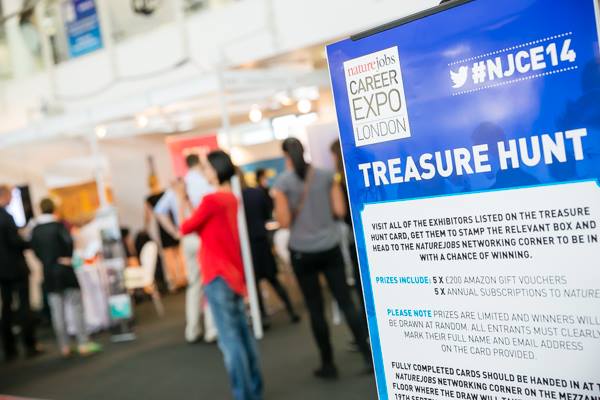
From all the Naturejobs team, a big thank you to everyone who attended the Naturejobs Career Expo in London last Friday. We hope you all managed to get a lot out of the day from the conversations you had with exhibitors and fellow Expo goers, the conference, the CV checking service and everything else that was on offer on the day. For some tips on how to follow up on any conversations you had, take a look at our post on what to do after the career fair.
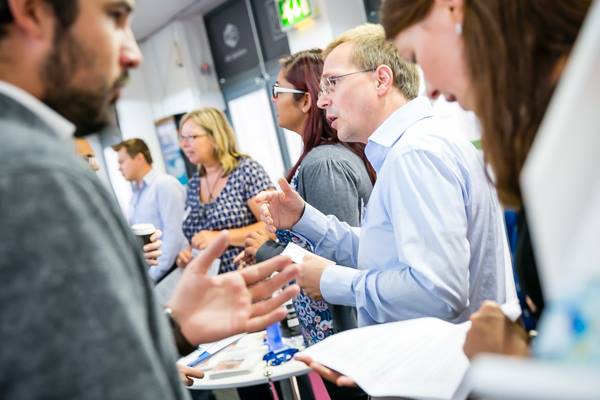
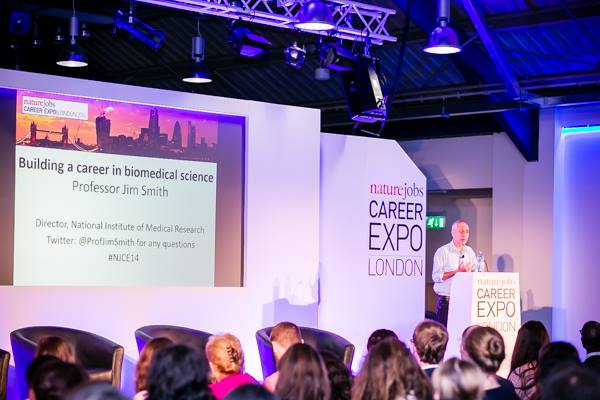
I’d also like to extend a special thank you to all the fantastic speakers who took part in the conference. Each panel had something different to offer: from a career in the biomedical science industry to CV skills, from the discussions on the breadth of academic opportunities to the challenges (and good parts!) of working in industry, and more. There were plenty of career insights which I hope gave you something to think about when you went home.
Special thanks also go to our event sponsors, FAPESP and Contact Singapore.
If you didn’t make it on the day, or were unable to catch a talk, stay tuned to the blog – we’ll be posting reports from the conference sessions and workshops. You can also have a look through the comments and conversations on Twitter with the hashtag #NJCE14.
If you were able to make it, we would appreciate your feedback and input. After all, we put this event on for you and we want to make it as useful to you as possible. We would love to hear your feedback from the event, whether it’s what you thought of the conference sessions and speakers, the CV checking service, the treasure hunt, the exhibitors, or anything else. Please leave your feedback in the comments section below or send us a message via email: naturejobseditor@nature.com or on Twitter or Facebook.
Fact of the day: the sounds of waves lapping onto the beach are relaxing because they occur at the same frequency as our breathing rate when we sleep. Thanks, Dr Thomas Weller!
{credit}Image courtesy of Lisa Michelle Restelli{/credit}
Lisa Michelle Restelli completed a masters degree in medical, molecular and cellular biotechnologies at San Raffaele University in Milan, Italy, and she is now a second-year PhD candidate at the University of Basel in Switzerland. Her work focuses on mitochondrial morphology and its relationship to the central nervous system, both in health and in disease. Outside the lab, she enjoys cooking, reading, and travelling, preferably in combination.
—-x—-
“Acceptance rates for grants in Switzerland are 30-40%,” proclaimed my prospective boss in February 2012 as I interviewed for a PhD position in neurobiology across the Alps. “We should get your project funded in no time.” As it turns out, it was actually 51% at the time for the Swiss National Science Foundation. These optimistic figures certainly had a lot to do with my final decision to move to Switzerland to pursue a PhD, closely followed by chocolate. Even as an undergrad, I could perceive the steady uncertainty of the worldwide funding situation, so I was eager to position myself in what seemed to be a safe haven.

{credit}Image courtesy of Annalise Smith{/credit}
Annalise Smith is a PhD candidate in microbiology and immunology at the University of Miami. She is funded by a predoctoral fellowship from the National Center for Complementary and Alternative Medicine and works on understanding the anti-cancer mechanisms of the natural plant derived compound Withaferin A in HER-2/neu breast cancer. Outside the lab, she enjoys the theatre, spending time with family and friends, reading and travelling. She is passionate about inspiring underprivileged students to dream bigger and aspire higher.
—-x—-
Like most incoming PhD students, I entered my studies in 2009 with a blind optimism for a successful career as an academic research scientist. I fanaticised about running my own lab and pursuing my own ideas with the noble goal of improving human health and ridding the world of disease. Convinced that there were only two career options post-graduation: academia or pharmaceutical industry research, the majority of my peers and I chose academia and pursued our lab rotations and graduate training opportunities with vigour. However, our hopes for success in our chosen career gradually diminished and our post graduation options seemed not as clear-cut as we first thought.
During my time as a PhD student, my peers and I looked on as assistant and senior professors were forced to cut staff due to decreased funding. We watched our PhD mentors submit grant application after grant application, only to be a few points shy of the funding cut-off every single time. We could feel their panic as they worried about sustaining their careers in science. The rumour mill was roaring with stories of which PhD mentors were considering a move to industry and very soon we graduate students were worried too. The simple solution was that we would all just go to industry, but we soon realised that getting a position in the pharmaceutical industry immediately after completing the PhD degree was not quite as easy. Continue reading
{credit}Image courtesy of Esther Cooke{/credit}
Esther Cooke is a 4th year PhD student at the Leeds Institute of Cardiovascular and Metabolic Medicine, University of Leeds. Her research interests include molecular mechanisms of haemostasis and thrombosis. Outside of work, Esther engages in various outdoor pursuits such as walking and climbing. She also enjoys music, spending time with friends, and is actively involved with her local church. With a keen interest in writing, Esther aims to start her own blog in the near future.
—-x—-
There can be a real sense of excitement in science from actively making new discoveries. Despite some apparent drawbacks – most notably job instability, salary and work/life balance – the majority of scientists claim to be content with their research, according to the Naturejobs career survey from 2010. Interestingly, guidance and mentoring from senior staff were deemed the strongest contributors to satisfaction score, followed by salary and independence.
Dwelling on my experience as a PhD student, studying cardiovascular medicine at the University of Leeds, there is one aspect that I believe epitomises the ideal working environment for scientific researchers: teamwork.
Many of us enter research with an unadulterated purpose of advancing our field of interest – a purpose which is easily distorted within such highly competitive frameworks. Motivation to combat heart disease or unveil the mysteries of the universe soon contest with a mounting pressure to advance your personal career, group or institution. We observe the bottleneck of PhD students and postdocs journeying to that prized permanent position. Continue reading

{credit}Image courtesy of Samuel Brod{/credit}
Samuel Brod is a keen researcher and often overly enthusiastic science communicator. He’s worked across academia and industry writing prolifically along the way. His current research investigates the links between emotion and the immune system.
—-x—-
“How will I die today?” sighs an exasperated postdoc, picking up the morning newspaper on his desk. “Cancer or terrorism?”
It’s an exciting time to be scientist. As the flow and freedom of information increases at a seemingly exponential rate, we see ever more innovative and ambitious research carried out across the globe (and off it). Accompanying this outflow has been a pleasing growth of public interest in the field. However there has also been a radical change in the way such information is valued. Greater media focus is now given to its speed of dissemination to the public and ease of digestion, often to the harm of more traditional information values such as quality and reliability of source.
This can be seen in the newspaper’s regular listings of a “new miracle cure” or “frightful risk” to our health. It’s become a running joke amongst those in my lab who are quick to point out flaws in the data quoted and the failings of the journalist presenting it. Often they are simply exasperated (and perhaps envious) that such preliminary findings could find their way into a national newspaper. Continue reading

{credit}Image courtesy of Simon Hazelwood-Smith{/credit}
Simon is an MSc student studying science and technology policy at the University of Sussex. He has a background in genetics, having previously worked as a research assistant in the Division of Genetics and Molecular Medicine at King’s College London. Outside of work he likes to keep active and enjoys rock climbing, playing football, cycling and skiing.
—-x—-
What would it mean for there to be too many PhDs? An obvious answer might be when the number of PhD studentships far outweigh postdoctoral positions. This is indeed where the current ratio lies (need to register with Vitae to read). However in my view this answer is inadequate; does it mean that there are too many PhDs, or too few postdocs? And is there inherently a problem with some students electing, or even being pushed, to leave academia and pursue other careers?
Science has for some time had a brutally pyramidal shaped career path with some comparing it, perhaps a little harshly, to a Ponzi scheme. For scientists, the reality of short contracts, relatively low pay and highly competitive progression into more senior positions is, in general, well acknowledged. In truth the idea that there is an issue only at PhD level is short sighted; scientists leave in high numbers at each stage of the possible academic career. Continue reading
{credit}image coutsery of Dorota Bijos and Babett Steglich{/credit}
Dominika Bijos loves communicating biomedical research. After earning her BSc in Italy and MSc in the UK, she worked in research labs across Europe. From DNA in the cell nucleus she moved her research interests to the smooth muscle in the bladder. She is now writing up her PhD thesis at the University of Bristol, UK, maintaining an international and interdisciplinary peer mentoring network and enjoys presenting research in comics and short presentations. She organizes a yearly meeting for early career researchers in urology, where she promotes interactions, networking and mentoring. @DBijos
—-x—-
In May my colleague Stefan thanked me when he received a fellowship from the prestigious European Molecular Biology Organization. At the time, I didn’t understand why – he did all the hard work. When I asked him, he told me that I had been his informal peer mentor: I pointed him towards the opportunity, helped him through the application process and provided feedback. And of course, I was there to cheer him up and keep his mind on other things during the long wait. At no point did I even consider I was being a mentor.
It made me think about what it means to be a mentor and how you become one. The core idea behind mentoring is to provide help and advice to those who need it on how to reach long-term career goals successfully. Continue reading
 Introducing Melissa Jones, one of the London Naturejobs Career Expo journalism competition runners-up.
I am an alumna of California State University Long Beach and a PhD candidate in Biomedical Sciences and Translational Medicine at Cedars-Sinai Medical Center in Los Angeles, California. My scientific interests include molecular mechanisms of human diseases, stem cell biology, and vision research. As a Southern California native, I enjoy going to the beach, running, and reading. My favourite book is Jurassic Park by Michael Crichton, because I like the moral that scientists should think about the consequences of their research in addition to the technicality of the experiments.
—-x—-
I am the only person in my family not pursuing a career in business. While they discuss market strategies, I am busy trying to figure out why I’ve been stuck on this antibody that hasn’t worked for the last four years (A little help, Santa Cruz Biotech?).
But my family and I aren’t worlds apart in the way we think, it’s just the jargon that we use. Science can be considered as a business, whether a biotech company or in academia. Scientists try to sell their ideas to grant review committees, a class of undergraduate students or to a group of donors. An important aspect of it is how well you are able to pitch your idea in a clear and productive manner, a task that many people often forget and a trait that is hard to teach. Continue reading