Minimum Viable Products in Biotech

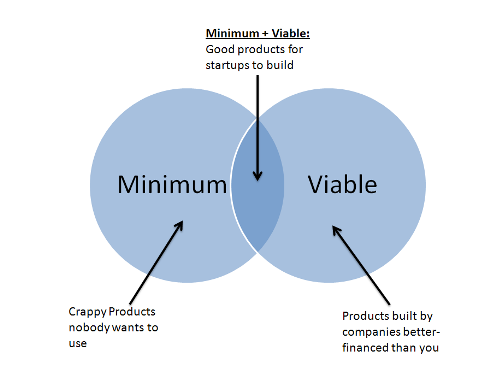
MVP2.PNG

Hat tip to the source.

A major pillar of Lean Startups is their use of Minimum Viable Products (MVPs) to test the validity of a product within a marketplace. By definition, a MVP has the minimal number of features that is required to test a given market hypothesis. A MVP allows the originating startup to gather invaluable feedback from customers, which in turn accelerates the feedback cycles around every aspect of development. Put differently, the use of an MVP avoids spending extensive time and resources building a finished product before validating the product concept with customers. When used in the context of validated learning, MVPs are a valuable tool for identifying product-market fit.

MVPs have been discussed extensively elsewhere (see related links below), usually in the context of information technology (IT) companies. The success of the MVP model has been validated in the IT industry, and a common operating procedure for IT product deployment is now early launch followed by rapid product iteration. Software based products, and specifically consumer web products are amenable to such rapid development, as the engineering challenges are well-defined even when significant. In contrast to most software / web based products however, products rooted in the hard sciences like the biotechnology or bioengineering sectors (and yes we lump all sciences together where progress is “hard” to come by), have an appreciable level of technical risk in addition to the market risk that MVPs are designed to address. To successfully map the MVP model onto the hard sciences, such technical risks need to be considered in the context of the large upfront capital and time investments required to abrogate them.

Re-framing the MVP model to include mitigation around the technical risk as well as the market risk is both appropriate as well as imminently necessary. We believe that MVP concepts can and indeed should be applied to fundamental research driven industries like biotech. Having entrepreneurs in these fields use MVPs and validate learning will lead to more capital efficient commercialization of technologies. This will benefit the entrepreneurs, founders and employees, as well as the funding organizations involved, be they VCs, foundations or the government. Because of the different set of starting assumptions inherent to these industries mentioned, we suggest the following three steps to adapt MVP concepts to these industries.

  1. Test product concepts to identify product/market fit.
  2. Conduct MVP-focused research.
  3. Explore adjacent marketplaces for the technology.

Test product concepts to identify product/market fit.

MVPs are used to evaluate the product/market fit. This concept can and has to be rigorously applied to the hard sciences. Too often researchers have an “if we build it they will buy it [come]” mentality, only to later find the developed technology lacks commercial relevance. As such, the first requirement of developing a technology for commercialization is to identify markets you think can be impacted by the technology, and then use an MVP to test the validity of the product within these markets. In the context of research intensive products, testing market need before demonstrating technical feasibility may seem premature and one may receive pushback from the researchers involved. However, to turn a scientific project into a commercial success, one needs to investigate the fit with greatest prejudice, and do that across multiple markets. This means talking to the end users early on. As compared with months of technical R&D that might be misdirected at worst or undirected at best, gaining a detailed view of multiple potential product-market fit scenarios is a high return-on investment effort.

Due to the constraints placed on the commercialization by the time/capital-investment function, entrepreneurs need to pursue clever ways to test product concepts in the marketplace prior to achieving technical proof. One important test is to create the appropriate product profile and socialize this to potential customers within the field. For example, for therapeutics this will involve identifying key stakeholders for a given indication and present to them a product profile of the anticipated active drug, including how it will be administered, dosage regimes, interaction with other drugs that are co-administered and potential side effects, etc. For example, if you’re developing a cancer drug, it will be critical to speak with oncologists, cancer patients, survivors, and payors. Understanding how your therapeutic could be adopted in the context of the current treatment regime is critical and most often clinical decisions are made on factors other than what molecular target is being drugged. This effort will illuminate the opportunities and point to the key challenges that need answering at the earliest stages of technology development. A crucial mistake many startups make is failure to take the current process into account. Never just assume that if you can successfully develop a product the customer will change his use pattern to accommodate you.

Conduct MVP-focused research

Research is often perceived to be a necessarily meandering path. However, as the development effort moves toward the application of the technology in the marketplace, applied research has to be efficiently guided. This requires an R&D process be in place and a significant amount of discipline from everyone involved to ensure that experiments are designed from the bottom up to really answer the important questions about the MVP product. For anyone aiming to develop any successful product, rigorous focus and capital efficient behavior is needed. It’s challenging and very difficult to implement a culture of laser-focused research effort, but fundamentally, a small biotech startup or commercially focused research lab has no choice if it wants to develop a product in times where raising capital on promising research alone is not a winning pitch. It should be noted that if the goal is to develop strong IP based on novel and early-stage science the parameters are different and we will cover those aspects in a following post.

Explore adjacent marketplaces for your technology

Last but certainly not least, early-stage research can and does create technologies that can have many applications – many startups are founded on the premise of a platform technology (technology push). This is often referred to as the “hammer looking for a nail” syndrome, and in many cases the most interesting nails are outside of the entrepreneurs domain of expertise. There are many examples of adjacent markets where products met their ultimate success. For instance, discovery of a drug target that impacted unexpected indications (e.g. Viagra was originally a cardiac drug), applied physics developments used in biotech applications (e.g. Pacific Biosciences optical waveguide technology used in sequencing), genetic engineering used in many industrial biology applications (eg. Genencor’s industrial enzyme production), and bioinformatics analysis technologies generally applied to the big data industry (eg. GNS’ foray into financial and systems analysis).

In summary, using an MVP based on a product profile enables the entrepreneur to be able to nimbly test product concepts in adjacent markets and generate invaluable feedback for further iterations of the MVP and final product. Additional posts will dig deeper into MVPs for different types of biotechnologies.

Here are some links to related content:

The Lean Startup

Minimum Viable Product Guide

Four Steps to the Epiphany, by Steve Blank.

James Taylor & Michael Koeris. Originally posted on Biotech Start.

Engineering a path from science to business

bridge.JPG

The folks at Nature Biotechnology asked us authors for a description of how we’ve navigated our careers from bench to business. My story is still a work in progress, but as a recent Ph.D. I do have some lessons for how you can prepare yourself for a career beyond research. First here’s a brief bio to give insight into my perspectives and biases.

I completed an Engineering Physics undergraduate degree at the University of British Columbia, with a focus on wireless and photonics. During this time, I worked at my first startups as an engineer, which ultimately sewed the entrepreneurial seeds. Following, I decided to pivot and apply my engineering skills to health and completed a Ph.D. in Genetics at the Institute for Systems Biology (ISB). My decision to conduct a Ph.D. was driven by my interest in the commercialization of advanced technologies and the ISB was a fantastically entrepreneurial organization to pursue this goal. Concurrent with my Ph.D., I was fortunate to work as a venture capital fellow at the ISB-affiliated venture capital firm, the Accelerator Corp. This was a tremendously valuable experience and during my three-year tenure, the Accelerator team started 7 biotech companies. After my Ph.D., I started looking for my next startup opportunity and met my co-founding team while working at an innovative technology transfer group, the Centre for Drug Research and Development. About 1.5 years ago I jumped ship to be a co-founder and CEO of Precision NanoSystems, where we are developing technology at the convergence of drug delivery, nanotechnology and genomics.

During my tenure as a Ph.D. student I often contemplated how to best use the degree to achieve my business goals, and as some of you are likely realizing, the path from bench to business is not always clear. Here are some lessons I learned during my degree that may be helpful for those wanting to pursue an entrepreneurial or business career:

Experience more than your Ph.D. offers.

Graduate or postgraduate studies are designed as a scientific training ground for a career as a scientist or professor. The knowledge gained is narrow and the skills learned are specific. For anyone serious about transitioning off the bench, you will need to actively pursue additional experiences and skills outside of your research work. There are many ways to do this during your degree, and I found that volunteering at an organization in an area of interest is one of the best ways to get your feet wet. My time at the Accelerator Corp. (which I initiated through a volunteer position) was one of the best experiences of my Ph.D. There I learned a tremendous amount about biotech, startups, and venture capital. I was very fortunate to have a Ph.D. supervisor supportive of my entrepreneurial interests and was able to dedicate half of a day to a full day a week to the experience (in addition to most of my evenings and weekends). If you are less fortunate, you may receive push-back from your supervisor, who may not recommend taking the time away from your thesis or papers.

However I strongly disagree. Ph.D. and Post-doc work is highly repetitive and obtaining orthogonal experiences will greatly enrich your time as a student. Further, your supervisor will benefit from his or her student’s success, be it in academia or industry, and should be supportive of those that demonstrate such ambitions.

Do not be wedded to a given technology.

During a Ph.D. or Post-Doc you spend a tremendous amount of time on a specific topic. At the outset you may feel completely invested in your corner of the technology world and that you should pursue a career involving that technology. However, this can be very limiting and greatly reduce your opportunities for success. Technology trends change constantly and what you picked 6 years prior may not be your best opportunity moving forward. Once you publish your papers or submit your thesis, take this unique transition period to adjust and consider on what technologies or business area you want to spend the next 5-10 years. Compare each potential area of interest as though you are making an investment (your career), and be prepared to defend your choice to your future self a few years out.

Want a job, create a company.

Lastly, the best way to gather vast business, management, and leadership skills is to start your own venture. Being a first-time entrepreneur is akin to drinking from a firehose and this time will greatly accelerate your experience and perspectives on our industry. Starting a company may seem like a daunting endeavor, but considering the potential career upside, it is actually a pretty reasonable proposition. Even if you fail, you will learn a tremendous amount, meet a community of like-minded folks, and become comfortable with taking career-altering risks. I suggest spending at least an extra 6 months at your institution to find an idea with legs and try to get it off the ground. Don’t do any bench work at this time, but use the period to find and test the commercial viability of potential new ventures. Be bold – talk to your tech transfer office to see if any technology is looking for a founder, ask professors to fund you from existing grants while you examine the commercial viability of a technology, join entrepreneur communities, attend founder speed-dating events, etc. And if your venture doesn’t fly, this time is a drop in a bucket compared with the 6 years just spent padding your academic CV.

James Taylor

Implications of Financing Your Biotechnology Start-up

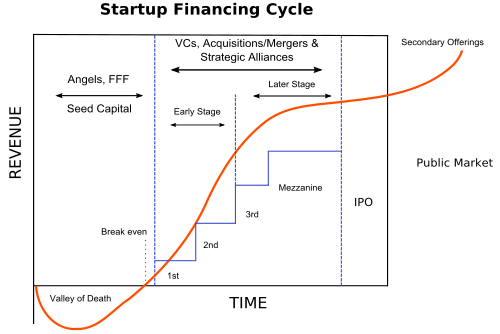
cycle.png Source: Kmuehmel

Starting a biotechnology company requires thoughtful strategies for the development of your product, and for your intellectual property portfolio, team, and many other areas. One such key aspect is your financing strategy. Deciding on what types of capital to raise and how much financing is required has major implications for the type of business you can operate, the amount of control the founders retain, and the types of exits available. In this post, I discuss the implications that financing has on two critical aspects of your business: the dilution of founder’s equity and the exit options available after financing is secured.

Dilution. When an entrepreneur takes money from an investor, the investor receives a percentage of the company that is proportional to the amount invested. For example, say you and your investor agree that your company is valued at $500,000 (this is called the pre-money valuation), and that the investor will give you $1,000,000 to operate your business for the next 12 months. Following investment, your company will have a valuation of $1,500,000 (the post-money valuation = pre-money valuation + investment cash) and your ownership will be diluted to 33% from 100% of the company. Dilution is an inherent aspect of equity financing, however this affect has the greatest impact when the company is at its youngest and has its lowest valuation. In the accompanying figure, I outline four scenarios that demonstrate the significance that the ratio of money raised to pre-money valuation has on the resulting founders’ percent ownership.

Dilution Figure2.png

Figure 1: Dilution following financing. Red indicates investor’s funds and resultant investor equity; blue indicates pre-money valuation and resultant founder’s equity.

In most areas of biotech, particularly in therapeutic, medical device, and diagnostic areas (where the regulatory burden requires significant capital investment), it is expected that investor financing will be required and that investors will become significant shareholders of the company. In fact, most companies require multiple rounds of financing, which can compound the dilution effect. As such, entrepreneurs should put in efforts at the earliest stages of their companies to fund their work using alternative financing sources in replacement of, or in addition to, traditional investors. These ‘non-dilutive’ sources include academic grants, government funds, industrial partnerships, making sales, etc., and allow entrepreneurs to retain control of the company while providing much needed operating cash. A savvy entrepreneur will use these funds to conduct critical proof-of-concept work that can increase the company’s valuation, leading to reduced dilution in future financings. In upcoming posts I will more specifically outline potential sources of non-dilutive funds in North America and give examples of how companies, including my own, are primarily funded by such sources. I will also discuss the cons of these monies, which can include an increased effort to secure, constraints on the use of capital, reporting requirements, and others.

Exit options available. A less well appreciated aspect that financing has on your business is how it can dictate the exit options available to your company. For example, compare two founding teams, NewCo A that raises $1 million from investors and NewCo B that raises $10 million. For simplicity, assume that in both cases the companies have a $1 million pre-money valuation, and both sets of investors expect to receive a 10x return on their investment upon exit. As shown in the table below, the two investments create very different business requirements for these companies.

table.doc

Whereas it may take a successful entrepreneur 3 – 4 years to build a $10 – 20 million company, it will likely take 7 – 12 years to build a company to a >$100 million valuation, and the probability of achieving such a level of success is lower. Considering that the founding team will receive the same absolute return upon exit (10 x $1 M = $10 M), the founders’ incentives for these two scenarios needs to be carefully considered. In addition, the methods of exit of the two companies are very different. For the smaller company, NewCo A the exit will likely be through an acquisition from either a large or medium sized company looking to expand their businesses or product line. The larger company, NewCo B, may exit through an initial public offering (IPO) on a public stock exchange or through a large acquisition by a large company. Based on the financing strategy chosen, the management team will need to align their skills and other elements of their business with these very different outcomes.

In summary. The capital requirements of your business will determine the amount of money that needs to be raised. Although simplistic, the financing scenarios I outline above start to demonstrate the impact that a financing strategy will have on your business. Alternative business models or the use of non-dilutive funding sources can help to reduce the amount of investor money required at the earliest stages of your company. In future posts I will describe alternative funding sources and the advantages and the costs associated with these monies.

Further reading. To have an understanding of how financing and dilution impact a business and its founding team, have a look at the resources put together by Venture Hacks (includes workable cap-table in spreadsheet format).

Basil Peters, an entrepreneur turned angel investor based in Vancouver and Silicon Valley, has written extensively about the impact financing has on exit strategy. I highly recommend both his book Early Exits and blog Angel Blog.

(For further opinions and insight into biotechnology, technology, financing, and innovation please see my blog at: www.persistentchange.com ; twitter: @jtbiotech)

James Taylor