The warp and weft of wearable electronics

Zhang 1

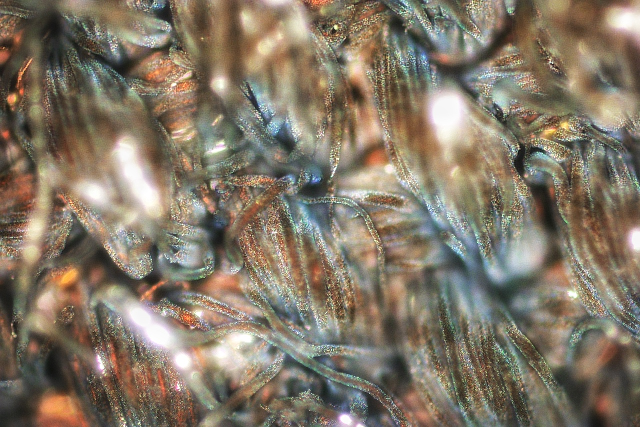
Optical microscope image of a battery electrode made of metallic textiles and active materials. {credit}Dongrui Wang{/credit}


3Q: Zijian Zheng

One of today’s challenges for materials scientists is wearable electronics — smart materials that monitor ailments, harvest energy, track performance or communicate. These remain expensive and hard to produce in bulk, and are often unattractive. Polymer scientist Zijian Zheng takes inspiration from his designer and business colleagues at Hong Kong Polytechnic University’s Institute of Textiles and Clothing. His solution: lightweight electronic yarns that can be made into textiles by adapting existing production processes.

 How do you create wearable electronics?

People need to feel like they’re not wearing electronics, so the materials must be lightweight and flexible. They must also be high-performance, as devices have to charge rapidly, last for a long time and be sweat-proof. Applying all these criteria, we create electronic textiles in which the fabrics themselves form the sensors and devices – from light-emitting diodes, photovoltaics, organic transistors and supercapacitors to batteries. We can make a supercapacitor using conductive yarn, made by coating cotton with nickel, and penetrating it with a form of graphene oxide. If you put a pair of these strands together in parallel, and fill the space between with an electrolyte gel, you can make it work as a supercapacitor storing energy as positively and negatively charged ions collect at the different wires. You could use that to power other devices, such as sensors, or store energy generated from photovoltaics. We’re working on making lithium batteries using the same principles.
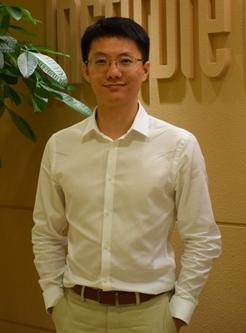
Polymer scientist Zijian Zheng.

Polymer scientist Zijian Zheng.

What are your biggest challenges?

When integrating different materials together in an electronic textile, the interfaces create the biggest problems. You can get mismatches between mechanical and thermal expansion properties, and in a flexible system the weakest points are where the device twists or bends. In my group we focus on using polymers to address these issues. For example, we make new polymers that add texture to the surface of textiles, allowing them to be coated in copper at low temperatures for durability. To ensure scalability, our goal is to make textiles that can be integrated with the technology the clothing industry has used for the past 200 years. Our composite yarns can be used in sewing machines, and complicated patterns can be created from them using machine embroidery. From there, you start to add active materials to make devices in ways that are compatible with textile processing. For example, we’re now making photovoltaic cells printable via textile colour-printing technology and encapsulating them with textile-finishing technology. And we are set to make a radio-frequency identification tagging device within a garment, powered by a supercapacitor. We’ve designed it to hide the supercapacitor as an embroidered pattern, like camouflage. We also have a student working with local textile company EPRO Development, trying to put the metallic, conducting textile into real production. Devices will come a bit later as they are ten times more complex to make. Cost is a challenge too: the textile industry cares about every penny. In introducing functional elements into garments such as a breathable section, you might only be allowed to increase production costs by around 10 cents.
Zhang 2

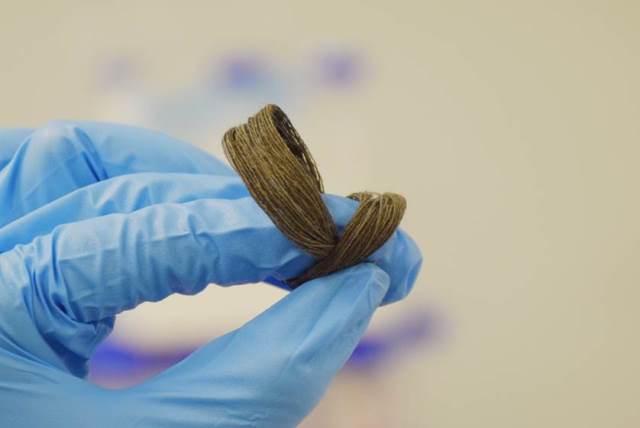
One hank of copper-coated cotton yarns used for making wearable devices and circuits.{credit}Ka-chi Yan{/credit}

How do the different disciplinary strands in your institute work together?

My institute covers the whole chain of production for textiles and clothing – with materials science and chemistry groups sitting alongside business and design. So we have three streams of students and teaching is totally different for each. The major challenge when I lecture is how to deliver my engineering or scientific-based content to a bunch of artists. We tend to give them an overview to help them understand first, with lots of examples, before we come down into the fundamentals. It’s very different from the physical science students, where we take them through a logical sequence from beginning to end. The artists ask so many questions. Generally they want to know if they can do something with a material, and don’t care about why it functions. They seldom ask “Why does this electron go through there?”

Interview by Elizabeth Gibney, a reporter on physics for Nature based in London. She tweets at @LizzieGibney.


For Nature’s full coverage of science in culture, visit www.nature.com/news/booksandarts.
Master builder: Ove Arup

Posted on behalf of Jo Baker

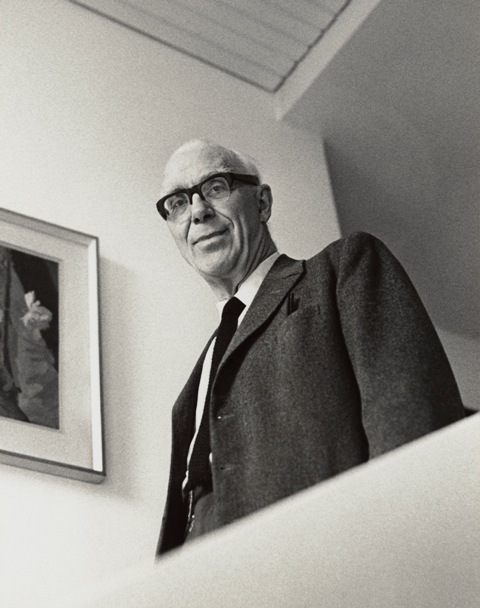
Ove Arup by Godfrey Argent, 1969.

Ove Arup by Godfrey Argent, 1969.{credit}© National Portrait Gallery, London. Engineering the World: Ove Arup and the Philosophy of Total Design, the V&A Engineering Season.{/credit}

He was the structural innovator behind Sydney Opera House, founded the world’s leading engineering consultancy, and pioneered the philosophy of “total design” — the equal partnership of engineers, architects and designers in construction. Anglo-Danish engineer Ove Arup (1895-1988) is now celebrated in this first retrospective of his work, Engineering the World, at London’s Victoria and Albert (V&A) Museum, part of its Engineering Season.

On show are 150 never-before-exhibited sketches, technical drawings, architectural models, photographs, calculations and manifestos from a century of work by Arup and his colleagues at his eponymous consultancy, whose forerunner he set up in 1938. The compact show (funded by Arup) is squeezed into a room-sized cage of red steel beams copied from those of the Pompidou Centre in Paris, which Arup co-designed with architects Richard Rogers and Renzo Piano in the mid-1970s. The explanatory panels are worth scrutiny: they reveal Arup’s interest in science and early computing, his playful character and his enthusiasm for training the next generation of engineers.

Born in Newcastle, UK, Arup became interested in philosophy and engineering while at school in Denmark. He studied both disciplines at university in Copenhagen, graduating in 1922 with a specialism in reinforced concrete. Equally passionate about the arts, he was influenced by the Modernist movement — which promoted the idea that science and technology could improve society — and its luminaries, such as architects Le Corbusier (Charles-Edouard Jeanneret) and Walter Gropius, who founded the Bauhaus group.

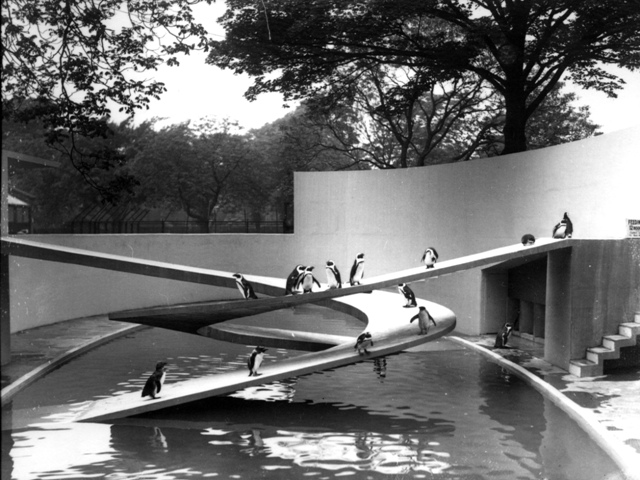
Penguin Pool, London Zoo, London, 1934.

Penguin Pool, London Zoo, London, 1934.{credit}© ZSL. Engineering the World: Ove Arup and the Philosophy of Total Design, the V&A Engineering Season.{/credit}

One of Arup’s early projects was the 1934 Penguin Pool at London Zoo. After studying penguin behaviour, he designed its thin gravity-defying spiral of interlocking ramps in concrete while working as a structural consultant for Berthold Lubetkin’s radical Tecton architectural partnership in London. The ramps’ curves were based on complex mathematics, and Arup’s calculations and notes are on display.

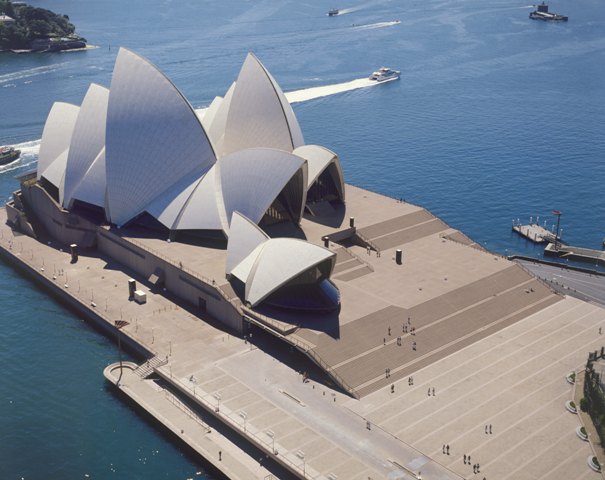
Sydney Opera House.

Sydney Opera House.{credit}© David Messent. Engineering the World: Ove Arup and the Philosophy of Total Design at the V&A Engineering Season.{/credit}

Arup had a strong sense of civic duty and designed air-raid shelters during the Second World War. His concepts were grand and controversial — massive concrete basements large enough to host hundreds of cars and people. (The government preferred small shelters.) Arup also worked on the Mulberry harbours, prefabricated temporary ports deployed during the 1944 Allied invasion in Normandy. He was responsible for a small but crucial element: a shock-absorbing fender that permitted the ships to dock. Photographs and technical drawings are on show.

Sydney Opera House is perhaps Arup’s most famous post-war project, and drawings and models of its design and construction form a focus of the exhibition. Faced with a freeform sketch of a collection of ‘sails’ by its Danish architect, Jørn Utzon, Arup pioneered the use of computers to solve the problem of how to build it from precast concrete. At the time most engineers still used slide rules and tables of logarithms. By renting a Ferranti Pegasus computer by the hour from the University of Southampton and writing their own software, Arup and his colleagues saved 10 years of manual calculations.

A doodle by Ove Arup.

A doodle by Ove Arup.{credit}© Private collection.{/credit}

The exhibition includes a wooden conceptual model explaining the solution he eventually conceived in 1961: sections cut from a sphere. A 2-metre-long wooden replica of the opera house used in wind tunnel tests is on show, along with charts illustrating airflow around it. When Utzon dropped out midway through the project, Arup took the construction to completion in 1973.

Arup eventually turned from engineering to shaping a new generation of engineers. In the 1970s and 80s successors emerged, including Peter Rice, Ted Happold and Mike Glover, who worked with architects including Piano, Rogers and Norman Foster on projects such as the Menil Collection gallery in Houston. A tilting model of the gallery — known for its naturally lit spaces — reveals how sun and shadows fall on the building through the day and year.

Engineering the World concludes with a look at the company today. Arup’s philosophy is still shared by its 12,000 employees in more than 90 offices around the world. A glass panel full of bubbling green liquid turns out to be a living façade where algae in an aerated soup of nutrients generate heat and biofuel. A section of wooden wall is part of a ‘wikihouse’ – a collaborative unfolding design for a home.

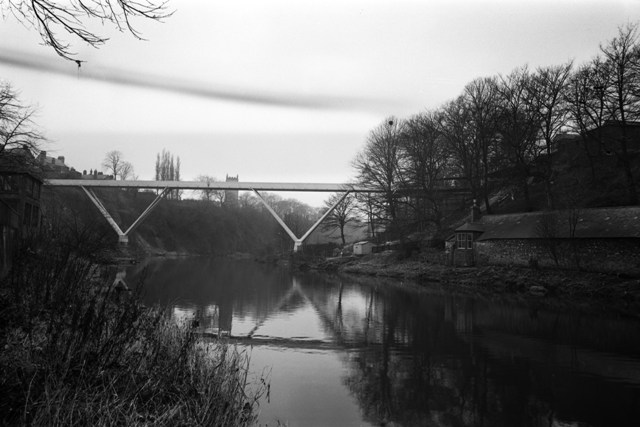
Arup’s ashes were scattered over a footbridge he designed: Durham’s Kingsgate, opened in 1963 and one of his favourites. He built it by rotating two halves into place — fittingly, for one whose creativity linked engineering and design.

View of Kingsgate Bridge, Durham, 1963.

View of Kingsgate Bridge, Durham, 1963.{credit}Reproduced by permission of Durham University Library. Engineering the World: Ove Arup and the Philosophy of Total Design at the V&A Engineering Season. {/credit}

Jo Baker is senior Comment editor at Nature.

Engineering the World: Ove Arup and the Philosophy of Total Design runs at the Victoria and Albert Museum, Cromwell Road, London, through 6 November. The V&A Engineering Season features displays, digital initiatives and a newly commissioned installation, Elytra Filament Pavilion, by experimental engineer Achim Menges with Moritz Dorstelmann, structural engineer Jan Knippers and climate-responsive engineer Thomas Auer. Inspired by filament structures of flying beetles’ forewing shells, the pavilion’s canopy is created from robotically fabricated carbon-fibre cells. Sensors in the canopy will capture anonymous data from the behaviour of visitors, allowing it to evolve.


For Nature’s full coverage of science in culture, visit www.nature.com/news/booksandarts.
Industrial optimist: Moholy-Nagy revisited

Posted on behalf of Jeff Tollefson

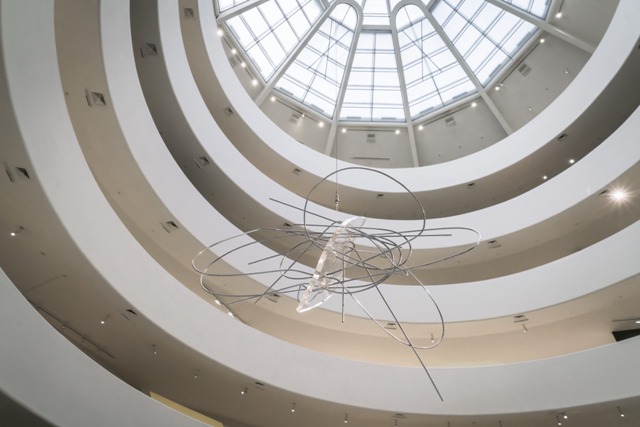
László Moholy-Nagy Dual Form with Chromium Rods, 1946 (Plexiglas and chrome-plated brass)

László Moholy-Nagy, Dual Form with Chromium Rods, 1946 (Plexiglas and chrome-plated brass).{credit}Solomon R. Guggenheim Museum, New York, Solomon R. Guggenheim Founding Collection 48.1149 © 2016 Hattula Moholy-Nagy/VG Bild-Kunst, Bonn/Artists Rights Society, New York. Photo: David Heald © Solomon R. Guggenheim Foundation{/credit}

I’m standing in the spiraling rotunda of New York’s Guggenheim Museum, and over me dangles a chaotic mess held together by translucent Plexiglas. In the shadow the sculpture casts on the wall, the shapes converge in a pleasing negative blending intention and happenstance – impossible to predict, yet clearly part of a plan. On evidence, this is an artist thinking experimentally, and in multiple dimensions.

The industrial designer, artist and photographer Lázló Moholy-Nagy (1895-1946) was certainly that. As the Guggenheim’s retrospective Moholy-Nagy: Future Present shows, the Hungarian pioneer of the Bauhaus and beyond worked in a dazzling array of media: film, photography, painting, sculpture, graphic design and typography. But behind the restless eclecticism, he adhered to the unifying theory (with the Constructivists) that art is integral to social transformation and must embrace new technologies. At a time of vast industrial expansion, he declaimed himself as “[n]ot against technological progress, but with it”, championing novel industrial materials — from Formica and aluminium to the Plexiglas in Dual Form with Chromium Rods (1946) in the rotunda. Drawn towards the airy, the transparent and the brilliantly coloured, he was also in love with light and movement: like contemporary Alexander Calder, he engineered moving parts and even electric motors into kinetic sculptures.

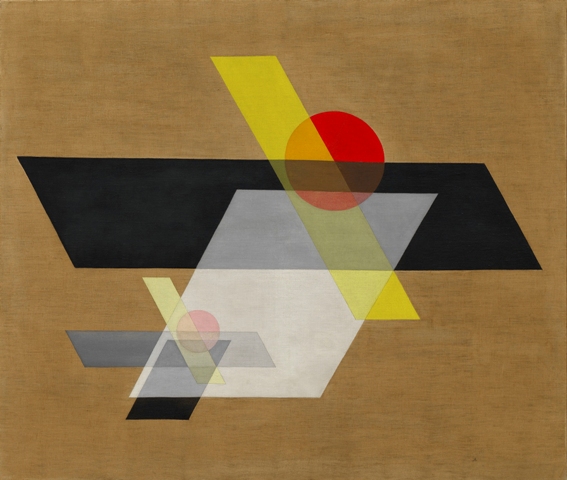
László Moholy-Nagy A II (Construction A II), 1924 Oil and graphite on canvas

László Moholy-Nagy, A II (Construction A II), 1924 (oil and graphite on canvas).
{credit}Solomon R. Guggenheim Museum, New York, Solomon R. Guggenheim Founding Collection 43.900 © 2016 Hattula Moholy-Nagy/VG Bild-Kunst, Bonn/Artists Rights Society, New York{/credit}

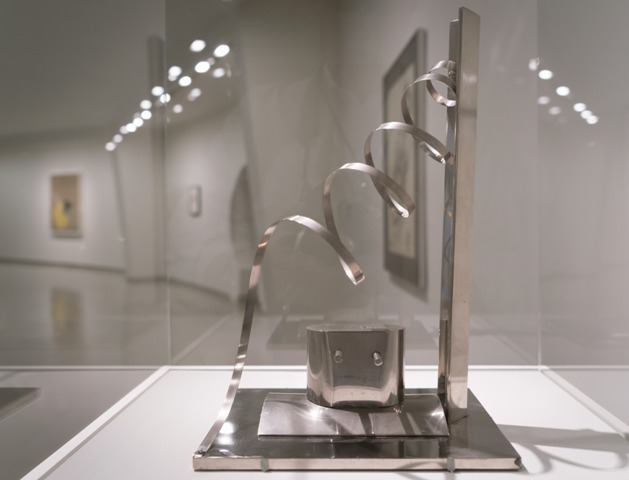
The exhibition takes a roughly chronological approach. Moholy-Nagy’s career began in earnest after he was injured in the First World War trenches. Much of the wall space is dedicated to earlier works such as the 1924 A II (Construction A II), an oil-and-graphite canvas in the Constructivist mode, that plays with colour intensity and transparency in rhombi and circles. Small abstract sculptures such as the welded, plated Nickel Sculpture with Spiral (1921) have a machined appearance. Its metal spiral inadvertently echoes the Guggenheim’s internal architecture, reflected on its glass case.

László Moholy-Nagy Nickel Sculpture with Spiral, 1921 (nickel-plated iron, welded)

László Moholy-Nagy, Nickel Sculpture with Spiral, 1921 (nickel-plated iron, welded).
{credit}The Museum of Modern Art, New York, Gift of Mrs. Sibyl Moholy-Nagy 1956 © 2016 Hattula Moholy-Nagy/VG Bild-Kunst, Bonn/Artists Rights Society, New York. Photo: David Heald © Solomon R. Guggenheim Foundation{/credit}

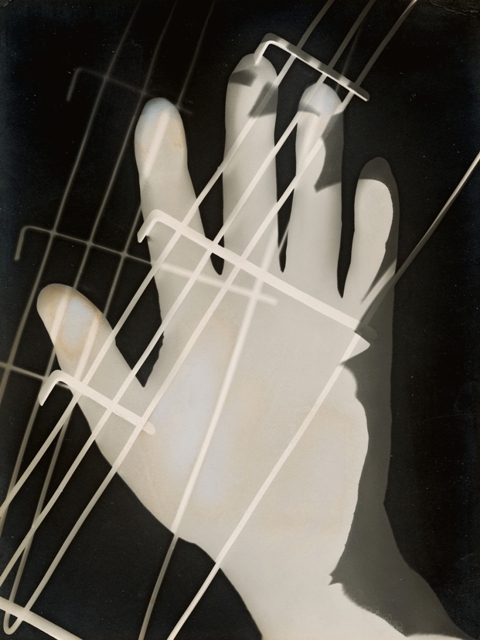
Deeper into the show we encounter Moholy-Nagy’s innovative photographic abstractions, which he called photograms. Developed directly on light-sensitive paper, these images (such as the 1926 Photogram) allowed the capture of objects in outline and even a playful profile of his own head. Other works reveal the artist’s intent to  harness the laws of physics. Space III (1940) is an abstract, multi-dimensional work composed of a Plexiglas sheet suspended in front of a white panel. The sheet is delicately etched and pigmented on both sides around an untouched circle, so that light both flows through and casts shadows on the panel. “Light does then what I could not do,” he wrote. “A sparkling, vibrating color effect through the addition of the shadows produce mixtures as no one could on the palette.”

Such materials and artistic approaches are ubiquitous now. But context and intention are critical to this show. There were moments when I felt as if I was in a history museum dedicated to the co-evolution of technology, industry and humanity. Clearly Moholy-Nagy was conscious of his place in time, and his role as interpreter of both past and present. He also sometimes felt he was speaking to the future. “I often had the feeling, when pasting my collages and painting my ‘abstract’ pictures, that I was throwing a message, sealed in a bottle, into the sea,” he wrote in 1944. “It might take decades for someone to find and read it.” Gradually I found myself seeing the avant-garde in the work by focusing on details and juxtaposition.

László Moholy-Nagy, Photogram, 1926 (gelatin silver photogram)

László Moholy-Nagy, Photogram, 1926 (gelatin silver photogram){credit}Los Angeles County Museum of Art, Ralph M. Parsons Fund © 2016 Hattula Moholy-Nagy/VG Bild-Kunst, Bonn/Artists Rights Society (ARS), New York Photo: © Museum Associates/LACMA{/credit}

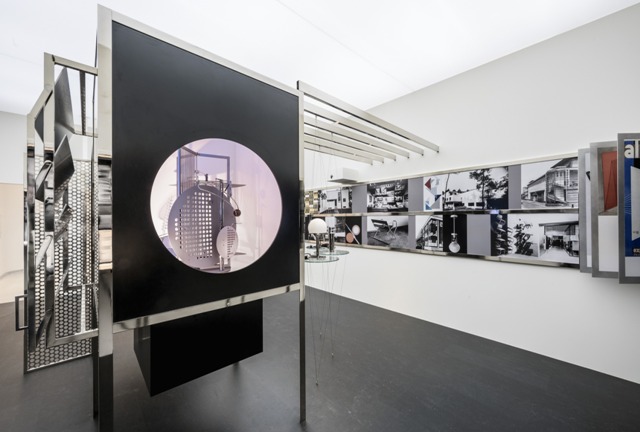
The Room of the Present offers a full realization of the artists’ vision, meshing space, light and an industrial aesthetic. An exhibition space within an exhibition space, it was never built in his lifetime, but constructed in 2009 based on architectural drawings, some of which are on display. Images of dancers and race cars jostle with those of laboratories and industrial facilities. Soviet filmmaker Sergei Eisenstein’s 1925 silent Battleship Potemkin is on view, but pride of place is given to a replica of Moholy-Nagy’s famous mixed-media kinetic sculpture Light Prop for an Electric Stage (1923-30). Attached to an electric motor and a simple gear box at the base, the collection of discs, springs and rods pivot, twirl and twist as the sculpture turns, casting colours and shadows onto the back of the box.

Moholy-Nagy left Nazi Germany in 1934, landing in Amsterdam, then London and eventually Chicago. There, in 1937, he founded the New Bauhaus, now known as the Institute of Design, at the Illinois Institute of Technology. He called his institute a “laboratory for a new education”, where art, industry and intellectual curiosity could come together to solve human problems, large and small. “If the unity of art can be established with all the subject matters taught and exercised, then a real reconstruction of this world could be hoped for — more balanced and less dangerous,” he wrote at the height of the Second World War, in 1943. Thanks to a little luck, and immigration, he survived both wars and remained an optimist to the end, dying from leukaeumia in 1946.

László Moholy-Nagy, Room of the Present, constructed 2009 (mixed media).

László Moholy-Nagy, Room of the Present, constructed 2009 (mixed media), with Light Prop for an Electric Stage, 1930 (exhibition replica, 2006; metal, plastics, glass, paint, and wood, with electric motor).{credit}Van Abbemuseum, Eindhoven. © 2016 Hattula Moholy-Nagy/VG Bild-Kunst, Bonn/Artists Rights Society, New York. Photo: David Heald © Solomon R. Guggenheim Foundation{/credit}

Among the last pieces on display at the Guggenheim are Nuclear I (1945) and Nuclear II (1946). A response to the bombings of Hiroshima and Nagasaki in 1945, the colourful globes in both paintings recall nuclear fireballs, frozen in a perpetual state of expansion. Inside are mosaic-like collections of abstract shapes, with faint hints of smoke and mushroom clouds.

 The bombings were a low point for the role of science in human affairs, but Moholy-Nagy interpreted the horror in his own way — with a chromatic intensity that speaks of hope amid destruction. In these and so many other works in this stunning exhibition, Moholy-Nagy’s belief in human resilience, as well as his sheer joy in experimenting with ideas, materials and light, shine through.

Jeff Tollefson is a reporter for Nature based in Washington DC. He tweets at @jefftollef. Moholy-Nagy: Future Present runs at the Guggenheim Museum at 1071 Fifth Avenue in New York through 27 September.


For Nature’s full coverage of science in culture, visit www.nature.com/news/booksandarts.
Suspended animation: Calder’s sculptural revolution

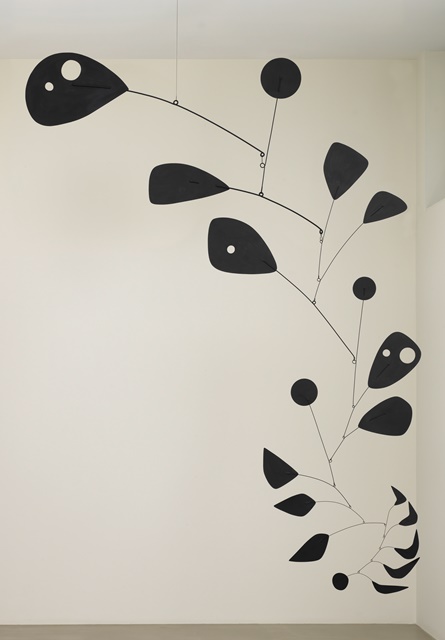
Alexander Calder's mobile Black Widow, c. 1948 (wire and painted metal), Instituto de Arquitetos do Brasil, São Paulo.

Black Widow, ca. 1948 (wire and painted metal), Instituto de Arquitetos do Brasil, São Paulo.{credit}© 2015 Calder Foundation, New York / DACS, London{/credit}

She hangs dark, immense and pocked with holes in a white room, a beast of many parts languidly revolving in the air. Part leaf, part lever, all magisterial grace, Black Widow is a quintessential Calder mobile — one of the signature inventions of the extraordinary twentieth-century artist-engineer.

This tremendous piece, three and a half metres long, is the finale to Alexander Calder: Performing Sculpture at London’s Tate Modern, a show that maps the evolution of Calder’s thought and practice on a route that is itself like the slow turn of a mobile. I spiralled through rooms mesmerised by manifestations of the propulsive, experimental drive of the man. Calder was not just a pioneer of kinetic sculpture and one of the first to use industrial materials other than pigments, such as steel. His early wire sculptures are scribbles in metal, yet miraculously evoke heft through mere line. And his fascination with sound and performance led to probings of chance and uncertainty that influenced avant-garde US composers such as Earle Brown and John Cage.

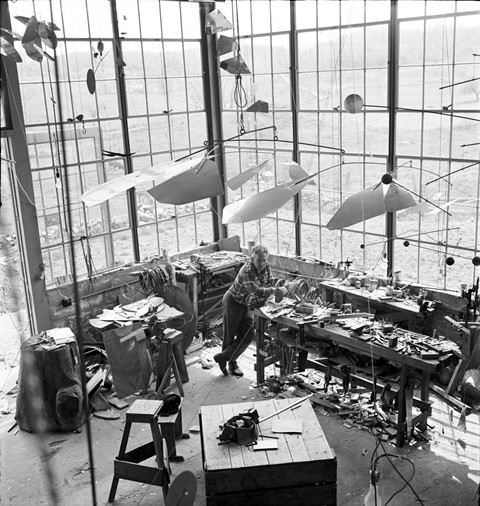
Alexander Calder in his Roxbury studio, 1941.

Alexander Calder in his studio in Roxbury, Connecticut, 1941.
{credit}Calder Foundation, New York / Art Resource, NY© ARS, NY and DACS, London 2014{/credit}

Astrophysics also exerted a singular pull on the artist. Fired by the sight, from shipboard, of a serendipitous equilibrium — a setting Sun and rising Moon on opposite horizons — Calder would declare years later that the “underlying sense of form in my work has been the system of the Universe”, the “idea of detached bodies floating in space, of different sizes and densities”. Calder was to investigate such momentous problems of motion and relationship in mobiles both wind-driven and motorised, such as A Universe (1934), in which two spheres go through different 40-minute cycles. (Einstein reportedly watched them from start to finish while viewing the piece in New York’s Museum of Modern Art.)

As the Tate show makes clear, Calder’s own balancing act — one foot in science, one in art — arose from both chance and deliberation. Born into a family of artists and sculptors, he decided at 17 to study descriptive geometry and applied kinetics at the Stevens Institute of Technology in New Jersey. He then pursued painting at New York’s seminal Art Students League in the early 1920s and, after experimenting with metal sculpture, set off in 1926 for the cultural crucible of Paris.

Here he began to explore the suggestion of movement in the fluidity of works in wire such as Hercules and the Lion (1928). The star of this period, however, is the Cirque Calder, a troupe of miniature acrobats and animals sculpted in wire, wood, cork, fabric and other materials and used for live-action shows that enthralled the likes of Joan Miró and Piet Mondrian. While the ingenious palette of materials may owe something to the Constructivism of Russian-born artist Naum Gabo, the wit and dogged study of the physics of moving objects are Calder’s own. A 45-minute film of him putting his performers through their paces, as fiercely concentrated as a four-year-old with a train set, is a major delight of this show.

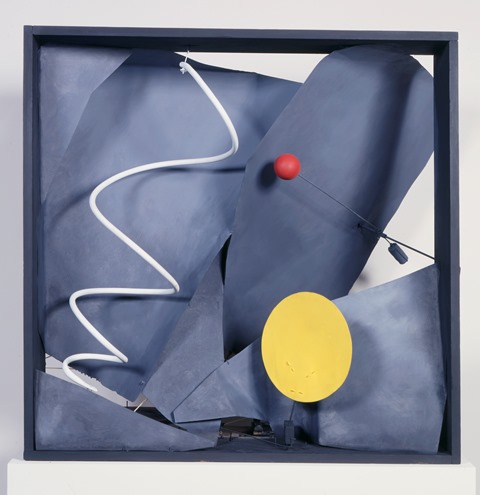
Black Frame, 1934.

Black Frame, 1934: one of Calder’s motorised sculptures. {credit}Calder Foundation, New York © 2015 Calder Foundation, New York / DACS, London{/credit}

And it’s one among many. We can, for instance, trace the gestation of Calder’s mobiles from his visit to Mondrian’s Paris studio in 1930, where he wondered why the Dutch painter didn’t set the cardboard rectangles he used to aid composition oscillating. Mondrian was dubious; Calder felt “like the baby being slapped to make its lungs start working”.

Small Sphere and Heavy Sphere 1932/33 (iron, wood, cord, thread, rod, paint, and impedimenta).

Small Sphere and Heavy Sphere 1932/33 (iron, wood, cord, thread, rod, paint, and impedimenta).{credit}Calder Foundation, Mary Calder Rower Bequest, 2011 © 2015 Calder Foundation, New York / DACS, London{/credit}

He began creating free-standing wire constructions hung with geometric forms in white, black and Mondrian-esque primaries, such as Small Feathers (1931). He played with mechanised motion in works like Black Frame (1934). And, distributing force through precise arrangements of levers and their fulcrums, he created suspended mobiles — suggesting orbiting planets, snowstorms, schools of fish, flotillas of cloud or, as some have noted, animated Mirós. He became an engineer of air, a definer of space.

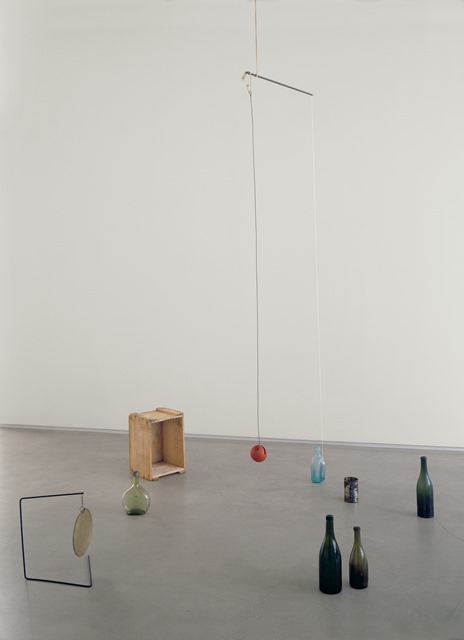
Around the same time, Calder’s interest in the aural grew. The elements of his sculptures, he noted, were “weight, form, size, colour, motion and then you have noise”. Small Sphere and Heavy Sphere (1932/3) is an open-ended experiment in which two suspended coloured balls are arranged so that one hits a collection of bottles, a box, a can and a gong. Visitors would reorganise these to create randomised ‘compositions’.

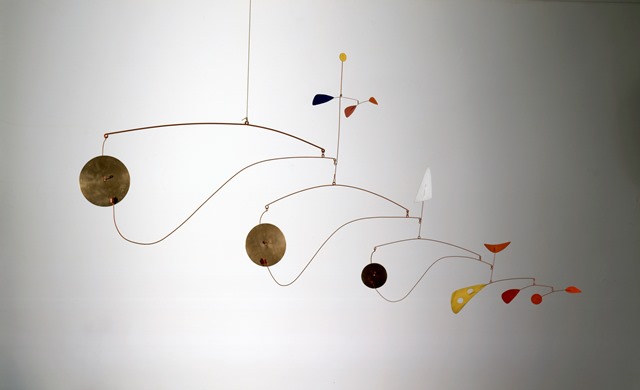
Such investigations of ‘open form’ reached a new pitch in the 1940s. Calder fitted large mobiles such as Triple Gong (1948) with beaters and differently pitched brass gongs to create evocative music as they shifted in air, not unlike exquisitely calibrated windchimes. Later still, he collaborated with Earle Brown on Calder Piece, a “sonic animation” of Calder’s mobile Chef d’Orchestre, which by moving ‘conducts’ a percussion ensemble.

As the show reveals, Calder’s boldness in testing possibilities extended to other materials and contexts. Mercury Fountain, created for the Spanish Pavilion at the 1937 World’s Fair in Paris  is one; there were also theatrical sets, the Water Ballet, an ‘acoustical ceiling’ in Caracas — and more.

Triple Gong, ca. 1948 (brass, sheet metal, wire, paint).

Triple Gong, ca. 1948 (brass, sheet metal, wire, paint).{credit}Calder Foundation, New York © 2015 Calder Foundation, New York / DACS, London{/credit}

Scientifically inspired art of the twentieth century might seem the usual seepage of ideas across disciplinary boundaries. Painters such as the Dadaist Max Ernst and muralist Diego Rivera were deeply influenced by developments in mathematics and particle physics, for instance. Sculptors, however, did not just depict; they embodied. Calder shaped the stuff of physics into a biomorphic aesthetic to rival Barbara Hepworth’s. And like Hepworth and her insistent use of voids in solid form, he found a way to marry the immateriality of air with a significant tonnage of standing and hanging metal.

This reassessment of an artist who created 22,000 works over an unstoppable career was a journey of discovery for me. As a child of thoroughly modernist artists, I early on absorbed (and loved) many of Calder’s works. But I found myself entranced, and educated, all over again — and seething with questions. I’d give a hell of a lot to know, for instance, what was going through Einstein’s mind as he gazed at Calder’s A Universe.

Alexander Calder: Performing Sculpture runs at Tate Modern, London, through 3 April 2016. The quotes from Calder in this piece are from the show’s programme notes.


For Nature’s full coverage of science in culture, visit www.nature.com/news/booksandarts.
Graphene structures at the cutting edge

Posted on behalf of Shamini Bundell

{credit}jannoon028/Pond5.com {/credit}

Did you ever make paper snowflakes as a kid? The kind where you fold a circle of paper several times, cut shapes out, then unfold it to reveal a beautifully symmetrical pattern? This is kirigami, the ancient Japanese art of paper cutting. Now physicist Melina Blees has applied the same technique to the ‘supermaterial’ graphene — strong sheets of carbon a single atom thick.

Blees, who works in Paul McEuen’s group at Cornell University in Ithaca, New York, has a background in the visual arts and so was used to getting to grips with the potential of a new material. What she didn’t realise was that this experience would help her turn graphene into tiny mechanical components for future nano-machines.

The Cornell team were working on a big sheet of graphene. One of the first things they did was start to physically explore its properties, like a child with a new toy. “We were sort of playing with these large sheets of graphene and it was crumpling and un-crumpling,” recalls Blees. They realised that it had the same kind of stiffness and flexibility as a sheet of paper. It was then that they thought of cutting it.

The team turned to kirigami (from kiru, meaning ‘to cut’, and kami, meaning ‘paper’), in which intricate three-dimensional shapes are formed from folding and cutting a sheet of paper. They picked up a children’s book on the technique and chose some of the simplest shapes.
 

Melina Blees talks about the kirigami shapes the Cornell team has made from graphene

Melina and her colleagues found themselves “sitting in a high tech lab with scotch tape and paper and scissors”. Their low-tech experimentation led to discoveries with amazing potential. One of the first was a method for turning a single sheet of graphene into a stretchable spring using just a few cuts.

 The group played around with different kinds of mechanical structures — pyramids, cantilevers and hinges — just a few tens of micrometres across. These basic components herald a day when physicists might make entire machines on minute scales.

Melina hopes to create tiny weighing scales from graphene springs, for instance, or to design nets that could lie over a living cell and measure electrical signals. Going smaller still, such approaches could one day allow the creation of nanoscale robots.

It’s difficult to imagine how things work at the micrometre scale with attendant differences in forces and properties. Scientists are usually one step removed from microscopic materials such as graphene, and have to use microscopes and robots to see and manipulate them. But Melina found that just poking at a sheet of graphene to see what happened was key to understanding its potential.

Kirigami graphene also shows what scientists can learn from art — and from going back to basics. High-tech experiments are all very well, but there’s a lot to be said for just messing about with materials. Now who wants to make a graphene snowflake?

Read the original Nature paper here. Shamini Bundell is a science communicator and multimedia editor at Nature. She tweets at @SBundell.


For Nature’s full coverage of science in culture, visit www.nature.com/news/booksandarts.
John A. Rogers

University of Illinois at Urbana-Champaign

A materials scientist comments on two methods for three-dimensional nanofabrication.

Methods for nanofabrication are crucially important to research in all areas of nanoscience and nanotechnology because they allow for the creation of functional structures — a key step towards useful applications and devices. Many techniques are available, but all have significant shortcomings and few are compatible with true, high-volume manufacturing modes. As the director of a centre for nanomanufacturing funded by the US National Science Foundation, I am deeply interested in emerging developments in this area.

Two papers on nanofabrication caught my attention. Both use sharp, scanning tips to form three-dimensional (3D) nanostructures. This 3D capability is important because it is unavailable in established techniques such as those used in the semiconductor industry.

In one paper, Jie Hu and Min-Feng Yu at the University of Illinois at Urbana-Champaign use nanometre-scale glass nozzles with engineered shapes to electroplate metal onto solid surfaces (J. Hu and M.F. Yu Science 329, 313–316; 2010). The positions of the nozzle and substrate are precisely controlled, enabling directed ‘writing’ of nanometre-scale conducting wires in freely suspended 3D arrangements.

In the second paper, Armin Knoll at IBM Research in Zurich and his colleagues use sharp tips as sources of heat to locally strip material from thin films of molecular glasses and thereby sculpt 3D shapes with nanometre-scale accuracy (D. Pires et al. Science 328, 732–735; 2010). The authors fabricate diverse structures, including a 25-nanometre-high replica of the Matterhorn, one of the Alps’ highest peaks.

Both techniques offer valuable capabilities in nanofabrication that seem to be scalable for practical use. Successful outcomes of efforts such as these will have central roles in the translation of new knowledge in nanoscience into meaningful forms of nanotechnology.

Viola Vogel

Swiss Federal Institute of Technology, Zurich

A bioengineer discusses how mechanical forces in tissues may promote malignancy.

The connective-tissue protein collagen has been considered to be a structural barrier against tumour invasion in tissues. Enzymes that cleave collagen and other extracellular matrix (ECM) molecules were thus thought to promote tumour progression, but inhibitors of these enzymes have failed in clinical trials. And paradoxically, increased collagen expression is associated with a greater incidence of cancer spread.

Working with mice, Valerie Weaver of the University of California, San Francisco, and her team show that other ECM-remodelling parameters regulate malignancy (K. R. Levental et al. Cell 139, 891–906; 2009). They studied an enzyme that initiates collagen crosslinking and is often found in tissue around tumours. They reveal that the crosslinking increases the stiffness of collagen matrices, which upregulates growth-factor signalling and breast malignancy. This suggests that tumour progression depends on a tissue-remodelling process that is regulated by biochemical and mechanical factors.

Bioengineers developing implantable materials that promote tissue regeneration can also learn a lot from this paper. Dense collagen capsules typically form around implanted biomaterials, which has prompted a search for clues to how to engineer surfaces that promote blood-vessel formation and tissue regeneration rather than scarring.

Knowing which factors promote malignancy may also help us to engineer materials and tissues that tip the balance towards enhanced tissue regeneration. This paper might thus stimulate ideas on how to interfere with the interplay between ECM-crosslinking enzymes that enhance matrix stiffness and ECM-protein-cleaving enzymes. Doing so may affect mechanosensitive cell-signalling pathways, promoting regeneration.

Achim Müller

University of Bielefeld, Germany

A chemist finds beauty in molecules that resemble an early model of the Solar System.

Since Plato’s time, people have been fascinated by the beauty of highly symmetrical objects. The symmetry of the C60 buckyball surely contributed to scientists’ tremendous interest in this spherical molecule. Indeed, I was convinced that the discovery of C60 would induce a rush among chemists to search for other symmetrical structures.

That rush may not have happened, but scientists have still turned up some surprising highly symmetrical structures. A recent report from researchers at Xiamen University in China (X.-J. Kong et al. J. Am. Chem. Soc. 129, 7016–7017; 2007) describes a cluster in which beauty cages beauty; it consists of an icosidodecahedron of nickel ions, having 20 triangular faces and 12 pentagonal faces, inside of which sits a dodecahedron of lanthanum ions.

The team describes the magnificent structure as ‘Keplerate’, a term that I and my colleagues first used around ten years ago to describe structures that contain Platonic and Archimedean solids (regular polyhedra, and polyhedra with two types of face, respectively) one inside another, like Russian dolls. It honours Johannes Kepler, who in the sixteenth century developed a model of the cosmos in which “the radii of the successive planetary orbits are proportional to the radii of spheres that are successively circumscribed around and inscribed within the five Platonic solids”.

Another recent report found these same shapes — the icosidodecahedron and dodecahedron — in Keplerate-type arrangements in quasicrystals (H. Takakura et al. Nature Mater. 6, 58–63; 2007). Such crystals are still poorly understood. I hope that future work will correlate these materials’ properties with their beauty.

Gautam R. Desiraju

University of Hyderabad, India

A chemist applauds an algorithm able to predict crystal structures from chemical composition alone.

I work in crystal engineering, a field that involves designing and constructing crystals with desired physical, chemical or pharmaceutical properties from small organic molecules. It is an experimental science based on pattern recognition and retrosynthetic strategies, in which the structure is considered as the sum of smaller, simpler parts.

Improvements to computational crystal-structure prediction could make design protocols more reliable. But this is such a difficult problem that only a handful of groups in the field work on it. In this context, I found a recent paper presenting a seemingly reliable method to be thought-provoking (A. R. Oganov and C. W. Glass J. Chem. Phys. 124, 244704; 2006).

Typically, crystal-structure prediction involves computer generation of putative crystal structures using a force field, which represents the interactions between atoms in neighbouring molecules. The correct structure is presumed to be that which minimizes the crystal’s energy.

The procedure is problematic because the force fields may not be well tailored to the molecules being studied, and because the experimental structure may not be the lowest-energy arrangement. It is also impossible to explore all conceivable structures, which are mind-boggling in number.

Oganov and Glass use an evolutionary algorithm to localize the search to the most promising structures. Their approach is attractive in that it requires no system-specific knowledge — the input is just the molecule’s chemical composition, not even its structure — and their ability to predict the unusual tetragonal structure of urea is impressive.

Is this the long-awaited breakthrough in crystal engineering? Perhaps not, but surely it’s an important step forward.

Iwao Ohmine

Nagoya University, Japan

A theoretical chemist compares love to hydrogen bonds.

Water molecules assemble into ice “palm to palm”, like Romeo and Juliet on their first encounter. Each molecule reaches out to four neighbours, forming hydrogen bonds that lock the molecules into a tetrahedral network. And like the love of Shakespeare’s pair, water’s hydrogen bonds are resilient. Ice contrives to keep its network, even in the tightest of spaces.

Researchers recently predicted that ice constrained by a carbon nanotube’s wall will form either tubular structures or intricate arrangements of double- and quadruple-stranded helices, depending on temperature, pressure and nanotube diameter (J. Bai et al. Proc. Natl Acad. Sci. USA 103, 19664–19667; 2006).

I have spent many years studying the structure and dynamics of water, but am still amazed by these luxuriant ice structures. Had computer simulations not shown how strenuously ice’s network can adapt for its molecules to keep their four hands touching, we could hardly have imagined such structures would be possible.

Simulations have also predicted that confined ice can have two symmetrically different phases, which become deformed and indistinguishable when put under pressure (K. Koga et al. Nature 412, 802–805; 2001). So we expect that one type of ice will easily transform into the other through collective motion of its hydrogen bonds.

My prediction is that confined liquid water, which has a disordered network of hydrogen bonds, will undergo similar structural rearrangements. Molecular mechanisms may cause large changes to the network structure of water trapped in proteins or at membrane surfaces, for example. These studies could therefore help us begin to understand another intimate relationship — the relationship between water and life.