Under the covers (Nature revealed) – 2 October

This week’s cover shows the findings from NASA’s Grail Mission which revealed ancient tectonics on the lunar nearside. Nature’s Art Director Kelly Krause talks us through the inspiration behind the cover.

Caption:

The Procellarum is a broad feature on the nearside of the Moon, characterized by low elevations and thin crust, and largely covered by dark basalts that can be seen from Earth with the unaided eye. The red colours on the cover image show gravity anomalies bordering the Procellarum region, calculated with data from the Gravity Recovery and Interior Laboratory (GRAIL) mission. The background globe represents the topography of the Moon as measured by the Lunar Orbiter Laser Altimeter (LOLA). Andrews-Hanna et al. interpret the observed gravity anomalies as evidence of ancient lava-flooded rift zones buried beneath the volcanic plains (or maria) on the nearside of the Moon. Cover: NASA/ Colorado School of Mines/ Goddard Space Flight Center/ Scientific Visualization Studio
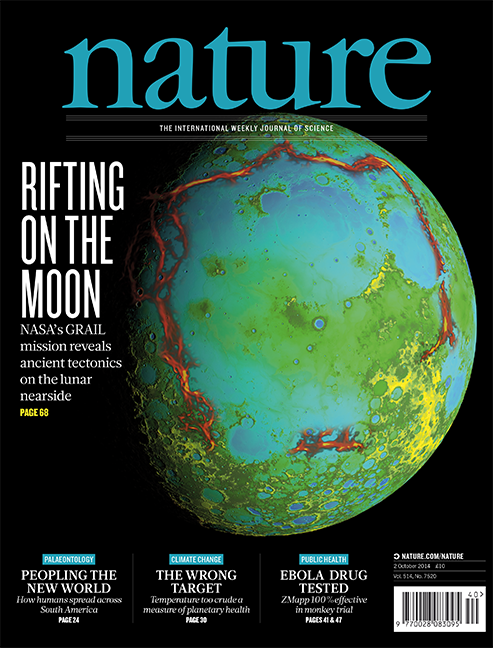
NASA's GRAIL mission reveals ancient tectonics on the lunar nearside.
NASA’s GRAIL mission reveals ancient tectonics on the lunar nearside.

Continue reading

Under the covers (Nature revealed) – 18 September

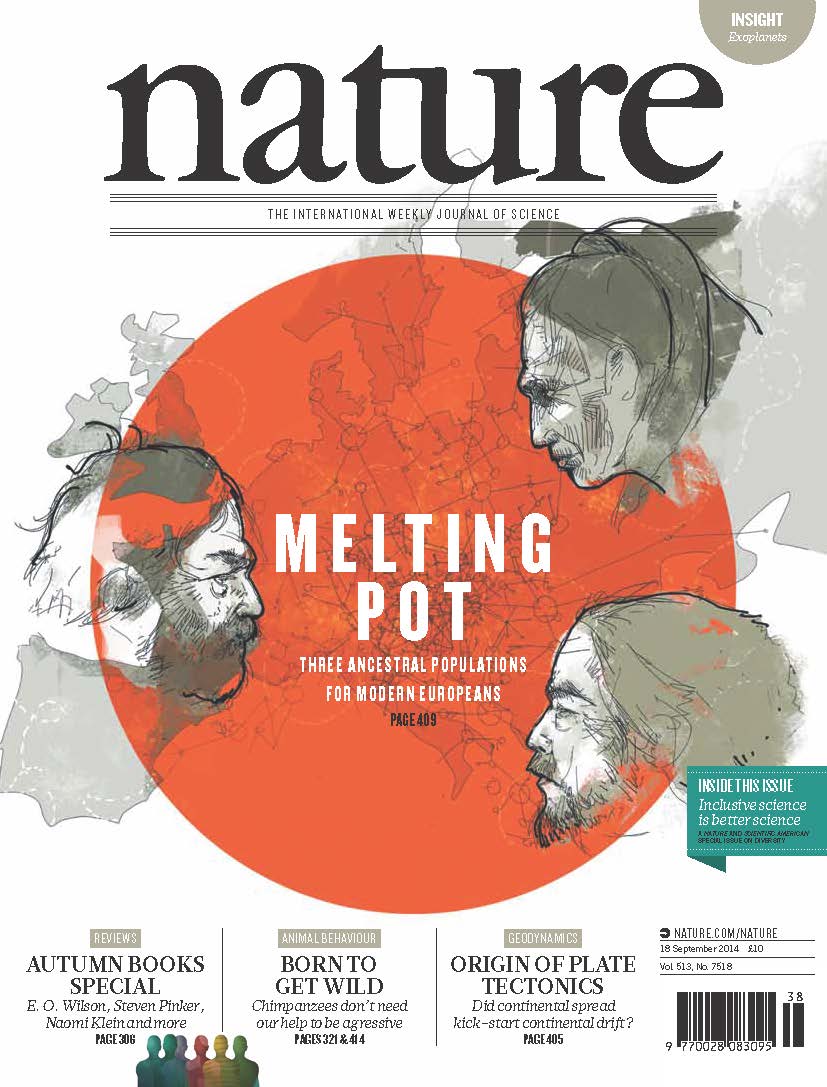
This week’s cover shows the three ancestral populations for modern Europeans in an informative and beautifully crafted sketch. Nature’s Art Director Kelly Krause talks us through the inspiration behind the cover.

Caption:

By sequencing and comparing the genomes of nine ancient Europeans that bridge the transition to agriculture in Europe between 8,000 and 7,000 years ago, David Reich and colleagues show that most present-day Europeans derive from at least three highly differentiated populations — west European hunter-gatherers, ancient north Eurasians (related to Upper Palaeolithic Siberians) and early European farmers of mainly Near Eastern origin. They further propose that early European farmers had about 44% ancestry from a ‘basal Eurasian’ population that split before the diversification of other non-African lineages. These results raise interesting new questions, for instance that of where and when the Near Eastern farmers mixed with European hunter-gatherers to produce the early European farmers. Cover: Leonardo Gonzalez.

Three Ancestral Populations For Modern Europeans

Three Ancestral Populations For Modern Europeans

Continue reading

Turning art to science: A focus on lung cancer

The fine art of representing complex science in illustrations and images can often be tasking to the most adept artists and designers. First there is the brainstorming process, then the pages and pages of sketches and templates, and then the small matter of aligning those thoughts and ideas with those of the editor.

This is a situation very familiar to UK illustrator, Russell Cobb, whose work has been much coveted by national publications and featured across the world. Cobb, this month, took on the challenge of designing the front cover of the Nature Outlook on lung cancer working alongside supplement editor, Herb Brody and the Outlook team.

Here Cobb and Brody talk through how their initial designs and thoughts evolved into the final cover seen below. Read the full Outlook supported by Cancer Research UK and Boehringer Ingelheim here.

Continue reading

The Dominant Malignancy: Lung Cancer

Lung cancer is the leading cause of cancer mortality. In some countries, incidence rates are dropping but survival rates for those with the disease remain low.

A special supplement published in Nature today explores the current risks, therapies and causes of lung cancer.

The Nature Outlook on lung cancer, supported by Cancer Research UK and Boehringer Ingelheim, contains commentaries, features and articles on topics including: the risks and costs associated with lung-cancer screening, therapies targeted at the specific genetics of a patient’s lung cancer, air pollution risks and key lung-cancer mutations in non-smokers.

Here is a snapshot of the striking graphics that can be found in the supplement.

For more graphics, features and information, click through to read the free-to-access Outlook.

Continue reading

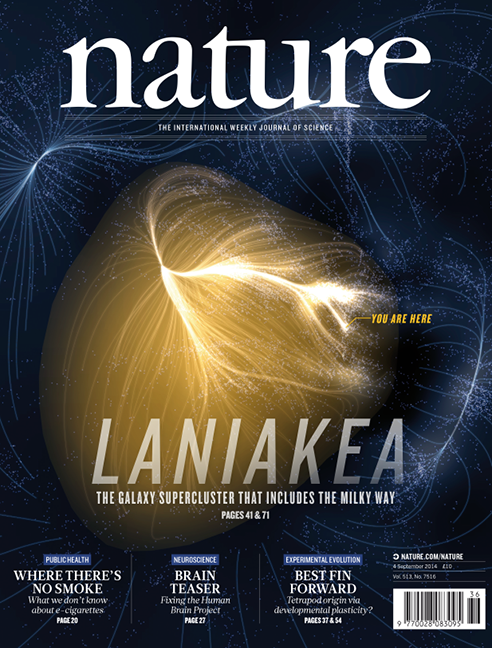
Under the covers (Nature revealed) – 4 September 2014

This week’s incredible image has been masterly put together by artist Mark A. Garlick and the Nature Art Team. Nature’s Art Director Kelly Krause talks us through the design process of the cover, which focuses on the Laniakea supercluster.

Caption:

A slice through the Laniakea supercluster — home: velocity flow streams within our supercluster are shown white, external flows dark blue. The Milky Way is a member of the Local Group of galaxies. The Milky Way is a member of the Local Group of galaxies. Now have sufficient data on the distances and motions of galaxies to be able to describe a much larger level of organization in our corner of the Universe — a supercluster 160 megaparsecs across and containing 1017 solar masses. Brent Tully et al. use a new catalogue of ‘peculiar velocities’, line-of-sight departures from cosmic expansion caused by gravitational perturbation, to develop a map representing the distribution of matter. They identify a ‘home’ supercluster that they name Laniakea — from the Hawaiian lani and akea (‘heaven’ and ‘spacious’). It includes the Virgo cluster, the Norma, Hydra and Centaurus clusters (also known as the Great Attractor), the Pavo-Indus filament and a number of voids. Cover art: Mark A. Garlick / Source: Daniel Pomarede.

The Galaxy Supercluster That Includes The Milky Way.

The Galaxy Supercluster That Includes The Milky Way

Continue reading

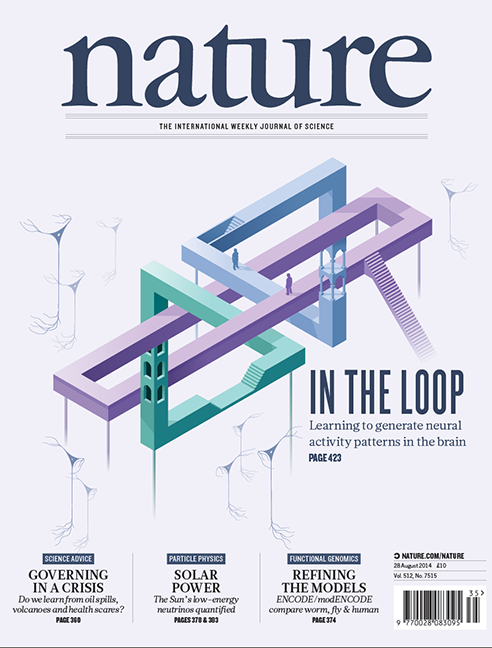
Under the covers (Nature revealed) – 28 August 2014

This week’s blog sees a thoroughly creative and conceptual image used to illustrate new patterns of neural activity in the brain generated through learning. Nature’s Art Director Kelly Krause and author Aaron Batista talk us through the selective process and cover design.

Caption:

In a study of the extent to which new patterns of neural activity can be generated through learning, Aaron Batista and colleagues examine neuronal network reorganization in Rhesus macaques learning to control a computer cursor using different patterns of activity in motor cortex. Some new neural activity patterns were more easily generated than others — corresponding to more easily learned tasks — and these could be predicted mathematically from the network topology at the beginning of the experiment. The authors speculate that the results provide a basis for a neural explanation for the balance between adaptability and persistence in action and thought. Cover: Jasiek Krzysztofiak/Nature

Learning to generate neural activity patterns in the brain

Learning to generate neural activity patterns in the brain

Continue reading

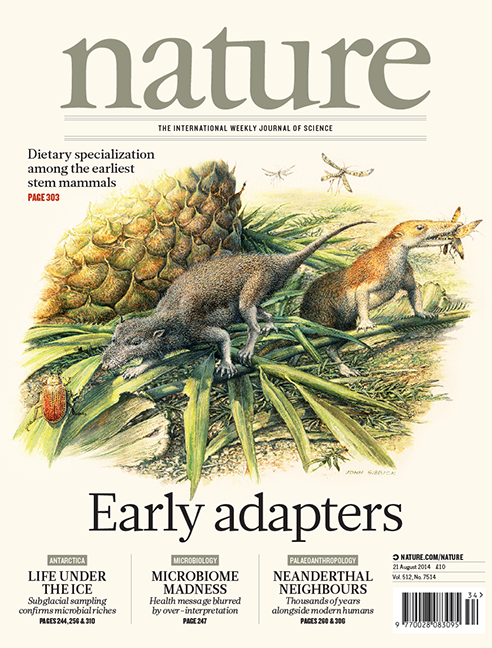
Under the covers (Nature revealed) – 21 August 2014

This week’s blog sees a stunning painting from John Sibbick imagining the Early Jurassic basal mammals,  Morganucodon and Kuehneotherium, hunting their prey. Nature’s Art Director Kelly Krause talks us through the front cover choice with a little help from some rather Jurassic themed cake.

Caption:

John Sibbick’s painting imagines the iconic Early Jurassic basal mammals, Morganucodon and Kuehneotherium, hunting their favoured prey on the small island that they shared in what is now Glamorgan, southern Wales. The very earliest mammals, living in the Late Triassic and Early Jurassic around 200 million years ago, were small and are often presumed to have been generalized insectivores. Now a close study of Morganucodon and Kuehneotherium shows that niche partitioning and dietary specialization were well under way even at that early date. Analysis of tooth wear and jaw biomechanics shows that whereas Morganucodon had powerful jaws, capable of crushing hard prey such as beetles,Kuehneotherium was adapted for snapping at softer prey, such as the scorpion flies illustrated here. Cover: www.johnsibbick.com

21 August 2014 Cover

Dietary specialization among the earliest stem mammals.

Continue reading

Under the covers (Nature revealed) – 7 August 2014

This week’s blog sees a very creative graphic used to illustrate the growth of nanotubes from molecular seeds. Nature’s Art Director Kelly Krause talks us through the selective process and cover design.

Caption:

The electronic properties of single-walled carbon nanotubes (SWCNTs) are extraordinarily sensitive to their precise structure. To exploit their technological potential fully, samples containing only one SWCNT type are needed. Juan Ramon Sanchez-Valencia et al. have combined synthetic chemistry with materials engineering to develop a strategy that, with further optimization, could provide a route to nanotube-based materials for use in light detectors, photovoltaics, field-effect transistors and sensors. They use a surface-catalysed cyclodehydrogenation reaction to fold rationally designed precursor molecules deposited on a Pt(111) surface to produce ‘end caps’ that act as seeds for the growth of defect-free and structurally pure SWCNTs. The technique requires only modest temperatures and is fully compatible with today’s complementary metal oxide semiconductor technologies. Cover: Konstantin Amsharov.

Structurally pure single-walled carbon nanotubes seeded from a rationally designed end cap.

Structurally pure single-walled carbon nanotubes seeded from a rationally designed end cap.

Continue reading

Under the covers (Nature revealed) – 1 August 2014

This week’s blog sees another stunning front page visualisation. Nature’s Art Director Kelly Krause talks us through the inspired thought processes behind it.

Caption:

A representation of the individual quantum trajectories that connect two points in quantum state space. Classical systems are unmoved when a measurement is performed. Not so quantum systems, where continuous monitoring can direct the quantum state along a random path. Steve Weber et al. have tracked the quantum trajectories in a qubit, consisting of two aluminium paddles connected by a tunable Josephson junction deposited on silicon. The authors manage to determine which of the possible paths between an initial and a final quantum state is the most probable and show that these ‘optimal paths’ are in agreement with the route predicted by theory, a quantum relative of the principle of least action that defines the correct path linking two points in space and time in classical mechanics. As well as giving insights into the interplay between measurement dynamics and evolution of a system, this work opens up new possibilities for first-principles synthesis of control sequences for complex quantum systems and in information processing. (Cover: Kater Murch)

Defining the optimal path through quantum space.

Defining the optimal path through quantum space.

Continue reading

Under the covers (Nature revealed) – 24 July 2014

In this week’s Under the covers (Nature revealed) blog, Nature’s Art Director Kelly Krause discusses the inspiration behind the striking front cover image of Antarctic fur seals.

Caption:

Antarctic fur seals (Arctocephalus gazella) on an iceberg at Bird Island, South Georgia. This species was hunted almost to extinction by the early twentieth century but numbers began to recover when sealing operations stopped, and thanks to an abundant food supply it has survived in large numbers. But fur seals are particularly vulnerable to climate change as they inhabit a region with fast-changing temperatures, and their relatively long generation time limits their ability to adapt evolutionarily. An analysis of three decades of data from South Georgia now shows that the seals are in decline again, with female numbers down by some 30% between 2003 and 2012. Harsh conditions have, however, selected for higher genetic heterozygosity among females. While this is not in itself an evolutionary response, as environmental conditions continue to worsen, heterozygote advantage could help maintain genetic variation, potentially buying time to allow the species to respond via adaptation. Cover photo: Jaume Forcada

Can rising heterozygosity help fur seals adapt to climate change?

Can rising heterozygosity help fur seals adapt to climate change?

Continue reading