Publishing tips: How not to fall for a predatory journal

In this new blog series called ‘Publishing tips‘, we bring expert advice to help researchers navigate the academic landscape better.

In the first post of the series, Lea Gagnon, Editorial Development Advisor at Nature Research Academies, shares a handy check list that researchers can use to avoid falling prey to predatory journals.

Lea Gagnon

In the  competitive academic landscape where researchers only have one chance of publishing their findings, some might be tempted to publish on the first invitation. Here’s one such classic, ego-flattering invitation:

Dear esteemed doctor, based on your valuable experience and contributions, we are delighted to invite you to submit a manuscript to our journal.

Hold on – if it sounds too alluring, it probably is. Many predatory journals use such aggressive seduction techniques (with repeated emails flooding your mailbox) to earn publication fees before acceptance and without delivering the promised services. Here are four evaluation criteria that could save you from falling prey to predatory journals.

Reputation

The first criterion to evaluate is the journal’s reputation. Is the journal published by an acclaimed publisher (e.g. Springer Nature, Elsevier, Taylor & Francis, Wiley, Sage, etc.)? How well do you and your colleagues know this journal? Are you familiar with the editorial board members? Some illegitimate journals will automatically play audio testimonies of researchers’ positive opinions on their website to influence you. Others will use the names of deceased or acclaimed researchers without their consent. And if they do agree to contribute, their involvement is often minimal. Make sure you discuss with your colleagues and confirm personally with the editors if and how much they are involved with the journal.

Credibility

The second indicator is the journal’s credibility. This can be assessed by its physical and online presence. Is the journal based in the middle of nowhere and only displays a P.O. Box? How easy is it to contact and hear from the editor? Can you find the journal in trustworthy databases such as Pubmed/Medline, Web of Science, Scopus, Embase or Directory of Open Access Journals (DOAJ)? Is the journal a member of the Committee On Publication Ethics (COPE)? Is it listed on the black or white lists of illegitimate or legitimate journals? While Jeffrey Beall’s infamous blacklist was retracted in 2017, Cabells International has since developed both a black and a white list, adding to the DOAJ selective whitelist

Impact

The third benchmark to review is the journal’s impact, evaluated by several metrics such as the famous impact factor (IF). Journal IFs are published annually by Clarivate Analytics and calculated from citations in journals indexed in Web of Science’s Science Citation Index (SCI) but also Emerging SCI (ESCI), Social SCI (SSCI), Arts and Humanities CI (AHCI), Book CI (BKCI) and Conference Proceedings CI (CPCI). Only journals indexed in SCI, SCI-Expanded and Social SCI receive IFs. Homemade bogus IFs are commonly displayed on predatory journals’ websites, such as the “Global Impact Factor”. Therefore it is wise to double check whether they match the official IF released only in the Journal of Citation Reports.

Quality

Lastly, the journal quality needs careful examination. Are there any spelling mistakes on the journal’s website? How is the peer review process (e.g. single-blind, double-blind or open)? Are the published articles sloppy? Can you access all archived full texts? Most predatory journals claim to use peer review but rarely do, leading editors to accept manuscripts either instantly (e.g. a few hours) or within a few days, compared to several weeks in legitimate journals. When a journal fails to provide details of peer review process, you might want to see a few papers and screen for any fake papers, like this Star Wars midichlorians paper. To help you assess a paper that appears legitimate, the Equator Network developed valuable checklists (e.g.  CONSORT for clinical trials) indicating what aspects of a study should be presented. The majority of predatory journals do not follow these checklists. For example, only 40% of 1907 human and animal studies published in predatory journals report having received approval from a research ethics committee. In genuine journals, such an unethical study would have been directly rejected from the editor’s desk.

So, exercise care when choosing your target journal by reading several articles from the journal and cross-checking its claims (IF, indexes). Follow this useful think-check-submit checklist and remember that most open access journals (except economic journals) only charge a fee after acceptance. If you do submit your hard work by mistake, never sign the copyright transfer agreement and insist on having your manuscript removed (see also advice on what to do if this happens).

After all, publishing your hard-earned research is one of the most important steps in your career.

[Lea Gagnon can be reached at lea.gagnon@nature.com]

Speak up if you experience intolerance, racism in your lab

Senior academics must step up and take the lead in discussing intolerance, says Devang Mehta, a postdoctoral fellow in the Laboratory of Plant Genomics at the Department of Biological Sciences, University of Alberta in Edmonton, Canada.

Mehta, who moved to Europe from India as a graduate student, regrets not having talked about such concerns with supervisors during his PhD.

{credit}Pixabay{/credit}

Last month, anti-Asian graffiti was painted in residences on the campus of my PhD alma mater, the Swiss Federal Institute of Technology (ETH) Zurich, and Asian students’ work was vandalized with racist slogans. That same week brought allegations that a leading astrophysicist at the Max Planck Institute for Astrophysics in Garching, Germany, had used racist language towards trainees, among other bullying. (The astrophysicist has defended her behaviour, and says her comments were distorted and taken out of context; see news story.)

When blatantly racist incidents occur in our universities, we academics usually prefer not to address them. We leave their handling to university administrators, who tend to deal only with the most serious cases, frequently long after they have happened. In my experience, scientists often do a poor job of recognizing and dealing with racism in our workplaces. In fact, several colleagues I spoke to while writing this article expressed scepticism that racial bias even exists in the often highly international scientific work environment. This blindness to the issue keeps us from addressing racism within the close-knit structures of academic labs.

{credit}devang mehta{/credit}

My own experiences pale in comparison to others’, but are still worth recounting. I came to Europe as a graduate student from India in 2012, just as terrorism and the refugee crisis were sparking a sharp increase in anti-immigrant rhetoric. However, working in incredibly diverse labs, I felt largely insulated.

This changed when a colleague asked me to tell a Muslim colleague off for having an untidy workbench because ‘they’ respond better to male authority. All I could do was stare, dumbstruck. In another instance, when asked about supporting diversity in a meeting with students, a European professor laughingly admitted to not hiring Asian researchers because he found ‘them’ difficult to work with. And I’ve heard many scientists casually dismiss all published papers from labs in certain countries as bad science, in the presence of students from those very countries.

I deeply regret that during my PhD I did not talk about these experiences with my supervisors. By not doing so, I denied them the opportunity to learn from and address my concerns in the manner in which I’m now confident they would have done. Why didn’t I work up the courage to report my concerns? I didn’t want to rock the boat. Like many scientists from ethnic-minority groups, I was an immigrant lacking the social and economic safety nets that citizens enjoy. It was so much easier to put my head down and race towards that PhD.

Although official policies such as institutional codes of conduct and instruments of redress for serious offences are essential, individual principal investigators (PIs) also need to model the sort of communication that is lacking today. If the reluctance of junior researchers like me to talk about racism is regrettable, the silence, and hence complicity, of senior faculty members is unconscionable. Scientists, as a community, must practise having tolerant conversations about intolerance, unconscious bias, unfair power structures and a friendlier workplace for everyone. And that just isn’t happening: both the targets of and witnesses to microaggressions worry that they are reading too much into certain actions. Relevant incidents rarely reach the attention of PIs.

The lead must come from the top — from PIs, deans, provosts. The first step could be something as simple as showing a willingness to hear about racism and intolerance from students and employees. I have asked around, and I have not heard of a single instance in which a lab head, of any race or ethnicity, male or female, held a lab meeting or sent a welcome e-mail explicitly recognizing that these are real problems they are willing to discuss. I write publicly about these topics, but I find it hard to even imagine raising racism or inequality with supervisors in face-to-face meetings unless they first signalled an openness to talk about them.

It’s not easy to call out colleagues over racist comments or intolerant behaviour, but we must. For inspiration, I sometimes consider the universal ethical code for scientists devised in 2007 by David King, then the UK government’s chief scientific adviser, which requires high standards of integrity for evidence and society (go.nature.com/2u7ydtd). And guidelines exist for essential conversations, for example those from the Massive Science Consortium, a group of more than 300 young scientists of which I’m a member. One tenet is “assume good intentions and forgive”. Talking about race can lead to people feeling persecuted, fairly or unfairly, and forgiveness is needed to move on from a confrontational or racist incident. (Assuming, of course, that the incident was minor, and apologies were offered.)

Another guideline is “step back and step up”. This asks privileged individuals to make sure they don’t dominate a discussion, and to listen to contributions from minorities and less powerful groups.

Perhaps the most important guideline is “speak and listen from personal experience”. In other words, do not instinctively question the validity of someone else’s experience; this happens so often with women and minorities. It is especially apparent when institutions reflexively defend the accused. It is up to tenured professors to protest and demand more introspection from their employers and employees.

Fundamentally, tackling racism and intolerance in science requires an acknowledgement from us all that it exists. I call on senior scientists to speak up and to invite others to do so.

[This piece was first published as a ‘World View’ article in Nature.] 

Raising a voice against anti-science

A peacock procreates by crying — there’s no sex involved, a peacock’s teardrops impregnate the peahen.

Panchagavya — a concoction of cow dung, cow urine, milk, curd and clarified butter (ghee) — has medical benefits.

Darwin’s theory of evolution is scientifically wrong — no one has ever seen a man turn into an ape.

Which of these sounds the most preposterous? (The last one questioning Darwin’s theory, by the way, was delivered yesterday by a minister in India’s Union cabinet.)

For a billion plus population in the world’s largest democracy, such embarrassing statements by people in positions of power have become alarmingly regular. So regular that some brush them aside with a smirk, some make a joke of them on Twitter and some rage over them during dinner table conversations. But here’s the scary bit: many — who either hero worship these people or are blinded or silenced by their stature — believe such random facepalm-worthy comments. And many, who should protest, stay quiet.

This promulgation of unverified ‘facts’ doesn’t even qualify as pseudoscience [dictionary meaning: a collection of beliefs or practices mistakenly regarded as being based on scientific method]. This is plain anti-science [dictionary meaning:  a set or system of attitudes and beliefs that are opposed to or reject science and scientific methods and principles].

Such statements by India’s politicians and people in powerful offices are bringing to a naught the scientific progress that this country is making in bits and pieces, with ambitions of becoming a science superpower.

Sample some more:

The elephant-headed Hindu god Ganesha proves Indians practiced cosmetic surgery way before it is mentioned in medical texts.

or

Genetic science was present during the Mahabharata. That is why Karna could be born outside his mother’s womb.

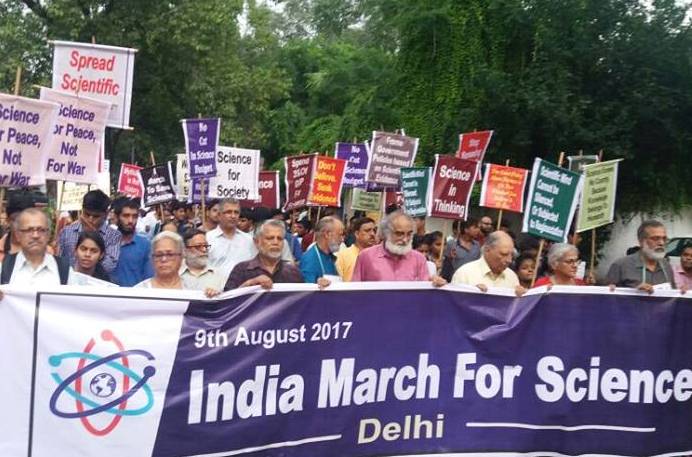
India March for Science

These are scary times for those who practice science in this country. An immediate letter of protest by India’s scientific community has challenged the minister’s anti-science blabber saying: “Statements such as ‘humans did / did not evolve from monkeys’ is an overly simplistic and misleading representation of evolution. There is plentiful and undeniable scientific evidence to the fact that humans and the other great apes and monkeys had a common ancestor.” The letter is in the right direction. So was ‘India March for Science‘ in 2017, though the country’s scientists had joined the global call belatedly.

Scotching pseudoscience and irrational thoughts is at one level, tackling the menace on a case-by-case basis with a letter of protest here or a march of solidarity there. But eradicating anti-science may need a deeper combing operation where scientists, science communicators and India’s science administration come together to make a bigger noise, a bigger dent.

How haldi and litchi cooked up a storm

[Reproduced with permission from Hindu Business Line, column ‘Science and Sensibility’. Published: 1 March 2017]

Under the lens

Subhra Priyadarshini

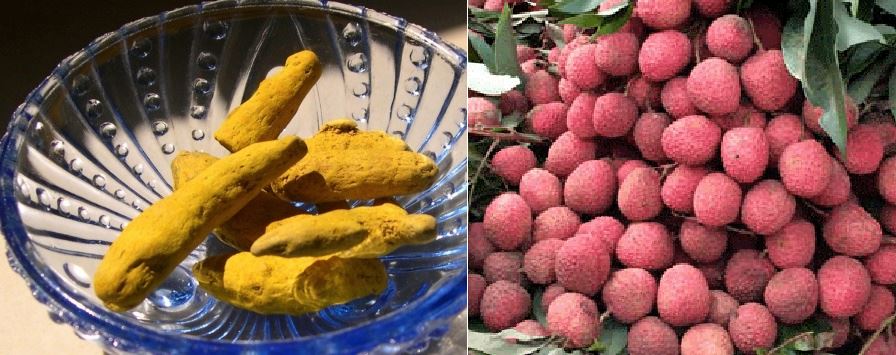
Two stories, both involving American and Indian scientists, have renewed discussions on scientific rigour and ethics. The stories veer around two of our beloved things — haldi (turmeric) and litchi.

The substance that gives haldi its bright yellow hue — curcumin — has been a hot favourite of Indian scientists. They have found innumerable virtues of curcumin — anti-inflammatory, anti-malarial, anti-cancer and, most recently, as a piggyback on nanofibres to regenerate bone tissues.

Two of India's favourite things.

Two of India’s favourite things.

When some American scientists debunked the medicinal value of curcumin in a reputed international journal recently, they stirred up a hornet’s nest back home. The article concluded that there was no evidence, whatsoever, of the therapeutic benefits of curcumin and that it wasn’t worth wasting one’s energy and money on researching it to find a new drug.

India’s scientists have taken exception to this, considering that over 10,000 papers have been published and more than 120 clinical trials using curcumin are in various stages of completion. Yes, curcumin may not make for a classical drug going strictly by the tenets of medicinal chemistry, but it certainly qualifies as an ‘adjunct drug’ to treat some infectious diseases. The contention is: summarily dismissing curcumin research as wasteful would be like throwing the baby out with the bath water. And that would bury a lot of remarkable science around the fragrant, yellow spice.

So, even as the dispute over curcumin’s candidature as a good research subject ensues, people across the world will continue to explore the benefits of ‘golden milk’. And Indian homes will continue to take any criticism of haldi with a pinch of salt.

Another controversy erupted around a red-peeled, juicy fruit that instantly transports one to the lazy summer afternoons of our childhoods. Litchis, you could gorge on them all afternoon. And most times, you skipped dinner afterwards brimming over with its sweet richness. Turns out, this innocent fruit-hogging and then not eating an evening meal, could be fatal. It kills a lot of children in Muzaffarpur region of Bihar, the litchi capital of India.

Scientists have been trying to fathom the cause of a mystery seasonal neurological disease outbreak in the region for years now. And some of them recently made a stunning revelation in Lancet: litchi fruits are laden with naturally occurring toxins — hypoglycin A and methylenecyclopropylglycine — that could actually trigger low glucose levels and metabolic derangement among children. Ironic, considering that litchi oozes sugar. The toxins embedded in the fruit apparently reverse all its sugariness.

But where’s the controversy? The dispute began when a set of scientists led by T Jacob John, a virologist earlier with the Christian Medical College Vellore, alleged that the Lancet study did not follow a basic ethical practice in science: acknowledging similar previous findings by his team. John and co-researcher Mukul Das called it ‘scientific misconduct’. Their contention: the Indo-US research group had failed to acknowledge somewhat similar results from 2014 — an act considered grossly unethical in science. True to its reputation, Lancet swung into action to figure out what went wrong in this case.

And that’s how the humble litchi taught our scientists a lesson in ethics.

India deadliest country for environment journalists: RSF

Doesn’t look like great times to be an environment journalist in India.

More than 3000 environment journalists from across the world have spent sleepless nights over the last 10 days to cover the Paris climate talks (or the 21st Conference of Parties — COP21) concluding today. However, excesses of a different kind threaten their peers elsewhere, according to a new report released by Paris-based body Reporters Sans Frontieres (RSF or Reporter Without Borders).

India has emerged as the deadliest country for environment journalists, according to a global investigation by RSF, with at least two inquisitive reporters in the Asian nation being murdered in 2015 and many others harassed, threatened and subjected to physical violence. Closely following is Cambodia, where one reporter was killed in 2014.

New Picture

Source: RSF

Jagendra Singh, a freelancer for Hindi-language papers for more than 15 years, died from burn injuries in Uttar Pradesh state after he posted an article on Facebook accusing a government minister of involvement in illegal mining and land seizures. Sandeep Kothari, another Hindi language reporter, was found dead in neighbouring Madhya Pradesh. Police said local organized crime members had pressured him to stop investigating illegal mining.

Ten environment reporters have been murdered since 2010, according to RSF’s tally. In the past five years, almost all (90 percent) of the murders of environmental journalists have been in South Asia (India) and Southeast Asia (Cambodia, Philippines and Indonesia.) The one exception is Russia. Mikhail Beketov, the editor of Khimkinskaya Pravda, a local paper based in the Moscow suburb of Khimki succumbed in April 2013 to the injuries he sustained in November 2008 while campaigning against the construction of a motorway through Khimki forest.

The RSF report points out that journalists who cover environmental issues live in a dangerous climate and are exposed to potentially devastating forces. “We are not talking about nature’s hurricanes, squalls, downpours or lightning,” says Christophe Deloire, RSF Secretary-General. At the intersection of political, economic, cultural and sometimes criminal interests, the environment is a highly sensitive subject, and those who shed light on pollution or any kind of planetary degradation often get into serious trouble, Deloire said in the report.

The situation of environmental reporters has worsened in many countries since 2009, when RSF conducted the first global study on the issue. Environment stories range from global warming to deforestation, the exploitation of natural resources, pollution – issues that often involve more than just protection of the environment, especially when they shed light on the illegal activities of industrial groups, local organized crime and even government officials. Environment reporters are often pitted against very strong lobbies and end up paying a high price for their journalistic pursuits. RSF says, like political and business reporters, many environmental reporters acknowledge being approached by companies trying to bribe them.

RSF notes that forming peer associations to protect themselves would be a better way of dealing with these atrocities instead of fighting lonely battles against mighty corporations, corrupt politicians and mafia groups.

Patent fiasco

This week seems to be the ‘patent fiasco’ week for India.

To grant or not{credit}Getty{/credit}

First up was a media report alleging that a top GM food crop scientist made false claims about his patents just to get a national award. The scientist in question — Kailash Bansal – claimed to have filed three patents for new gene discoveries in crops. On the basis of the claims, he was selected for a national award for outstanding research in transgenic crops for the year 2007-2008.  However, it turns out that he had not applied for any patent even till July 2009, when he got the award.

The report goes on to provide proof of this goof up by citing data obtained from a ‘Right to Information’ (RTI) query as well as through sources from the patent application committee of the scientist’s institute, which had no clue of the applications till the award citation mention them. When the committee quizzed Bansal on this, he provided a patent application number filed in August 2009.

The scientist, subsequently designated director of India’s plant gene bank despite these false claims, continues to hold the award.

The question that the case raises is whether such misconduct by senior scientists will continue to be pushed under the carpet or will the Indian Council of Agricultural Research – the coveted research body that employs the scientist in question – respond to the allegations and hold him accountable.

In another significant development, India revoked a patent on a herbal medicine to treat diabetes. The government withdrew a patent given to drug maker Avesthagen on its diabetes drug made out of extracts from locally available plant parts. The reason: the extracts are known to be integral parts of the Ayurvedic, Unani and Siddha systems of medicine.

The move is being seen as the first step towards scrapping of many similar patents on medicines made out of commonly used plants and fruits such as amla, methi, karela and ashwagandha on grounds that they are part of traditional knowledge, something that India has begun to protect fiercely.

Coincidentally, Wired magazine started a series this week, analysing what is wrong with the patent systems and trying to find solutions to fix them. It would be great to follow the discussions over the coming weeks to see what lessons India can take home.

Race defense

University of Connecticut Health Center researcher Dipak Das found guilty of fabrication and falsification of data has raised the ‘Indian therefore harassed’ card heard so many times in the past in western scientific circles.

Dipak Das

The researcher who worked on the health benefits of a chemical in red wine fabricated data in 145 separate research projects, a three-year investigation by the university has found. University officials have notified 11 scientific journal studies co-authored by Dipak Das of the fraud. The Jadavpur University alumnus, whose work focused on the grape skin antioxidant resveratrol, responded to the inquiry in a 2010 letter saying it was a “conspiracy against Indian scientists”.

“Careful examination of these papers (the inquiry report) would result in a striking feature. All the accused authors are of INDIAN ORIGIN…it is an entirely racial issue – war against Indian community and unfortunately I am also an Indian,” he said in a lengthy response to the inquiry defending himself and his Indian co-authors.

Now, why does this sound familiar? Why is it that falling back upon the ‘racial’ defense is the first response of many researchers found guilty of  misconduct. We discussed the feeling of ‘third world alienation’ in another blog post earlier and got some pertinent responses.

It would be good to hear from our readers — based on their analysis of the charges by the University of Connecticut and the defense provided by Das — as to whether they think the racial card is played with or without much substance in many such cases. What’s your view of the whole issue as a case study in this regard?