Pre-Columbian fossil collectors unearthed

Excavation pit houses at the Harris Archaeological Site in southwestern New Mexico.{credit}L.W. Falvey and B. McLaurin{/credit}

Posted on behalf of Sid Perkins.

Native Americans that lived in the Mimbres Valley of southwestern New Mexico more than a millennium ago are well known for their distinctive pottery, but now they may have a new claim to fame. They collected fossils — apparently for ritual use in their homes, and probably from a site dozens of kilometres from their village.

Lauren Falvey, an archaeologist at the University of Nevada, Las Vegas, and her colleagues have excavated more than a dozen of the ‘pit houses’ found at the Harris Archaeological Site located just east of the town of Georgetown. These structures, each about the size of a bedroom in a modern-day American home, were made by digging a 2-metre-deep pit and then lining the wall with adobe bricks. The home’s roof was supported by wooden posts placed at intervals around the inner edge of the pit. Residents entered the homes via a ramp dug into one wall of the pit. Homes were occupied for several decades before residents demolished them and built new homes nearby. The abandoned pits were then used as trash dumps, says Falvey. Previous studies suggest that the pit houses excavated by Falvey and her colleagues were built between 850 and 1000 AD.

One day, while digging out one of the village’s homes, Falvey, who also has a keen interest in palaeontology, noticed fossils in the rubble that didn’t match the stones or other material used to make the adobe walls. Besides appearing in limestone hand tools found at the site, 25 individual fossils — including a wide variety of marine creatures, such as corals, and shelled creatures, such as brachiopods — have been recovered from 14 of the 19 homes excavated thus far. The fossils, which came from limestone dating to between 318 million and 385 million years ago, stood out because they didn’t come from the rocks immediately surrounding the village, says Falvey.

Several of the fossils were found within the collapsed adobe walls of a pit house, sometimes alongside other objects believed to have ritual importance, such as crystals and bits of turquoise. These objects — but no fossils as of yet, says Falvey — have sometimes been found at the bottom of postholes. The intentional placement of such objects during the home’s construction may have been somewhat like embedding a lucky coin in the foundation of a new home today.

Although outcrops of limestone that once entombed the fossils are located within 4 kilometres of the Harris Archaeological Site, several clues hint that the fossils actually came from Cookes Peak, a mountain 43 kilometres away that was apparently revered by the people of the village. For one thing, says Falvey, all of the ramps leading out of the pit houses point towards the mountain, an orientation that ensures that residents departing their homes get a clear view of the distant peak. Also, she notes, rock carvings found on Cookes Peak suggest that the Mimbres people conducted rituals or ceremonies there. Detailed geochemical analyses of the fossils could help to determine where the fossils were originally collected, she notes.

Finding fossils at archaeological sites in the American Southwest is unusual, say Falvey and Brett McLaurin, a geologist at Bloomsburg University of Pennsylvania and senior co-author of the GSA presentation. Nevertheless, Falvey notes, researchers excavating other sites — especially those without a background or interest in palaeontology — may not have not reported any such finds simply because they didn’t recognize the anomalous provenance, and therefore the ritual significance, of any fossils they had unearthed.

Correction: An earlier version of this blog post incorrectly stated that some of the fossils were found at the bottom of postholes.

The tale of the tail: measuring dinosaurs is tough when bones are missing

{credit}Photo courtesy of debaird™ via Flickr under Creative Commons{/credit}

Posted on behalf of Ed Yong.

Travel down the body of a dinosaur, and our knowledge of its anatomy tails away past its hips. As Dave Hone from University College Dublin has discovered, the vast majority of dinosaur skeletons, even many that have been deemed ‘complete’, are missing parts of their tails.

These lost bones are important because tails are included in estimates of dinosaur length, which are often quoted, and sometimes used to estimate mass. “A fairly simple question of ‘How long in total was this dinosaur?’ could be really quite tricky to answer for a very good number of species,” says Hone, writing in his Guardian blog. If tails are telling tall tales, other important measures could be inaccurate.

Hone did a painstaking search for complete tails among the scientific literature, more than a dozen museums, photos and his colleagues’ memories. His search came up largely empty. Even many of the best-preserved fossils, which have feathers and skin imprints, have only partial tails.

“Despite having thousands of dinosaur fossils, including a good few hundred that could broadly be considered complete, we’ve got barely two dozen complete tails,” he says. His results are published this week in the Journal of Vertebrate Paleontology. Continue reading

Neanderthal sex debate highlights benefits of pre-publication — UPDATED

{credit}Wikimedia Commons{/credit}

An argument over sex that has been going on for more than a year is finally seeing the light of day. Today, scientists at the University of Cambridge, UK, and Harvard Medical School in Boston, Massachusetts, let the world in on a long-running discussion over whether or not humans and Neanderthals really interbred — and how you go about proving it.

I’ll get to the sex. But this debate underscores a topic I wrote about last month (see ‘Geneticists eye the potential of ArXiv‘) that noted that high-profile papers from population geneticists are beginning to appear on the preprint server, once the domain just of theoretical physicists. That story is relevant because a new paper, entitled ‘The date of interbreeding between Neandertals and modern humans’, was posted to ArXiv on Friday. Meanwhile, a second paper raising doubts about human-Neanderthal hanky-panky appears in the Proceedings of the National Academy of Sciences (PNAS) today.

Both papers were presented at conferences more than a year ago. Their publication today raises the question of whether this debate would have been more timely if it had occurred on preprint servers such as ArXiv.org and not at specialist conferences and behind the walls of peer review.

Continue reading

Updated: US Justice Department calls for return of tarbosaur fossil

A nearly complete tarbosaur fossil that sold for more than US$1 million was illegally smuggled out of Mongolia, claims a US Department of Justice (DOJ) civil complaint seeking the fossil’s return. The complaint was filed 18 June in a Manhattan federal court.

The sale of the Tyrannosaurus bataar fossil by Texas-based Heritage Auctions sparked widespread condemnation from palaeontologists, who questioned the company’s claim that the fossil was legally imported from China.

“Though these fossils could potentially be found in adjacent regions of the Gobi Desert of China, no specimens of this quality have been discovered there; and even if these fossils were originally found in China, their collection and export is still illegal,” said Philip Currie, president of the Bethesda, Maryland-based Society of Vertebrate Paleontology, in a 23 May statement on the case.

A Texas court issued a temporary restraining order on 19 May, requested by the Mongolian government, blocking sale or transfer of the fossil. Heritage went ahead with the auction on 20 May, which garnered nearly $1.1 million. Heritage has agreed not to complete the sale, pending conclusion of the Mongolian government’s case, and the fossil is being stored in New York (see a revised temporary restraining order updated after the sale here). Continue reading

Complete Denisovan genome offers glimpse of ancient variation

Posted on behalf of Katherine Rowland.

From the fragment of a finger bone found in a Siberian cave, researchers have created the most accurate genetic map yet of an extinct human relative that, before 2010, was not known to exist.

Thanks to innovations in gene-sequencing technology, molecular geneticist Svante Pääbo and his colleagues at the Max Planck Institute of Evolutionary Anthropology in Leipzig, Germany, and his colleagues have improved their genetic picture of the Denisovans, mapping every position of the genome 30 times over, with an unprecedented level of resolution. “Now we can look at variation,” says Pääbo. “We have a complete catalogue of what makes a fully modern human.”

Yesterday, the researchers released the complete DNA sequence online, with the hopes that the scientific community will start to answer some of the many questions raised by the discovery of this mysterious hominid.

Named after the cave in which the fragment was found (pictured), the Denisovans — pronounced dun-EE-suh-vinz — inhabited Asia at least 30,000 years ago, leaving behind no more than a tiny piece of finger and a wisdom tooth.

But from those scant remains, researchers have been able to map the entire genome. In 2010, the Leipzig team presented their first-draft genome, suggesting that the Denisovans are distinct from the Neanderthals and early modern humans in Eurasia (see ‘Fossil genome reveals ancestral link‘).

But where the preliminary sequence raised a host of questions, the newly released data may begin to provide some answers about who the Denisovans were. The improved resolution allows researchers to spot the differences between gene copies inherited from the mother and from the father.

Richard Edward Green, a biomolecular engineer at the University of California, Santa Cruz, who led the original gene sequencing, says that the new information provides a window into the population genetics of this species. “It’s pretty powerful,” he says of the technologies that transform a fingertip into an evolutionary record. “Every spot on the genome has a unique evolutionary history, and we can now draw comparisons and identify where there were common ancestors.”

Image © MPI for Evolutionary Anthropology

The sweet song of a Jurassic cricket

Posted on behalf of Dan Jones.

The fossilized remains of long-extinct animals provide clear evidence of their size, stature and gait, but can we ever know what they sounded like? A reconstruction of the song sung by a fossilized katydid that lived 165 million years ago shows how it can be done. The results are published in the Proceedings of the National Academy of Sciences (PNAS).

Like other crickets, male katydids (also known as bush crickets) sing to females through a technique called stridulation, in which noise is generated by rubbing a thick, ridged vein (called a file) on one wing against a ‘scraper’ on another. The length of the file, and the speed with which it is dragged over the scraper, determines the frequency of the noise it generates. The fossil katydid in the new study, dubbed Archaboilus musicus and described in the PNAS paper for first time, is exceptionally well preserved for such an old specimen, allowing for detailed measurements of the sound-making file.

The shape and structure of the file determines whether a katydid creates a pure (musical) tone of a single frequency, or ‘elaborate noise’ that ranges over a broad bandwidth of frequencies. The A. musicus fossil suggests it produced a pure, musical tone.

To predict the frequency of the tone A. musicus emitted, the team first plotted the lengths of files from nearly 60 living species of katydid against the frequency of sound they produce, showing that shorter files tend to create a lower-frequency sound. Next, this model was validated by showing that it could accurately predict the songs known to be sung by two living katydid species most closely related to A. musicus. Then it was simply a matter of seeing where A. musicus fell on this graph, and estimating the frequency of its song.

This analysis suggests that A. musicus produced a relatively low and pure tone of around 6.4 kHz (you can hear a reconstruction of the song in the video above). The team says this low tone would have been well-suited to communicating over long distances and close to the ground in the sparse vegetation of Jurassic forests. In particular, females could have picked out this pure tone above the rabble created by other creatures in the area, says Fernando Montealegre Zapata of Bristol University, UK, who is a co-author on the paper. The next challenge, he says, is to work out why the low, pure tones of early katydids evolved into the variety of higher-frequency songs and non-pure tones that are heard among katydid species living today.

Chilean desert yields trove of whale fossils

whalefoss.jpg

Posted on behalf of Patricio Segura.

In Chile’s Atacama Desert, the driest in the world, a team of researchers from institutions in Chile, Brazil and the United States has found more than 80 exquisitely preserved whale fossils.

The finds, made near the northern city of Caldera, are just the first from what promises to be one of the largest and most diverse paleontological troves of its kind. First indications are that the fossils are 7 million years old.

The site is remarkable for the concentration and quality of specimens, and for their diversity, says team member Nicholas Pyenson, curator of fossil marine mammals at the Smithsonian Institution in Washington DC. The fossils include adult and juvenile baleen whales, a walrus-whale, an extinct species of sperm whale, and possibly a seal or sealion.

As well as pinning down the fossils’ age, the team excavating the site is trying to work out why it contains so many whales, with a view to determining how they died.

The researchers are also studying the site’s geology, says Pyenson. “We wish to understand the environment in which the remains of these marine mammals were preserved, and we also wish to understand the processes of disarticulation and decay that has preserved their bones,” he says.

In 2010 a construction company working on a highway, under the supervision of researchers from the Palaeontological Museum of Caldera, found a high concentration of baleen whale skeletons. Amazed by the findings, researchers began excavating the site, which is about 20 m wide and 240 m long.

The road builder’s schedule means that palaeontological work must be completed by December 2011

Pyenson and his colleagues are working to document the fossils while they are still in the ground, using scanners to take images from which three-dimensional digital models can be constructed. He hopes that online digital images of the fossil whales, in the conditions in which they were found in the field, will be made available, and that other museums will be able to make replicas of the skeletons.

Even though the road builders will soon get the original site back, the researchers believe they will find more fossils nearby.

Image courtesy of Felipe Infante/Chilean National Museum of Natural History.

Who were Europe’s first humans?

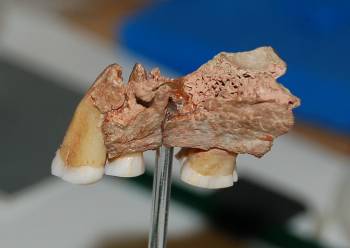
kents400.jpgSeveral sets of teeth suggest that ancient humans roamed Europe thousands of years earlier than previously thought.
A jawbone and its teeth discovered in a South England cave, Kent’s Cavern, in 1927 is more than 41,000 years old, suggests new dates linked to animal remains in the same cave. Meanwhile, two teeth excavated from a southern Italian site, Grotta del Cavallo, in the 1960s and attributed to Neanderthals may instead belong to modern humans. At 43,000 to 45,000 years old, they are the oldest anatomically modern human remains identified in Europe.

Together the two new studies (which are published online today in Nature) emphasize how much archaeologists have to learn about early human forays into Europe. Instead of making a single trek from Africa and the Middle East into Eastern Europe and then striking north and west, the first humans to reach Europe may have expanded in bursts, says Chris Stringer, a paleoanthropologist at the Natural History Museum in London who was involved in the Kent’s Cavern paper. Brief warm spells would have pushed the hunter-gatherers into new territory. “They followed their food,” he suggested at a press briefing this morning.

Continue reading

The shrinking effects of climate change

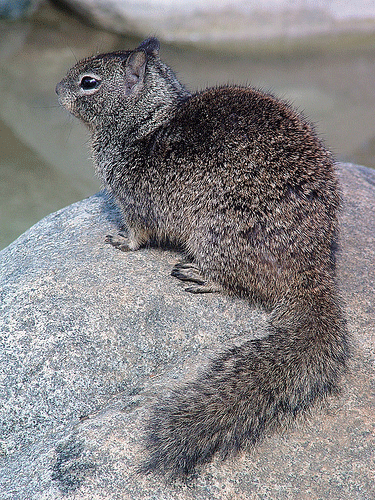
3280023185_0f14b48a1d_sm.gifDespite the claims of a few grandstanders, it’s clear that our planet’s thermostat is dialing up. Some plants and animals have already responded to this change by modifying their distributions away from the Equator, towards the cooler poles, and by shifting the timing of their breeding or flowering cycles. But beyond their location and behaviours, the physical stature of some organisms is also affected by climate change — which could play havoc with ecosystems and even global food security.
The more we can predict and prepare for such changes, the better we will be able to mitigate their effects, argue Jennifer Sheridan of the University of Alabama in Tuscaloosa and David Bickford of the National University of Singapore. In a Perspective published today in Nature Climate Change, the conservation biologists outline the evidence for past and present downsizing of organisms in response to warming environments and how these changes could affect ecosystems as well as human health.

Fossil evidence suggests that over the last 65 million years or so, organisms ranging from diatoms to ground squirrels have shrunk when the Earth has warmed. Similarly, over the past century, various plant species, and land and ocean animals have scaled down as temperatures increased. The trend holds up in experimentally controlled environments as well — a variety of plants and their fruits shrink as temperatures grow, as do fish, beetles, marine invertebrates and salamanders.

For cold-blooded organisms, whose internal temperatures are inherently connected to the environment, higher temperatures could lead to a higher metabolic rate, say the authors. Unless these animals can compensate with more food or limited activity, it’s possible that their revved up metabolism would lead to quicker development and shrinking body sizes.

Continue reading

Stunningly intact dinosaur fossil found in Germany

Posted on behalf of Marian Turner.

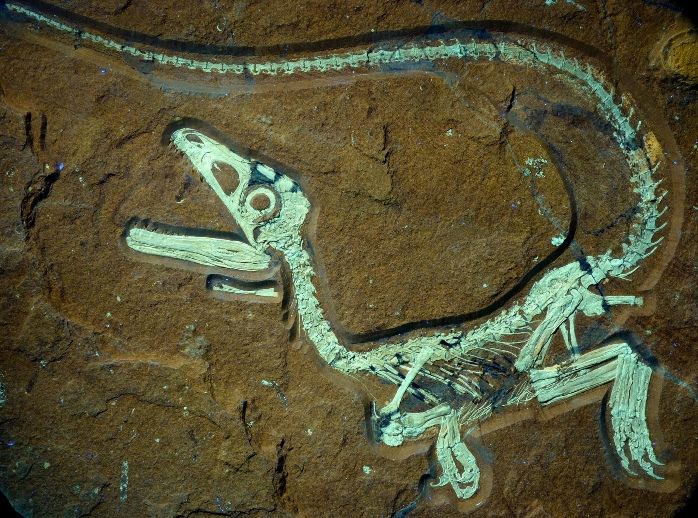
The almost perfectly complete fossil of a young theropod dinosaur – including some preserved hair and skin* (see update below) – was unveiled yesterday by scientists from the Bavarian paleontological and geological collections (BSPG) in Munich, Germany. BSPG conservator Oliver Rauhut described it as the best preserved dinosaur skeleton to have ever been found in Europe.

german dinosaur.jpg

Darren Naish, palaeontologist at the University of Southampton, says the fossil is “incredible”. Rauhut says that fossils of theropod dinosaurs, which include the genus Tyrannosaurus, are rare and usually fragmented. “The best-preserved Tyrannosaurus we have are about 80 percent preserved, and that is already terrific,” he says. The new fossil is around 98% intact.

Continue reading