Physicists defend Big Bang wave announcement

Cosmic swirls that were hailed earlier this year as evidence for primordial gravitational waves – ripples in spacetime dating back to the early universe – may turn out to have been caused by dust. But several top physicists are standing by the decision to announce the result back in March, before it had been peer-reviewed.

“I think it’s important to give it at the same time to the scientific community as to the general public,” said Rolf Dieter-Heuer, the director general of Europe’s particle physics Laboratory, CERN.  “We did the same two years ago when we announced the discovery of the Higgs boson.” Not a member of  the BICEP2 team that made the original claim, Dieter-Heuer was speaking to journalists at the International Conference on High Energy Physics (ICHEP) in Valencia, Spain.

When the BICEP2 team first reported that their telescope in the South Pole had detected twists in the polarization of relic light from the Big Bang, known as the cosmic microwave background, the results  seemed to confirm that the baby Universe underwent a period of rapid expansion, a theory known as inflation. But since then, the finding has been scrutinised and challenged by physicists who raised the possibility that grains of dust in the Milky Way – rather than gravitational waves – created the swirling polarization pattern. That culminated in the team last month scaling back their claims when publishing in the peer-reviewed journal Physical Review Letters1

It is something that the European Space Agency’s Planck telescope has the power to answer, said Enrique Martinez, a physicist at the Institute of Physics of Cantabria and a member of the Planck collaboration. He too was speaking at ICHEP, in a huge auditorium packed with delegates who had gathered in the hopes of some resolution on the BICEP2 result. But his talk failed to satisfy the expectant crowd.

Instead he promised that Planck would release results for the part of the sky relevant to the findings within a month, followed by its full dataset in October. He also confirmed that the Planck and BICEP2 teams were in the final stages of forming an agreement to collaborate on a joint, but separate, analysis.

Was BICEP2’s March announcement premature? Speaking alongside Dieter-Heuer, Alan Guth, the cosmologist who first proposed the inflation concept in 1980, said the team’s decision to speak to the press, which they did at the same time as posting a paper to the pre-print server ArXiv, was a natural one to take. “The press wants to know, the referring process is slow, and meanwhile the scientific community would probably find out anyway,” he said.

However, there should have been more caveats and cautionary remarks, he said: “It was almost presented if there was no way the experiment could not be interpreted as they interpreted it to be. When others came to look at it, that seemed no longer to be the case.”

In a talk in which he represented the BICEP2 collaboration, Roger O’Brient, a physicist at Caltech’s Jet Propulsion Laboratory, stressed the effort his team had taken to distinguish the signal from the dust or other causes of polarization. “We actually thought through this for about a year and a half before we published,” he said.

Afterwards, O’Brient told Nature that releasing the paper publicly had actually been good for science, as it had spurred others, sometimes from surprising areas of the scientific community, to examine the results.  “It’s not clear to me that the peer review process on its own in a vacuum would have necessarily caught issues.”

Guth is not giving up on BICEP2. During another talk at the conference, he said there was “reasonable hope” the signal would turn out to be the long sought after gravitational waves. However he also stressed that if the signal turns to dust, it would not cause any problems for his theory – other than from a public relations perspective. “If it turns out to be all dust, that’s not a mark against inflation,” he said.
NASA launches carbon-monitoring satellite

oco20140702-640

{credit}NASA/JPL-Caltech{/credit}

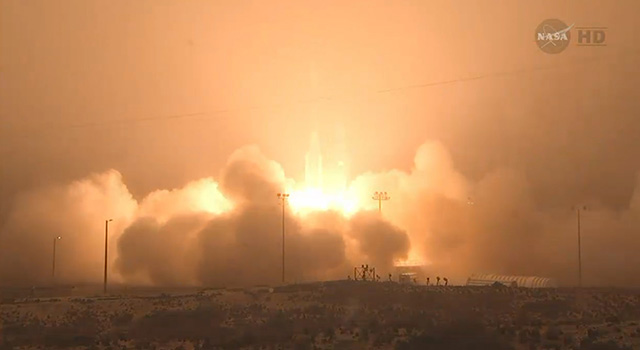
NASA has launched its first probe dedicated to mapping the distribution of carbon dioxide in the atmosphere, the agency announced today. The US$465-million Orbiting Carbon Observatory-2 lifted off just before 3 AM local time (11 AM British Summer Time) from Vandenberg Air Force Base in California, after a 1-day delay caused by technical issues with the launchpad.

That is a relief for the US space agency, which tried — and failed — to launch a nearly identical CO2-monitoring probe, the original Orbiting Carbon Observatory (OCO), in 2009. The crash, blamed on a faulty launch vehicle, devastated researchers who had spent years preparing to analyse what would have been some of the first space-borne measurements of atmospheric CO2. “The complete loss of the original OCO mission was heartbreak,” NASA’s OCO-2 project manager, Ralph Basilio, said at a 12 June briefing.

But all hope was not lost: in the wake of the OCO’s failure, the Japan Aerospace Exploration Agency agreed to share the data from its CO2-tracking satellite — GOSAT, launched in January 2009 — with the OCO science team. That helped NASA to test the algorithms that it will use to process and interpret data from OCO-2. “The partnership that we have had with the Japanese has been exceptional,” says Paul Wennberg, an atmospheric scientist at the California Institute of Technology in Pasadena. Wennberg has contributed to developing a network of ground-monitoring stations that have validated GOSAT’s data and will do the same for OCO-2.

If everything goes according to plan, data from the US probe will help researchers track large natural sources and sinks of CO2, such as oceans and forests, and perhaps some manmade sources, such as sprawling urban areas or even large power plants.

From its orbit 705 kilometres above Earth’s surface, OCO-2 will peer down into the atmosphere with a spectrometer, monitoring the level of CO2 in the atmosphere by detecting sunlight reflected by molecules of the greenhouse gas. Each measurement covers a column of air from the satellite to Earth’s surface, with a footprint of roughly 3 square kilometres — much smaller than GOSAT’s 85-square-kilometre footprint.  And the satellite will also spy on plants’ carbon uptake by measuring the weak fluorescence that is produced by chlorophyll during photosynthesis.


NASA finds asteroids to visit but may lose an important tool for studying them

NASA’s controversial plan to capture an asteroid and study it is facing a challenge beyond the obvious technical feat: the potential shuttering of the Spitzer Space Telescope, whose observations can help calculate an asteroid’s size.

The Spitzer telescope’s ability to observe in infrared light is potentially crucial. Doing so allows it to measure absolute brightness, which tracks directly with asteroid size. Images taken in visible light can’t reveal the true dimensions of an asteroid, because a highly reflective rock might appear to be larger than it actually is. And NASA needs to accurately know the size of an asteroid before sending a spacecraft there.

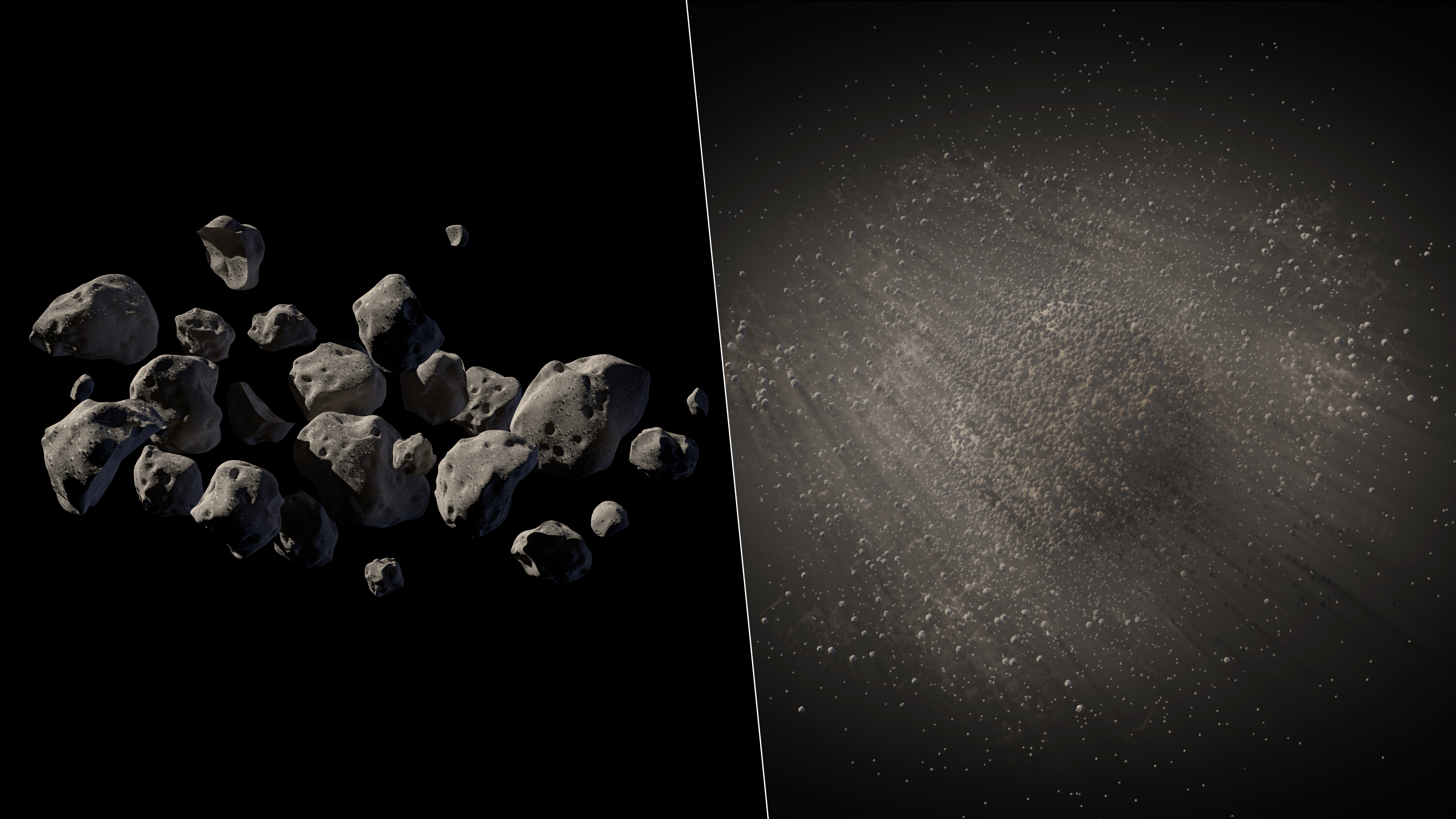
An artist's representation of asteroid 2011 MD suggest that it could be a pile of small rocks (left) or a single rock surrounded by dust particles (right).

An artist’s representation of asteroid 2011 MD suggest that it could be a pile of small rocks (left) or a single rock surrounded by dust particles (right).{credit}NASA{/credit}

But the agency’s astrophysics division, facing tight budgets, has proposed turning off Spitzer next year. It scored lowest in a recent ‘senior review’ of all the astrophysics missions the agency is trying to keep operating.

“We have to look at other ways to fund operations of Spitzer,” said Lindley Johnson, near-Earth object programme manager at the Johnson Space Center in Houston, Texas, during a 19 June update of the asteroid mission. The telescope costs about US$17 million a year to operate. NASA is exploring several possible scenarios, Johnson said, including running Spitzer only part of the time or getting extra money from other institutions or funding sources.

The other big challenge is to find the right space rock to visit. Two possible projects are on the table: grab a single small asteroid, or fly to the surface of a large asteroid and grab a boulder. In both cases, the sample would be dragged near the Moon, where astronauts could visit it for close-up study.

NASA currently has six asteroids on its short list — three of the single small variety, and three that are on the order of 100–500 metres across, large enough to have boulders on their surfaces that could be retrieved.

The small-rock option includes 2011 MD, an asteroid about 6 metres across that zipped past Earth three years ago. Its orbit is very similar to that of Earth, but it travels more slowly. Over time, 2011 MD falls behind and is no longer visible from Earth. In February of this year, it passed close to Spitzer.

Spitzer stared at 2011 MD for 20 hours, said David Trilling, an astronomer at Northern Arizona University in Flagstaff. He and his colleagues, led by Michael Mommert, used those observations to calculate the size and then the density of the rock. It turns out to be very porous (about 65% empty space) and about as dense as water. “This object might swim if you put it in a swimming pool,” said Trilling. The work appeared today in Astrophysical Journal Letters. The best time to grab the asteroid would be in 2024, when Earth will again catch up to it.

Candidates for the boulder retrieval attempt include the asteroid Itokawa, which the Japanese spacecraft Hayabusa visited in 2005; one known as 2008 EV5; and Bennu, which the OSIRIS-REx spacecraft aims to visit.

“We are looking to have a fairly large list of potential candidates,” said Johnson. “It won’t be dozens, but it might be ten or so by the time we need to make the decision.”

NASA plans to choose between the small- and large-rock approaches by December, said Michele Gates, programme director for the asteroid redirect mission. It won’t have to pick an actual target until about a year before launch, currently targeted for 2019.

Hubble telescope to search for spacecraft target beyond Pluto

The Hubble Space Telescope has begun searching for an icy world in the outer Solar System that NASA’s New Horizons probe can visit after it flies past Pluto in July 2015.

The awarding of Hubble observing time, announced today, could greatly increase the chances of the mission’s success. The spacecraft was meant to fly first past Pluto and then past another object in the cluster of icy bodies known as the Kuiper belt. But mission scientists have been unable to identify a suitable Kuiper belt object (KBO) using big telescopes on the ground. They needed the space-based vision of Hubble.

“Hubble is coming to the rescue of New Horizons, and we’re very excited about it,” says Alan Stern, principal investigator for the mission and a planetary scientist at the Southwest Research Institute in Boulder, Colorado.

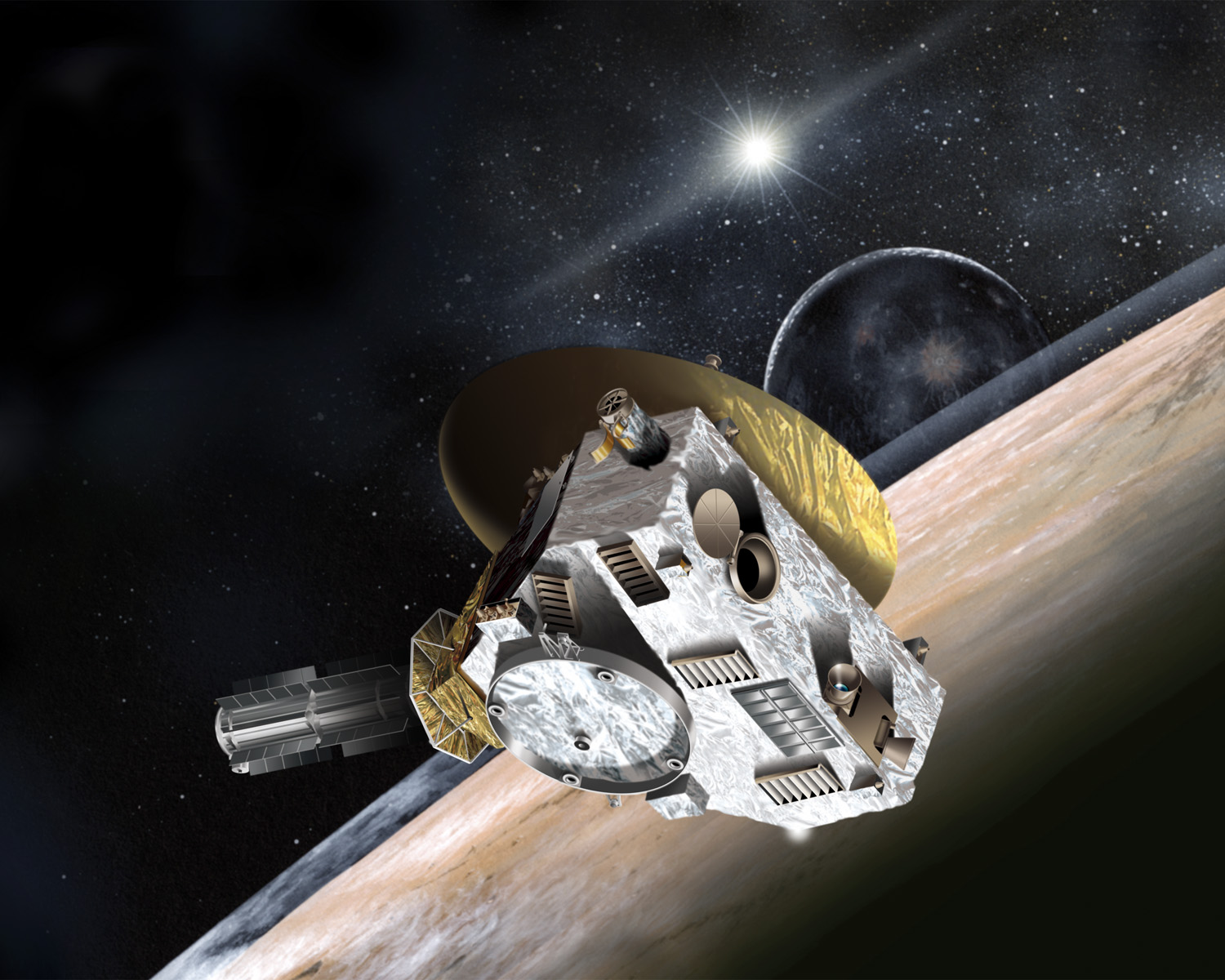
An artist's illustration of the New Horizons spacecraft.

An artist’s illustration of the New Horizons spacecraft.{credit}JHUAPL/SwRI{/credit}

Launched in 2006, New Horizons is currently about nine-tenths of the way to Pluto. Mission planners woke it up yesterday for an extended diagnostic assessment.

NASA has yet to approve funding to fly past a second target after Pluto, but without a candidate KBO the question was moot. The problem has been how to pick out KBOs, which are far away and thus very faint, from the crowded background field of Milky Way stars against which the New Horizons probe is travelling. Mission scientists began their ground-based search in earnest in 2011, but they’ve been stymied by bad weather at observing sites, and the fact, discovered only recently, that that there are actually fewer faint KBOs than one might expect given the number of bright ones. They have discovered more than 50 faint KBOs, but none are in the right region of space for New Horizons to make a close-up visit.

New Horizons has been given an initial allotment of 40 Earth orbits of Hubble observing time, or about 40 hours. If it finds two faint KBOs during that period, then a second observing period of 156 orbits will kick in. The first set of observations is meant to show whether there are enough faint KBOs, statistically speaking, for it to be worth Hubble’s time to continue with the full search. The group that allocates telescope time agreed “that going forward with at least the pilot was a good use of Hubble time,” says Matt Mountain, director of the Space Telescope Science Institute in Baltimore, Maryland.

First observations began over the weekend and the data are already being processed. Time is of the essence because the team must identify at least one KBO target by roughly the end of August to be able to follow its trajectory for at least a year and accurately plan a visit. The probe has limited fuel; mission scientists intend to fire the probe’s thrusters soon after the Pluto flyby next summer in order to accurately set it on a course to visit a KBO.

Ideally, Stern says, the Hubble search will turn up several candidate KBOs that are in the right place for a New Horizons visit. The team will continue to use ground-based telescopes to hunt throughout the year, but they calculate that having Hubble time raises their chances of finding a suitable KBO target from less than 40% to more than 90%.

“This is going to make all the difference,” he says.

Germany pulls back from international mega-telescope project

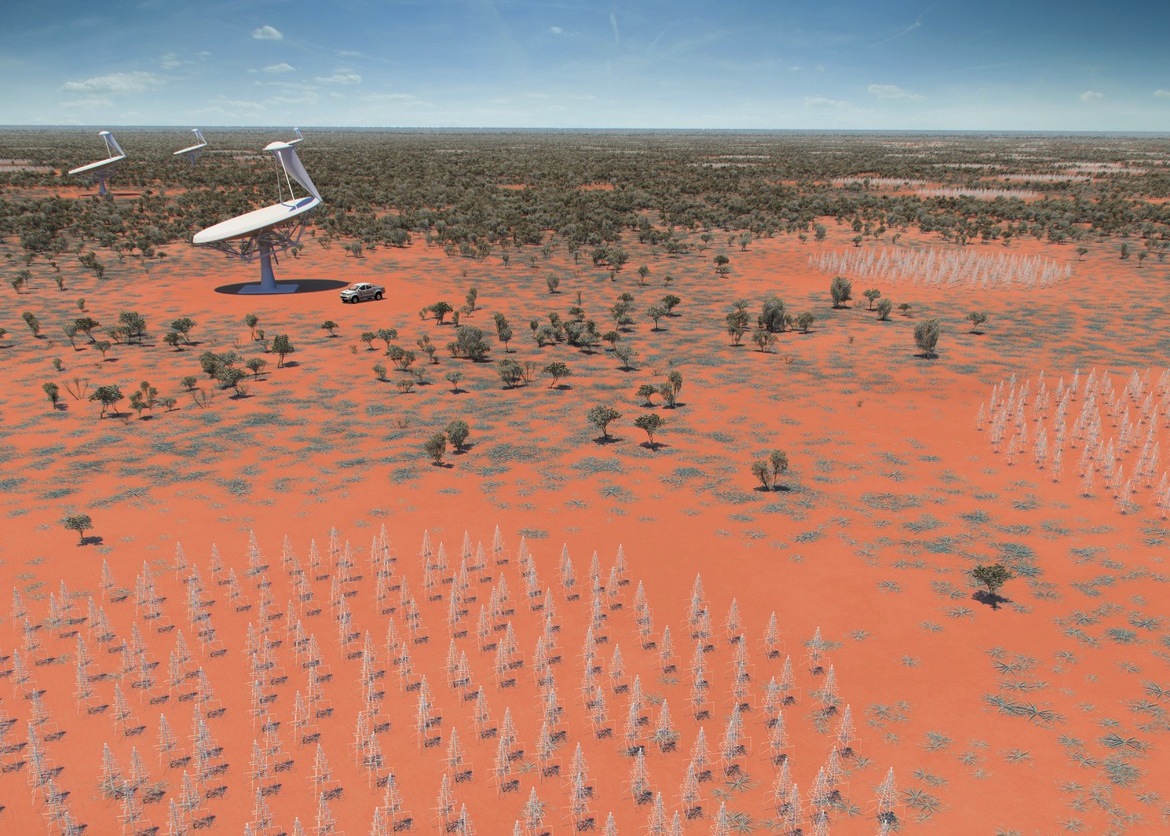
Aus_LF_wideAngle_Ska.screen

Credit: SKA Organisation

Germany’s science funding may look healthy to outsiders, but its research ministry seems to have stretched its cash too thinly. Last week, it decided that helping to fund the world’s biggest radio telescope — to be built in South Africa and Australia by 2024 at a cost of more than €1.5 billion (US$2 billion) — was one international mega-project too many. On 5 June, it said it would pull out of the Square Kilometre Array (SKA), to the dismay of German astronomers, who say that they were not consulted and are hoping to reverse the move.

“It looks like Germany is in danger of derailing one of Africa’s first really big science projects,” says Michael Kramer, the director of the Max Planck Institute for radioastronomy in Bonn. From the SKA’s point of view, however, a loss of German support (which might have amounted to tens of millions of euros to an estimated €650-million first construction phase) would be “disappointing, but not catastrophic”, says Philip Diamond, director-general of the SKA Organization, headquartered in Manchester, UK, which coordinates the efforts of ten supporting nations. Nonetheless, says Diamond, “I and my German colleagues are working hard to do what we can to overturn this decision”.

Continue reading

Comet begins to steam off as Rosetta homes in

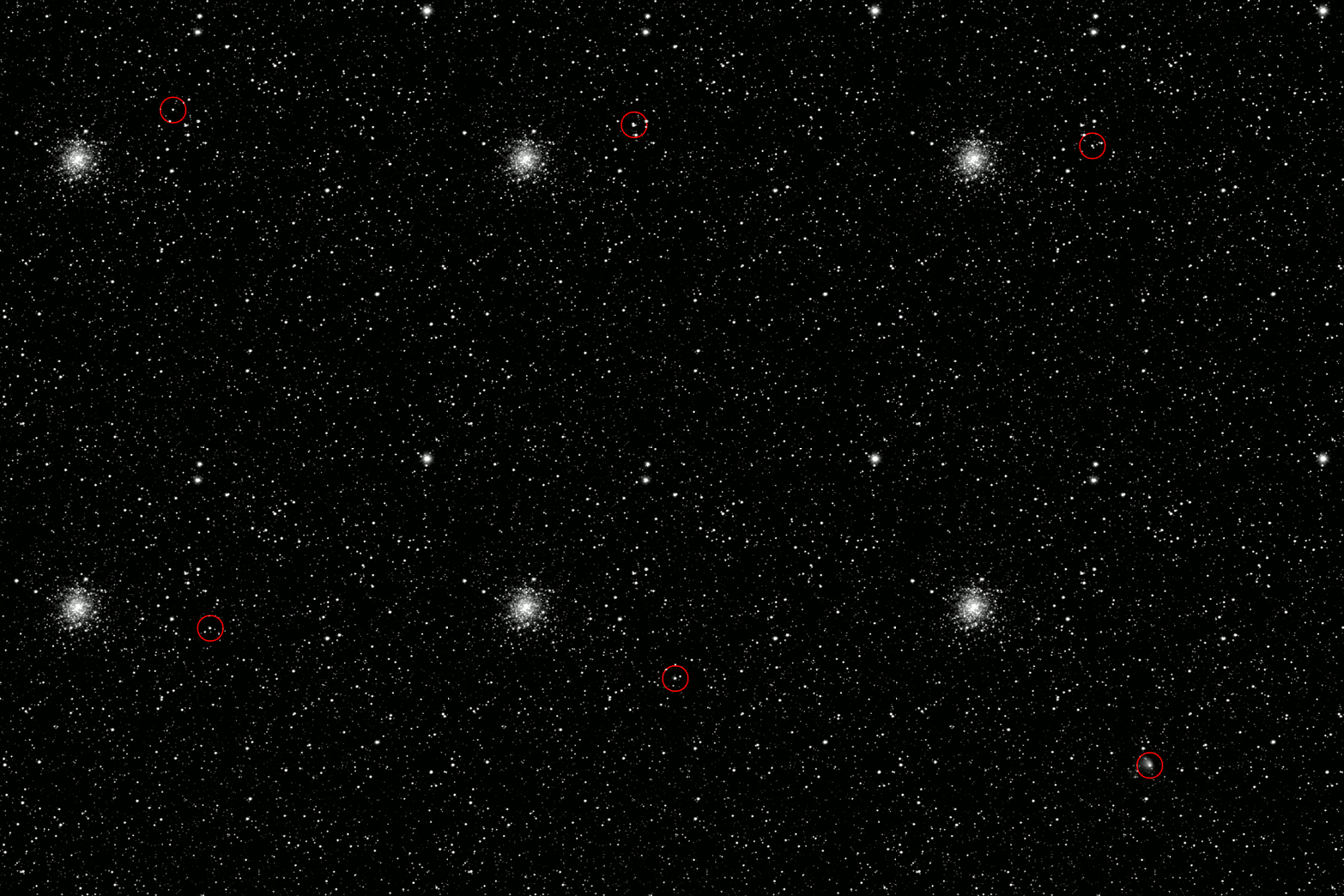
 Comet_develops_a_coma_large

Hurtling through space at thousands of kilometres per hour, the comet-chasing Rosetta spacecraft has photographed its target spewing out gas and dust as both get closer to the Sun.

The €1-billion (US$1.4-billion) European Space Agency spacecraft woke up in January this year after almost three years in hibernation. By August it hopes to catch up with the comet before setting down its lander, Philae, on the surface in November. This will be the first time a soft-landing has been attempted on a comet.

The images from Rosetta’s OSIRIS camera, released by ESA today, show 67P-Churyumov–Gerasimenko increasingly releasing gas and dust over six weeks, from 27 March to 4 May. During that time Rosetta closed the distance to the comet from around 5 million kilometres to 2 million kilometres.

As the Sun heats the comet, surface ice turns into gas. This escapes carrying dust into space, forming the visible ‘coma’. Dust and gas around the comet will increase as it approaches the Sun, eventually forming into a characteristic tail. Rosetta will have to negotiate this cloud as it descends to as low as 1 kilometre from the surface to land Philae.

Relatively little is known about the comet. Rosetta’s 11 science experiments, lander and its 10 instruments have now all been activated and already turned up one surprise – that the comet is rotating every 12.4 hours, a period 20 minutes shorter than previously thought.

Scientists hope that by studying 67P-Churyumov–Gerasimenko and its dust they will learn clues about the Solar System’s early history, as well as whether comets played a role in bringing  water and the basic building blocks of life to Earth.

Moon dust probe crashes

LADEE

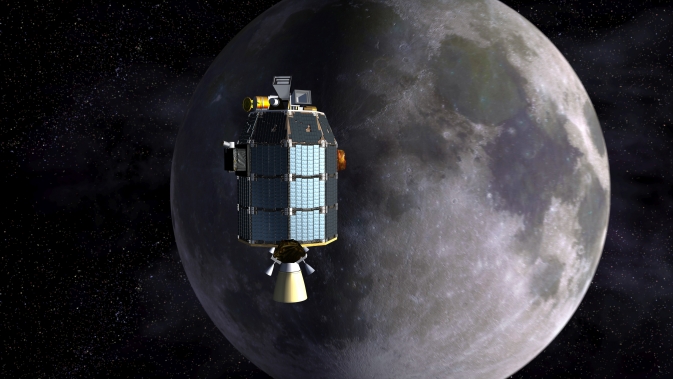
The LADEE mission has ended in a controlled crash.{credit}NASA{/credit}

A NASA spacecraft that studied lunar dust vaporized into its own cloud of dust when it hit the Moon, as planned, in a mission-ending impact on 17 April. Launched last September, the Lunar Atmosphere and Dust Environment Explorer (LADEE) finished its primary mission in March. In early April, on an extended mission, it made close passes as low as 2 kilometres above the surface, gathering data on more than 100 low-elevation orbits. Mission controllers deliberately crashed it to avoid the chance that, left alone, it might crash and contaminate historic locations such as the Apollo landing sites.

During its lifetime, LADEE made the best measurements yet of the dust generated when tiny meteorites bombard the surface. It is still hunting the mystery of a horizon glow seen by Apollo astronauts. It also carried a test for future laser communications between spacecraft and Earth.

In its final days the probe unexpectedly survived the cold and dark of a total lunar eclipse on 15 April. Just before the eclipse, NASA had the spacecraft perform a final engine burn that determined the crash trajectory. LADEE normally coped with just one hour of darkness every time it looped behind the Moon. The eclipse put it into darkness for some four hours, potentially jeopardizing the ability of its battery-powered heaters to keep the spacecraft from freezing to death. But the spacecraft survived.

NASA has been running a contest to predict the exact date and time of the LADEE impact, and this morning predicted there may be multiple winners. When it hit, the probe was travelling about three times as fast as a rifle bullet. In the coming months the Lunar Reconnaissance Orbiter will take pictures of the crash site, which engineers are still determining.

Lunar dust mission still chasing mystery of ‘horizon glow’

LADEE at moon credit NASA

{credit}NASA{/credit}

Posted on behalf of Alexandra Witze.

NASA is preparing one last blast for its expired Lunar Atmosphere and Dust Environment Explorer (LADEE) spacecraft — a controlled crash into the Moon’s surface, probably on 21 April. But before it goes, LADEE will take a final shot at unravelling one of the main mysteries it went to the Moon to uncover.

A major goal of the mission was to understand a bizarre glow on the Moon’s horizon, spotted by Apollo astronauts just before sunrise. “So far we haven’t come up with an explanation for that,” project scientist Rick Elphic, of NASA’s Ames Research Center in Moffett Field, California, said at a media briefing on 3 April. One leading idea is that the Sun’s ultraviolet rays cause lunar dust particles to become electrically charged. That dust then lofts upwards, forming a cloud that caught the light and the astronauts’ eyes.

LADEE carries an instrument that measures the impact of individual dust particles, as well as the collective signal from smaller particles. Lunar scientists had expected a certain amount of tiny dust to explain what the Apollo astronauts saw. But LADEE didn’t find it. “We did measure a signal that indicates that the amount of lofted dust has to be at least two orders of magnitude below the expectations that were based on the Apollo reports,” says Mihály Horányi, the instrument’s principal investigator, who is at the University of Colorado. Perhaps the dust lofting happens only occasionally, he suggests, and the astronauts were in just the right place at the right time to see it.

LADEE will try one more time to unravel the horizon-glow mystery. As it gets closer and closer to the lunar surface, it will point its star tracker towards the Moon’s horizon to try to replicate the angle and conditions under which the astronauts saw the glow. The star tracker is not designed for high-resolution imaging, but Elphic says that it’s worth looking.

This weekend, mission managers will guide LADEE on a trajectory just 3 kilometres above the Apennine mountains on the Moon’s near side. The goal is to see what sort of dust LADEE can spot so close to the surface. Then it will move slightly higher for its remaining few weeks before plunging to its doom. It is destined to follow the natural decay of its orbit and vaporize itself on the lunar far side.

LADEE scientists have plenty of science to distract them from mourning. The spacecraft made the best measurements ever of the Moon’s dusty envelope, generated as tiny meteorites bombard its surface. The mission also discovered exotic atoms such as neon, magnesium and aluminium in the Moon’s outer atmosphere.

ESA picks next planet-hunting mission

PLATO

A concept illustration for the exoplanet mission proposal approved by ESA.

The European Space Agency (ESA) will launch an observatory to search for planets outside our solar system in 2024, it announced on 19 February.

Plato — which stands for planetary transits and oscillations of stars — was selected as a future medium (M) class mission by the agency’s science programme committee at a meeting in Paris.

The observatory will monitor relatively bright and nearby stars, looking for Earth-sized planets and super-Earths at distances from their parent star that would allow them to be habitable. Plato will use an array of 32 small, identical telescopes and cameras, plus two specialized cameras, to look for planets around up to 1 million stars. The mission will also carry out sensitive ‘astroseismology’ — using minute changes in starlight caused by vibrations within a star to determine characteristics such as its age.

Like the NASA planet-hunter Kepler, Plato will look for the dips in stars’ brightness that signals a planet is travelling in front of them, known as the transit method. When combined with ground-based radial-velocity observations — measurements of the star’s ‘wobble’ due to the planet’s gravity — these let physicists calculate planets’ density and likely composition.

Plato is the latest in a growing line of exoplanet missions. Following its launch in 2009, Kepler detected more than 3,000 exoplanet candidates. Mechanical failures ended the mission in its current form in 2013 and NASA is still considering its future.

But by the time Plato gets off the ground, ESA’s CHEOPS (Characterizing Exoplanet Satellite) mission, set for launch in 2017, should already be in the sky, investigating systems known to host planets. NASA also plans to launch its new exoplanet hunter, the Transiting Exoplanet Survey Satellite (TESS) in 2017. Both TESS and Plato will be upgrades to Kepler, surveying a much greater portion of the sky. Compared to TESS, Plato will be able to look for smaller planets and those with longer orbital periods.

Plato will have an initial six-year mission, operating from the second Lagrangian point (L2), a stable position 1.5 million kilometres outside Earth’s orbit around the Sun. It is the third medium-scale mission selected under ESA’s 20-year Cosmic Vision programme. The Solar Orbiter, which will study the Sun and solar wind, is planned for launch in 2017, and Euclid, mapping the geometry of the ‘dark universe’, will go up in 2020.

The observatory beat four other mission ideas for the spot. These were EChO (the Exoplanet Characterisation Observatory), designed to study exoplanet atmospheres; LOFT (the Large Observatory for X-ray Timing) a mission to study matter near black holes and neutron stars; MarcoPolo-R, which would return a sample from an asteroid; and STE-Quest (Space-Time Explorer and Quantum Equivalence Principle Space Test), which would test Einstein’s general theory of relativity.

EU may set up body in European Space Agency

The European Union (EU) may set up a dedicated directorate within the European Space Agency (ESA) to resolve mismatches in the way the two bodies cooperate.

The option emerged as the leading contender in a report published by the European Commission on 6 February, which scoped out several scenarios for their future relationship.

The “pillar” or “chamber” would allow EU projects to be run under EU rules but from within ESA. A second route explored in the report, based largely on results of an external study by Munich-based Roland Berger Strategy Consultants, would be to improve cooperation under the status quo, with an improved interface between the two. Other options — for example to turn ESA wholesale into an EU agency — curried little favour.

The EU currently allocates around three-quarters of its space budget to ESA, making it the agency’s largest contributor. ESA already delivers dedicated EU-funded projects such as the global satellite navigation system Galileo and the Earth observation programme Copernicus.

But the two organisations run in very different ways. While ESA is under direct control of member states, the EU reports to both member states and the European Parliament. In its industrial dealings, ESA operates under a policy of juste retour that guarantees states contracts roughly proportionate to their financial contributions, while the EU goes on the principle of best value.

Nor do the two bodies have the same membership: among ESA’s members are Norway and Switzerland, with Canada also an associate. The Commission says this membership asymmetry could become a particular concern as ESA and the EU move into more defence-related activities.

The Commission laid out the case for reforming the relationship based on these asymmetries in 2012, with member state ministers also backing a change in February last year.

Ministers will discuss the findings when the Competitiveness Council meets on 21 February, with the Commission planning to further analyse the options over the coming year. Depending on the outcome — as well as dialogue with ESA — the Commission says it could produce concrete proposals towards the end of 2014 or early 2015. ESA is expected to take a decision about the evolution of the agency during its council meeting in December.

Speaking at the sixth annual Conference on EU space policy in Brussels last month, UK science minister David Willetts outlined his government’s objection to bringing ESA into the EU structure. “This suggestion has caused a lot of distraction and delay, while our competitors outside Europe focus on growth and make progress,” he says.

The EU has plans to increase its spending on space. Between 2014 and 2020, it will spend almost €12bn on funding space activities — a doubling of investment compared to the previous financial planning period.