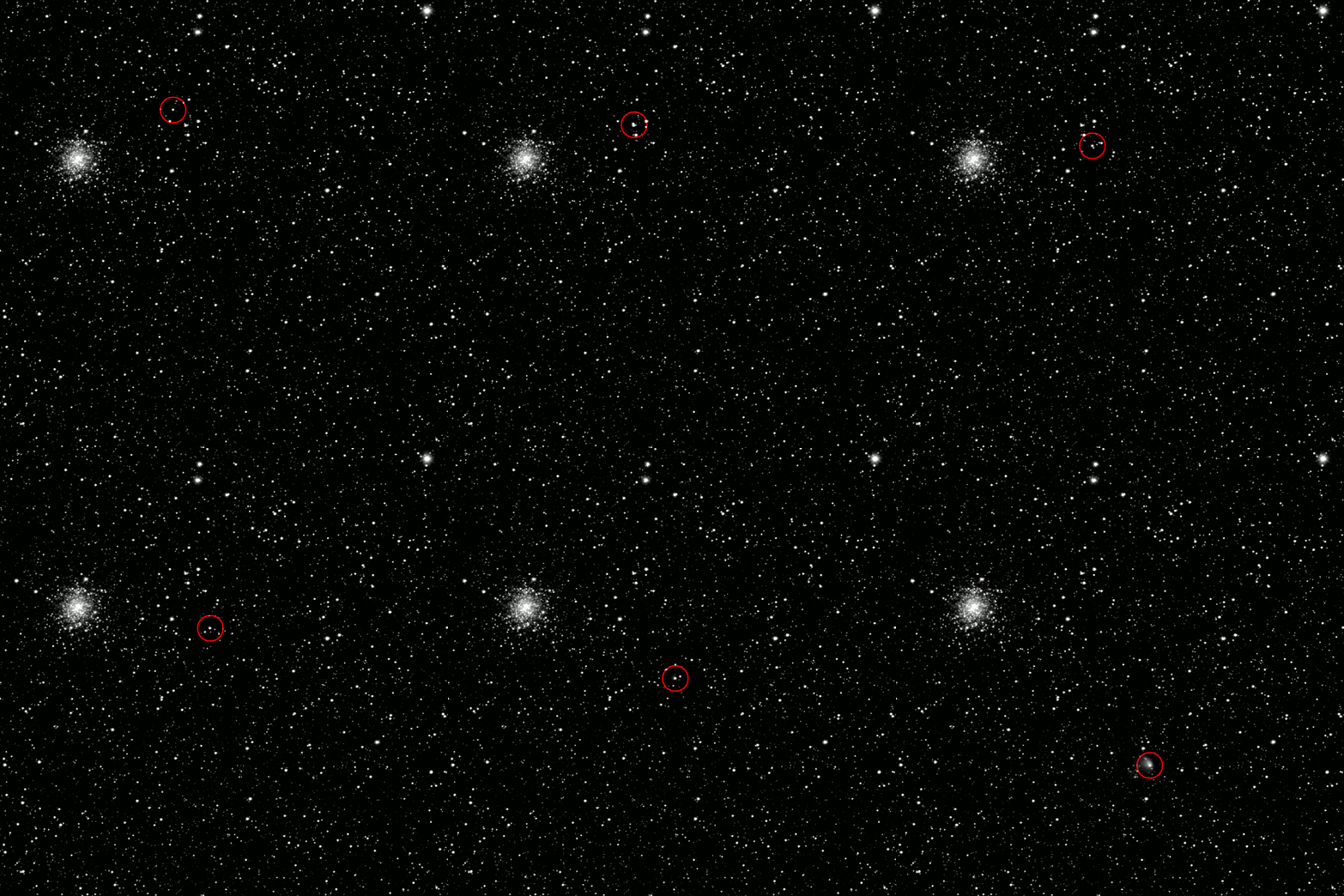
Comet begins to steam off as Rosetta homes in

 Comet_develops_a_coma_large

Hurtling through space at thousands of kilometres per hour, the comet-chasing Rosetta spacecraft has photographed its target spewing out gas and dust as both get closer to the Sun.

The €1-billion (US$1.4-billion) European Space Agency spacecraft woke up in January this year after almost three years in hibernation. By August it hopes to catch up with the comet before setting down its lander, Philae, on the surface in November. This will be the first time a soft-landing has been attempted on a comet.

The images from Rosetta’s OSIRIS camera, released by ESA today, show 67P-Churyumov–Gerasimenko increasingly releasing gas and dust over six weeks, from 27 March to 4 May. During that time Rosetta closed the distance to the comet from around 5 million kilometres to 2 million kilometres.

As the Sun heats the comet, surface ice turns into gas. This escapes carrying dust into space, forming the visible ‘coma’. Dust and gas around the comet will increase as it approaches the Sun, eventually forming into a characteristic tail. Rosetta will have to negotiate this cloud as it descends to as low as 1 kilometre from the surface to land Philae.

Relatively little is known about the comet. Rosetta’s 11 science experiments, lander and its 10 instruments have now all been activated and already turned up one surprise – that the comet is rotating every 12.4 hours, a period 20 minutes shorter than previously thought.

Scientists hope that by studying 67P-Churyumov–Gerasimenko and its dust they will learn clues about the Solar System’s early history, as well as whether comets played a role in bringing  water and the basic building blocks of life to Earth.

EU may set up body in European Space Agency

The European Union (EU) may set up a dedicated directorate within the European Space Agency (ESA) to resolve mismatches in the way the two bodies cooperate.

The option emerged as the leading contender in a report published by the European Commission on 6 February, which scoped out several scenarios for their future relationship.

The “pillar” or “chamber” would allow EU projects to be run under EU rules but from within ESA. A second route explored in the report, based largely on results of an external study by Munich-based Roland Berger Strategy Consultants, would be to improve cooperation under the status quo, with an improved interface between the two. Other options — for example to turn ESA wholesale into an EU agency — curried little favour.

The EU currently allocates around three-quarters of its space budget to ESA, making it the agency’s largest contributor. ESA already delivers dedicated EU-funded projects such as the global satellite navigation system Galileo and the Earth observation programme Copernicus.

But the two organisations run in very different ways. While ESA is under direct control of member states, the EU reports to both member states and the European Parliament. In its industrial dealings, ESA operates under a policy of juste retour that guarantees states contracts roughly proportionate to their financial contributions, while the EU goes on the principle of best value.

Nor do the two bodies have the same membership: among ESA’s members are Norway and Switzerland, with Canada also an associate. The Commission says this membership asymmetry could become a particular concern as ESA and the EU move into more defence-related activities.

The Commission laid out the case for reforming the relationship based on these asymmetries in 2012, with member state ministers also backing a change in February last year.

Ministers will discuss the findings when the Competitiveness Council meets on 21 February, with the Commission planning to further analyse the options over the coming year. Depending on the outcome — as well as dialogue with ESA — the Commission says it could produce concrete proposals towards the end of 2014 or early 2015. ESA is expected to take a decision about the evolution of the agency during its council meeting in December.

Speaking at the sixth annual Conference on EU space policy in Brussels last month, UK science minister David Willetts outlined his government’s objection to bringing ESA into the EU structure. “This suggestion has caused a lot of distraction and delay, while our competitors outside Europe focus on growth and make progress,” he says.

The EU has plans to increase its spending on space. Between 2014 and 2020, it will spend almost €12bn on funding space activities — a doubling of investment compared to the previous financial planning period.

Rosetta wakes up and phones home

The European Space Agency’s Rosetta spacecraft has successfully woken up after almost three years in hibernation.

The craft at the heart of ESA’s €1-billion (US$1.4-billion) comet-hunting mission was shut down in 2011 to save energy while travelling in deep space (see ‘Comet craft ready to wake’). Rosetta successfully re-established communications with Earth on 20 January.

With an alarm pre-set for 10:00 GMT, a signal was expected at any time from 17:30 GMT, once the spacecraft had warmed up and turned its antenna towards Earth. But Rosetta kept everyone guessing, with the first sign that everything had gone to plan only arriving around 40 minutes later.

ESA’s European Space Operations Centre erupted in cheering and hugging as small spikes appeared in radio signals received at NASA deep-space communications centres in Canberra and in Goldstone, California.

The first radio signal received from Rosetta

The first radio signal received from Rosetta

Messages take 45 minutes to travel the 807 million kilometres each way to the craft. This means ESA scientists will have to wait another 90 minutes after the first signal before receiving a health report from Rosetta.

All being well, the craft will now journey to its target, the comet Churyumov-Gerasimenko, which it will approach in August. Rosetta will observe the comet up close before landing a probe in November. This will be the first time a soft landing has even been attempted on a comet.

In the ESA control room, spacecraft-operations manager Andrea Accomazzo was delighted to see Rosetta come back to life. “I think it’s been the longest hour of my life,” he said.

Star-mapping mission lifts off

Gaia, a European mission to map the Milky Way, has successfully launched from the European Space Agency’s base in French Guiana.

Its two telescopes were dispatched from the launch pad in Kourou at 9.12 GMT on a Soyuz-Fregat rocket. The spacecraft will now journey 1.5 million kilometres to its destination — Lagrange point L2, a gravitationally stable point beyond Earth’s orbit around the Sun.

Mission controllers confirmed that Gaia completed the most crucial part of its launch and early orbit, including deploying its 10.5-metre-wide sunshield, designed to provide the craft with solar power and shade its sensitive equipment from sunlight.

The mission is designed to chart 1 billion stars, with the aim of helping astronomers to answer fundamental questions about the origins of our Galaxy as well as uncover tens of thousands of previously unseen objects, such as asteroids and black holes (see ‘Europe’s star power’).

Its two telescopes will rotate once every six hours, sweeping over the same regions of space and building up a precise map of star locations using a 1-billion-pixel camera. As it moves around in orbit, Gaia will also make use of the parallax effect to measure the distance between Earth and 10 million stars to more than 99% accuracy, building up a three-dimensional map.

Gaia is scheduled to arrive in position in three weeks and start routine operations in April 2014. The spacecraft will remain in position for five years, collecting data to be published in its star catalogue in 2021.

The mission is the first major attempt to precisely measure the positions of the stars since the European Space Agency’s High Precision Parallax Collecting Satellite (Hipparcos), which launched in 1989 and ran until 1993. Hipparcos measured the distances to about 118,000 stars, but only 400 to the degree of precision planned for Gaia.

X-ray observatory confirmed as ESA’s next big mission

The European Space Agency (ESA) has confirmed that its next ‘large’ (L-class) mission, dubbed L2, will be an X-ray telescope investigating the “hot and energetic Universe”.

At a meeting in Paris yesterday, the agency’s Science Programme Committee selected the theme on the basis of the recommendation of ESA’s director of science and robotic exploration, Alvaro Giménez, reported in Nature earlier this month.

Scheduled for launch in 2028, the L2 project will investigate how gas evolves into galaxy clusters and how black holes grow and shape the Universe. The exact mission will be selected through a call next year, with the Advanced Telescope for High-energy Astrophysics (Athena+), the mission outlined alongside the theme, a clear forerunner.

At the same meeting the committee confirmed “the gravitational Universe” as the theme for the following L-class mission, L3, in 2034, meaning advocates for space-based gravitational wave astronomy, a field never before attempted in space, will have to wait another two decades for their observatory.

Its associated mission, the evolved Laser Interferometer Space Antenna (eLISA), would detect the gravitational waves that are thought to stretch the fabric of space-time, opening a new window on the Universe outside the electromagnetic spectrum.  A pathfinder mission to test the necessary technology for the observatory — which would eventually hope to detect signals from colliding supermassive black holes and the early Universe — is set to fly in 2015 after several years of delays.

The L2 and L3 science themes were chosen from 32 proposals that the European science community had put forward since March. Total costs for the two selected will be in the order of €2 billion (US$2.7 billion).

ESA’s first L-class mission of its current programme, the Jupiter Icy Moons Explorer (JUICE), was approved last year and is set for launch in 2022.

(Additional reporting by Quirin Schiermeier)

Exomars and the History of Mars Exploration – Can Russia Help?

Amy Shira Teitel is an historian of spaceflight, blogger and freelance writer passionate about making space history accessible to everyone. She blogs at Vintage Space where she chronicles her love of space history and space exploration, and she’s currently working on a book about NASA’s pursuit of runway landings during the space race. In the meantime, her work appears regularly on Discovery NewsMotherboard, and America Space.

 
In February, President Obama revealed NASA’s budget for 2013. At $17.7 billion the agency is taking a hit, but the biggest loser is the agency’s Mars program which has been allocated $318 million less than last year. This funding cut has forced NASA out of ExoMars, the joint mission with the European Space Agency (ESA) designed to culminate with a sample return mission. Without NASA, ESA is left in pieces; the US agency was responsible for the launch vehicles and interplanetary spacecraft, not to mention substantial funding. Now, ESA is hoping the Russian Space Agency Roscosmos will take NASA’s place. This partnership could be without payoff since neither country has had great luck with Mars. Particularly Russia, whose missions have been thwarted by the mythical galactic ghoul. Continue reading