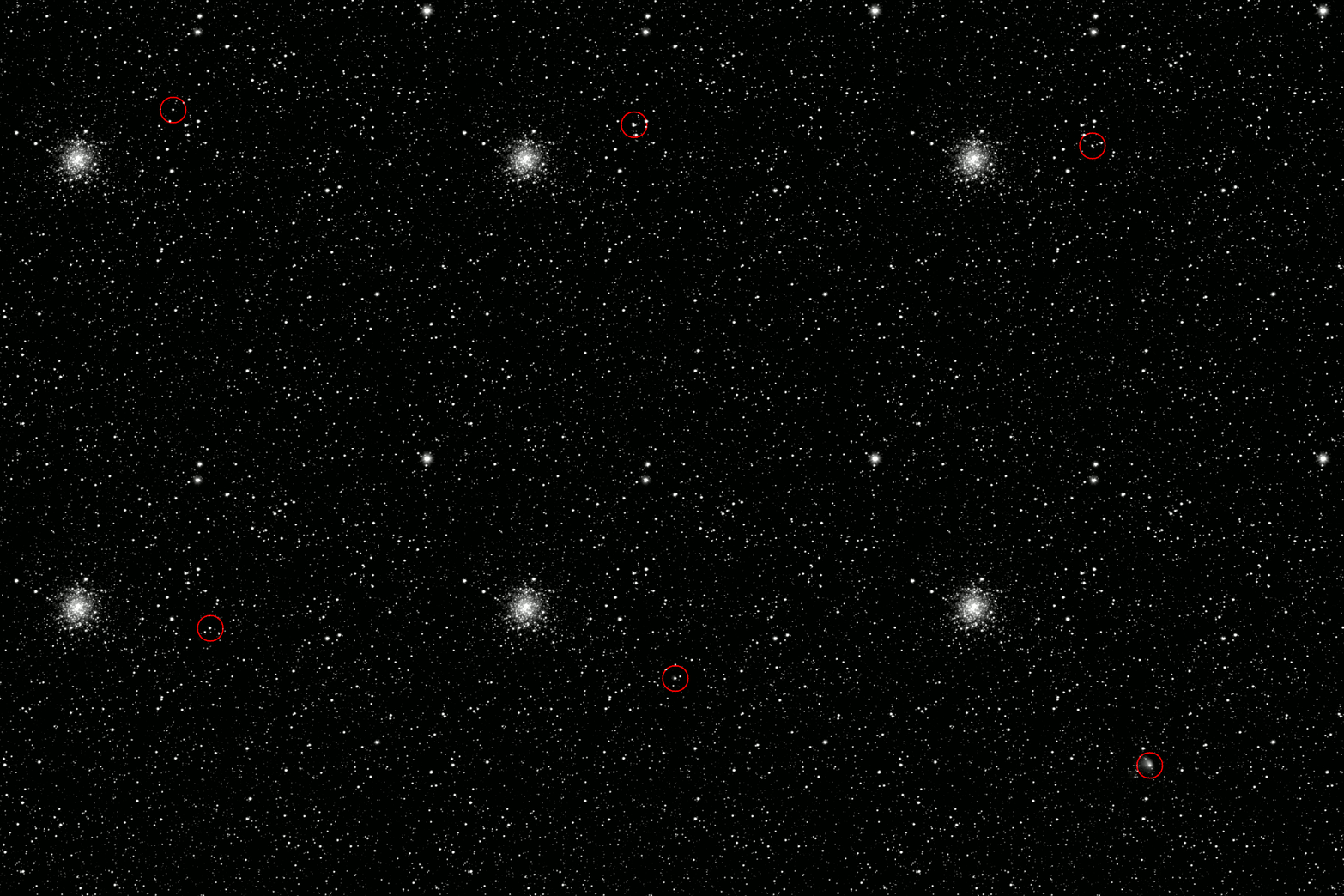
Comet begins to steam off as Rosetta homes in

 Comet_develops_a_coma_large

Hurtling through space at thousands of kilometres per hour, the comet-chasing Rosetta spacecraft has photographed its target spewing out gas and dust as both get closer to the Sun.

The €1-billion (US$1.4-billion) European Space Agency spacecraft woke up in January this year after almost three years in hibernation. By August it hopes to catch up with the comet before setting down its lander, Philae, on the surface in November. This will be the first time a soft-landing has been attempted on a comet.

The images from Rosetta’s OSIRIS camera, released by ESA today, show 67P-Churyumov–Gerasimenko increasingly releasing gas and dust over six weeks, from 27 March to 4 May. During that time Rosetta closed the distance to the comet from around 5 million kilometres to 2 million kilometres.

As the Sun heats the comet, surface ice turns into gas. This escapes carrying dust into space, forming the visible ‘coma’. Dust and gas around the comet will increase as it approaches the Sun, eventually forming into a characteristic tail. Rosetta will have to negotiate this cloud as it descends to as low as 1 kilometre from the surface to land Philae.

Relatively little is known about the comet. Rosetta’s 11 science experiments, lander and its 10 instruments have now all been activated and already turned up one surprise – that the comet is rotating every 12.4 hours, a period 20 minutes shorter than previously thought.

Scientists hope that by studying 67P-Churyumov–Gerasimenko and its dust they will learn clues about the Solar System’s early history, as well as whether comets played a role in bringing  water and the basic building blocks of life to Earth.

Rosetta wakes up and phones home

The European Space Agency’s Rosetta spacecraft has successfully woken up after almost three years in hibernation.

The craft at the heart of ESA’s €1-billion (US$1.4-billion) comet-hunting mission was shut down in 2011 to save energy while travelling in deep space (see ‘Comet craft ready to wake’). Rosetta successfully re-established communications with Earth on 20 January.

With an alarm pre-set for 10:00 GMT, a signal was expected at any time from 17:30 GMT, once the spacecraft had warmed up and turned its antenna towards Earth. But Rosetta kept everyone guessing, with the first sign that everything had gone to plan only arriving around 40 minutes later.

ESA’s European Space Operations Centre erupted in cheering and hugging as small spikes appeared in radio signals received at NASA deep-space communications centres in Canberra and in Goldstone, California.

The first radio signal received from Rosetta

The first radio signal received from Rosetta

Messages take 45 minutes to travel the 807 million kilometres each way to the craft. This means ESA scientists will have to wait another 90 minutes after the first signal before receiving a health report from Rosetta.

All being well, the craft will now journey to its target, the comet Churyumov-Gerasimenko, which it will approach in August. Rosetta will observe the comet up close before landing a probe in November. This will be the first time a soft landing has even been attempted on a comet.

In the ESA control room, spacecraft-operations manager Andrea Accomazzo was delighted to see Rosetta come back to life. “I think it’s been the longest hour of my life,” he said.