NIH tackles workforce and diversity challenges

The US National Institutes of Health (NIH) will boost postdoctoral stipends and launch two new grant programmes as part of its response to two sobering reports on structural problems in the US biomedical workforce.

The US$31-billion biomedical agency on 6 December laid out its plans for reacting to the data-rich reports, one describing and dissecting the problems resulting from a glut of young researchers in the biomedical workforce and a second documenting that workforce’s lack of diversity and the uphill struggle of non-white applicants to win grants.  The latter was spurred by a paper by Ginther et al., published in Science in 2011.

Both reports were presented last June to a committee of external advisers to NIH director Francis Collins (see ‘A workforce out of balance‘).

Today, Collins and his senior lieutenants responded with their plans for implementing the reports’ recommendations. An outline of the agency’s plans to boost its grantees’ diversity is here; the gist of its workforce initiative is here.

Continue reading

Great Ape bill in US Senate showdown

A bill that would end invasive research on chimpanzees in the United States is this week the subject of behind-the-scenes negotiations in the US Senate. There, supporters are vying to bring it to an up-or-down vote in the coming days, while opponents are doing all they can to prevent this from happening.

This revised version of the Great Ape Protection and Cost Savings Act is the subject of the maneuvering. It was crafted in recent weeks by Maria Cantwell, the Washington state Democrat who is its primary Senate sponsor.

The revisions are intended to address concerns of opponents of the original bill — concerns that include the costs of  implementing it. Both versions of the bill would require  hundreds of  research chimpanzees to be retired to sanctuaries, with attendant construction costs.  This Congressional Budget Office (CBO) assessment in mid-November put the cost of such a change at $56 million between 2013 and 2017. However, this week the CBO, in a reassessment, says that the newly revised bill would cost the government nothing.

Movement of the bill began this summer, when the Senate Environment and Public Works Committee passed the earlier version.  Among the changes made since then are an extension, from three years to four, of the time during which invasive research on chimps would need to be phased out.  The newly revised bill also allows the great apes to be held  in laboratory housing after the four years elapse, if sanctuary space is not yet available, thus allowing the government to spread sanctuary construction costs over a longer time.

The revised bill also makes it easier for retired chimps to be pulled back into research if an emergency arises. The earlier iteration required a task force to sign off on new research, after considering public comments.  The revised bill gives sole discretion to decide to use chimpaznees in an emergency like a pandemic to the Secretary of Health and Human Services.

However, the heart of the bill — banning invasive research on great apes, whether publicly or privately funded — remains the same, and animal research supporters are still actively opposing it.  The National Association for Biomedical Research (NABR) this week issued this “Urgent Alert” asking supporters to lobby their senators to oppose the bill.  (The alert appears to be reacting to the older version of the bill; NABR could not be reached for comment this afternoon.)

Continue reading

Texas cancer agency reveals another grant misstep

An embattled agency charged with doling out US$3 billion in Texas taxpayer money for cancer research and prevention has discovered during an audit another unreviewed commercialization grant. The Austin-based Cancer Prevention and Research Institute of Texas (CPRIT) announced yesterday that it has put a hold on the $11-million award and that the company that received it, Dallas-based Peloton Therapeutics, has resubmitted the proposal for commercial and scientific review.

The finding comes on the heels of months of controversy about an $18-million unreviewed grant that went to the University of Texas MD Anderson Cancer Center in Houston.

The award to Peloton, titled ‘Company recruitment, relocation and formation’, was made in June 2010, just six months after the company’s founding, without either scientific or commercial review.  It was among the first commercial grants made by CPRIT.

The company was founded by Steve McKnight, chair of biochemistry at the University of Texas (UT) Southwestern in Dallas. It includes on its board of directors Nobel laureate Michael Brown, the director of UT Southwestern’s Erik Jonsson Center for Research in Molecular Genetics and Human Disease.

CPRIT’s press release yesterday noted that “Peloton was unaware CPRIT processes had not been followed and had played no role in placement of the proposal on the award slate.”

Critics suggested yesterday that the grant is evidence of favoritism by CPRIT to UT Southwestern, which has received many CPRIT grants, and which was the home base of Al Gilman, the Nobel-prizewinning chief scientific officer of CPRIT, who resigned last month in protest over irregular review procedures. Gilman began his job at CPRIT in 2009.

Gilman today protested at the suggestion that he eased the way for the Peloton grant. “I was never sent, and I have not to this day ever seen, the proposal that Peloton sent to CPRIT. The research side of CPRIT had nothing to do with [commercial] review. “

Peloton has also raised $18 million in venture capital financing, which it announced in July 2011.

CPRIT announced last week that Jerry Cobbs, its chief commercialization officer, is resigning, effective today.  In yesterday’s press release, the agency blames Cobbs for the lack of review of the Peloton award, arguing that he “improperly included the Peloton proposal on a commercialization award slate presented to the Institute’s Oversight Committee.”

However, CPRIT’s rules (see page 7) state that executive director William Gimson has final say on which proposals go before the oversight committee for approval. The oversight committee, CPRIT’s governing board, gives final approval to all grant awards.

CPRIT also announced today a change that is not likely to please potential scientific reviewers who are used to an honour system governing peer-review deliberations: an independent third-party monitor will henceforth observe all peer-review meetings and document that the institute’s grant-review policies are followed.


NIH sticks with ‘two strikes’ grant rule – updated

The US National Institutes of Health (NIH) will continue a policy that allows grant applicants just one resubmission if their proposal is rejected the first time, the agency announced today.

The policy, launched  in 2009 as part of an overhaul of peer review at the NIH, “continues to achieve the stated goals of enabling NIH to fund as much meritorious science as possible in as short a time period as possible,” Sally Rockey, the NIH deputy director for extramural research, wrote on her blog Rock Talk.

The ‘two-strikes’ policy has received negative reviews from the grantee community, many of whom argue that its effect, in an era of historically low grant-funding levels, is to randomly cull proposals of high merit.

The decision “is a characteristic refusal by administrators to admit they erred badly when they made a change that has been consistently unpopular with those it affected, in this case NIH grant applicants,” says John Moore, a senior HIV/AIDS scientist at Weill Cornell Medical College in New York, and a longtime NIH grantee.

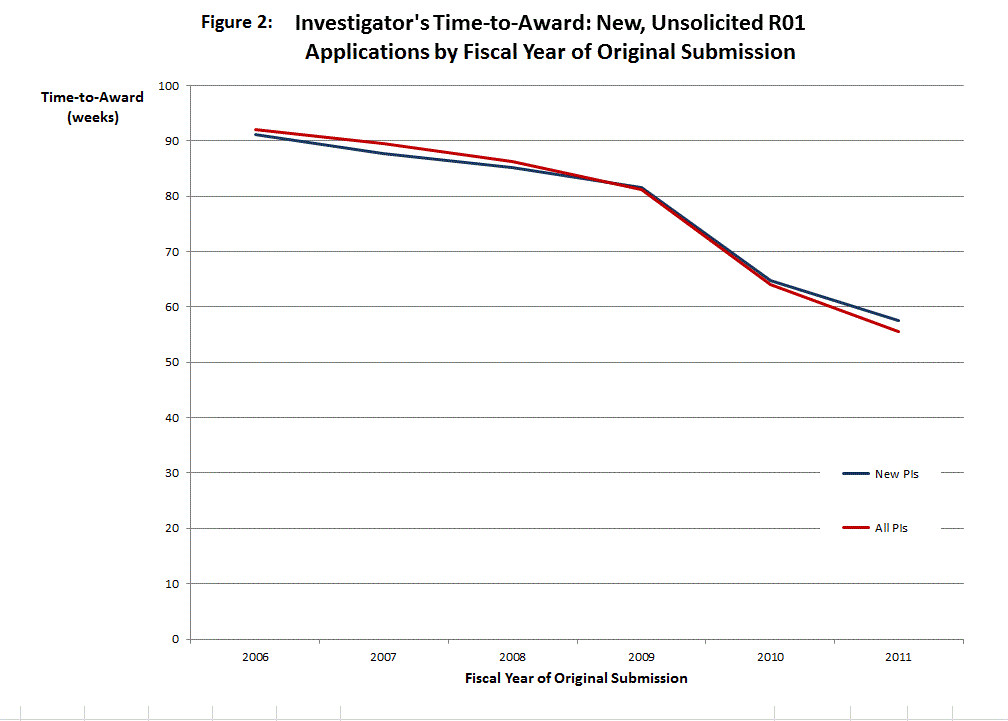
Rockey based her decision on new data the agency has generated that continue through the end of the government’s 2011 fiscal year.  As shown in Figure 2 (below) from Rockey’s blog, the average time that scientists wait to receive an award has decreased from more than 80 weeks to 56 weeks since the policy was implemented.

{credit}NIH{/credit}

Continue reading

Research dogs shipped to India under airline’s radar

{credit}PETA{/credit}

Animal activists have known for some time that beagle puppies bred in China are regularly shipped to Indian contract research organizations like Bangalore-based Advinus, which uses them for drug toxicity studies, after which the animals are euthanized.

What they didn’t know was how the animals were getting into India. Most major airline carriers now refuse to transport animals bound for research labs, as Nature recently reported (see ‘Lab Animal Flights Squeezed‘).

It emerged last month that in at least one case, the shipper has gotten around this problem by identifying beagles as “pets.” The discovery was made after an activist snapped the above photo of the crates of 70 beagle puppies in Chennai, India, after they landed on 19 October on a Cathay Pacific flight from China. The puppies were being sent to Advinus from Beijing Marshall Biotechnology, a China-based branch of Marshall BioResources of North Rose, New York, a major research beagle breeder. Cathay Pacific has very publicly refused to transport research animals.

Continue reading

NIH jettisons plan for single addictions institute

The US National Institutes of Health (NIH) has shelved plans to create a single institute devoted to the study of substance abuse, saying that it will instead maintain two existing, separate institutes that are devoted to studying, respectively, drug addiction and alcohol abuse.

The NIH director, Francis Collins, announced in a statement today that “after rigorous review and extensive consultation,” he has opted not to pursue a proposed dissolving of the National Institute on Drug Abuse and the National Institute on Alcohol Abuse and Alcoholism. The two institutes, with respective budgets of $1 billion and $459 million, would have been replaced by a single, substance use, abuse and addictions institute. Instead, Collins, said, he will seek “functional integration” of the two existing institutes’ work, along with related research housed in the agency’s 25 other institutes and centres.

Nature examined the proposal for a single addictions institute in-depth in this news article, “Plan for Addiction Institute Splits NIH.”  That article was published shortly after a board that advises Collins on major structural changes at NIH recommended, on a vote of 12-3, that the single institute be established.

Today, Collins said that the time, energy and resources that would be needed to enact a major structural reorganization were not warranted in a time of fiscal duress for the agency. He added that the same ends could be achieved by better coordination of addiction-related work among all existing NIH institutes.

The decision represents an about-face for Collins, who told his committee of external advisers in June: “The goal at the moment is to aim to launch this new institute at the start of [fiscal year] 2014, on October 1 2013.”

At the June meeting Collins also noted, “We have heard from leaders in the alcoholic beverage industry and they are concerned about this new institute.” The opposition suggests the industry was uncomfortable with a research entity that would more closely link public perceptions of alcohol consumption and abuse with drug addiction.

Another factor may have played into the decision: NIH’s launch in January of the new National Center for Advancing Translational Sciences, and the attendant dissolution of the agency’s National Center for Research Resources. The reorganization had generated controversy at NIH (See “NIH Revamp Rushes Ahead.”) and with that experience fresh in mind, the agency’s leaders may have lost their appetite for further major structural change so soon.

To get a sense of the split engendered at NIH by the proposal to establish a single addictions institute, consider the reactions to the proposal, two years ago, from two former directors of the relevant institutes:

“It makes infinite scientific sense. There’s no question that these are all drugs of abuse and addiction and they should be treated together, dealt with together.”

–Alan Leshner, who directed NIH’s drug abuse institute from 1994 to 2001

“It’s a terrible idea. This is not a meeting of equals. This is one institute trying to take over another.”

–Enoch Gordis, director of the NIH’s alcohol abuse institute for 15 years, until 2001

NIH asked to grant open licence on HIV drug

Should a sick person in the United States have to pay US$9.18 for an anti-AIDS pill when a Canadian is paying $1.16 for the same tablet, and a New Zealander $1.15?

Four consumer and medical groups led by Washington, DC-based Knowledge Ecology International are asking the US National Institutes of Health (NIH) to say no to that question. On 25 October, they petitioned the agency to exercise a never-used legal privilege known as a ‘march in right’ to grant open licences to would-be makers of the protease inhibitor Norvir (ritonavir), now marketed exclusively by Abbott Laboratories.

March in rights are part of the Bayh-Dole Act, a landmark 1980 US law that aimed to spur the commercialization of government-funded inventions and helped to launch the biotechnology industry. The law says, in part, that the NIH can ‘march in’ and force open licensing of an invention it funded when the exclusive license-holder, in this case, Abbott, is not taking adequate steps to “achieve practical application” of the invention. (See section 203 of the Bayh-Dole Act here.) The NIH funded Norvir’s discovery by a scientist then at Abbott.

That language covers the situation where a licensee simply sits on an invention and doesn’t develop it, but the law also defines “practical application” to mean that the invention’s benefits are “to the extent permitted by law or Government regulations available to the public on reasonable terms” (see section 201 of the Bayh-Dole Act).

Continue reading

MRC awards drug resurrection grants

A new effort by the UK Medical Research Council (MRC) and the pharmaceutical company AstraZeneca to resurrect abandoned drugs made its first award announcements today.

Fifteen lead investigators will receive a total of £7 million pounds over the next four years to repurpose AstraZeneca drugs that were abandoned for strategic reasons, or that had failed against diseases including prostate cancer, diabetes and chronic obstructive pulmonary disease. The selected projects will use nine of 22 cast-aside compounds that the drug company made available free of charge when the programme was first announced and applications invited last December.

The awardees hope to redirect the culled drugs to attack diseases ranging from chronic ear infections to Alzheimer’s disease to muscular dystrophy. Six of the projects will test compounds in human subjects; seven will involve only preclinical work; and two will encompass both preclinical and human testing. Here is a full list of the MRC drug repurposing awards, which vary in size from about £300,000 to £800,000. More detail about three of them, which target chronic cough, Alzheimer’s disease, and muscular dystrophy, is provided here.

At least one of the winners credits the drug company for being willing to offer up the compounds. Seth Love, professor of neuropathology at the University of Bristol, received over £500,000 to deploy against Alzheimer’s disease an AstraZeneca drug that resoundingly failed against prostate cancer. “By offering it to the scientific community, something they hadn’t dreamed of as a potential application has been identified. It has just been a win-win situation for everyone,” says Love.

He plans to use the molecule, zibotentan, to demonstrate proof-of-concept in rats, and then, if that is successful, move it into a human trial. The compound selectively blocks the ETA endothelin receptor. Endothelin is a potent blood vessel constrictor, and blocking its action in the brain may help fight the symptoms of Alzheimer ’s disease, in which reduced cerebral blood flow is implicated.

The MRC-AstraZeneca programme drew over 100 expressions of interest after it was announced in December; 23 of those were invited to submit full applications, and the 15 announced today were drawn from among those. Professor Patrick Johnston, Chair of the MRC’s Translational Research Group, declared the applications’ quality to be “higher than we could ever have hoped.”

Nonetheless, the £7 million in funding announced today fell short of the “up to £10 million” that the organizers initially said could be available under the programme.

An MRC spokesperson noted that the initial amount was not “set in stone.” She added: “We’ve had a significant level of interest from other companies in repeating a similar partnership and therefore were prudent in not over-committing to allow sufficient resources for future initiatives.”

In a time of languishing drug industry pipelines, the concept of enlisting academic investigators to turn old, discarded drugs to new uses is gaining a foothold on both sides of the Atlantic. In May, the new translational research centre at the US National Institutes of Health (NIH) announced a similar initiative involving three big drug companies, including AstraZeneca. By June, five more pharmaceutical giants had signed on to the programme run by NIH’s National Center for Advancing Translational Sciences. Called ‘Discovering New Therapeutic Uses for Existing Molecules’, it has similarly received scores of expressions of interest (read more about the programme in our recent news story ‘New cures sought from old drugs’). In contrast to the UK programme, US applicants must pursue projects that test drugs in humans. Its first awards will be made in June, 2013.

NIH re-evaluating ‘two strikes’ rule – Updated

The US National Institutes of Health (NIH) is considering reversing a highly unpopular policy that allows its grant applicants only one additional try at winning funding if their application is at first rejected.

Senior leaders at the US$31-billion biomedical agency in Bethesda, Maryland, will decide in the next several weeks whether to abandon a ‘two strikes and you’re out’ policy that was instituted in January 2009 as part of an extensive overhaul of peer review at the agency. Before then, grant-seekers were allowed a third try if a proposal twice failed to pass muster with peer reviewers.

A spokeswoman for the NIH said that the agency cannot comment on whether and when it will return to a three-strikes policy, because the decision is still under active consideration by senior officials.

“It’s about time” that the biomedical agency reconsidered, says Robert Benezra, a cancer biologist at Memorial Sloan-Kettering Cancer Center in New York, who spearheaded a 2011 letter from more than 2,300 scientists to the NIH, asking it to return to the three-strikes system.

The NIH’s rationale for the 2009 change was that the three-strikes rule was causing peer reviewers, either consciously or subconsciously, to favour second and third submissions over first-time proposals, creating, in effect, a queue similar to airplanes circling an airport waiting for a free runway to allow them to land. “Support for meritorious science may be delayed if initial submissions are placed at the end of the queue,” the expert group that reviewed peer review for the NIH concluded in a draft report in 2008 that showed the success rates for first-time applications falling from more than 60% in 1998 to 30% in 2007. (See page 33 of the report for the graph plotting these numbers.)

However, the change generated tremendous push-back from scientists, who have complained of it nearly incessantly to the NIH Office of Extramural Research. But after the agency received the petition from Benezra and his co-signers, it held firm to the two-strikes policy.

Sally Rockey, NIH deputy director for extramural research, published the NIH’s response to Benezra in a blog post, which included a graph that showed first-strike applications for the NIH’s mainstay ‘R01’ grants climbing between 2008 and 2010 as a percentage of all funded R01 grants. The new policy “certainly has achieved the intended goals: the number of applications funded [on the first try] is increasing and there is no queue piling up at the [second try] level,” Rockey wrote.

The critics retorted that, in the absence of third strikes, of course more first-strike applications would be funded; they also noted, ironically, that 100% of successful first-strike applications would be funded if the second strike opportunity were also eliminated.

Benezra and his allies argue that it is impossible for peer reviewers to discriminate between a proposal that scores in the top 10% of applicants and one that scores, say, at 19%. They say that the peer review process, by its nature, is not sufficiently fine-tuned to discriminate at that level.

Continue reading

US Senator Arlen Specter, NIH supporter, dead at 82 – Updated

{credit}United States Senate{/credit}

Arlen Specter, a former US Senator from Pennsylvania and one of Washington’s biggest boosters of the National Institutes of Health (NIH), died on 14 October at age 82. He succumbed to complications of non-Hodgkin’s lymphoma (NHL), his son Shanin told media outlets including the New York Times.

During his 30-year career in the US Senate, Specter was a passionate advocate for biomedical research even before he underwent cardiac bypass surgery, was diagnosed with a brain tumour and later fought NHL, a blood malignancy.

A Republican until he switched parties in 2009, Specter “worked for decades to increase our country’s investment in lifesaving medical research,” his Senate colleague Tom Harkin, Democrat of Iowa, said in a statement.

Francis Collins, the NIH director, issued a statement calling Specter “the epitome of a public servant” and said: “I truly miss Arlen’s steady hand and vision for our agency.”

“Patients, their families, and the research community lost a legendary leader today,” added Darrell Kirch, president and CEO of the Association of American Medical Colleges.

Specter was a big proponent of the doubling of the NIH budget over a five-year period that ended in 2003. He also vocally supported US government funding of human embryonic stem cell research and was almost singlehandedly responsible for the NIH receiving over $10 billion as part of the economic stimulus package that Congress passed in early 2009, during the throes of the recession.

Because his vote was crucial to passage of that bill in a Senate sharply divided on partisan lines, Specter was able to insist that the huge bolus for NIH be included.

Specter also crafted legislation authorizing the Cures Acceleration Network, a new NIH programme to speed high-needs cures from the laboratory to the bedside. It was written into the health reform law of 2010.

Harkin and others said that the politically moderate Specter embodied a spirit of bipartisanship that is increasingly rare in the US Congress today. But his conversion to the Democratic Party ultimately cost him his Senate seat in 2010, when he failed to win the Democratic primary nomination that would have allowed him to seek re-election that year.

Updated on 15 October to include Francis Collins’ statement.