Agenda set for earth summit

Posted on behalf of Natasha Gilbert.

At the earth summit in Rio de Janeiro, Brazil, in June, countries will be asked to sign up for 10 new sustainable development goals for the plant covering priority areas such as oceans, food, and sustainable cities, reports The Guardian.

A draft of the summit’s agenda seen by the Guardian also says governments will also discuss a new agreement to protect oceans, and transform and strengthen the UN Environment Programme body into a world agency for the environment so it is better able to tackle ecosystem decline. The appointment of a global “ombudsperson”, or high commissioner for future generations is also on the agenda (see Nature’s previous coverage of the Rio + 20 earth summit).

The previous earth summit in 1992 was attended by more than 190 heads of state and was considered the world’s biggest ever political gathering. This year’s meeting will be more modest – David Cameron, the UK’s prime minister, for example, is not expected to attend.

Ruth Davis, chief policy adviser at Greenpeace UK, told The Guardian, “This Rio summit comes after two decades of delays and broken promises on sustainable development which has left millions in poverty and pushed ecosystems to the brink of collapse. Whilst this draft text covers the key issues, it also demonstrates a dismal lack of urgency in tackling them.”

US announces 20-year ban on uranium mining in the Grand Canyon

Posted on behalf of Katherine Rowland.

The Obama administration has banned uranium mining on one million acres of land around the Grand Canyon in Arizona. The move, announced on Monday by the Secretary of the Interior, Ken Salazar, outlaws new mining claims in the uranium-rich region for the next 20 years.

“A withdrawal is the right approach for this priceless American landscape,” Salazar said. “People from all over the country and around the world come to visit the Grand Canyon. Numerous American Indian tribes regard this magnificent icon as a sacred place and millions of people in the Colorado River Basin depend on the river for drinking water, irrigation, industrial and environmental use.”

Mining claims on lands adjacent to the Grand Canyon rose dramatically during the administration of former US president George Bush, as high prices led to a new “uranium rush.” According to mining industry data, the price of uranium skyrocketed from roughly US$20 a pound to nearly $140 a pound between 2005 and 2007.

The ban will not affect the 3,200 existing mine claims in the area, and the US Bureau of Land Management anticipates that up to a dozen new projects could be developed under previously established rights. Continue reading

US seeks to dismiss lawsuit over unethical VD research in Guatemala

Posted on behalf of Matthew Walter.

The US Department of Justice (DOJ) asked a federal judge on 9 January to dismiss a lawsuit from hundreds of Guatemalans seeking compensation for their participation in a US-led experiment in the 1940s in which they were infected with venereal diseases (see A shocking discovery).

The DOJ called the experiments unethical and said they had caused “a terrible wrong”. But the motion submitted by the department maintained that the United States has immunity against this kind of lawsuit. “This lawsuit is not the proper vehicle — and this Court is not the proper forum — through which the consequences of this shameful conduct may be resolved,” said the justice department in its motion.

President Barack Obama and Secretary of State Hillary Clinton issued an apology in 2010 after a historian at Wellesley College in Massachusetts discovered the experiments. A US government commission found last year that American and Guatemalan scientists, led by John Cutler with funding from the US National Institutes of Health, exposed 1,308 people in Guatemala to venereal diseases including syphilis, gonorrhea and chancroid without their consent. The subjects included prisoners, prostitutes, mental patients and soldiers, and researchers also used young orphans to conduct diagnostic testing (see US bioethics panel urges stronger protections for human subjects).

Rudy Zuniga, a Guatemalan attorney representing the alleged victims, said that the US request to dismiss the case today was expected, and that his team will continue to press for payment. US law firms Conrad & Scherer and Parker Waichman Alonso are representing the plaintiffs.

“I expect there to be compensation for these people,” Zuniga said in an interview. “These people were inoculated without consent. There are families here who are still suffering consequences from these infections.”

Continue reading

Extinct Galapagos tortoise may just be hiding

Posted on behalf of Henry Nicholls.

A species of Galapagos tortoise thought to have been extinct for more than 150 years may, in fact, be alive and well. This finding, by geneticists at Yale University in New Haven, Connecticut, is particularly surprising given that this reptile is of giant proportions, measuring more than a metre from the front to the back of its shell and weighing more than 200 kilograms. How could such a behemoth have gone unnoticed for so long?

The answer, it turns out, is simple. They’ve been hiding. When Charles Darwin visited the Galapagos Island of Floreana in 1835, he found no sign of its native tortoise and assumed that whalers, pirates and human settlers had wiped them out. Since about 1850, no tortoises have been found on the island (except for one or two introduced animals kept as pets by the locals). It makes sense, therefore, that the International Union for Conservation of Nature would classify the Floreana tortoise Chelonoidis elephantopus (sometimes called Chelonoidis nigra) as extinct.

But the Yale geneticists now have good evidence that some purebred Floreana tortoises may still be alive on a different island in the archipelago. For more than a decade, the researchers have been absorbed by the bizarre mixture of genes found in the tortoises on Wolf Volcano at the northern tip of Isabela, the largest island in the chain. They began by studying mitochondrial sequences, which suggested that tortoises from the distant islands of San Cristobal and Espanola have somehow reached Wolf. Their guess was — and still is — that whalers and pirates were responsible. “Tortoises were occasionally stashed on various islands for safe-keeping and even tossed overboard in large numbers in nearshore areas to lighten cargo during flight or battle,” they wrote in 2002.

Continue reading

Revised rules for botanical taxonomy take effect

Posted on behalf of Katherine Rowland.

Since Linnaean taxonomy took hold in the eighteenth century, Latin has been the lingua franca of botany. In addition to designating the names of ranked genus and subspecies in Latin, botanists have also used the language to describe new taxa.

But not anymore.

As of 1 January, the new International Code of Botanical Nomenclature is in effect, allowing botanists the options of writing descriptive statements in English and of publishing papers electronically.

The changes follow the amendments ratified at the International Botanical Congress (IBC) held in Melbourne, Australia in July of last year (see Botanists shred paperwork in taxonomy reforms).

The earlier code, which required botanists both to write diagnoses in Latin and to publish only in print journals, made the documentation of new taxa a laborious process.

Botanists estimate that the roughly 200,000 names published thus far represent just more than half of existing plant species and only a fraction of the world’s fungi and algae. “We’re still describing several thousand new species every year,” says botanist Mark Chase of the Royal Botanic Gardens, Kew, in Surrey, UK. “Electronic publishing will definitely enhance the rate at which we describe new species.”

Continue reading

Debate over role of Eppstein-Barr virus in MS reinvigorated

Posted on behalf of Katherine Rowland.

Research on the possible contribution of Epstein-Barr virus (EBV) to Multiple Sclerosis (MS) has yielded discordant results. However, a new study on EBV and MS suggests that the association may be more “sophisticated” than thought.

MS is a multifactorial disease; its causes are many and include both genetic and environmental influences.

EBV is one of several identified infectious risk factors. “It’s not the only candidate,” says Jan Lünemann of the University of Zurich, “but it is by far the strongest candidate.”

A professor at the Institute of Experimental Immunology, Lünemann explains: “We know there is an epidemiological link between symptomatic EBV, or mononucleosis, and MS risk later in life. That is accepted in the field. The controversy is whether EBV drives the inflammation of the central nervous system associated with MS.”

Continue reading

Mathematician claims breakthrough in Sudoku puzzle

Posted on behalf of Eugenie Samuel Reich.

Go ahead, give it a try.

An Irish mathematician has used a complex algorithm and millions of hours of supercomputing time to solve an important open problem in the mathematics of Sudoku, the game popularized in Japan that involves filling out a 9X9 grid of squares with the numbers 1-9 according to certain rules.

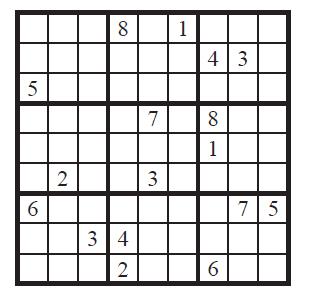
Gary McGuire of University College Dublin shows in a proof posted online 1 January that the minimum number of clues – or starting digits – needed to complete a puzzle is 17 (see sample puzzle, pictured, from McGuire’s paper), as puzzles with 16 clues or less do not have an unique solution. In comparison most newspaper puzzles have around 25 clues, with the difficulty of the puzzle decreasing as more clues are given.

The emerging consensus among mathematicians at a conference in Boston on 7 January was that McGuire’s proof is likely valid and an important advance in the growing field of Sudoku maths.

“The approach is reasonable and it’s plausible. I’d say the attitude is one of cautious optimism,” says Jason Rosenhouse, a mathematician at James Madison University in Harrisonburg, Virginia, and the co-author of a newly released book on the maths of Sudoku.

The rules of Sudoku require puzzlers to fill out a 9X9 grid with the numbers 1-9 in such a way that no digits is repeated within the same column, row, or within one of nine 3X3 subgrids. The clues are numbers that are filled in to begin with and enthusiasts have long observed that while there are a small number of puzzles with 17 clues, no one has been able to come up with a valid 16 clue puzzle. Continue reading

‘Zombie’ fly parasite killing honeybees

Cross-posted from Scientific American‘s Observations blog on behalf of Katherine Harmon.

A heap of dead bees was supposed to become food for a newly captured praying mantis. Instead, the pile ended up revealing a previously unrecognized suspect in colony collapse disorder — a mysterious condition that for several years has been causing declines in US honeybee populations, which are needed to pollinate many important crops. This new potential culprit is a bizarre — and potentially devastating — parasitic fly that has been taking over the bodies of honeybees (Apis mellifera) in Northern California.

John Hafernik, a biology professor at San Francisco State University, had collected some belly-up bees from the ground underneath lights around the university’s biology building. “But being an absent-minded professor,” he noted in a prepared statement, “I left them in a vial on my desk and forgot about them.” He soon got a shock. “The next time I looked at the vial, there were all these fly pupae surrounding the bees,” he said. A fly (Apocephalus borealis) had inserted its eggs into the bees, using their bodies as a home for its developing larvae. And the invaders had somehow led the bees from their hives to their deaths. A detailed description of the newly documented relationship was published online Tuesday in PLoS ONE.

The team performed a genetic analysis of the fly and found that it is the same species that has previously been documented to parasitize bumblebee as well as paper-wasp populations. That this parasite hasn’t previously been reported as a honeybee killer came as a surprise, given that “honeybees are among the best-studied insects of the world”, Hafernik said. “We would expect that if this has been a long-term parasite of honeybees, we would have noticed.”

The team found evidence of the fly in 77% of the hives they sampled in the Bay Area of California, as well as in some hives in the state’s agricultural Central Valley and in South Dakota. Previous research has found evidence that mites, a virus, a fungus, or a combination of these factors might be responsible for the widespread colony collapse. (Read more about colony collapse disorder in our feature Solving the Mystery of the Vanishing Bees.) And with the discovery that this parasitic fly has been quietly killing bees in at least three areas, it might join the list of possible forces behind colony collapse disorder.

Read the rest of this story on Scientific American.

Image: Parasitic fly larva emerging from a dead bee’s neck. Courtesy of John Hafernik.

Wildfires threaten Patagonia’s biodiversity

Posted on behalf of Patricio Segura Ortiz.

Fifteen thousand hectares of native forest and steppe have gone up in smoke since forest fires started raging last week in the Torres del Paine National Park in Patagonia,  one of Chile’s most important protected areas.

The 180,000-hectare park was declared a UNESCO Biosphere Reserve in 1978 for its remarkable beauty, with peaks, cliffs, glaciers, waterfalls, rivers, lakes and lagoons adorning the scenery. It is home to some of the world’s most unique ecosystems, such as Pre-Andean scrublands, the deciduous Magellan Forest, Patagonian Steppes, and Andean desert. Of these, the wildfires have affected 4% of the deciduous Magellan Forest, 30% of the Pre-Andean scrublands and 65% of the Patagonian Steppe, according to Eduardo Katz, manager of Protected Areas of Chile’s National Forest Corporation, in an interview with BBC World.

This year’s fires exceed the destruction of the one that raged in February 2005, when 14,000 hectares burned, and an earlier one on February 1985, which destroyed a similar area. In 1970 and 1990 two smaller fires affected around 500 hectares each.

Continue reading

Missing medical data could harm patients

Cross posted from Scientific American’s Observations blog on behalf of Katherine Harmon.

Big clinical trials—to test new drugs or procedures—generate reams of important data about safety and efficacy. Only a fraction of that information sees the light of day, a publishing practice that could put patients at risk, according to a special report published this week in the British Medical Journal (BMJ).

Even though scientific and medical journals are loaded with what might seem like endless reports—and lengthy methodology descriptions–from clinical trails each year, about half of clinical trial results go unpublished, An-Wen Chan, of the University of Toronto’s Women’s College Research Institute, noted in one of the seven new papers in the BMJ special section. Published results typically lack details about how studies were conducted and outcomes for individual participants. Although these particulars might seem negligible or dull to a causal reader, “the overall result is that the published literature tends to overestimate the efficacy and underestimate the harms of a given intervention,” she noted.

Even major trials for drugs submitted to the U.S. Food and Drug Administration (FDA) contained substantial data holes in their published reports, according to one new analysis. A San Francisco- and Denmark-based team performed meta-analyses that included previously unpublished data for nine drugs that were submitted for FDA approval. With this newly included data, they found that 38 of 41 meta-analyses about these drugs were off: 19 of them overestimated the efficacy of the drug, and 19 of them underestimated it. It can be difficult to get a journal to publish—or a drug company to support publication of—harmful—or null, i.e. “negative”–results from a trial. But, as that paper’s authors noted, “when unfavorable results of drug trails are not published, meta-analyses and systematic reviews that are based only on published data may overestimate the efficacy of the drugs.”

Read the rest of this story on Scientific American.