What really happened in Malta this September when contagious bird flu was first announced

Cross posted from Scientific American’s Observations blog on behalf of Katherine Harmon.

A controversy over whether the U.S. government should allow details of a deadly new flu strain to be published in scientific journals has recently caught fire in the media. But I first heard the news of the mutated virus months ago in Malta at the European Scientific Working group on Influenza (ESWI) meeting.

The morning was sunny and warm on September 12 in St. Julian’s. Inside the Intercontinental hotel and conference center, young researchers, jaded veteran scientists and jet-lagged policy makers piled their plates with softly scrambled eggs, American-style sausages and an obligatory piece of fruit or two, shoveling in the offerings and mumbling hellos, in the bright, sky-lit hotel restaurant.

Just across the hall, however, in the cannily named Eden Arena (pictured), the room was dark, as researchers prepared to mount the stage and explain some of the many ways that humanity might soon be threatened by a truly terrifying flu pandemic.

So maybe it wasn’t quite that dramatic, but perhaps it should have felt more so. Less than an hour later, a suspiciously sniffly Ron Fouchier, a lanky virologist from the Erasmus Medical Center in Rotterdam with a wry smile and reassuringly understated manner, would announce that he and his lab had found a way to make the deadly H5N1 that would likely be just as transmissible from one human to the next as the seasonal flu.

Circulating seasonal strains, such as H3N2, are adept at attaching to the human nasal cavity and trachea, making them easily transferable among people via a sneeze, cough or sigh. But fortunately for us, H5N1, as it has circulated in bird populations, has not yet developed this capability. Fouchier and his team wanted to see if it was possible to give it that power.

So they “mutated the hell out of H5N1,” Fouchier said, towering over the podium at the meeting’s Monday morning plenary session. But as it turns out, they hardly needed to. With just a few genetic substitutions, the virus was able to affix to nose and trachea cells—a development “which seemed to be very bad news,” he said. Fortunately for the lab’s test ferrets, a common animal model for human flu transmission, the flu still didn’t seem to pass airborne from animal to animal.

And that was when “someone finally convinced me to do something really, really stupid,” Fouchier recounted. They put the mutated H5N1 into the nose of one ferret, then took a sample of nasal fluid from that ferret and put it in the nose of another. After 10 ferrets, the virus began spreading from ferret to ferret via the air just about as easily as a seasonal flu virus.

Read the rest of this post at Scientific American. Image courtesy of Katherine Harmon.
Science’s breakthroughs of the year

Like most publications, our friends over at Science have compiled a “best of 2011” list — in their case setting out their top 10 breakthroughs of the year. (Don’t miss our own end-of-year special, featuring our newsmakers of the year and 2011’s best science photos).

We wrote about many of the stories on Science‘s list in our news coverage this year. So here is Nature’s take on Science’s breakthroughs of the year.

Number one on Science’s list was the discovery that antiretroviral treatments for HIV could double as prevention. The drugs, when given to those infected with the virus, not only help the patient, but also reduce transmission to their partners by up to 96%.

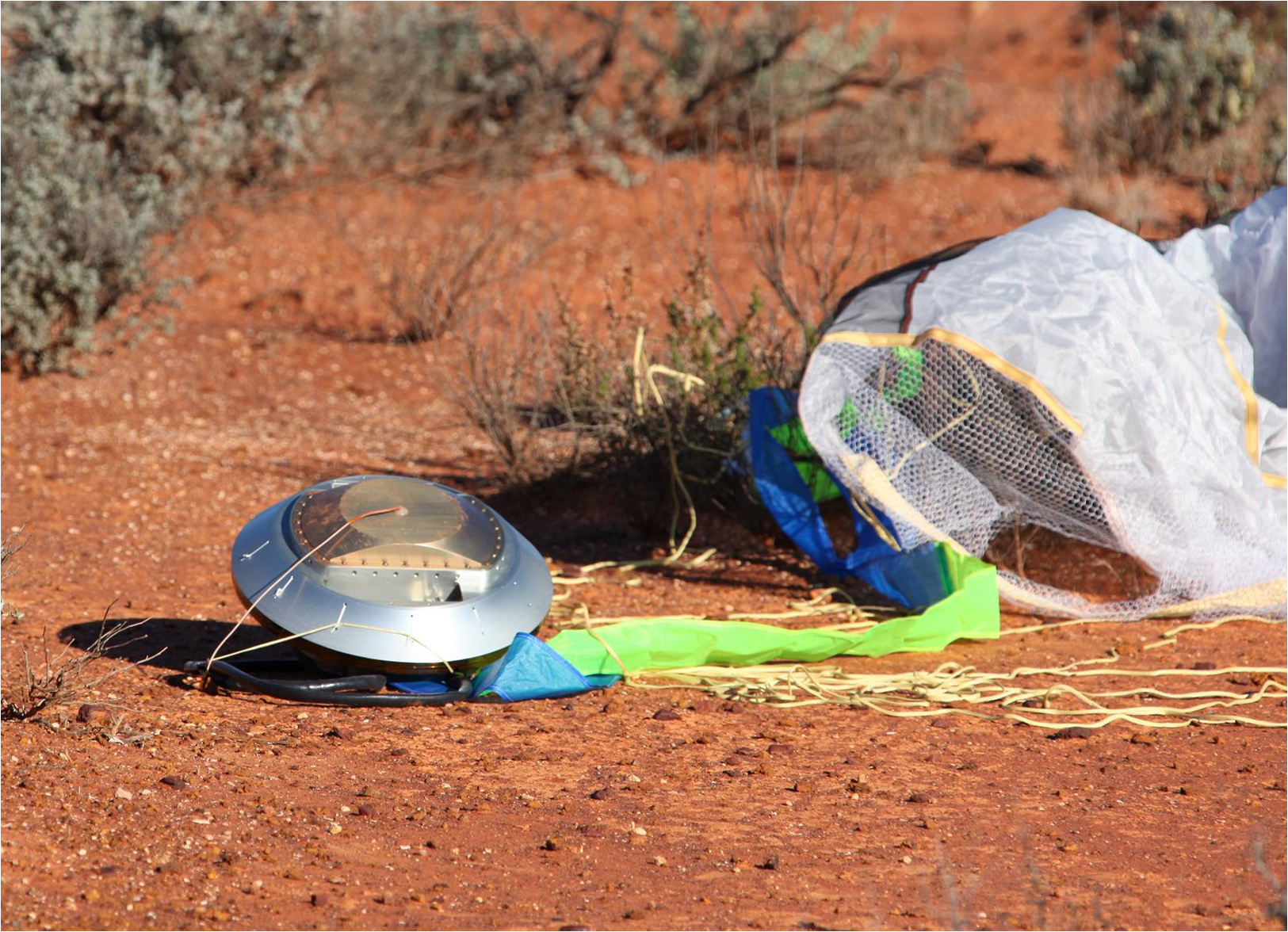
Japan’s Hayabusa probe returned samples of dust from the asteroid Itokawa (pictured), after a harrowing trip where nearly everything that could go wrong, did. The samples helped to settle the mystery about why asteroids are a different colour than most of the meteorites that fall to Earth (answer: the solar wind has discoloured the asteroids). Continue reading

Thousands of old manuscripts burned amidst renewed clashes in Cairo

Cross-posted from Nature Middle East’s House of Wisdom blog on behalf of Mohammed Yahia.

A page from the Description de l'Égypt book.

Renewed clashes between protesters and soldiers over the weekend near Tahrir Square, the epicentre of Egypt’s January revolution,  saw the Institut d’Egypte,  home to some of Egypt’s oldest manuscripts and books, set on fire.

Ismail Serageldin, director of the Library of Alexandria, commented on his Twitter account that the institute, Egypt’s Academy of Science, was the second oldest modern academy outside Europe, after the American Philosophical Society. “Priceless manuscripts and irreplaceable books are lost.”

Nobody is sure who started the fire, but it quickly spread through the building. Fire trucks very close by the academy did not move to put out the fire. Protesters tried to put it out but it was in vain. Hundreds of protesters tried to rush in and save as many books and manuscripts as possible.

The academy was home to over 200,000 old maps, manuscripts and books. However, the protesters managed to save only 30,000 of those — many in poor condition from the fire.

The academy was originally built by Napoleon Bonaparte and his scientists in 1798 during his campaign to invade Egypt. The most precious book in the academy was the original copy of the Description de l’Égypt, a book compiled by more than 150 of Napoleon’s scientists and scholars from data gathered between 1809 and 1821, and some 2,000 artists and technicians. They produced 20 volumes of text that offered a detailed peek into Egypt’s contemporary and ancient histories at that time.

Unfortunately, the nine volumes of the book that were in the academy were lost. There are three other copies that remain, however. The Library of Alexandria has also digitized all 20 volumes for protection and to make them more accessible to the public.

Serageldin lamented the ongoing clashes and the burning down of the Academy of Science. “Learning and knowledge are additional victims,” he said on Twitter.

Read more on Nature‘s Arab Spring news special and on the House of Wisdom.

Croatia’s largest research institute hit by tax evasion charges

Posted on behalf of Mico Tatalovic.

The largest public research institute in Croatia, Ruđer Bošković Institute in Zagreb, has been found to have evaded tax payments, mainly through fictitious student contracts.

The Ministry of Finance’s tax administration report, released last week, found that the institute failed to pay 7.5 million Kuna (around US$1.3 million) in tax through various illegal activities in 2008. For example, researchers claimed around 2.2 million Kuna for paying expenses to student volunteers through false contracts for students who did not work at the institute.

The report looks at finances for 2008, before executive director Danica Ramljak joined the institute.

Continue reading

Video animation: RNA interference

Our colleagues over at Nature Reviews Genetics have put together this very cool animation of RNA interference. Check it out.

You are currently viewing a placeholder content from YouTube. To access the actual content, click the button below. Please note that doing so will share data with third-party providers.

More Information

RNA interference (RNAi) is an important pathway that is used in many different organisms to regulate gene expression. This animation introduces the principles of RNAi involving small interfering RNAs (siRNAs) and microRNAs (miRNAs). We take you on an audio-visual journey through the steps of gene expression and show you an up-to-date view of how RNAi can silence specific mRNAs in the cytoplasm.

2-degree global warming limit is a ‘prescription for disaster’, says Hansen

Cross posted from Scientific American’s Observations blog on behalf of Mark Fischetti.

A mantra that has driven global negotiations on carbon dioxide emissions for years has been that policy-makers must prevent warming of more than two degrees Celsius to prevent apocalyptic climate outcomes. And, two degrees has been a point of no return, a limit directly or indirectly agreed to by negotiators at international climate talks.

James Hansen, director of the NASA Goddard Institute for Space Studies in New York, whose data since the 1980s has been central to setting that benchmark, said on Tuesday that two degrees is too much.

New, extensive study of the paleoclimate record going back 50 million years by Hansen and others now shows that the two-degree target for global temperature rise “is a prescription for disaster,” Hansen said here at a news conference during the American Geophysical Union meeting.

Hansen came to that conclusion after reviewing average and extreme perturbations in the paleoclimate record that have been more thoroughly documented in the past few years. The record shows that 50 million years ago, Earth was free of ice, and sea level was 70 meters higher on average than it is today. Both phenomena resulted from natural variations in mean temperatures due to slight changes in the sun’s output and Earth’s orbit over geological time scales. Rising temperatures today, over far shorter time scales in which neither the sun nor the orbit are factors, are caused primarily by higher levels of CO2 and other greenhouse gases in the atmosphere.

Read the rest of this post over on Scientific American’s blog.

More salmon shenanigans in British Columbia

sockeye salmon.jpgPosted on behalf of Anne Casselman.

Whether or not infectious salmon anemia (ISA) has spread among British Columbia’s wild salmon is the latest controversy in a protracted debate about whether farmed salmon endanger wild stock (pictured) in the Pacific Northwest.

A row has erupted over the revelation that the Department of Fisheries and Oceans, Canada’s federal fisheries agency, kept the lid on a study that detected an ISA-like virus in 100 wild fish back in 2002. According to The Seattle Times, the incident raises doubts among environmentalists and US politicians alike as to how well equipped the DFO is to handle such threats given its dual mandate to safeguard and manage wild fish while promoting salmon farms.

This recent outing of subterfuge comes hot on the heels of an announcement made in mid-October by Simon Fraser University biologist Rick Routledge that ISA was present in two out of 48 young salmon from Rivers Inlet, British Columbia. For all anyone knew, Routledge’s discovery was the first reported case of ISA in wild salmon. But with the revelation of the 2002 DFO report, it appears that may not be the case.

Wild fish advocates have long feared that open-net farms of Atlantic salmon reared along the Pacific coast might endanger local wild salmon by exposing them to new diseases. Whether these whispers of ISA represents their worse fears realized remains to be seen, as the data is inconclusive and has yet to be corroborated.

Continue reading

Could crowd sourcing provide the next genetics breakthrough?

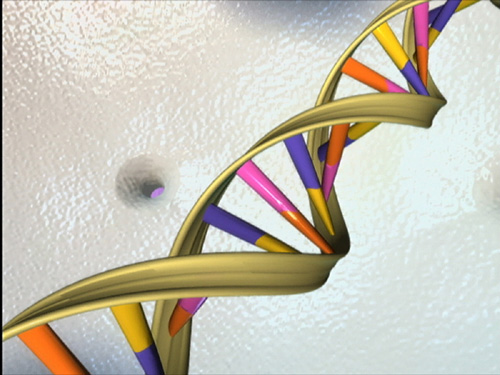
dna.jpgPosted on behalf of Zoë Corbyn.

A wealth of extra free genetic data could be at scientists’ fingertips if a new website allowing the public to make their test results available gets enough traction.

OpenSNP provides a way for people who have had tests carried out by direct-to-consumer genetic testing companies – so far 23andMe, deCODEme and Family Tree DNA are supported – to upload their raw results online along with personal characteristics they wish to share from their eye colour to artistic ability to coffee consumption. Everyone can see the resulting data and download it, including scientists.

The non-profit hobby project, developed by three master’s degree students and a web developer, has just won first place – worth $10,001 – in the inaugural API Binary Battle, a competition funded by the paper sharing site Mendeley and the open access publishers Public Library of Science (PLoS) to build applications to make science more open while tapping into either or both platforms.

Continue reading

UK pumps £200m back into scientific infrastructure

British chancellor George Osborne announced £200 million (US$314 million) for science infrastructure projects in his annual Autumn Statement today.

The new money includes £82 million for the next phase of the Institute of Animal Health’s Pirbright laboratory redevelopment, £62 million to Research Councils UK for capital investment, £25 million for demonstration projects in fields such as smart energy grids and low-carbon vehicles, £20 million for Earth-monitoring satellites (which is intended to attract further private investment) and £13 million for new scientific computing infrastructure.

The investment is part of the government’s updated National Infrastructure Plan, which includes an additional £5 billion for infrastructure projects, funded by further cuts in spending elsewhere, in an attempt to stave off recession.

Continue reading

Scientists make the ‘perfect’ foam

foam1.pngPosted on behalf of Philip Ball.

Physicists working at Trinity College in Dublin, Ireland, have finally made the perfect foam. Whereas most Dubliners might consider that to be the head on a pint of Guinness, Denis Weaire and his colleagues have a more sophisticated answer.

‘Perfect’ here means the lowest-energy configuration of packed bubbles of equal size. This is a compromise between the surface area of the bubbles and the stability of the many interlocking faces of the polyhedral bubbles in the foam. The Belgian scientist J. A. P. Plateau calculated in the nineteenth century that three soaps films are mechanically stable when they meet at angles of 120 degrees, whereas four films meet at the tetrahedral angle of about 109.5 degrees.

So what bubble shape minimizes the total surface area while (more or less) satisfying Plateau’s rules? That’s essentially the same as asking what shape balloons, or any squashy spheres, will adopt when squeezed together. Scientists including the French zoologist Georges Buffon have pondered that question, using lead shot and garden peas, for centuries. The Irish scientist Lord Kelvin thought he had the answer in 1887: the ‘perfect foam’ is one in which the cells are truncated octahedra, with eight hexagonal faces and six square ones — provided that the faces are a little curved to better fit Plateau’s rules.

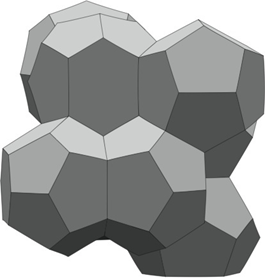
Kelvin’s solution was thought to be optimal for a long time, but there was no formal proof. Then, in 1994, Weaire and his colleague Robert Phelan found a better way. It wasn’t so elegant — the structure had a repeating unit of 8 polyhedra, 6 of them with 14 faces and 2 with 12, all with hexagons and imperfect pentagons and, again, slightly curved (pictured, top). This has 0.3% less surface area than Kelvin’s foam.

Continue reading