Gold motifs from Tutankhamun’s tomb hint at Levantine influence

Photographer: Christian Eckmann

Photographer: Christian Eckmann{credit}RGZM, DAI Cairo and University of Tübingen{/credit}

Tutankhamun’s tomb is the gift that keeps on giving, it seems, as archaeologists continue to uncover new “treasures” after examining, for the first time, embossed gold applications on artifacts recovered from the famed tomb.

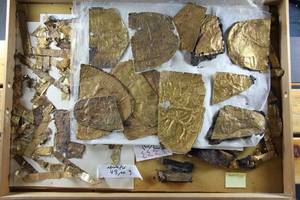
The objects, along with the tomb itself, were previously unearthed by English archaeologist Howard Carter in 1922 and, for decades, had been stowed away in the Egyptian Museum. Now, archaeologists from Tübingen University have painstakingly restored and analyzed the motifs adorning the tomb a century after the historical discovery. And according to their observations, the art on the motifs – images of battling animals and goats – is foreign to Egypt and betrays strong Middle Eastern, specifically levantine, aesthetic influence.

“Presumably these motifs, which were once developed in Mesopotamia, made their way to the Mediterranean region and Egypt via Syria,” says Peter Pfälzner, leader of the team of archaeologists and conservators. According to the lead archaeologist, the images from the Pharaoh’s tomb resemble those previously found on a tomb in the Syrian Royal city of Qatna, discovered during a dig in 2002.

“This again shows the great role that ancient Syria played in the dissemination of culture during the Bronze Age.”

The next step, says Pfälzner, lies in solving the riddle of how the foreign motifs came to be adopted in Egypt to begin with.

The origins of cats

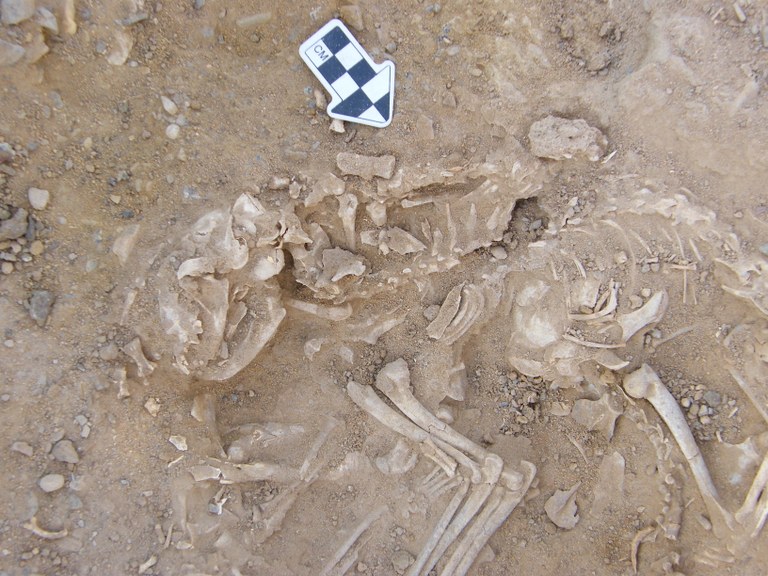
One of the cat skeletons excavated from a site in Egypt.

One of the cat skeletons excavated from a site in Egypt.{credit}© Hierakonpolis Expedition{/credit}

A new study reveals some fascinating insights into the origin story of the cat, arguably the internet’s most favorite creature and a cherished companion to countless humans.

Paleogeneticist Claudio Ottoni and his peers from KU Leuven and the Royal Belgian Institute of Natural Sciences have been collecting DNA from several archaeological sites in an attempt to track down the origins and trace the ancient journeys of the domestic cat.

The scientists unearthed over 200 cat skeletons from sites in Africa, Europe and the Near East and scrutinized DNA from feline skin, hair, bones and teeth that date back to between 100 and 9,000 years ago.

The result? A revelation about how cats dispersed in the ancient world. According to the study, the domestic cat we know today originated in ancient Egypt and the Near East.

Back then, the cats had stripes, not spots – the latter cropped up during the Middle Ages, but not before. The Middle Ages is also when the cat’s coat color had started to become variant.

The ancient felines were domesticated some 10,000 years ago, mostly by farmers wishing to chase away rodents from their fields. When the farmers moved, the cats moved with them. They also spread across the old world through trade, hopping on ships to protect stocks from vermin, and jumping from one port to the next, eventually covering long distances, and traveling far and wide. Now, the domestic cat is present on all continents except Antarctica.

The cats can all be traced back to one Felis silvestris, also known as the African wildcat, originally a feral, territorial and solitary hunter. Both the Near Eastern and Egyptian populations of Felis silvestris, according to the study, contributed to the gene pool of the domestic cat at different historical times.


2014 Year in Review: Nature Middle East highlights

In retrospect, 2014 was a mixed bag for the region – with some significant research produced on one hand, but on the other, in some countries, education, health and sectors in academia received some hard blows as a result of conflict and war.

In Syria for instance, the risk of infectious diseases is at its highest, warned a study published in PLOS Pathogens. The crisis was branded “a public health emergency of global concern” – with vaccine-preventable diseases not only reappearing in Syria but spreading to other countries with the outpouring of refugees, such as Lebanon and Iraq, which itself is reeling from years of damage to infrastructure and a myriad of health disasters.

Outbreaks of polio were reported – years after the Middle East was deemed “clean” – with WHO, UNICEF and ministries of health rushing to contain it. But even the largest vaccination campaign in the region’s history couldn’t reach its target as hundreds of thousands of children remain vaccinated, especially with access to hot zones barred.

Measles and rubella continue to be a burden in Syria, and in one instance, the vaccine killed instead of saved. At least 15 children died last September after being administered vaccines that were wrongly formulated, probably turning families away from seeking it and leaving many children unprotected.

Also in Syria, the lack of medical personnel is forcing untrained volunteers to tend to the injured and sick in hospitals.

Adding insult to injury, a study in The Lancet this year says that civilians aren’t even a priority for hospitals in a country like Syria, torn by civil wars. Fighters take up the majority of the available spots. In other hospitals, doctors risk their lives when they treat patients from the “opposite camps.”

In Iraq, the Islamic State (IS) is spreading its own brand of terror – taking over big universities and closing them down, including the historic University of Mosul. The education hubs are now used as makeshift camps for the militants. An independent Baghdad-based research tells Nature Middle East that soon conducting quality research in Iraq will be impossible. Skilled professors are already migrating in droves, in fear for their lives. “Many won’t come back even if the conflict ends,” says the researcher.

The International Center for Agricultural Research in the Dry Areas (ICARDA) conservation agriculture project that helps local farmers increase food production has been in jeopardy in Iraq since IS takeover. Insecurity, fuel shortages and lack of necessary equipment is breaking them, they decry.

Nearby, an estimated 3,900 schools in Syria had been destroyed or closed down during the first two years of the war. By April 2013, “22% of the country’s 22,000 schools [were] rendered unusable,” according to UNICEF.

The year 2014 also saw a comeback by Middle East respiratory syndrome coronavirus (MERS-CoV), which killed and inflected hundreds worldwide across 19 countries, with most of the infections concentrated in Saudi Arabia, where the virus was first discovered.

Nature Middle East was lucky to exclusively speak to the Egyptian virologist who first identified the virus, telling us the story of “patient zero” who died from an acute respiratory condition which was later revealed to be MERS itself. The mystery of MERS’ transmission was not lifted in 2014, but at least some countries are speeding up research into antiviral drugs that could contain it, or hinder its spread. Still, the fact remains, there are no anti-MERS drugs on the market so far.

In fact, overall things have been going south – health wise – for many in the region; not counting conflict victims and health complications due to war. A silent yet lethal predator, diabetes, has been preying upon the masses – with 35 million diagnosed with type 2 diabetes in the region.

Essentially, we have the  highest prevalence level of  in the world – with 1 in every 10 people living with it. Type 2 is tied to lifestyle, while type 1 has to do with genetics, autoimmune and environmental factors – and the incidence of the latter is rising sharply.

The highest rate of type 1 diabetes is in Saudi Arabia, with a shocking incidence of 14,900 children living with the disease, approximately a quarter of those in the Middle East and North Africa.

But in slightly better news, the region has managed (so far) to evade Ebola, which transmits through direct contact with bodily fluids and gains access to the body through skin abrasions and mucous membranes. The virus, however, has culled many in the central parts of Africa, and has fatality rates of up to 90%.

In terms of research, the region has been more prolific. Nature Middle East‘s chief editor Mohammed Yahia writes about the freshly released Nature Index, which was released in November and tracks where high impact research is being conducted around the world, and it shows many positive trends in the region – with Saudi Arabia leading with 358 papers, followed by Egypt.

Examples of prominent regional research includes one showing how Neolithic North Africans began exploiting cereal crops at least 500 years earlier than previously thought, published in PLOS ONE. The earliest evidence of cereal crop domestication in North Africa comes from the Fayum area of middle Egypt, and dates back to around 4350 BC.

In Lebanon, researchers from the American University of Beirut identified an algae species that can be a possible source of superfood and cheap renewable energy. In neighboring Syria, it turns out, two areas have the world’s highest concentration of wild-growing crops. The potential for these crops, distantly related to today’s agriculturally produced crops, lies in their gene pool, and adaptability – something that can provide breeders with genes that could enhance crop resistance to stresses such as climate change, pests, and disease.

Other breakthroughs include: In Sudan, a stunning discovery of a 3,000-year-old skeleton with metastatic carcinoma challenges the notion that cancer is a modern disease, opening new horizons for specialists to research cancer’s etiology and evolution. The ancient Nubian is probably the first cancer victim in archaeological record. As well, dinosaurs lived in Saudi Arabia, it seems. Fossilized remains identify specific dinosaur species from millions of years ago in the Arabian Peninsula when the area was covered by lush vegetation.

That being said, this year was not easy on the region, and infrastructures that provide the backbone of scientific endeavors have bore the brunt of political upheavals. In terms of progress – if we choose to compare notes with developed countries – we’re only barely inching forward.

Independent or university-backed research in the Arab world, collaborations with world-class institutions notwithstanding, is not enough to help Arab-affiliated researchers catch up with an incredibly prolific West. Governments must step in, opines Nobel laureate Ahmed Zewail and the academic president of Zewail City of Science and Technology Sherif Sedky.

“Renaissance in the Arab world will not be possible without genuine government recognition of the critical role of science in development and policies providing commensurate funding for basic research and reform of rigid bureaucracy which thwarts progress,” the experts say.

And considering it’s politics that seems to be setting the region back, Zewail and Sedky’s words ring true.

It is essentially a tug of war – between competent scientists and experts who’re aspiring to propel this region into the future, and governments staggering to make ends meet for their people, giving science a cold shoulder in the process. The next year may not tell us who wins, but it may very well give us indications – through statistics above all – of who is tugging harder.

Tomb of ancient Egypt chief physician unearthed in Giza

The massive tomb carries the mark of elevated status.

The massive tomb carries the mark of elevated status.{credit}Arab Republic of Egypt Ministry of State for Antiquities Affairs{/credit}

The tomb of a top ancient Egyptian physician, who treated royals, was discovered in the Abusir necropolis, a site of excavations just 25 kilometres south of Cairo. A Czech archaeological mission unearthed the limestone tomb last week, confirming through press interviews and on its Facebook page that the tomb does indeed belong to the head of the physicians of the north and south of Egypt some 4,400 years ago.

Shepseskaf-Ankh, which translates to “Shepseskaf is living,” was associated with royalty, including a ruler of Egypt named Niuserre. The same site, which shelters the remains of 14 pyramids, served as the resting place of two other physicians from the fifth dynasty, as well as Old Kingdom rulers and a number of high temple priests close to the kings.

The architecture of the tomb, and its size, stretching across 21 by 14 meters and rising up 4 meters in height as well as housing an open court and eight burial chambers, gives away the high and noble status of the chief physician—who is believed to come from an elite Egyptian family, according to Ali Al-Asfar, deputy head of the ancient Egyptian section of the Ministry of State of Antiquities.

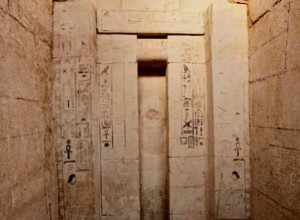
In one section of the tomb, a false door carries some of the ancient doctor’s prestigious titles, including Priest of Ra—the sun god—and Priest of Magic.

Miroslav Bárta, director of the archaeological team from the Czech Institute of Egyptology, told the National Geographic that he is pleased with the historical details contained in the tomb. “This microcosmos illustrates general trends that ruled the society of the day,” he said. “This is exactly the moment when the empire starts to break down due to rising expenses and increasing independence of powerful families.”

Thousands of old manuscripts burned amidst renewed clashes in Cairo

Cross-posted from Nature Middle East’s House of Wisdom blog on behalf of Mohammed Yahia.

A page from the Description de l'Égypt book.

Renewed clashes between protesters and soldiers over the weekend near Tahrir Square, the epicentre of Egypt’s January revolution,  saw the Institut d’Egypte,  home to some of Egypt’s oldest manuscripts and books, set on fire.

Ismail Serageldin, director of the Library of Alexandria, commented on his Twitter account that the institute, Egypt’s Academy of Science, was the second oldest modern academy outside Europe, after the American Philosophical Society. “Priceless manuscripts and irreplaceable books are lost.”

Nobody is sure who started the fire, but it quickly spread through the building. Fire trucks very close by the academy did not move to put out the fire. Protesters tried to put it out but it was in vain. Hundreds of protesters tried to rush in and save as many books and manuscripts as possible.

The academy was home to over 200,000 old maps, manuscripts and books. However, the protesters managed to save only 30,000 of those — many in poor condition from the fire.

The academy was originally built by Napoleon Bonaparte and his scientists in 1798 during his campaign to invade Egypt. The most precious book in the academy was the original copy of the Description de l’Égypt, a book compiled by more than 150 of Napoleon’s scientists and scholars from data gathered between 1809 and 1821, and some 2,000 artists and technicians. They produced 20 volumes of text that offered a detailed peek into Egypt’s contemporary and ancient histories at that time.

Unfortunately, the nine volumes of the book that were in the academy were lost. There are three other copies that remain, however. The Library of Alexandria has also digitized all 20 volumes for protection and to make them more accessible to the public.

Serageldin lamented the ongoing clashes and the burning down of the Academy of Science. “Learning and knowledge are additional victims,” he said on Twitter.

Read more on Nature‘s Arab Spring news special and on the House of Wisdom.

Science Across Egypt© Project

gihan.png This week’s guest blogger is Gihan Samy Soliman, an Educational Consultant & Master’s Researcher at the Institute of Environmental Studies & Research, Ain Shams University.

Since 1936, when Egypt became a party to the Convention Relative to the Preservation of Fauna and Flora in their Natural State, they have been among the pioneering countries taking an active interest in the conservation of biodiversity and the preservation of natural resources. In 1992, Egypt signed the Biodiversity Convention of Rio de Janeiro and ratification of this Convention was completed in 1994. This Convention required the parties to formulate national strategies setting a framework for the conservation of biological diversity (biodiversity). Although much “technical” attention has been paid to biodiversity in Egypt, with many conferences, recommendations and ratification of laws, the problem of an evidently defective system of education in Egypt means that the right information on conservation doesn’t seem to reach the right people: students.

fig 1.jpg

Teaching methods in Egypt need to be addressed, particularly in relation to biodiversity. Biodiversity is the degree of variation of life forms within a given ecosystem and is a measure of the health of ecosystems. Biologists define biodiversity as the “totality of genes, species, and ecosystems of a region.” For students in the US, biodiversity is studied as a science; students can explore textbooks and review material according to their curriculum, which is usually based on each state’s learning standards (Figure 1). However, in Egypt there is hardly any real relationship between science and the environment, making learning about these issues difficult.

Several attempts at reform have been made to enhance science education in Egypt and raise awareness of biodiversity issues. However, they’re usually confined to issuing books, booklets, CDs and posters which are not systematically presented to students and end up sitting on school library shelves and hidden away in cupboards (e.g. www.biomapegypt.org ).

As an educational consultant working with Ahmed Abdel Azeem, Ph.D, I have started working with schools on a self-financing environmental and applied science project called Science Across Egypt©. The project’s aim is to integrate conservation of biological diversity into curricula and extra-curricular activities in “Egyptian schools”.:https://www.misrnewsagency.com/main/art.php?id=109&art=10914

fig 2.png

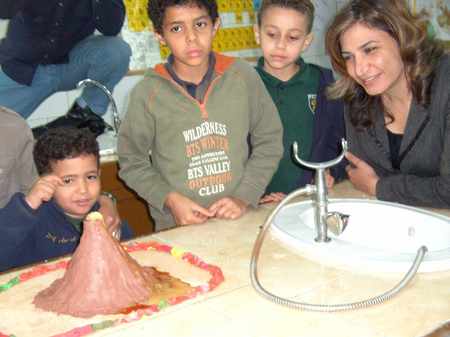
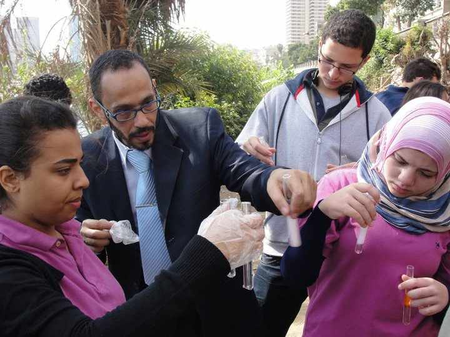
The Science Across Egypt project carries out many initiatives that aim to teach children more about the environment. As an example, on International Water Day on March 22, 2011, students of Port Said American School

were accompanied to the Nile River bank to celebrate the event and take water samples to measure the level of pollution onsite. They also campaigned for declaring the river Nile as a natural protectorate (Figure 2). The Media reported the event as being a unique opportunity for children to learn more about the environment.

fig 3.jpg

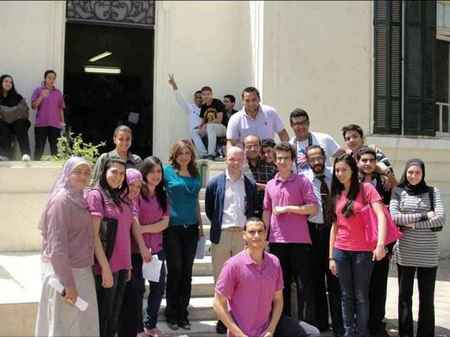
Reforming science education in Egypt will need more determined efforts on both national and international levels (Figure 3). Taking a step in this direction, for the first time in Egypt, a group of scientists and attentive community leaders have established an international Egyptian NGO (International Foundation for Environment Protections and Sustainability) to address the issues of biodiversity in Egypt (www.ifeps.org ). Will such efforts work? Let’s keep our fingers crossed.

FameLab: Secrets of successful science communicators

This Saturday evening The Times Cheltenham Science Festival in the United Kingdom will host the 2011 international final of the FameLab competition, featuring leading science communicators from Europe, Asia and the Middle East. Naturejobs caught up with three of the 14 finalists to get their tips on how you can improve the way you present and discuss your research to those outside your field.

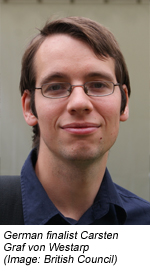
carsten.jpgCarsten Graf von Westarp, a PhD student from Germany studying semiconductor physics at the University of Hamburg, says the key to successful communication is to show how your research relates to everyday life. “Be aware of the interests of the audience or reader,” he says. Use simple language: keep technical terms to a minimum, and make sure you explain any that you do use.
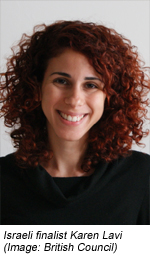
Another tip from Graf von Westarp is to show your fascination with your topic, advice that is echoed by the other two finalists. Karen Lavi, a PhD student studying memory and learning at the Bar-Ilan University and Haifa University in Israel, says enthusiasm is essential for good communication. “Keep in mind that [to you] your subject is the most interesting topic that ever existed — otherwise you wouldn’t have chosen to invest your whole life in it,” she says. “Try to pass on this feeling to your audience.”

karen.jpgFellow finalist Mahmoud Abu-khedr, a third-year student at the University of Alexandria in Egypt, agrees that talking from your heart is key, and adds that you also need to believe in the importance of science communication itself.
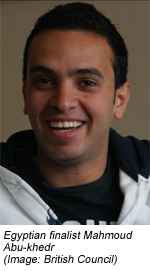
In addition, Lavi emphasises the power of using metaphors and story-telling, suggesting that you talk about your research as if it were a detective story rather than a presentation at a conference. She also recommends you try to personalise your audience — “Imagine you are talking with your mother,” she says — and make sure that you can sum up your entire talk in a few sentences: “What is the message your audience should take home with them? What will they tell their friends and family?”

mahmoud.jpgConsidering how you present yourself can also help you communicate better, says Abu-khedr. Remember to smile, and work on your charisma: “You have to act as well as present,” he says. Lavi adds that you should also inject some humour if you can. But don’t force it so that you become uncomfortable — it’s important to have confidence in yourself. “Be how you are,” concludes Abu-khedr.

Do you have any tips to add? Share your advice and experiences below. And best of luck to all the FameLab international finalists.

UPDATE: Congratulations to Karen Lavi and Mahmoud Abu-khedr, who took second and third places respectively in the competition. You can read more about the results on the FameLab website.