Would you return to your home country to set up a lab?

Last week EMBO announced the recipients of its 2011 Installation Grants – a round of funding that supports scientists who want to relocate to a country that is currently building its fundamental research capacity. The 2011 grants, which comprise an annual award of 50,000 euros for three to five years, will enable seven scientists to set up laboratories in the Czech Republic, Poland, Estonia and Turkey.

One of the recipients, Nurhan Özlü, has returned to her home country of Turkey after spending ten years in the United States. In an EMBO podcast, she says that for a junior group leader, establishing a lab in a country that’s growing its scientific capacity has several benefits, but she also has to adapt to a developing research infrastructure. “[In the United States] all the facilities, resources and services were available and if I purchased something it arrived the next day,” she says. “[In Turkey] experiments take a lot more effort and time.”

In a Nature Careers article on the topic from 2009, the head of a lab in the Czech Republic said that while the research infrastructure was comparable to Germany and the United States, it was necessary to assemble attractive salaries from several sources of funding.

Would you trade a scientific powerhouse such as the United States for a country with a less-developed research infrastructure if it meant you could set up your own lab? Have you already done so and thrived on the opportunity? Let us know your thoughts and experiences. The next application deadline for EMBO Installation Grants is 15 April 2012.

Sustainability is a fast-growing field, says study

The number of scientists publishing research relating to sustainability is doubling every eight years, according to research from Los Alamos National Laboratory and Indiana University in the United States.

Research into sustainability has become a field of science in its own right, say the study authors, and is growing exponentially despite the economic downturn of the late 2000s.

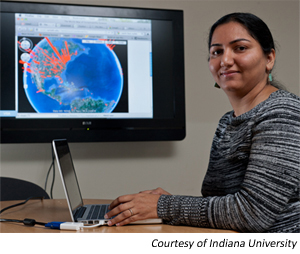
sustainability-kaur.jpgThe field has a wide geographic spread and is prominent in locations with political and economic power. “The world’s leading city in terms of publications in the field is Washington DC, outpacing the productivity of Boston or the Bay Area,” explains study co-author Jasleen Kaur (right), a PhD student in Indiana University Bloomington’s School of Informatics and Computing.

Bob Peoples, director of the American Chemical Society’s Green Chemistry Institute, based in Washington DC, was surprised that the city was top when it came to productivity, but said the high concentration of government bodies and non-governmental organisations (NGOs) could be a factor.

In Europe, productive cities include London, Stockholm and Wageningen. Other regional centres that produce a high number of papers include Nairobi, Cape Town, Beijing, Melbourne and Tokyo. Smaller universities and laboratories are strong in the field as well as national research centres.

But is the growth of the field in itself sustainable? Peoples believes so – and says it will translate into new job opportunities. The green chemistry industry, for example, “is forecast to grow to $100 billion by 2020,” he says. “That’s a 48% annual growth rate. This will certainly correlate with jobs since it requires different skill sets and training.”

Scientists interested in moving into sustainability research should build a multidisciplinary set of knowledge, contacts and tools, he advises. For green chemistry in particular, topics that researchers need an awareness of include mechanistic toxicology and life-cycle analysis as well as chemistry.

The productivity findings, published later this week in the Proceedings of the National Academy of Sciences, come from an analysis of more than 20,000 academic papers published between 1974 and 2010.

Related articles:

Number of new US science PhDs falls for first time in seven years

The number of science doctorates awarded in the United States fell by 1% in 2010, ending a seven-year run of annual increases.

The new figures from the National Science Foundation (NSF) also show that in the decade from 2000 to 2010, the number of PhDs in agricultural sciences and psychology both fell by more than 5% – whereas all other major science fields saw an increase in the number of PhDs.

Other key figures include the following:

  • Between 2005 and 2010, there was a 29% increase in the number of women receiving a science or engineering (S&E) PhD – more than double the increase seen for men (13%)
  • The share of S&E PhDs awarded to women increased from 38% in 2005 to 41% in 2010
  • The share of S&E PhDs awarded to US citizens and permanent residents who identify themselves as members of a minority group rose from 22% in 2005 to 24% in 2010

Improving work-life balance: US National Science Foundation wants your ideas

Do you have a creative suggestion for how to address issues with career-life balance in mathematics and physical sciences in the United States? If so the National Science Foundation (NSF) wants to hear from you. In an open letter published yesterday, NSF’s Edward Seidel called for the mathematics and physical sciences community to contribute to NSF’s recently launched Career-Life Balance Initiative.

Ideas specific to mathematics and physical sciences can be sent to MPSplans@nsf.gov.

General ideas for any scientific discipline can be sent to career-life-balance@nsf.gov.

Practices to improve work-life balance that NSF encourages include:

  • No-cost extensions or temporary suspensions of NSF awards due to family leave
  • Flexible start dates for NSF awards
  • Supplements for additional personnel to sustain research when principal investigators are on family leave
  • Options for remote panel participation
  • Local childcare recommendations for panellists
  • Flexible postdoctoral fellowships to accommodate dual-career placements

Engineering a path from science to business

Cross posted from the Trade Secrets blog

James Taylor

The folks at Nature Biotechnology asked us authors for a description of how we’ve navigated our careers from bench to business. My story is still a work in progress, but as a recent Ph.D. I do have some lessons for how you can prepare yourself for a career beyond research. First here’s a brief bio to give insight into my perspectives and biases.

I completed an Engineering Physics undergraduate degree at the University of British Columbia, with a focus on wireless and photonics. During this time, I worked at my first startups as an engineer, which ultimately sewed the entrepreneurial seeds. Following, I decided to pivot and apply my engineering skills to health and completed a Ph.D. in Genetics at the Institute for Systems Biology (ISB). My decision to conduct a Ph.D. was driven by my interest in the commercialization of advanced technologies and the ISB was a fantastically entrepreneurial organization to pursue this goal. Concurrent with my Ph.D., I was fortunate to work as a venture capital fellow at the ISB-affiliated venture capital firm, the Accelerator Corp. This was a tremendously valuable experience and during my three-year tenure, the Accelerator team started 7 biotech companies. After my Ph.D., I started looking for my next startup opportunity and met my co-founding team while working at an innovative technology transfer group, the Centre for Drug Research and Development. About 1.5 years ago I jumped ship to be a co-founder and CEO of Precision NanoSystems, where we are developing technology at the convergence of drug delivery, nanotechnology and genomics.

During my tenure as a Ph.D. student I often contemplated how to best use the degree to achieve my business goals, and as some of you are likely realizing, the path from bench to business is not always clear. Here are some lessons I learned during my degree that may be helpful for those wanting to pursue an entrepreneurial or business career:

Experience more than your Ph.D. offers

Graduate or postgraduate studies are designed as a scientific training ground for a career as a scientist or professor. The knowledge gained is narrow and the skills learned are specific. For anyone serious about transitioning off the bench, you will need to actively pursue additional experiences and skills outside of your research work.

Continue reading on the Trade Secrets blog

Ten tips on getting recruited abroad

At the recent Naturejobs Career Expo in London, Michael Schneider from Imperial College London spoke about how to maximise your chances of getting recruited overseas. Schneider, currently director of Imperial’s British Heart Foundation Centre of Research Excellence, studied at Harvard, the University of Pennsylvania, and Duke, followed by research training at the US National Institutes of Health (NIH). In our final follow-up to the Expo we present a summary of his advice – if you have any tips to share, please add them below.

  1. If you’re at an early stage of your science career, be aware that a strong academic record is not enough to secure a position abroad. “Posts go to those with something more [than excellent qualifications],” says Schneider.
  2. Early research experience is the key discriminator – and it should be sustained or unusually intensive.
  3. If you’re still studying, find high-impact summer and winter research opportunities – examples that Schneider highlighted include the Erasmus student exchange programme in Europe and the Cold Spring Harbor Undergraduate Research Program (URP) in the United States.
  4. You’ll need to make personal contacts with overseas scientists – and email is generally the best way to make initial speculative enquiries with overseas labs.
  5. Don’t focus exclusively on the usual suspects – in the United States for example, Schneider says there are at least a dozen universities where mentors are as good as at prestigious institutes such as Harvard, MIT, University of California and Stanford – but there is less competition because they are less well-known.
  6. Try to have complete research ‘stories’ – and be aware that for this reason completing a three-year PhD can put you at a disadvantage against those whose PhDs typically last longer, such as in the United States.
  7. Fund yourself if possible.
  8. Carefully check the eligibility criteria of funding opportunities – for example the US NIH only offers postdoc fellowships to US citizens, with one exception, says Schneider – the Pathway to Independence Award (K99-R00) is open to overseas applicants.
  9. When considering a career move, vertical promotion – where you move up within the same institution – can be counter-productive, says Schneider: “Research funders typically prefer to see relocation as proof of independence.”
  10. When considering who to apply to, make sure you check where your potential superior publishes, and also where their trainees have gone afterwards.

New podcasts on networking and moving to the United States

During the recent Naturejobs Career Expo in London we recorded interviews with two of our speakers, which are now available as podcasts on naturejobs.com.

Lisa Kozlowski from Thomas Jefferson University in Philadelphia spoke about moving to the United States at the Expo. Listen to the podcast for tips including what to expect from the working culture, how to adapt to the social culture, and some pointers on funding and visas.

In our second podcast, Madeline Paterson from Symmetry Coaching talks about networking – an important aspect of your job search or career development. The podcast includes tips on networking for introverts and online networking.

You can listen to more Naturejobs podcasts on the podcasts section of naturejobs.com.

Major survey of PhD students in Europe sheds light on working life

A survey of more than 7,500 PhD students from 12 European countries has highlighted the variety of doctoral experiences found across the continent.

There is significant variation in whether or not students receive a salary or scholarship while working on their PhD, with almost all respondents from Norway receiving funding compared with just over half of those in Austria.

The Eurodoc survey, published on 30 September, also reveals striking data related to gender issues and family life. Men were more likely than women to believe their gender would be a disadvantage in their academic career, while students in several supposedly ‘family-friendly’ countries reported strong pressure to delay having children, or to avoid taking parental leave if they do.

We’ve outlined some of the key findings below — have a read and let us know what you think.

The 12 countries featured in the survey were Austria, Belgium, Croatia, Finland, France, Germany, the Netherlands, Norway, Portugal, Slovenia, Spain and Sweden, and the majority of respondents were aged between 26 and 35.

Funding

The proportion of PhD students receiving a salary or scholarship varied significantly: 54% received funding in Austria, compared with 76% in Germany and 82% in France. Norway scored highest, with 98% of female students and 96% of male students receiving an income. When asked whether the level of funding met living costs, over 40% of students in the Netherlands, Norway and Sweden said it did to a very high extent, compared with fewer than 10% in Croatia, Portugal and Spain.

Family life

PhD students in Austria, France, Germany and the Netherlands are more likely to be single or not living with their partner: one-third or more compared with around one-fifth in the other countries. In most countries, fewer than one-quarter of students have children — the exceptions were Norway, where 40% have children, Sweden (31%) and Finland (30%).

Awareness of the right to parental leave varied hugely across the countries surveyed — just 1% of female PhD students in Croatia said they didn’t know whether they had the right to maternity leave (99% said they did have the right), compared with 32% in Austria and 31% in Germany.

Surprisingly, some of the countries with reputations for being particularly ‘family-friendly’ did not score well on family-related issues. More than 50% of respondents in Sweden, Norway and Finland said they are strongly discouraged from taking parental leave, compared with 18% in Spain, 30% in Germany and 34% in France. The pressure to delay having children in the first place also seems to be particularly high in the Nordic countries polled: over 70% of men and 50% of women in Sweden, Norway and Finland said they felt a great deal of pressure to postpone having children, compared with 28% of men and 16% of women in Spain and 44% of men and 32% of women in Germany.

Impact of gender on career prospects

According to the survey, male students were more likely than female students to feel that their gender will hold them back in academia. The proportion of men who said they were very disadvantaged in their academic career because of their gender ranged from 77% to 91% across the countries surveyed, compared with 36% to 61% of women.

Work experience and employment status

The highest number of PhD students who said they had no contract was in Austria (25%), compared with 17% in Germany, 12% in France and just 1% in Norway.

Students also reported differing levels of work experience between their previous degree and the beginning of their doctoral research. Around 68% of PhD students in France have none, compared with just 25% in Norway.

Productivity

In Germany, 33% of respondents said they had published at least one peer-reviewed article in an international journal so far, compared with 64% in Croatia. In the latter country, 15% of respondents said they had published five or more articles, compared with 4% in France and 2% in Germany.

Although over 40% of respondents in all countries bar Slovenia said they spend more than 21 hours a week on research related to their thesis or dissertation, around one-quarter said they don’t spend any time actually writing it. Students in France reported the highest administrative burden, with almost half saying they spend more than 21 hours a week on admin, compared with 33% in Norway and 23% in Slovenia.

Students in Finland were most likely to have been involved in writing grant proposals, with 75% reporting they had contributed compared with 32% in the Netherlands and 35% in France.

Mobility

In the majority of countries surveyed, less than half of respondents had studied abroad before starting their doctorate. Researchers in Spain and France were most likely to continue their career abroad after finishing their doctorate, and the most common reason given for wanting to work abroad was improved career prospects.

Have your say

What do you think about these findings? How do they compare to your experience? Let us know your thoughts below.

Nobel laureates share career insights with young scientists

Each year, young researchers from all over the world meet with Nobel prize-winners on the German island of Lindau to discuss the big questions in science. The 2011 meeting focused on the world’s greatest health challenges and how to tackle them, and the Nature Video team was on hand to capture the conversations on camera.

The young researchers in these films are working on malaria, cancer, viruses and more. They are also learning how to be scientists: how to write grant applications, how to collaborate with other research groups and how to find the right career path. See what advice the laureates offer — and what questions they have in return.

There are five films in the series, and one will be published each week from 15 September to 13 October.

29 September: Bench or bedside? with Ferid Murad

Camelia-Lucia Cimpianu is trying to decide between a career as a researcher or a practising doctor. In this film, she seeks advice from Nobel Laureate Ferid Murad who faced the same dilemma as a medical student in the 1960s.

22 September: Combating cancer with Edmond Fischer

Nobel Laureate Eddie Fischer was born in Shanghai in 1920. Since then, China has emerged as an economic superpower. Now it’s becoming a scientific heavyweight too. Tong Qing belongs to the newest generation of Chinese scientists. She decided to study cancer after a family friend became ill with breast cancer. In this film, she tells Fischer about life and research in China today.

To see more videos, go to the Nature Video Lindau collection website.

If you have any problems loading the videos, please try updating your Flash player.

38 tips on writing an academic CV

Many academic job vacancies have fairly basic application forms, so the main way you will get an interview is by having a very good academic CV, says Emma Baker, careers advisor for the graduate school at King’s College London. Baker outlined a number of tips for writing academic CVs at the 2011 Naturejobs Career Expo, held last week in London. Have a read and let us know what you think – if you have any to add, please leave a comment below.

Length

You may have heard that your CV shouldn’t be more than two pages long, but Baker says that doesn’t apply to academic CVs. “[Academia] seems to be the only field where you can make it as long as you want it to be,” she says. However, you’ll need to think carefully about the structure you use to make sure the length doesn’t put a potential employer off reading it.

Structure

The most important information should be on the first half of the first page, says Baker, and the very first thing should be your name, not the words ‘curriculum vitae’. Your contact details should be at the top of the first page and should include a professional-looking email address – avoid using an inappropriately worded personal account. Also be aware that your current work email address will most likely expire once you leave, so it may not be the best one to use. Baker adds that it’s no longer necessary to list your postal address on your CV, as most applications are done by email and the job application form probably asks for that information.

Baker says she sees a lot of CVs that start by saying something like: “I’m a passionate, hard-working individual with a PhD and I’m good at working in teams.” Avoid generic terms like this – you want to stand out from the crowd. Concentrate on your ‘unique selling points’.

Consider the use of appendices for lists of publications and other large sections.

Content: the basics

The three main sections that should form the bulk of your academic CV are:

  • Research
  • Teaching
  • Administration

Generally speaking, content in each section should be in reverse chronological order, with the most recent thing first.

Research

Baker recommends including the following in your section about research:

  • A description of your PhD or postdoc – this could be a brief overview with a more detailed account listed in the appendices
  • Consider writing a research statement about your current area of research or the area you want to move into
  • Your publications – you can include papers that aren’t published yet if you indicate what stage they are at

You may also want to include a concise list of the specific lab techniques that you have used.

In the research section, include details of any funding you have received – if you haven’t secured a research grant or fellowship yet, consider including travel or conference grants. “Academics want to know that you have the capability of attracting funding and going through the process involved in creating a funding bid,” says Baker. Give details of the process that you went through and the amount you received.

Don’t forget to include details of any conferences you’ve presented at, and make it clear whether you did a poster or oral presentation.

Teaching

Baker says people often overlook information about teaching on their CV and don’t give enough detail. Explain what level of teaching you have done, for example undergraduate or postgraduate, and what kind of teaching it was, for example a lecture or a seminar.

Administration

“However you look at going into an academic post, [admin] will probably form part of an academic career,” says Baker. Examples of admin experience you could mention include organising symposiums or mini-conferences.

Tailoring your content

The best way to customise the content of your CV for each job vacancy is to make it match the person specification. “Make sure you’ve got evidence for every single point on the person specification in your CV, because it should be the criteria that [the employer uses] when deciding who they want to interview,” says Baker.

Check the department’s website to see what kind of research they are currently involved in and what techniques you need to be aware of. Use your network of contacts to get information about the department to help tailor your CV.

Formatting

“Don’t be afraid to use bullet points,” says Baker. If you do use them, try to limit the number of bullet points to five per section, and order them so the most relevant point is at the top. If you have more than five points to include, consider breaking the section down into sub-sections.

Use a consistent style for headings and subheadings so it’s clear which content belongs together. Getting this wrong is “a really common mistake”, says Baker, and it’s one of the first things she looks at in a CV. Employers also place great importance on spelling and grammar, so make sure you ask someone to proofread your CV.

Finally, if you’re not sure which international format you should use for your CV, ask the employer. “Universities are global now, so a lot of them will be used to receiving CVs in different formats,” says Baker, adding that the difference between CVs across countries is becoming less pronounced.

Have your say

Do you have any comments or further advice to share? Let us know your thoughts below.