LinkedIn tips for jobseekers

At yesterday’s American Chemical Society virtual career fair, social media expert and author Joshua Waldman gave advice on how to optimise your LinkedIn profile for job-seeking. Although LinkedIn is not primarily a job search platform, Waldman says it’s safe to assume that potential employers will look you up online and so you should have control over the information presented about you.

To start with, make good use of your LinkedIn headline. This gets attached to your name and photo in every communication that you send within LinkedIn and “is probably going to be in many cases your first impression”, says Waldman. You can write up to 120 characters so instead of just listing your job title alone, consider crafting a statement that explains what you do and what sets you apart from others who do the same. You can change your headline by clicking on the edit link next to your name in the edit profile section.

Once you’ve optimised your headline, take a look at your profile summary. Waldman recommends this should answer the following questions:

  • Who are you – name, job, specialising in…
  • What do you do – what particular problems do you solve
  • Why are you the best – describe your successes

If you are currently unemployed, also explain what kind of job you are looking for in your summary and incorporate a call to action to encourage potential employers to get in touch.

Your overall profile should be 100% complete, says Waldman. “Recruiters and hiring managers have been using LinkedIn for a long time now. They know when profiles are not complete and when they see [incomplete] profiles, [alarm bells] go off in their head.” Profiles that are complete also show up higher in LinkedIn search results.

If you are connected to your current employer and you don’t want them to know you are actively job-seeking, Waldman suggests you turn off your ‘activity broadcasts’. These announce when you change your profile, make a recommendation or follow a company. These alerts can be a “red flag for employers”, says Waldman. To turn off the broadcasts, click on settings under your name in the top-right of the page – the option is under privacy controls in the profile section.

Make sure you include a photo of yourself in your profile. “We are very visual animals,” says Waldman. “If we don’t have a picture, we create a feeling of distrust.” He adds that concerns over discrimination shouldn’t stop you posting a photo – as well as there being legal protection against discrimination, showing who you are can help you find a job you’ll be more comfortable in. “Unless you show up to your job interview with a paper bag over your head, they’re going to see you at some point,” says Waldman. “If the organisation is going to look at your picture on LinkedIn and make a discriminatory decision, that’s probably not a place you want to be at.”

Our final tip from Waldman’s talk is for students who are unsure if they should set up a LinkedIn profile before they start work – Waldman says go for it. “If you really look at your experiences, you can start to fill out a very nice-looking LinkedIn profile right away. You’ll have more time to grow a larger network and you’ll have a leg up on your peers who wait until they graduate.”

We’d also encourage you to join the Naturejobs science jobs and careers discussion group on LinkedIn to see highlights from Naturejobs and to connect with fellow jobseekers.
Sustainability is a fast-growing field, says study

The number of scientists publishing research relating to sustainability is doubling every eight years, according to research from Los Alamos National Laboratory and Indiana University in the United States.

Research into sustainability has become a field of science in its own right, say the study authors, and is growing exponentially despite the economic downturn of the late 2000s.

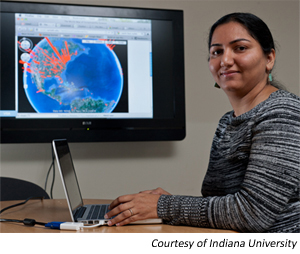
sustainability-kaur.jpgThe field has a wide geographic spread and is prominent in locations with political and economic power. “The world’s leading city in terms of publications in the field is Washington DC, outpacing the productivity of Boston or the Bay Area,” explains study co-author Jasleen Kaur (right), a PhD student in Indiana University Bloomington’s School of Informatics and Computing.

Bob Peoples, director of the American Chemical Society’s Green Chemistry Institute, based in Washington DC, was surprised that the city was top when it came to productivity, but said the high concentration of government bodies and non-governmental organisations (NGOs) could be a factor.

In Europe, productive cities include London, Stockholm and Wageningen. Other regional centres that produce a high number of papers include Nairobi, Cape Town, Beijing, Melbourne and Tokyo. Smaller universities and laboratories are strong in the field as well as national research centres.

But is the growth of the field in itself sustainable? Peoples believes so – and says it will translate into new job opportunities. The green chemistry industry, for example, “is forecast to grow to $100 billion by 2020,” he says. “That’s a 48% annual growth rate. This will certainly correlate with jobs since it requires different skill sets and training.”

Scientists interested in moving into sustainability research should build a multidisciplinary set of knowledge, contacts and tools, he advises. For green chemistry in particular, topics that researchers need an awareness of include mechanistic toxicology and life-cycle analysis as well as chemistry.

The productivity findings, published later this week in the Proceedings of the National Academy of Sciences, come from an analysis of more than 20,000 academic papers published between 1974 and 2010.

Related articles:

Tips for chemists on succeeding in academia

Are you applying for faculty positions in academia, or new in your role at a university? Speaking yesterday at the American Chemical Society (ACS) career fair, three US academics representing different types of institutions shared their advice on job applications, interviews and how to succeed in your first two years.

Applying for a position

The composition of your application package will vary between institutions. For a faculty position at a research-intensive (R1) university, Jason Ritchie, associate professor of chemistry and biochemistry at the University of Mississippi, recommends formatting the research proposals that you submit as if they are mini grant proposals. “You want to show the committee that you’re going to write grant proposals that are going to get funded,” he says.

When applying for a role at a primarily undergraduate institution (PUI), where there is more emphasis on teaching, it’s still important to show your commitment to securing funding, says Laurel Goj, a tenure-track faculty member at Rollins College in Florida. “It may not be that gigantic NIH [National Institutes of Health] grant but we do expect that you are going to obtain some funding.”

For a community college vacancy, teaching experience is key. When describing your teaching philosophy, Christine Gaudinski, chemistry professor and chair of the science department at Aims Community College in Colorado, recommends making clear how your approach will serve the college’s mission and vision. She also suggests emphasizing your commitment to community service, and your experiences of working with diversity — which covers more than just race, gender or disability — in the classroom.

You may be applying for several positions at once, so keep a copy of the job adverts and your applications for reference. “It’s often a long time between the time you apply and the time you hear back,” says David Harwell, assistant director for career management and development at ACS. “You don’t want to look like you don’t remember [what you’ve applied for].”

The interview

If you get invited for interview at an R1 university, be prepared for a long campus visit that may last two days. “You’re going to eat breakfast, lunch and dinner with the committee,” says Ritchie. Interviews at a PUI can also be two days long, with the second day often reserved for a teaching demonstration. “We’ll have you in a classroom with an assigned topic and students,” says Goj. Gaudinski says the process is generally shorter and simpler at a community college; the campus visit may only last a couple of hours, for example.

When discussing your start-up package, make sure you’ve considered the minimum that you would be prepared to accept, but remember that there are often other resources available once you’re in position. “I was able to get everything I needed with less than I thought was necessary,” says Ritchie. “I was able to find that money [from elsewhere].” Also think carefully about the top end of what you ask for, as the university will expect to see a return on its investment in you. “The benchmark is you should be able to earn back enough money [through grants] to cover your start-up before you get to tenure,” Ritchie explains. “The more you ask for, the bigger the expectation is.” Start-up packages are generally smaller at PUIs — expect to use departmental instruments — and basically non-existent at community colleges, says Gaudinski.

Your first two years

Ritchie says it’s important to obtain early research results in your first two years at an R1 university, and try to teach a graduate class in your first semester. “Demonstrate purpose,” he recommends. Also remember that your existing graduate students will pass on their opinions of you to new or prospective students, who will be working for you during the critical time when you apply for tenure. “The graduate students that you recruit in your first two years are going to do the research that makes up your tenure package,” he says.

At a PUI, Goj recommends spending your first year preparing for new classes and labs, recruiting interesting students for summer research and setting up your research lab. In your second year you should start to contribute towards the development of courses.

Share your tips

Do you have any advice to add? Let us know below.

Chemists face employment woes – but there are ways to prosper

The rise of the biochemist and the challenges faced by recent chemistry graduates were among US employment trends discussed by analysts from the American Chemical Society (ACS) and the US Bureau of Labor Statistics (BLS) in a webinar last week. We’ve summarised the key points for you below – let us know your thoughts by leaving a comment.

Troubling figures

Unemployment among ACS members in 2009 and 2010 was at the highest level since 1972, when the society started collecting annual data, according to ACS researcher Gareth Edwards. “It’s a very troublesome figure,” says Edwards. “We are hoping it has at least plateaued or is going to decrease in forthcoming years.”

But biochemistry is blossoming

Brian Roberts from the BLS says employment trends for life scientists are much more positive than for chemists.

One of the reasons is that while chemists are “falling out of favour” in pharmaceutical research, biochemists are flourishing due to the shift in emphasis towards biotechnology and other life sciences in the sector.

Experience beats youth

Recent chemistry graduates are losing out to older, more experienced employees when it comes to finding a job. “In the race between people with experience and new graduates, people with experience are winning,” says David Harwell, assistant director for careers at ACS.

“Having seasoned vets on staff seems to be cheaper than hiring two [less experienced people] at half the price,” adds Edwards.

“Try before you buy”

The unpredictable financial climate in the United States has resulted in an increase in the number of people being employed on fixed-term contracts. “That’s especially true at the bachelor’s or associate level,” says Harwell. “It’s a little bit of ‘try before you buy’ for the employers.”

Have you been affected?

Are you a recent chemistry graduate struggling to find a job? Are you looking at biochemistry as an alternative option? Share your experiences in the comment box.

Tips for job hunting in dual-career relationships

Chemists Sarah Tolbert and Benjamin Schwartz shared useful insight on some of the challenges of a dual-career relationship in academia at an American Chemical Society webinar last week.

The ‘two-body’ issue, which arises when one member of a couple with dual careers is exploring a job opportunity in a distant location, is widespread in academia: in Naturejobs’ 2010 salary survey, almost half of respondents said it was problematic (see ‘A dual dilemma’). The ‘trailing spouse’ must either look for a post in the new location as well, or take on a lengthy commute, deal with a long-distance relationship or accept unemployment.

Tolbert and Schwartz, an academic couple at University of California, Los Angeles, offered several tips from a US perspective on how to approach the first option: looking for two new jobs.

When looking for two equal academic jobs, if possible they advise choosing your fields so that you can both add to the academic diversity of a department. “If you have the same research background, it is very hard to justify a department hiring both of you,” says Tolbert.

It’s also a good idea to go on the job market together, and when you are both as close as possible to your peak. If you can, avoid having one of you labelled as ‘the spouse’ at all – it’s better for whoever is hiring you to feel that they are making a free decision.

If you’re looking for jobs in different sectors or types of organisations, focus on bigger cities where you have better odds of finding two appropriate positions due to the greater number of academic institutions and companies. In addition, most departments have personal ties to local industry or community colleges that you may be able to take advantage of. “It is okay to ask people to use these personal connections to help find a position for your spouse,” says Tolbert. Most universities also have lecturer positions that may be suitable for spouses.

Tolbert adds that universities sometimes have extra pools of money earmarked for hiring spouses, although these will only be used if a department really wants both members of a couple.

Whatever tactic you use, timing is crucial. “Your maximum negotiating power as a couple is in that very small window between when the department has given you an offer and when you actually say yes,” says Tolbert. “You have incredible power.” She ascribes this to the stubborn nature of many academics – once they have finally agreed on who they should make an offer to, they’ll work very hard to get that person.

Do you agree with their advice? Do you have any other useful tips for managing job hunting in dual-career relationships? Are you affected by the two-body issue? Let us know what you think by leaving a comment.