Bonding in Boston: The importance of networking in science

Naturejobs journalism competition winner Ashish Nair finds new hope at our Boston career expo.

A long time ago in a land galaxy far far away, there was a great gathering where those weary of the well-trodden trail of tenureships and grants repaired themselves. The gathering in question was the Naturejobs career expo, a free one-day event organized for students and scientists alike. Featuring some truly inspiring speakers, it gave a much-needed boost to my hope for a career in science that can be both emotionally and financially (yes, $$$) satisfying.

Continue reading

The beginner’s guide to the LinkedIn network

Exploring career paths sometimes feels like coming out of a cocoon – who knows what’s out there?

Naturejobs journalism competition winner Elisa Lazzari

ElisaLazzari-smaller

{credit}Jean Branan{/credit}

Continue reading

Skills for your next networking adventure

Networking may seem terrifying, but once you master the basics, it can be a real career boost

Naturejobs journalism competition winner Andy Tay

Networking during academic events such as conferences and seminars can be nerve-wrecking. Most of us can remember when we pretended to be engrossed in a programme booklet, wishing we could finally muster the courage to speak to the speaker with ground-breaking research standing ten feet away. You’re not alone, and there is a solution. Effective networking is a skill and anyone can benefit from more practice.

Do your homework

It’s a good habit to read the abstracts of presenters and download their papers to learn more about them before you join a conference. If you’re interested in their work, look up their profiles on platforms like Google Scholar, PudMed and ResearchGate. These platforms automatically update publications and can be better sources of information than many lab webpages, which are less regularly updated. By being diligent, and finding out more about the presenters and their research, you’ll be more confident and ready to ask critical, intelligent questions.

{credit}iStockphoto/Thinkstock{/credit}

Continue reading

LinkedIn tips for scientists

Are you In?{credit}LinkedIn{/credit}

This week, one Naturejobs reader sent us the following question:

“How important is it and in what way can a scientist make their LinkedIn profile look good? I hear it so often that sometimes I wonder whether it is worth all the effort to keep it savvy the way I see IT professionals or finance professionals do.”

As scientists work in different ways to a lot of other professionals, having online profiles might seem unnecessary. But whilst many scientific contacts are made through more formal networks, that’s no reason to dismiss the power of sites like LinkedIn. Here are just a few reasons why:

  •   So many people now use social media sites like LinkedIn to look for other professionals, you don’t want to be left out in the cold.
  •  Science involves collaboration – and online profiles are a great way to network and share ideas. It doesn’t replace more traditional methods like conferences, but adds to them.
  • You can tailor your profile more easily than an academic profile page, which often follows a standard format. What’s more, your online profile will go with you when you change jobs/institutions, whereas academic profiles get outdated.
  • It’s about more than a profile – joining groups and discussions on LinkedIn, and following others, can help you with your career interests.
  • Any digital profile allows you to include links to other sites, projects, or work that says even more about who you are -such as blogs, a Twitter profile, or a conference you spoke at recently, to name but a few.
  •  Algorithms that match you to people with similar interests could lead to unimagined opportunities.
  • Having all your information in one place means you can us it to create tailor made CVs for different jobs, or to supply information to visualisation tools, like Vizify.

As for the other part of the question – how to make your profile look good?

Continue reading

Ten words to avoid on your online job profile

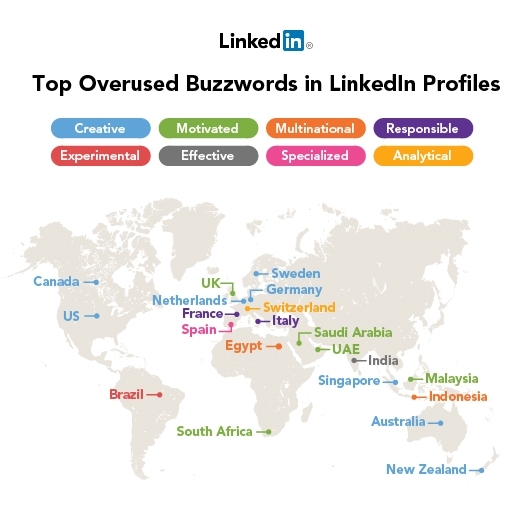
Universally unoriginal{credit}LinkedIn{/credit}

Are you a motivated employee? Boring! Creative? Yawn! Responsible? We’ve heard it all before! This week, LinkedIn have released a list of the words that are the most abused by their users. Recognise any of them?

In the US, these include:

  1. Creative
  2. Organizational
  3. Effective
  4. Motivated
  5. Extensive experience
  6. Track record
  7. Innovative
  8. Responsible
  9. Analytical
  10. Problem solving

If you too describe yourself in this way, you will need to find another way to stand out, says Linkedin’s career expert Nicole Williams: “If you want opportunity to come knocking, you’ve got to make your LinkedIn Profile stand out from the pack. Millions of professionals say they’re ‘creative,’ so set yourself apart by describing and linking to projects you’ve worked on that truly were different, unique and compelling. Pointing to concrete examples of the creative work you’ve done is more convincing than simply stating you are a ‘creative’ professional.”

If you’re using these hackneyed words on you online profiles, chances are they are littering your CV and cover letters too, so make sure you give specific examples in each, or crack open that thesaurus! And for those outside the US check out the infographic above; ‘Creative’ isn’t just unoriginal in the US, but across much of the globe – if you really are all that creative, you won’t find it hard to think of a better way to say it!


LinkedIn tips for jobseekers

At yesterday’s American Chemical Society virtual career fair, social media expert and author Joshua Waldman gave advice on how to optimise your LinkedIn profile for job-seeking. Although LinkedIn is not primarily a job search platform, Waldman says it’s safe to assume that potential employers will look you up online and so you should have control over the information presented about you.

To start with, make good use of your LinkedIn headline. This gets attached to your name and photo in every communication that you send within LinkedIn and “is probably going to be in many cases your first impression”, says Waldman. You can write up to 120 characters so instead of just listing your job title alone, consider crafting a statement that explains what you do and what sets you apart from others who do the same. You can change your headline by clicking on the edit link next to your name in the edit profile section.

Once you’ve optimised your headline, take a look at your profile summary. Waldman recommends this should answer the following questions:

  • Who are you – name, job, specialising in…
  • What do you do – what particular problems do you solve
  • Why are you the best – describe your successes

If you are currently unemployed, also explain what kind of job you are looking for in your summary and incorporate a call to action to encourage potential employers to get in touch.

Your overall profile should be 100% complete, says Waldman. “Recruiters and hiring managers have been using LinkedIn for a long time now. They know when profiles are not complete and when they see [incomplete] profiles, [alarm bells] go off in their head.” Profiles that are complete also show up higher in LinkedIn search results.

If you are connected to your current employer and you don’t want them to know you are actively job-seeking, Waldman suggests you turn off your ‘activity broadcasts’. These announce when you change your profile, make a recommendation or follow a company. These alerts can be a “red flag for employers”, says Waldman. To turn off the broadcasts, click on settings under your name in the top-right of the page – the option is under privacy controls in the profile section.

Make sure you include a photo of yourself in your profile. “We are very visual animals,” says Waldman. “If we don’t have a picture, we create a feeling of distrust.” He adds that concerns over discrimination shouldn’t stop you posting a photo – as well as there being legal protection against discrimination, showing who you are can help you find a job you’ll be more comfortable in. “Unless you show up to your job interview with a paper bag over your head, they’re going to see you at some point,” says Waldman. “If the organisation is going to look at your picture on LinkedIn and make a discriminatory decision, that’s probably not a place you want to be at.”

Our final tip from Waldman’s talk is for students who are unsure if they should set up a LinkedIn profile before they start work – Waldman says go for it. “If you really look at your experiences, you can start to fill out a very nice-looking LinkedIn profile right away. You’ll have more time to grow a larger network and you’ll have a leg up on your peers who wait until they graduate.”

We’d also encourage you to join the Naturejobs science jobs and careers discussion group on LinkedIn to see highlights from Naturejobs and to connect with fellow jobseekers.

PhD students: how to improve your communication skills – and why you should

Many employers think that PhD students often lack ‘soft’ skills such as being able to communicate well, according to a new report from the UK Department for Business Innovation and Skills (see ‘Survey shows science graduates neglect career planning’ for other findings). One of the report’s authors, Robin Mellors-Bourne from the Careers Research & Advisory Centre, says a lot of employers are sceptical that PhD candidates will fit in. “They’re deemed almost to be too specialised,” he says. Christine McCary, the employment concerns chair of the US National Association of Graduate-Professional Students (NAGPS) and a full-time PhD student at Northwestern University in Chicago, Illinois, says the situation is similar in the United States. So what can you do to improve your soft-skill set?

Science careers consultant Sara Shinton, of UK-based Shinton Consulting, says PhD students should always be proactive about developing their soft skills because of the high number of people being awarded postgraduate qualifications. “It’s like it used to be with [an undergraduate] degree,” she says. “A PhD on its own isn’t enough. You are going to be competing against people with the same baseline.”

Stand out from the crowd

Shinton’s advice is to look for unusual activities that will make your communication skills stand out from the crowd, such as being a representative on a committee for a professional body. “That’s not something everybody can do,” she says. It’s also something that will get an employer’s attention – in a recent survey of graduate employers, researchers from Oklahoma State University found having a leadership position in an academic organisation comes second only to the personal interview in importance for showcasing your communication skills.

Shinton says you should join the society or association first, and then get involved at a local level to raise your profile. Just being a young scientist can also help. “The voice of the young researcher at the front line is one that most professional bodies are very keen to hear from,” she says.

McCary says another way to stand out is to take a leadership role in your local community, for example by starting a science club for younger students. If you succeed, she says, “that would be direct evidence of your ability to communicate with people”.

Show initiative

Another major plus is showing initiative by making something happen that wouldn’t have otherwise, such as arranging your own scientific roadshow or conference, or setting up an informal journal within your university.

Remember to cover the basics

That’s not to say you can forget about the more traditional ways of developing communication skills, such as getting involved in outreach – Shinton says companies now expect to see this as standard on a candidate’s CV or résumé. “It’s worth doing on every sort of imaginable level,” she says, “but it isn’t something that an employer would highlight.”

And the basics include getting to grips with social media websites such as LinkedIn, Twitter and Facebook. “These days every single scientist should have [a LinkedIn profile], even while they’re a student,” says McCary.

Get outside the box

Both Mellors-Bourne and McCary advocate developing your skills outside of academia. “Spending some time with different people or in a different environment is very valuable,” says Mellors-Bourne. “Even academic employers are looking for well-rounded people to work for them,” adds McCary. Shinton, however, cautions against this approach if you intend to stay in research: “It very much depends what your career trajectory is. If you intend to be a scientist, showing that you are having an impact in lots of different ways as a scientist possibly has more value.”

All three agree that studying overseas can be a boon for your communication skills. “The whole experience of overseas study strengthens you as an individual,” says Shinton. “It challenges you and it helps you to grow.” Mellors-Bourne spent four months in the United States as part of his PhD, which he found to be a life-changing experience: “I restarted my research afterwards with a completely different view of the world.”

Have your say

Do you have any other tips to add? Have you found a particular approach or method to be more effective than others? Share your thoughts by leaving a comment.