Communicating science effectively needs more than facts, says Eileen Parkes.

{credit}iStockphoto/Thinkstock{/credit}

{credit}iStockphoto/Thinkstock{/credit}

{credit}Noel Hendrickson/Getty{/credit}
As scientists, our work is often driven by data collection and results. But a key step in the scientific process, and one that increases the value of our findings, is the effective communication of our investigative processes and results. Science communication is not only important within our fields for the advancement of our disciplines – communication to other audiences also influences the public perception and credibility of scientists and the work we do.
By Beth Kenkel
This condensed social media guide for scientists provides key facts about how researchers report using social media and concrete examples of how you can use LinkedIn, Twitter and Facebook to network, exchange scientific ideas, or advance a career. This is an all ages guide designed for scientists at any career stage.
Thomas Prigg is a brain cell circuitry researcher at Carnegie Mellon University in Pittsburgh, Pennsylvania, US. Now he’s using his science skills to fuel his campaign for Congress in 2018. He talks to Nikki Forrester. Continue reading
 Written by: Tina Harseim, Head of Social Media, Springer Nature and Gregory Goodey, Research Analyst, Springer Nature
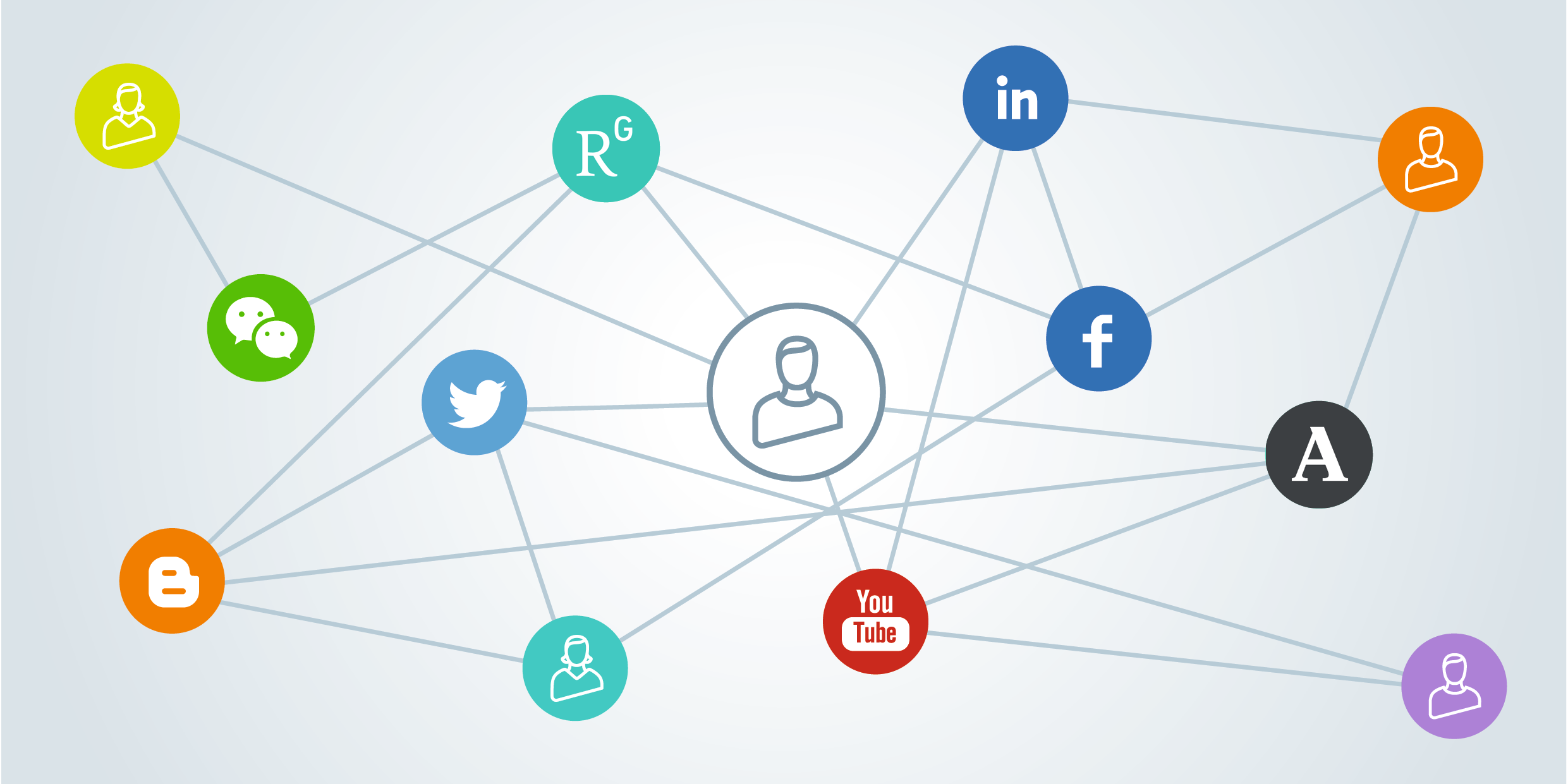
Social media is not only a way for authors and publishers to disseminate research findings, it’s also increasingly being used by researchers to discover and read scientific content.
To better understand how social media and scholarly collaboration networks (SCNs) are used within academia to support research activity, Springer Nature conducted a survey in February. This was in follow up to a Nature survey carried out in 2014. (The original survey can be found here: Online collaboration: Scientists and the social network)
Over 3,000 researchers from STM and HSS fields (humanities and social sciences) completed the survey, though numerically dominated by STM respondents (89%). Researchers covering all career levels gave us their views, with the largest groups of respondents from Europe (33%), the Americas (31%) and Asia (31%).
The survey revealed researchers’ views on their professional use of social media and SCNs, to what extent it can help them in their work, and the role publishers and journals can play to support researchers with activity on these platforms.
All data is available to view and download on Figshare, along with a summary of the key findings.
These include:
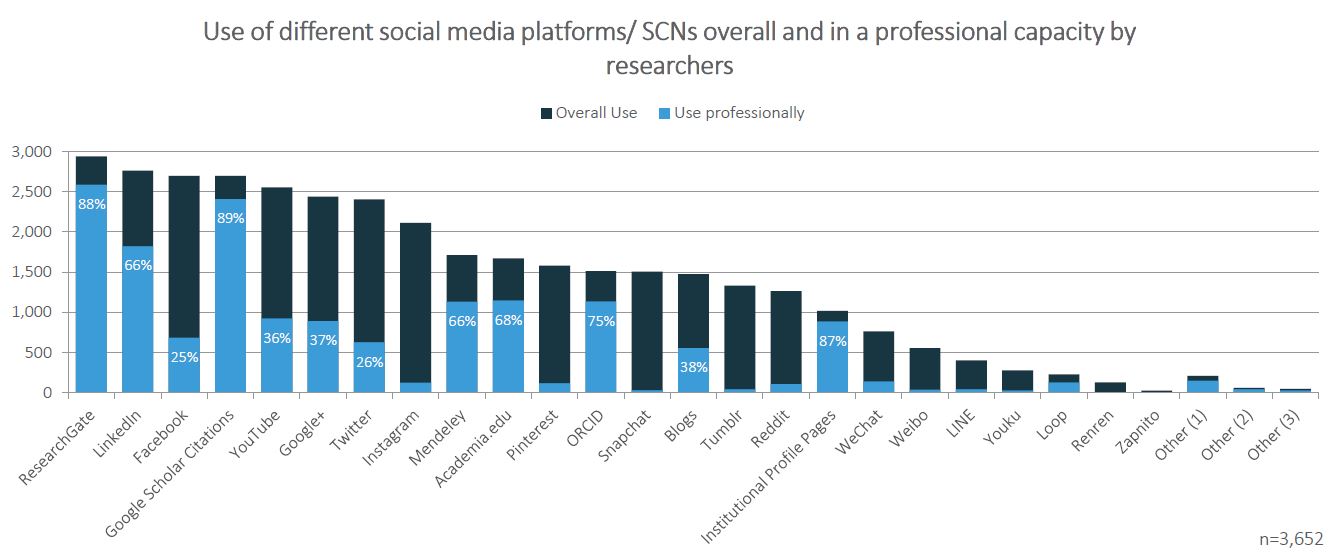
• Over 95% of respondents said they used some form of social media or SCNs for professional purposes
• ResearchGate was the platform with the greatest proportion of professional users (71%), followed by Google Scholar (66%)
• While respondents stated they used SCNs in high numbers, frequency of use, and therefore platform engagement, was reported to be higher for social media
• 50% of professional users said they accessed Facebook on a daily basis
• In the Nature survey conducted in 2014, the most-selected activity on both ResearchGate and Academia.edu was simply maintaining a profile in case someone wanted to get in touch (68%). This year’s survey revealed that the research activity that over three quarters of respondents stated that they use social media and SCNs for was discovering and / or reading scientific content (Nature’s 2014 study 33%)
• 57% of respondents to the survey used some form of social media and /or SCNs to support with self or research promotion
• Therefore, unsurprisingly, the content that the majority of researchers appreciate from publishers is information on new topics and trends; and research relevant to their field and article recommendations
• Over 80% of respondents would also expect to some degree that any research of content provided by the publisher / journal on these sites should be openly accessible
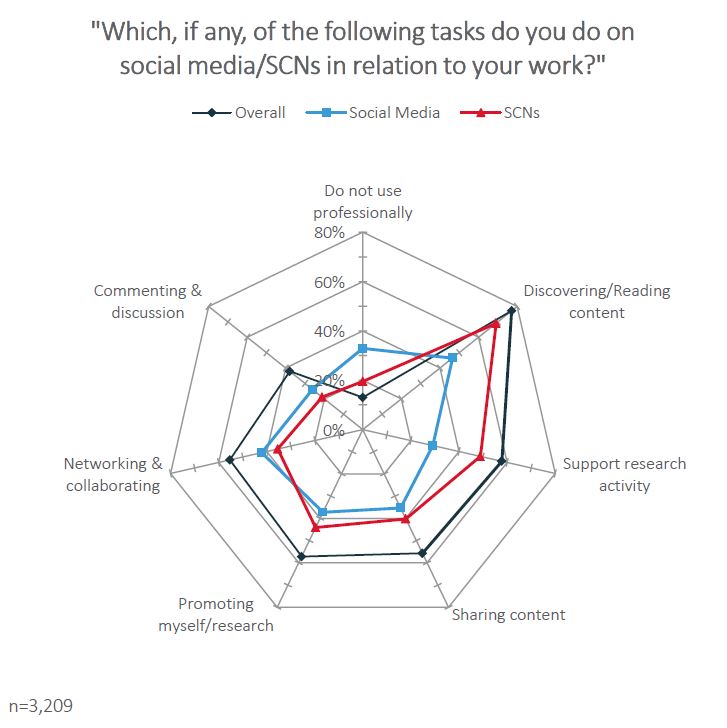
The survey enables us to provide the best service for our authors, and keeps us close to the views of our community. Over 70% of respondents did agree that they felt that they should do more to promote their research using social media / SCNs.
A significantly higher proportion of Twitter and Facebook professional users share scientific content than any other social media platform or SCN. This gives us confidence that SharedIt, Springer Nature’s content sharing initiative, is offering the functionalities that our users need.
We will use these results to support our approach to social media, discussions on the value SCNs provide for researchers, and how we can best shape our services to meet the needs of the academic community.
The data from this survey has been made open access for anyone who would like to use it. You can find it on FigshareFigshare.
There are plenty of reasons to become active in the field of science communication, and for many early career researchers (ECRs) still exploring research, it’s a great way to find their niche and voice their opinions.
Yet, like many of its participants, the field of science communication itself is fairly young, and is constantly evolving from its original aim — to translate scientific findings to the public, in order to raise awareness and funding for the grand scientific endeavor. When 3000 new academic papers are published every day, it‘s impossible for any single scientist to keep track of every development.

Science communication is practiced by a range of journalists, editors, freelance writers and free-time writers, yet the aim remains the same: to communicate important findings in quick soundbites that provide enough information for scientists but are still digestible to the general public. Continue reading

{credit}CC-BY-SA Atos/Flickr{/credit}
Don’t forget that you need to nurture your online persona – the summation and entirety of every bit of online information about you or that involves you, both written and visual. Someone may well have already posted some of this. But you can still shape and guide a great deal of the accessible online information about you — and the image that this information creates — by actively managing the content over which you have some control.
This is especially true if you’re looking for a job. It’s safe to assume that potential employers will look you up online and so you need to have control over the information presented about you.
LinkedIn is still one of the most highly used sites for finding out about jobs through your virtual network – and occasionally getting one. You’ll need to make your profile look good — and you’ll need to find a way to stand out from the rest of the pack.
If you’re not seeking employment, though, social media is still a hugely powerful and useful tool. It can help you reach networks of like-minded scientists, build research collaborations and even make friends
Lots of your colleagues find particular sites to be key venues when they want to engage in collaborative discussion, peer-review papers, share negative results that might never otherwise be published, and even upload raw data sets
And through these sites, you can build a powerful virtual network that will yield opportunities, information and advice. Here’s to the click!
But you can’t fling it off like a mosquito. To ‘network’ is simply to connect with others, and we’ve rounded up expert advice on why it’s important, even crucial – and how you can network in ways that don’t involve too much cringing or trying to schmooze strangers at your field’s annual conference.

It’s no secret that social media has created manifold ways to establish and boost your profile. But used appropriately, these platforms can help you to forge vital links. Twitter, for example, isn’t only a means of publicising yourself and exchanging information. It’s a great way to network virtually – and maybe even get a job.
You may know by now that there are many social-media sites specifically for researchers and academics. Are you familiar with all of them? Their benefits can be legion, finds a Nature survey: they can help you with collaborative discussion, accessing papers, sharing results and more.
Still, you have to get off your phone at some point and do some real face time. It isn’t easy for everyone, yet it doesn’t have to be an introvert’s nightmare. The key, says Nature Careers columnist Peter Fiske, is to aim for a steady level of regular interaction with others.
And ‘others’ is a central concept here. You have to diversify your network: even its weakest links count, says a Naturejobs blogger. Don’t try to persuade yourself that reaching out only to contacts of colleagues or potential collaborators means you’re done.
So after all that networking, you feel virtuous and accomplished – and probably exhausted, as another Naturejobs blogger laments. But you’ve got to carry on. After all, you never know where that chance encounter will lead – or whom it might connect you with.
Guest contributor Daniel Harris of SoftwareAdvice.com
The explosive economic impact of big data has blurred the line between the business world and the scientific world like never before. A new type of business leader, the data scientist, has evolved as an amphibian, capable of thriving in both worlds, swimming in data lakes to bring useful insights back to the solid ground of business concerns.
Of course, companies have been using business intelligence (BI) tools to analyse their operational and financial performance metrics for decades.
But datasets generated by the web are so large that they must be stored on clusters of servers with thousands of nodes. Traditional methods for analysing these datasets have faltered, necessitating a more scientific approach.

Hadoop cluster by fogcat5 is licensed under CC BY-SA 2.0