Productivity for researchers: 9 brilliant tips

Are you great at procrastinating? Do you wish you could get more done in a week, or just do things ‘better?’ Here are some helpful hints and tips for your research workflow!

By Stacy Konkiel

At Altmetric, we provide actionable insights into the online engagement surrounding published research. In early 2017 we asked researchers to share their favorite productivity tips and tricks for tackling their to-do lists, in the hope picking up some ideas ourselves and sharing their wisdom with the wider community. Here are some of their top recommendations.

cube Continue reading

How do researchers use social media and scholarly collaboration networks (SCNs)?

Written by: Tina Harseim, Head of Social Media, Springer Nature and Gregory Goodey, Research Analyst, Springer Nature

Social media is not only a way for authors and publishers to disseminate research findings, it’s also increasingly being used by researchers to discover and read scientific content.

To better understand how social media and scholarly collaboration networks (SCNs) are used within academia to support research activity, Springer Nature conducted a survey in February. This was in follow up to a Nature survey carried out in 2014. (The original survey can be found here: Online collaboration: Scientists and the social network)

Over 3,000 researchers from STM and HSS fields (humanities and social sciences) completed the survey, though numerically dominated by STM respondents (89%). Researchers covering all career levels gave us their views, with the largest groups of respondents from Europe (33%), the Americas (31%) and Asia (31%).

The survey revealed researchers’ views on their professional use of social media and SCNs, to what extent it can help them in their work, and the role publishers and journals can play to support researchers with activity on these platforms.

All data is available to view and download on Figshare, along with a summary of the key findings.

These include:

• Over 95% of respondents said they used some form of social media or SCNs for professional purposes
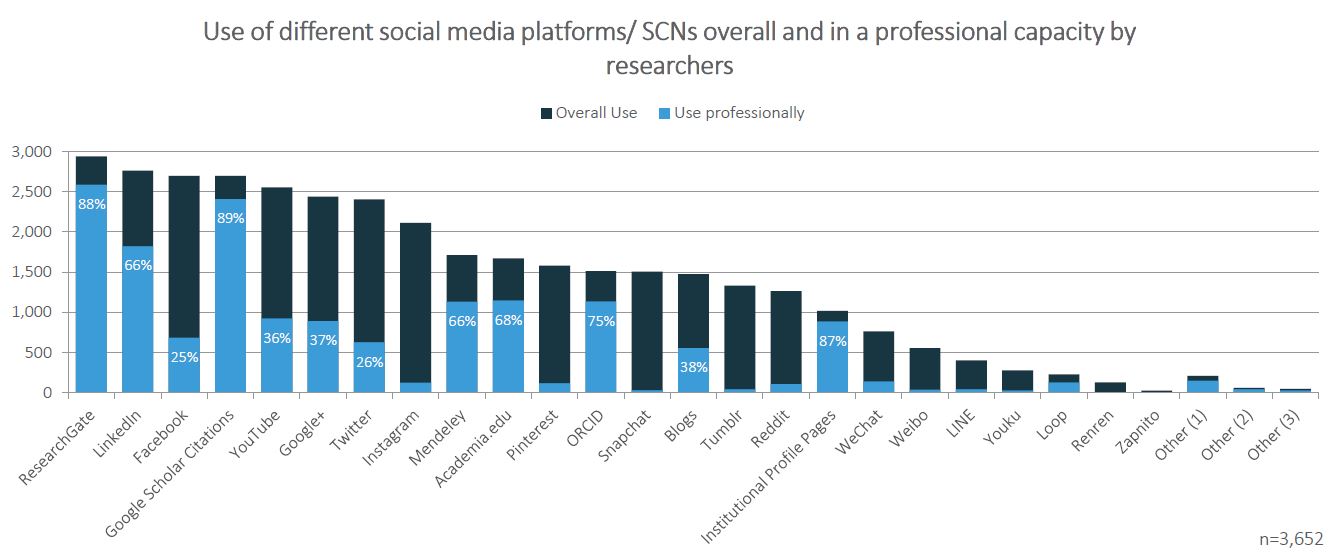
• ResearchGate was the platform with the greatest proportion of professional users (71%), followed by Google Scholar (66%)
• While respondents stated they used SCNs in high numbers, frequency of use, and therefore platform engagement, was reported to be higher for social media
• 50% of professional users said they accessed Facebook on a daily basis


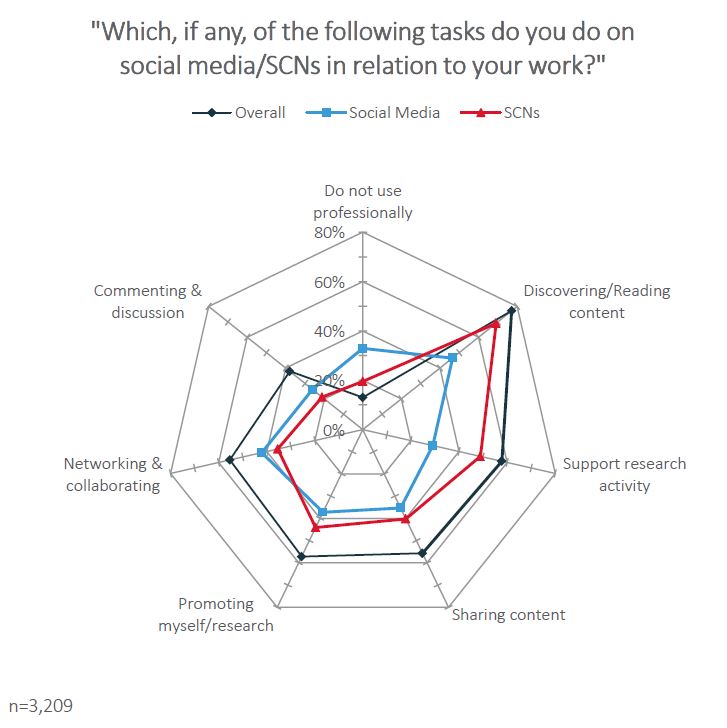
• In the Nature survey conducted in 2014, the most-selected activity on both ResearchGate and Academia.edu was simply maintaining a profile in case someone wanted to get in touch (68%). This year’s survey revealed that the research activity that over three quarters of respondents stated that they use social media and SCNs for was discovering and / or reading scientific content (Nature’s 2014 study 33%)
• 57% of respondents to the survey used some form of social media and /or SCNs to support with self or research promotion
• Therefore, unsurprisingly, the content that the majority of researchers appreciate from publishers is information on new topics and trends; and research relevant to their field and article recommendations
• Over 80% of respondents would also expect to some degree that any research of content provided by the publisher / journal on these sites should be openly accessible

The survey enables us to provide the best service for our authors, and keeps us close to the views of our community. Over 70% of respondents did agree that they felt that they should do more to promote their research using social media / SCNs.

A significantly higher proportion of Twitter and Facebook professional users share scientific content than any other social media platform or SCN. This gives us confidence that SharedIt, Springer Nature’s content sharing initiative, is offering the functionalities that our users need.

We will use these results to support our approach to social media, discussions on the value SCNs provide for researchers, and how we can best shape our services to meet the needs of the academic community.

The data from this survey has been made open access for anyone who would like to use it. You can find it on FigshareFigshare.

Lab quizzes, cake clubs and lunch dates

A Nature special issue last week examined the plight of young scientists. David Payne runs over the details.

Interviewees described the pressure to publish, secure funding and earn permanent positions, leaving little time for actual research.

The cluster of articles, along with a podcast and infographic, do propose some ways forward to improve the situation. For example, four researchers suggest ways of enabling scientists to pursue promising ideas, and three “agents of change” who have left the bench explain how they’re trying to improve junior researchers’ experiences.

happy legos-smaller Continue reading

We want to know: What do researchers do next?

what do researchers do next?In May this year, Vitae (a career development service for researchers)  and Naturejobs co-launched a survey: What do research staff do next? The goal of this survey, according to Dr Janet Metcalfe, Chair and Head of Vitae, is to: “create a range of career stories of former research staff that reveals their career journeys and explores what were the tipping points in their careers.”

There have been 1500 responses to this survey so far, but we’re hoping to have more input from those who have transitioned from academia into industry. This is an on-going survey, and the initial results will be announced at the Vitae Researcher Development International Conference in September this year.

Advice to transitioning scientists 

Imagine you are your younger self: an academic, unsure of your future prospects as funding bodies chop and change their budgets and the number of postdoc positions dwindle. You’ve decided you would like to leave academia. But what now? It can be a daunting position to be in, and one that would welcome some advice from someone who has been through this before.

Fast forward to your present self: Would you agree with the advice that others presented in the survey? What would you add?

“Try and identify which kind of skills you acquire while doing research, there are many such as management skills, analytical skills, organizational skills, etc. that will be useful in many jobs.”

“To nurture a strong ethic of self-care when making the transition, as sloughing off one’s academic identity is no small feat. Also, be patient; your first job is unlikely to be your dream job. Try to use your first job as a means of figuring out what you’d really like to do.”

“If your passion isn’t in bench research, do something else.  There is tons of stuff out there for life scientists that leverages your existing skills.”

“If you’re not ready to let HE go completely, look for support roles. Often the work is similar to research, and there is less focus on profit margins and overzealous management than in industry. Your employer is also more likely to support future professional training because they understand your need to learn and develop intellectually.”

“Go for it!  It may seem daunting but if you never try, you’ll never know. And if you decide that a career outside of research is not for you, there’s nothing to stop you from going back.”

Insight into transitions

By taking part in this survey, you’re providing an insight into the transition between the two. “Through the survey results we will also start to understand the motivations for researchers leaving higher education,” says Metcalfe, “and how their competencies and experiences are transferable into other employment options.” This insight could help careers advisers and others understand how to provide better advice to those wishing to move from academia to industry. Several of the researchers highlighted areas of difficulty during their transition when they were asked about their reasons for leaving academia.

“When I failed to secure further research funding or teaching posts, I fell back on my transferable skills and found myself immediately short-listed for two jobs I applied for.”

Some transitions are harder than others. A few of those who have shared their stories have mentioned that they chose to leave because they wanted to and a great opportunity came up.

“I had a good opportunity at the right time:  permanent and interesting employment that fitted with my desire to continue to do research for the benefit of society.”

Others weren’t so fortunate.

“Organisational restructuring led to a loss of my department and insufficient alternative posts to accommodate everyone.”

Whatever your story, whether you left academia to pursue your dream career, or because you had to leave, please share it and take part in the survey by following this link.

You can share this survey with colleagues, friends and family – anyone who has transitioned from academia into another career. You can also follow the action on Twitter by using the hashtag #PostAcStory, where you will find those who have blogged about their experience, including Dr Beeton (@Shackleford_LB) and you can watch the #PostAcStory Vitae Google Hangout.

You can also share this flyer to help spread the word.

How researchers network

Researchers rely heavily on networking at conferences and seminars and make little use of personal introductions, online social networking or proactive self-promotion, according to a report published by UK researcher development organisation Vitae.

Vitae surveyed almost 500 researchers at eight UK universities and found that less than a fifth regularly use online social networking to develop existing work contacts or make new ones. Only 14 percent feel comfortable asking someone they know to introduce them to an important person in their field, and 85 percent rarely send copies of their work to these prominent individuals.  

Overall, researchers’ networks show several characteristics of a ‘good’ network as recognised by career theory, such as a large number of work-related contacts spread across a wide geographical area. However, the people researchers know through their work also tend to know each other, which can limit the effectiveness of the network.

“The picture was of networking within a fairly limited set of contacts, with few attempts to become more visible to many of the people with power in the respondent’s field,” said the report.

A recent post on the Guardian Careers blog also highlights the importance of having a diverse network that includes weaker ties as well as close contacts, explaining that acquaintances who hail from a different social circle or industry niche are more likely to have “unique network intelligence” about available job opportunities.

“Working out strategies to connect personally with key people would help researchers manage their profile within their research field, but may also prove useful in applications for roles outside higher education,” says Vitae director Ellen Pearce. “Good networking is about being purposeful as well as widening your contacts.”

Related articles

Useful resources