The number of scientists publishing research relating to sustainability is doubling every eight years, according to research from Los Alamos National Laboratory and Indiana University in the United States.
Research into sustainability has become a field of science in its own right, say the study authors, and is growing exponentially despite the economic downturn of the late 2000s.
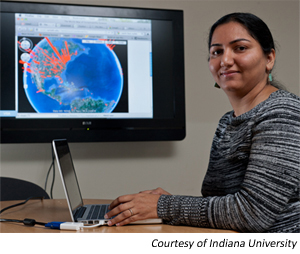 The field has a wide geographic spread and is prominent in locations with political and economic power. “The world’s leading city in terms of publications in the field is Washington DC, outpacing the productivity of Boston or the Bay Area,” explains study co-author Jasleen Kaur (right), a PhD student in Indiana University Bloomington’s School of Informatics and Computing.
Bob Peoples, director of the American Chemical Society’s Green Chemistry Institute, based in Washington DC, was surprised that the city was top when it came to productivity, but said the high concentration of government bodies and non-governmental organisations (NGOs) could be a factor.
In Europe, productive cities include London, Stockholm and Wageningen. Other regional centres that produce a high number of papers include Nairobi, Cape Town, Beijing, Melbourne and Tokyo. Smaller universities and laboratories are strong in the field as well as national research centres.
But is the growth of the field in itself sustainable? Peoples believes so – and says it will translate into new job opportunities. The green chemistry industry, for example, “is forecast to grow to $100 billion by 2020,” he says. “That’s a 48% annual growth rate. This will certainly correlate with jobs since it requires different skill sets and training.”
Scientists interested in moving into sustainability research should build a multidisciplinary set of knowledge, contacts and tools, he advises. For green chemistry in particular, topics that researchers need an awareness of include mechanistic toxicology and life-cycle analysis as well as chemistry.
The productivity findings, published later this week in the Proceedings of the National Academy of Sciences, come from an analysis of more than 20,000 academic papers published between 1974 and 2010.
Related articles: