How to navigate an academic career

careers-in-academia-naturejobs

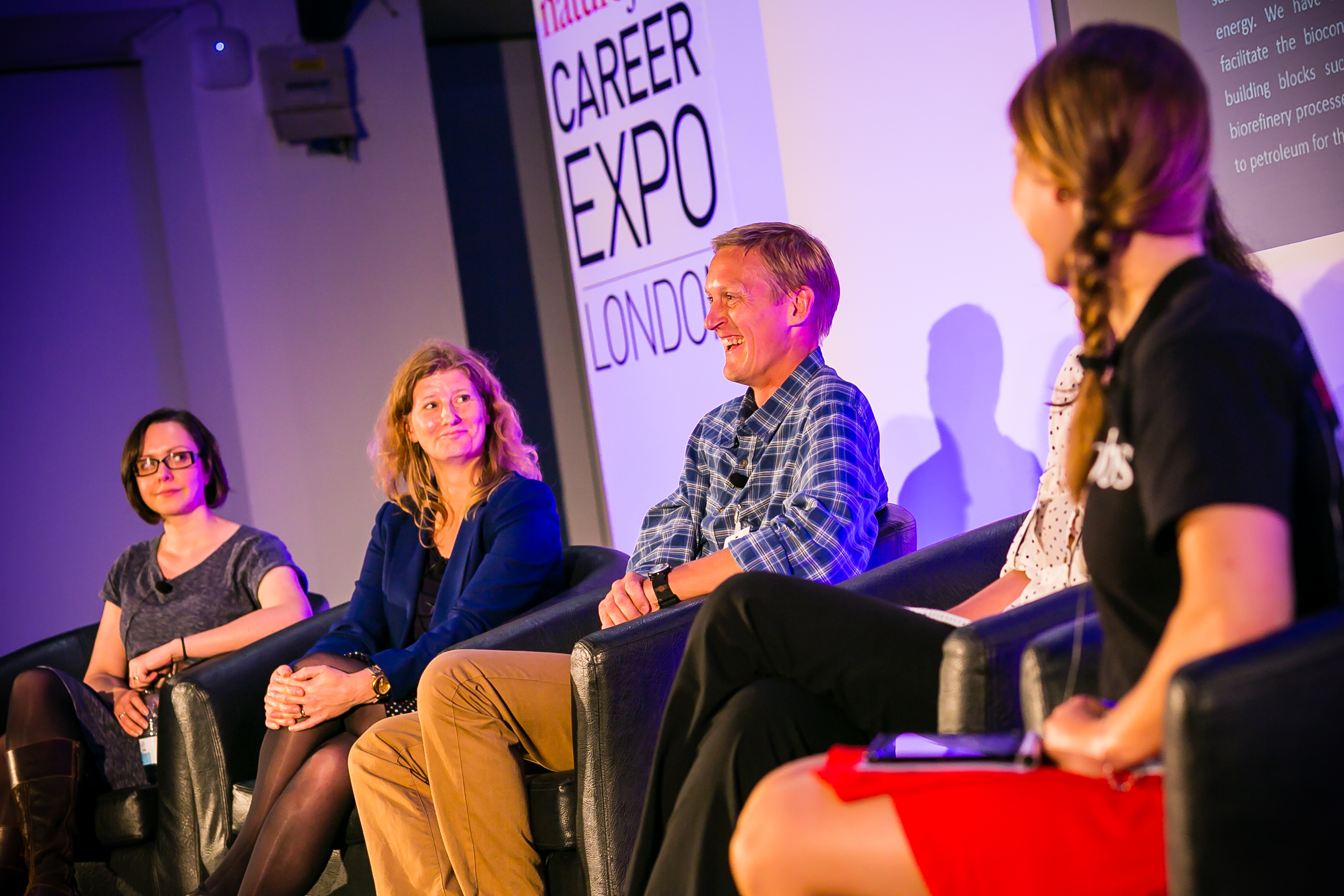
L-R: Louise Horsfall, Lorraine Kerr, Jim Usherwood, Julie Gould

Find the right path and reach your potential: There are multiple ways

Contributor Esther Cooke

As a PhD student or postdoc, in thrall to lab work or immersed in writing papers and grant applications, it can be easy to forget that pursuing an academic career is seldom solely about the research. The Career paths in academia workshop at the Naturejobs Career Expo 2014 gave early-career researchers an insight into the variety of roles available in academia. Four scientists gave an overview of their careers, and discussed the pleasures and pitfalls of their day-to-day jobs, before passing on some advice on how to succeed in the academic world.

Exploring the options

Not all academic careers need include research. Dr Anita Hall has a teaching-only position as a senior fellow at Imperial College London, having first progressed up the academic research ladder from PhD student to lecturer. Her responsibilities include course design, teaching, assessment and giving careers advice. Despite feeling drained at times, Hall appreciates the rewarding nature of teaching, and says that, in terms of work/life balance, “teaching is much more liberating” than research. At the opposite end of the spectrum, Dr Jim Usherwood of The Royal Veterinary College is heavily involved in research. Although passionate about his work, Usherwood describes a vicious cycle of writing papers to get funding and vice versa. Continue reading

How to succeed at a career in industry

L-R; Simon Cutler, Mark Christie, Nessa Carey, Emma Garvey and Ramana Sundara

L-R: Simon Cutler, Mark Christie, Nessa Carey, Emma Garvey and Ramana Sundara{credit}Annalise Smith{/credit}

Lessons learned from the Naturejobs Careers in industry panel

Contributor Annalise Smith

A love of science, willingness to try something new, forward thinking, planning and discipline were the key tenets of success presented during the Naturejobs Career Expo panel discussion on Careers in Industry. The panel included three prominent scientists who have maintained successful careers in industry, plus a recently minted PhD; it was chaired by: Simon Cutler, Innovation Programme Manager developing collaborative training programs at the Biotechnology and Biological Sciences Research Council (BBSRC).

One common theme among the panelists was the importance of passion. “If you find something you love then that’s the first step,” said panelist Mark Christie, a director of Akranim Ltd, who has a PhD in pharmacology. The other speakers echoed this view. Ramana Sundara, manager of external research collaborations at Nestle Product Technology Centre (PTC) in York, UK (PhD in food science), advised attendees to “choose the job you love to do, that way you won’t be working every day.” Nessa Carey, international director of PraxisUnico and visiting professor at Imperial College London (PhD in virology), said “it’s not being successful that makes you happy, it’s being happy that will make you likely to be successful.” Continue reading

Ten tips on getting recruited abroad

At the recent Naturejobs Career Expo in London, Michael Schneider from Imperial College London spoke about how to maximise your chances of getting recruited overseas. Schneider, currently director of Imperial’s British Heart Foundation Centre of Research Excellence, studied at Harvard, the University of Pennsylvania, and Duke, followed by research training at the US National Institutes of Health (NIH). In our final follow-up to the Expo we present a summary of his advice – if you have any tips to share, please add them below.

  1. If you’re at an early stage of your science career, be aware that a strong academic record is not enough to secure a position abroad. “Posts go to those with something more [than excellent qualifications],” says Schneider.
  2. Early research experience is the key discriminator – and it should be sustained or unusually intensive.
  3. If you’re still studying, find high-impact summer and winter research opportunities – examples that Schneider highlighted include the Erasmus student exchange programme in Europe and the Cold Spring Harbor Undergraduate Research Program (URP) in the United States.
  4. You’ll need to make personal contacts with overseas scientists – and email is generally the best way to make initial speculative enquiries with overseas labs.
  5. Don’t focus exclusively on the usual suspects – in the United States for example, Schneider says there are at least a dozen universities where mentors are as good as at prestigious institutes such as Harvard, MIT, University of California and Stanford – but there is less competition because they are less well-known.
  6. Try to have complete research ‘stories’ – and be aware that for this reason completing a three-year PhD can put you at a disadvantage against those whose PhDs typically last longer, such as in the United States.
  7. Fund yourself if possible.
  8. Carefully check the eligibility criteria of funding opportunities – for example the US NIH only offers postdoc fellowships to US citizens, with one exception, says Schneider – the Pathway to Independence Award (K99-R00) is open to overseas applicants.
  9. When considering a career move, vertical promotion – where you move up within the same institution – can be counter-productive, says Schneider: “Research funders typically prefer to see relocation as proof of independence.”
  10. When considering who to apply to, make sure you check where your potential superior publishes, and also where their trainees have gone afterwards.