Interview: Lucy Thorne, FameLab London winner!

Last week we brought you news that the FameLab London final had been won by Imperial virologist Lucy Thorne. Today we’re delighted to bring you an interview with Lucy ahead of her appearance in the National final in the spring.

Hello, Lucy, welcome to Nature Network London! Firstly, congratulations on winning the FameLab London heats! Tell us a bit about what you presented and why you picked it.

My final presentation was about how RNA viruses are incredibly good at mutating, which can really give them the upper hand in the face of selective pressures like our immune system and anti-viral drugs. I tried to illustrate this with the emergence of drug-resistant swine flu during the pandemic last year as I hoped it was an example that everyone would remember or may have even experienced- although I might have stretched that a bit when I began by asking the audience to imagine they were a swine flu virus being attacked by a drug!

How did you become interested in communication and have you ever done anything like this before?

I really enjoy trying to get people interested in science and I’ve done university outreach work in the past so I volunteered this year as a demonstrator for the Society of General Microbiology at the Cheltenham Science Festival. It was a great day and made me realise how much I enjoy it but Famelab is the first time I’ve done any competitive science communication and on such a large public scale so it was a bit nerve-wracking!

Your style obviously struck a chord with the judges. What do you think is important when communicating science to the public?

I think it’s firstly really important to somehow get people to want to listen and not to switch off when the science bit comes in! It needs to be entertaining and I also tried to relate it to experiences the audience may have had to get their attention and keep them interested. Secondly, I think it’s really important to explain it as clearly as possible without using jargon- when you’re working in detail on a subject every day it’s easy to forget which scientific words are commonly used and which ones may need explaining.

As part of your victory, you will be going on a weekend course with some science communication experts to hone your skills. What are you hoping to get out of that weekend?

Before the heats we had a short master class with one of the experts who gave us some brilliant tips on how to compose and deliver a good talk, make an impact and not overwhelm your audience- so hopefully lots more of the same! We’re really lucky to have the expert advice and the chance to practice with them so I hope to come out of it a confident public speaker. From what I hear from previous contestants it’s a great weekend!

Back to the day job for a minute: tell us about your research and areas of interest.

My PhD is on noroviruses, which are some of the RNA viruses that we think are incredibly good at mutating. We know that the norovirus RNA polymerase, the enzyme that is responsible for producing new copies of the viral genome, has a high mutation rate and must generate a diverse mix (or population) of viruses during replication. For other RNA viruses, such as hepatitis C virus, existing as a diverse population has many benefits, it enables them to evolve, to escape host immune responses and cause persistent infections and it can also determine the virulence and the extent of disease a virus can cause. I’m interested in the importance of this high mutation rate in norovirus infections because there is recent data to suggest that the noroviruses that have caused the majority of infections since 2002, called GII.4 noroviruses, may mutate faster than other noroviruses. We are using the mouse norovirus polymerase to learn more about the regions of the protein that determine the high mutation rate, so that we might be able to generate a virus with a RNA polymerase that has a reduced error rate i.e. it makes mistakes less often. This would enable us to determine how important having a high mutation rate is to the success of both acute and persistent norovirus infections in the host and the benefits it brings. In theory, this virus may be able to vaccinate animals against infection proving a new method of generating norovirus vaccines.

You’re in your final year of your PhD now: do you have a plan for the future? Do you hope to stay in academia or would you like to do this sort of thing full time?

Yes I’m definitely enjoying the research and I hope to stay in academia but I’d love to be able to do some science communication events alongside.

Sci-comm seems to be on a high at the moment, with everyone talking about Frozen Planet and wanting to live with penguins. Looking into the future, do you have a dream presenting gig?

I love travelling and exploring new places so to be able to combine it with science in something like Frozen Planet would be incredible!

Thank you very much for talking to us, Lucy, and good luck at the UK final!

Lucy Thorne will be competing in the FameLab final alongside regional winners from across the UK in March 2012. The competition will be held at the Royal Institution and ticket details will be available from FameLab in the New Year

Communities Happenings – 2nd December

#YuleTubeCalendar

To celebrate our love of both science and music we’ve created an online advent calendar

Check back each day in the approach to Christmas to reveal a new YouTube video which alludes to a science story from 2011. Can you guess which story we’re referring to? Leave your answers in the comments, or tweet using the hashtag #yuletubecalendar.

We have also created some simple instructions if you would like to join the fun by creating your own calendar to share. You can add videos, images or even link to other blog posts to create your own round-up of 2011.

AIDS day

World AIDS Day took place yesterday and provides an opportunity for people worldwide to unite in the fight against HIV. In order to mark World AIDS Day, Boston blogger, Tinker Ready, has been updating her readers on local events. Do keep an eye on her blog as she also plans to be reporting from AIDS @ 30 International Symposium. To find out about other science-related events in the area, check out her calendar of events.

Don’t forget that we’ve also created Google Calendars for some of the other major science cities: London and Cambridge in the UK and DC, NYC and San Francisco in the US as well as our latest addition, Paris.

SONYC!

Make sure you join us this Thursday 8th December either in person at Rockefeller University from 7pm EST, or online via our Livestream channel for the seventh SONYC! The theme is, matching medium and messengers to meet the masses.

Attracting and maintaining an audience outside the core of science enthusiasts requires a carefully crafted match of the medium and messenger. Reaching an audience that’s already interested in science is relatively straightforward; however, reaching a broader audience can be challenging. This week’s SONYC will deliberate when and how scientists and science communicators should highlight science issues to the general public. Should we be ready to respond and correct public misunderstandings or attempt to influence science policy?

The Panelists include:

• Darlene Cavalier, the woman behind the Science Cheerleaders.

• Jamie Vernon, a science policy analyst and co-organiser of a recent video on teaching evolution in schools.

• Molly Webster, lead producer for live programming at the World Science Festival.

• Kevin Zelnio, Assistant Editor and Webmaster for Deep Sea News and a freelance writer.

The event is free to attend and includes the opportunity to meet the panellists and other attendees afterwards. If you’d like to follow the online discussion, keep an eye on the #sonyc hashtag or check back here for our write-up and storify of the online conversations. There’s also a SoNYC Twitter account and Facebook page where you can find information.

FameLab

FameLab, set up in 2005 by Cheltenham Science Festival, is an international competition for science communicators and the last heats took place this week at Kings College London. A winner and a wildcard from each heat made the final on Wednesday. Nature Network London has been featuring interviews with the winners and wildcards. First up was wildcard and Imperial PhD student, Ned Yoxall. Next we heard from Babraham Institute PhD student, Harry Armstrongand. Finally a few thoughts from Harry Cliff of the High Energy Physics group at the University of Cambridge:

Hello, Harry, congratulations on making the FameLab final! Tell us a bit about what you presented and why you picked it.

I talked about bottoms and how they hold the secret to the existence of the Universe. Bottom quarks that is, tiny particles which are produced in huge numbers at the Large Hadron Collider. Particle physicists are interested in them because they can teach as a great deal about the differences between matter and antimatter. One of the great unsolved problems of particle physics and cosmology is why matter and antimatter weren’t made in equal quantities at the Big Bang. If that had happened we wouldn’t be here today as the two should have annihilated each other leaving a cold, dark and empty Universe. Bottom quarks offer an exciting opportunity to study the phenomenon known as “charge-parity symmetry violation”, which is needed to explain why matter was created in greater abundance than antimatter.

Stay tuned on the London blog for more posts on FameLab.

Tweetups

If you’re based in or around London, there are plans afoot on Twitter for a pre-Xmas #ukscitweetup. If you’d like to meet other people interested in science and science communication for an evening of chat and making new friends, follow the hashtag and complete the doodle poll to indicate your preferred date.

The trend for science tweetups has now also spread to Chicago, where the first #ChiSciTweetup will take place on Sunday January 15th. More info on their Facebook page.

FameLab London heats won by Imperial virologist Lucy Thorne!

Congratulations to Lucy Thorne, of Imperial College London, last night crowned London’s official representative in the FameLab final! PhD student and virologist Lucy came through yesterday’s second heats with a presentation on Norovirus and completed her victory by taking the final with three minutes on how viruses mutate.

For newcomers, FameLab works like this: six regions hold heats. Each heat results in one winner and up to two wildcards. Winners go to the national final at the Royal Institution in March 2012 with the wildcards going into a pool from which judges will pick the remaining finalists in January. London being such a large region held four heats, two last week, two this week, so yesterday at Kings College London was a mammoth day of science communication with two heats followed by a grand final.

Held on the Guys Campus at London Bridge, the event was hosted by Dr Mark Miodownik,. member of the Engineering and Physics departments at Kings and last year’s RI Christmas Lecturer, who made a valiant effort towards a pun on every contestant’s topic as he handed them over to the judges. Contestants included PhD students, post docs and even included a science teacher doing a rather impressive demo involving smashing ice with a hammer to demonstrate its relative fragility before you add sawdust. Presentations went from the winning mutating viruses to the moons of Saturn (Enceladus, the sixth largest, was the moon of choice) via the classic Doppler shift-slinky demonstration applied to climate science.

To summarise them all would be impossible, and the videos are expected to be published in the near future, but suffice to say the standard was generally very high and an impressive panel of judges – King’s Vice Principal for Research and Innovation, Chris Mottershead; Director of Public Engagement at King’s, Chris Coe; Vice Dean of Academic Psychiatry, Professor Simon Wessely, science teacher Dr Simon Foster and writer, comedian and trainer in science communication Timandra Harkness – took their time choosing winners in all the competition.

Lucy will now join contestants from across the UK at a weekend MasterClass with Professor of Science and Society and Science communication, Kathy Sykes, and experienced trainer, specialising in media & communication skills, Malcolm Love, where she may be joined by one or both of London’s wildcards and previous Nature Network London interviewees, Ned Yoxall whose chosen subject was quantum mechanics and Harry Cliff who spoke on the Large Hadron Collider.

FameLab: Interview with Harry Cliff

In the third of our series of interviews with science communicators hoping to triumph at the FameLab final, please meet our second Harry: Harry Cliff of the High Energy Physics group at the University of Cambridge. Harry won his heat last week with a rather unusual topic…

Hello, Harry, congratulations on making the FameLab final! Tell us a bit about what you presented and why you picked it.

I talked about bottoms and how they hold the secret to the existence of the Universe. Bottom quarks that is, tiny particles which are produced in huge numbers at the Large Hadron Collider. Particle physicists are interested in them because they can teach as a great deal about the differences between matter and antimatter. One of the great unsolved problems of particle physics and cosmology is why matter and antimatter weren’t made in equal quantities at the Big Bang. If that had happened we wouldn’t be here today as the two should have annihilated each other leaving a cold, dark and empty Universe. Bottom quarks offer an exciting opportunity to study the phenomenon known as “charge-parity symmetry violation”, which is needed to explain why matter was created in greater abundance than antimatter.

How did you become interested in communication and have you ever done anything like this before?

Ever since I was at school I’ve enjoyed sharing interesting things I’ve learnt with my friends and family. Talking to the public about science in a more formal setting just seems a natural extension of this. I’ve given quite a few talks to public audiences before, and recently even tried my hand at a bit of science stand-up comedy, but competitive speaking is new to me.

Your style obviously struck a chord with the judges. What do you think is important when communicating science to the public?

Being clear and not taking yourself or your subject too seriously. All too often science is seen as complicated or difficult but this is almost always due to a lack of clarity. Science is about understanding a complex world with a simple set of principles. If you strip out the jargon and stick to the crucial elements, the crux of any scientific idea can be explained to a non-expert in a few minutes. A bit of humour always helps the pill go down more smoothly too!

Back to the day job for a minute: tell us about your research and areas of interest.

I work on the LHCb experiment, which is one of the four detectors at the Large Hadron Collider (LHC), the superlative-stretching particle accelerator near Geneva. At the moment I’m involved in searching for signs of new physics, beyond our current theories, through processes involving the “bottom” quark. Actually, at LHCb we tend to call it the “beauty” quark, which sounds a bit sexier. Although, I guess that depends on your point of view.

Do you have a plan for the future? Do you hope to stay in academia or would you like to do this sort of thing full time?

I’ve just finished my PhD and am about to start a new post, half continuing in research and half working in science communication. I think working in both areas will be complimentary; having a foot in research makes you more credible as a communicator and keeps you up to date with the latest developments while having contact with the public keeps you enthusiastic about your work and reminds you why you got into it in the first place.

Sci-comm seems to be on a high at the moment, with everyone talking about Frozen Planet and wanting to live with penguins. Looking into the future, do you have a dream presenting gig?

How about a special edition of The Sky at Night presented live from the surface of Mars, perhaps with Bill Bailey providing humorous musical accompaniment.

Do you have a website or have any events coming up where readers can see you in action?

I’ll be doing a short science-comedy set in London on the 13th December as part of “Bright Club”, an evening of academic research presented through the medium of stand-up comedy. See https://www.brightclub.org/ for more details.

Tell us something cool about science!

You are a leftover. Every particle in your body is a survivor from an almighty shoot-out between matter and antimatter that happened a little after the Big Bang. In fact, only one in a billion particles created at the beginning of time have survived to the present day.

Thanks very much for talking to us, Harry: good luck in the final!

FameLab: Interview with Harry Armstrong

The second in our series of interviews marking science communication competition FameLab, meet second London wildcard making it through to the final: Babraham Institute PhD student Harry Armstrong! In the interest of a fair competition, I put exactly the same questions to him as to Friday’s interviewee Ned Yoxall: to find out more about Harry’s winning presentation and his ambitions to educate the world on epigenetics, read on:

Hello, Harry and congratulations on making the FameLab final! Tell us a bit about what you presented and why you picked it.

My presentation was on the effect of our environment on our genes and the ability of these epigenetic marks to be passed on to our children. It’s a bit of a scary thought the experiences our parents have even before we are born effect who we are!

How did you become interested in communication and have you ever done anything like this before?

It’s something I’ve always enjoyed and I’ve been involved in quite a lot of outreach stuff through the institute I work at (Babraham Institute) mainly in schools, with all ages from 9 to 17. We do a lot of good work and it’s always great fun.

Your style obviously struck a chord with the judges. What do you think is important when communicating science to the public?

The most important thing is enthusiasm. If you can get that across then people will always be interested by what you’re saying and want to learn more. Then I think it’s clarity. Unfortunately a lot of people, never mind just scientists, get caught up in the detail and miss what the really fascinating points of a subject or talk are. It’s very difficult to step back, particularly from what you do, but if you can and make a story out of your work you’re on to a winner.

Back to the day job for a minute: tell us about your research and areas of interest.

We are interested in a group of epigenetic regulators which are important for stem cell development and have roles in all sorts of cell biology pathways. What I’m really interested in is the 3D structures formed in the nucleus by DNA looping and how our proteins are involved in determining these distant gene interactions.

Do you have a plan for the future? Do you hope to stay in academia or would you like to do this sort of thing full time?

I would love to move into science communication full time but would like to keep contacts with research. I think it’s important to be involved in some why with research so you can keep your finger on the pulse. I have a few ideas for some bigger projects in the near future so fingers crossed.

Sci-comm seems to be on a high at the moment, with everyone talking about Frozen Planet and wanting to live with penguins. Looking into the future, do you have a dream presenting gig?

A documentary would be fantastic and something I’m putting some stuff together for but really doing anything where you get to engage with people and fascinate them about science is what it’s about!

Do you have a website or have any events coming up where readers can see you in action?

Not anything concrete at the moment but it’s all in the pipe line. But definitely come and support Famelab, it’s a great competition and all the speakers are terrific!

Tell us something cool about science!

There are two areas in the brain that deal with visual information. One which makes the visual picture and a second older part of the brain which deals with more basic things like movement or shape but doesn’t make or store visual information. People have had accidents where the visual processing centre (occipital lobe) has been damaged but the older visual centre is left unharmed. They are able to pick up pencils, post letters and see movement without actually being able to see any off it! This pretty amazing condition is called Blindsight

There’s also a good video from New Scientist which explains the epigenetic reasons why identical twins are never quite Identical and how the environment effects who we are a basic cellular level.

Thanks very much for talking to us, Harry: good luck in the final on Wednesday!

Communities Happenings – 28th November

Scientific events in Boston

Boston blogger, Tinker Ready, has been alerting those in the area to a jam-packed week of scientific events and you can keep updated on the latest events by checking out her calendar. This week, she will be focusing her blogging efforts on viruses and she’ll be heading over to the AIDS @ 30 event. Do let us know if you plan to attend any of these events, or if there is anything missing from the calendar.

Don’t forget that we’ve also created Google Calendars for some of the other major science cities: Paris, London and Cambridge in the UK and DC, NYC and San Francisco in the US. Below you can find links to all of the Google Calendars we have put together:

Please do let us know if you can see any important omissions, or if you would like to contribute to any of the calendars.

SONYC!

Join us on Thursday December 8th, in person at Rockefeller University from 7pm EST, or online via our Livestream channel for the seventh SONYC! The topic for discussion will be, Matching medium and messengers to meet the masses.

Reaching an audience that’s already interested in science is relatively straightforward; however, reaching a broader audience can be challenging. Attracting and maintaining an audience outside the core of science enthusiasts requires a carefully crafted match of the medium and messenger. This SONYC will consider when and how scientists and science communicators should seek to highlight science issues to the general public? Should we be ready to respond and correct public misunderstandings or attempt to influence science policy? What material can be handled through social media and what requires a more involved form of engagement, such as a science festival?

The event is free to attend with an opportunity to meet the panellists and other attendees afterwards. If you’d like to follow the vocal online discussion, keep an eye on the #sonyc hashtag or check back here for our write-up and Storify of the online conversations. Do continue to check the official Twitter account for more information.

FameLab

FameLab, set up in 2005 by Cheltenham Science Festival, is the international competition for science communicators and this week the London heats have begun! Kings College London is the venue for the heats, with a winner and a wildcard from each heat making the final next Wednesday. Over the next few days, Nature Network London will feature interviews with the winners and wildcards. First up is wildcard and Imperial PhD student, Edward Yoxall:

How did you become interested in communication and have you ever done anything like this before?

I’ve never done anything like FameLab, but I guess I’ve always enjoyed being on stage. Gives you such a rush! I’ve been working for the BBC on the ‘Bang Goes the Theory’ roadshow as a science demonstrator, so that’s been pretty good practice for speaking in front of crowds. It’s also been good at making me pitch at the right level – finding the balance between complexity and simplicity is definitely one of the hardest parts of the job.

Do keep an eye on the London blog for the remaining interviews.

Nature Outlook: Allergies

The increased prevalence of allergies and asthma, especially in the developed world, has raised the stakes in the quest for prevention and cure. In light of this, the latest Nature Outlook supplement is all about allergies. Nature Network blogger Paige Brown features in the supplement with her article, Atopy: Marching with allergies, where she details her lifelong struggles with allergic disorders and hyper-reactivity:

My mother, herself allergy-prone, remembers my inflamed and itchy skin lesions in infancy. These are classic symptoms of atopic eczema, better known in the United States as atopic dermatitis. Then, in my toddler years, as my father recounts, I started to show “this peculiar reaction” around animals, scratching at my throat as my eyes went red, watery and swollen. These typical symptoms of allergic rhinitis, or hay fever, owe their origins to human immune-system responses to specific protein allergens, for example those found in animal dander:

You can read the whole, free supplement here.

cover.jpg

#Scitweetups

Science Tweetups are a great way to meet local scientists and science communicators for an evening of chitchat in the pub. There are now regular tweetups in NYC ( #NYCscitweetup, ) Cambridge, UK ( #camscitweetup ) and Washington DC (#DCscitweetup. )

The sixth #NYCSciTweetup is on Thursday 1st December at the Peculier Pub. Join in from 6.30pm onwards.

On the other side of the Atlantic, there is also a pre-Xmas #ukscitweetup in London; here’s the doodle poll where you can vote for your preferred dates. To find out who else is attending, watch the #ukscitweetup hashtag on Twitter.

It is question time

This week NatureNews have been asking via their brand new Facebook page, “Who owns your lab notebook?” In response to a legal dispute about missing notebooks in Nevada, some have wondered whether most working scientists even know who technically owns their lab notebooks. So, for the working scientists out there, is it clear that the research notes you take generally belong to the institution you work for? You can respond to their FB poll here and make sure you “like” them to keep updated on the latest news.

For those interested in Nature’s other social media presences, we also have a Twitter list cataloguing all of our NPG Twitter accounts and we also have a Google + circle featuring all the NPG Google+ pages. This circle will be continuously updated as and when accounts are created.

FameLab: Interview with Ned Yoxall

FameLab, the now international competition for science communicators is back this autumn and the London heats have begun! The search for the UK champion starts in heats around the country: London is so talented that Kings College London hosted two heats this Wednesday with a winner and a wildcard from each heat making the final which will be held next Wednesday.

Over the next few days, Nature Network London will feature interviews with the winners and wildcards hoping to make the UK final and first up is wildcard and Imperial PhD student Edward Yoxall:

Hello, Ned, congratulations on making the FameLab final! Tell us a bit about what you presented and why you picked it.

I did my presentation on invisibility. I work in a (vaguely) related field, but to me it’s just one of those subjects that’s straight out of science fiction. I remember being incredibly impressed the first time I heard it was doable – although there are obviously massive limitations on what we can do at the moment. Still, I’ve no doubt we’ll get there!

How did you become interested in communication and have you ever done anything like this before?

I’ve never done anything like FameLab, but I guess I’ve always enjoyed being on stage. Gives you such a rush! I’ve been working for the BBC on the ‘Bang Goes the Theory’ roadshow as a science demonstator, so that’s been pretty good practice for speaking in front of crowds. It’s also been good at making me pitch at the right level – finding the balance between complexity and simplicity is definitely one of the hardest parts of the job.

Your style obviously struck a chord with the judges. What do you think is important when communicating science to the public?

I’ve got fairly strong opinions about this, and I imagine some will disagree strongly. To me, science communication should purely be aimed at entertaining. Let’s be honest, in a short speech you’d be lucky if people remember one single thing you said. Hopefully it’ll be a little snippet they’ll share down the pub later, but if we can link science with something that’s cool and fun, I see that as job done. People will do all the rest on their own – but they’ll only do that if you can persuade them that it’s not all learning about blocks on a tilted plank as they remember it from school!

Sci-comm seems to be on a high at the moment, with everyone talking about Frozen Planet and wanting to live with penguins. Looking into the future, do you have a dream presenting gig?

Yep, Blue Peter. Always wanted to do it – training with the Marines one day, feeding lions the next, all topped off with a healthy dose of ’here’s one I prepared earlier’. I don’t think life could get much better!

Back to the day job for a minute: tell us about your research and areas of interest.

OK, I’m a 3rd year PhD student at Imperial. I work on a super-high resolution imaging technique called s-SNOM which stands for scattering-type scanning near-field optical microscopy. Basically it’s a way of getting around the diffraction limit and has loads of potential uses. I’m interested in doing plasmonics imaging and infrared spectroscopy with it.

Do you have a plan for the future? Do you hope to stay in academia or would you like to do this sort of thing full time?

Good question! I love my work, so I’d like to stay in academia, but who knows, if the right opportunity comes up… Ask me again in 5 years!

Do you have a website or have any events coming up where readers can see you in action?

I’ll be in Salford on the 16th December for a special sports science version of Bang Goes the Theory Live. I believe some of the Manchester City players will be there which is pretty awesome!

Tell us something cool about science!

Look around you. Science did pretty much all of it! Otherwise, check this video out. Definitely the most jaw dropping demonstration I’ve ever seen.

Thank you very much for talking to us, Ned: good luck in the final on Wednesday!

FameLab: Secrets of successful science communicators

This Saturday evening The Times Cheltenham Science Festival in the United Kingdom will host the 2011 international final of the FameLab competition, featuring leading science communicators from Europe, Asia and the Middle East. Naturejobs caught up with three of the 14 finalists to get their tips on how you can improve the way you present and discuss your research to those outside your field.

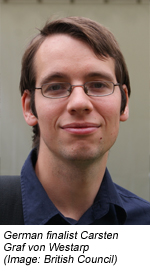
carsten.jpgCarsten Graf von Westarp, a PhD student from Germany studying semiconductor physics at the University of Hamburg, says the key to successful communication is to show how your research relates to everyday life. “Be aware of the interests of the audience or reader,” he says. Use simple language: keep technical terms to a minimum, and make sure you explain any that you do use.

Another tip from Graf von Westarp is to show your fascination with your topic, advice that is echoed by the other two finalists. Karen Lavi, a PhD student studying memory and learning at the Bar-Ilan University and Haifa University in Israel, says enthusiasm is essential for good communication. “Keep in mind that [to you] your subject is the most interesting topic that ever existed — otherwise you wouldn’t have chosen to invest your whole life in it,” she says. “Try to pass on this feeling to your audience.”

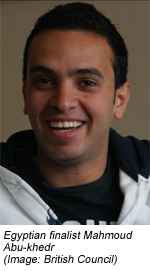
karen.jpgFellow finalist Mahmoud Abu-khedr, a third-year student at the University of Alexandria in Egypt, agrees that talking from your heart is key, and adds that you also need to believe in the importance of science communication itself.
In addition, Lavi emphasises the power of using metaphors and story-telling, suggesting that you talk about your research as if it were a detective story rather than a presentation at a conference. She also recommends you try to personalise your audience — “Imagine you are talking with your mother,” she says — and make sure that you can sum up your entire talk in a few sentences: “What is the message your audience should take home with them? What will they tell their friends and family?”

mahmoud.jpgConsidering how you present yourself can also help you communicate better, says Abu-khedr. Remember to smile, and work on your charisma: “You have to act as well as present,” he says. Lavi adds that you should also inject some humour if you can. But don’t force it so that you become uncomfortable — it’s important to have confidence in yourself. “Be how you are,” concludes Abu-khedr.

Do you have any tips to add? Share your advice and experiences below. And best of luck to all the FameLab international finalists.

UPDATE: Congratulations to Karen Lavi and Mahmoud Abu-khedr, who took second and third places respectively in the competition. You can read more about the results on the FameLab website.