Communities Happenings – 5th March

Communities Happenings is a weekly post with news of interest to NPG’s online communities. The aim is to provide this info in one handy summary. Listings include tweetups and conferences which we’re attending and/or organising as well as new online tools, products or cool videos. We also occasionally flag up NPG special offers and competitions plus updates about NPG social media activities such as new accounts you might want to follow. Do let us know what you find most useful!

#LensesonBiology

Last week Nature included an Outlook supplement focusing on Lenses on Biology, to coincide with the launch of Nature’s Education’s Principles of Biology textbook. Featuring overviews of 5 different subject areas by 5 top scientists, we complemented the special on Of Schemes and Memes with 5 blog posts by 5 young scientists at different stages of their careers.

First up was Vince Macri discussing productive failure and cancer research:

Part of my focus this term (Spring 2012) is on the molecular biology of cancer, a field which thrives on collaboration between various disciplines.  Novel drug-delivery systems, medical devices and techniques increasingly allow us to engage with and manipulate the various environments of malignant tumors. For example,  insight into molecular markers expressed frequently or exclusively by cancer cells allows for targeting of nanoparticles and drug conjugates to tumors and tumor vasculature.  Such targeted therapies have the potential to increase the effectiveness and reduce the side effects of drugs to combat cancer.
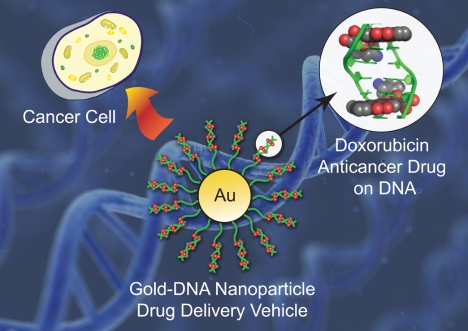
Researchers Use Gold Nanoparticles as Drug Carrier in New Cancer Treatment

 Next up was PhD student Christie Wilcox revealing her route to grad school:

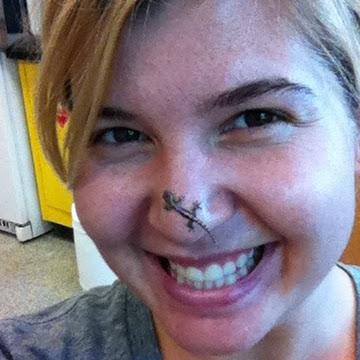
 Christie Wilcox with a small gecko on her nose

 I got into science for a lot of reasons. I have always loved animals of all shapes and sizes. My childhood desire to gaze upon gecko tongues was just the beginning of a life-long obsession that includes squealing each and every time I hold a baby anything, an inexplicable urge to swim towards dangerous animals instead of away, and compulsively touching the bells of jellyfish. My passion for wildlife is only trumped by my fascination with puzzles. I am excited by the adventure of science, by the idea of stepping out into the universe and discovering something no one else has ever seen or solving a mystery no one else has. 
Post-doc, Holly Bik, taking a slightly more alternative approach to explaining how she enjoys looking for the zen in genomes:

I realised that success requires you to define your own niche. My niche, I’m finding, lies at the intersection of tradition and innovation, using cutting-edge genomics and computational biology to answer longstanding questions about deep-sea ecosystems. The deep-sea is a vast, complicated ecosystem, we know little about the “big picture” and next to nothing about the cellular machinery which breathes life into a specialized and sometimes grotesque fauna.
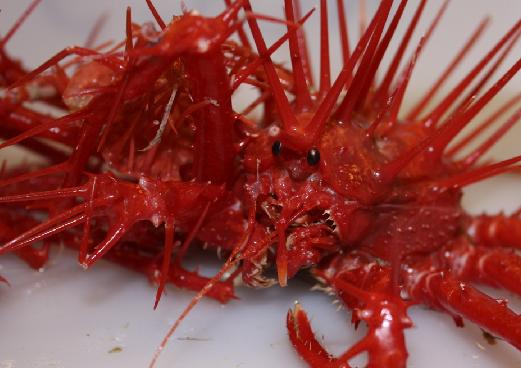
Unidentified crustacean species inhabiting the Mid-Atlantic ridge surrounding the Charlie-Gibbs Fracture zone in the North Atlantic

Undergrad, Katy Chalmers looks at how combining science and art has helped her to see details she might have otherwise missed:

The field of synthetic biology, which combines science and engineering to come up with new biological systems not found in nature, has many parallels with the relationship that I discovered between science and art. By looking at living systems in new and different ways, synthetic biologists find new ways of seeing the world. Using art to communicate science can do the same. In order to create a cohesive image, the subject material must be looked at from different perspectives. Often these different perspectives can lead to increased knowledge of the subject material, both on the part of the artist and the viewer.
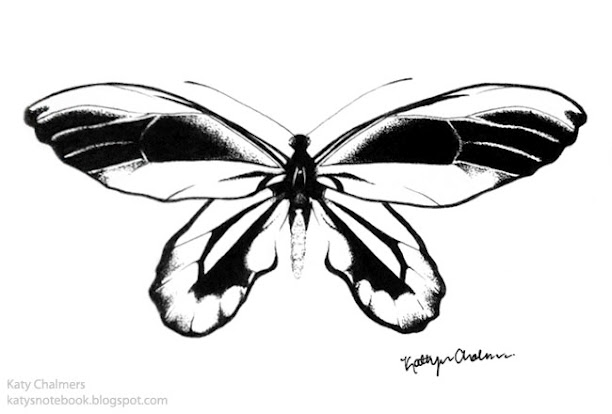
Ornithoptera alexandrae butterfly. 

Finally, high-school student and Scitable blogger, Naseem Syed considers a how her experiences out of the classroom have enhanced her interest within it:

As I advance into my freshman year, I have begun to answer more of my own curiosities: Why do some male animals such as the Blue Footed Booby prance around in a seemingly silly dance? Having studied animal interactions I know their dance is part of a ritualistic mating courtship. Why don’t we look 100% like our parents? The field of genetics helps us understand that DNA is like a shuffled card deck with some probabilities dictated by the genes of our parents. Knowing more about biology helps with everyday life; having studied plant life I now know that the closet isn’t a good place to leave my potted plants and by learning more about climate change, I can understand news stories about global warming and what the consequences mean for our planet.

To continue with the Lenses On Biology discussion, follow the #lensesonbiology hashtag on Twitter, read Nature Job’s summary, or check out Scitable’s Khalil A. Cassimally‘s post, Scientists And Science Students Tell Us Why Science Matters.

UK Conference of Science Journalists

The UK conference of science journalists will take place this year on June 25th. Their website is now live and earlybird registration is open until the end of March. The keynote will be by Jay Rosen and you can follow the online discussions on the #ukcsj hashtag. Nature.com’s Lou Woodley will be helping to coordinate a session focusing on online tools for science journalists, so stay tuned for further information.

Shorty awards – final round

The Nature News team‘s Twitter account has made it to the final round of the Shorty Industry Awards in the category, ‘Best Use of Social Media for News’ for their coverage of Fukushima. This means they are now in competition with CNN, the BBC Breaking News and NBC News/MSNBC Twitter accounts.  They are also up for the science shorty too – so thanks if you have voted for them!

Good luck, News team!

SoNYC

SoNYC is the monthly discussion series that the nature.com Communities team organises in collaboration with Ars Technica and RockefellerUniversity. The event is also live-streamed and archived and we create a round-up post including a Storify storyboard of all the online conversations around the event. February’s event took place on Thursday 16th in partnership with the American Museum of Natural History for Social Media Week and discussed, Beyond a trend: enhancing science communication with social media. The panel included author Carl Zimmer, BBC journalist, Matt Danzico and was moderated by Jennifer Kingson of the New York Times Science section. Write-up, including Storify of the tweets here.

March 20th’s event is a re-scheduling of last October’s event on, Setting the research record straight and features Retraction Watch blogger, Ivan Oransky, John Krueger of the Office of Research Integrity and Liz Williams, Executive Editor of The Journal of Cell Biology.  As we did for February’s event, we will be posting related content on Of Schemes and Memes so stay tuned and please get in touch if you’d like to contribute anything.

Twitter, Facebook and Google +

This week has seen the revival of another NPG account on Twitter: @NatureEDU 
You can also find a full Twitter list of NPG journals and products here.

Nature Reviews and Scientific American Mind  now have their own Facebook pages, so make sure you “like” them.

Finally, there are now 8 NPG Google+ pages and they can all be found in this circle.

SciBarCamb tickets

April sees the return of SciBarCamb – an unconference for scientists and technologists, taking place on the evening of Friday 20th April and all day on Saturday 21st. The earlybird tickets have now sold out, but there’s another chance to reserve your place from 10am on February 29th.  If you’d like to find out more about the event, read what co-organiser, Eva Amsen has to say about it.

Events elsewhere

Our scientific events calendars have been freshly updated to include the latest scientific events. Make sure you check them out. Please do get in touch if we are missing any events or if you would like to contribute to this calendar or any of the other calendars listed below.

London Science Events

Cambridge Science Events

DC Science Events

NYC Sci Comm events

Boston Science Events

San Francisco Science Events

Paris Science Events


Communities Happenings – 27th February

Communities Happenings is a weekly post with news of interest to NPG’s online communities. The aim is to provide this info in one handy summary. Listings include tweetups and conferences which we’re attending and/or organising as well as new online tools, products or cool videos. We also occasionally flag up NPG special offers and competitions plus updates about NPG social media activities such as new accounts you might want to follow. Do let us know what you find most useful!

Free Ebook 

Nature Reviews Key Advances in Medicine eBook is now available to download for free. The 90 page eBook summarises the key clinical studies published in 2011 and highlights trends to watch for in 2012. It has already been downloaded over 10,000 times this year! The 43 Key Advances  articles are written by international experts who identify the ground-breaking research papers published in their speciality and between them, the authors summarise 200 key papers.

This eBook is a perfect resource for busy medical students, physicians and clinical researchers who want to catch up with the medical literature from 2011, so make sure you download your free copy today.

Events in Cambridge, UK.

There are two important dates for your calendars if you’re in or around Cambridge, UK.  Firstly, March 2nd is when the next #camscitweetup will take place in The Empress pub. A chance to meet others interested in science for an evening of relaxed chatting, everyone is welcome to join in.

Secondly, April sees the return of SciBarCamb – an unconference for scientists and technologists, taking place on the evening of Friday 20th April and all day on Saturday 21st. The earlybird tickets have now sold out, but there’s another chance to reserve your place from 10am on February 29th.  If you’d like to find out more about the event, read what co-organiser, Eva Amsen has to say about it.

Events elsewhere

Our scientific events calendars have been freshly updated to include the latest scientific events. Make sure you check them out. Please do get in touch if we are missing any events or if you would like to contribute to this calendar or any of the other calendars listed below.

London Science Events

Cambridge Science Events

DC Science Events

NYC Sci Comm events

Boston Science Events

San Francisco Science Events

Paris Science Events

SoNYC

Make a note in your diary for this month’s Science Online NYC (SONYC!) which will take place onTuesday 20th March at Rockefeller University from 7pm EST at Rockefeller University from 7pm EST. You can also watch online via our Livestream channel. The theme is Setting the research record straight:

The internet has enabled the faster and more thorough dissemination of published science, meaning that more eyes than ever are available to check the accuracy, veracity and integrity of the research record. With our enhanced ability to spot plagiarism and image manipulation electronically, it appears that the frequency with which we’ve flagged potentially fraudulent or plagiarized papers has gone up. This panel will look at the trends in retractions and how they relate to real or perceived increases in research misconduct. We hope to discuss what steps publications are taking to deal with the sloppy or fraudulent research practices that sometimes result in retractions, and also what research institutions are doing to investigate and deter such practices. Is the system broken, and what can researchers do to help fix it if it is?

Panelists:

– John Kreuger of the Office of Research Integrity.

– Ivan Oransky, Executive Editor, Reuters Health and one of the people behind the Retraction Watch blog.

– Liz Williams, Executive Editor, The Journal of Cell Biology.

The event is free to attend and includes the opportunity to meet the panelists and other attendees afterwards. If you’d like to follow the online discussion, keep an eye on the #sonyc hashtag or check back here for our write-up and Storify of the online conversations.  There’s also a SoNYC Twitter account and Facebook page where you can find information and do check out our NYC Science Communication events calendar that lists this event and others. To prepare for the upcoming discussion, we’re running a series of guest posts here on Of Schemes and Memes. In our series we will consider examples of research misconduct, look at what publications are doing to prevent fraudulent research and discuss the role of social media in exposing dishonesty, so stay tuned. If you would like to contribute to this series please do get in touch, or leave a comment in the thread.


Communities Happenings – 13th February

Communities Happenings is a weekly post with news of interest to NPG’s online communities. The aim is to provide this info in one handy summary. Listings include tweetups and conferences that we’re attending and/or organising as well as new online tools, products or cool videos. We also occasionally flag up NPG special offers and competitions plus updates about NPG social media activities such as new accounts you might want to follow. Do let us know what you find most useful!

Social Media week and a super SoNYC!

February’s SoNYC is a super social media week special event at the American Museum of Natural History!  Please join us on Thursday February 16th, in person or online, via the social media week livestream to discuss Beyond a Trend: Enhancing Science Communication with Social Media. This month’s panel:

– American Museum of Natural History educators who are developing a “tool kit” of mobile apps, websites and more to help middle school students collect, share and present data on urban biodiversity

– Ben Lillie, the co-organizer of The Story Collider, which tells science stories by combining verbal narratives with podcasts, Twitter and an online magazine

– Matt Danzico, a BBC journalist who conducted a 365-day blog experiment called “The Time Hack” looking at how we perceive time

– Carl Zimmer, a science journalist whose latest book, Science Ink: Tattoos of the Science Obsessed, is based on feedback he received on his Discover Magazine blog when he asked the question: are scientists hiding tattoos of their science?

– Moderator: Jennifer Kingson, day assignment editor, Science Department, The New York Times

The event is free to attend with an opportunity to meet the panellists and other attendees afterwards. If you’d like to follow the vocal online discussion (we average around 600 tweets per SoNYC event), keep an eye on the #sonyc hashtag or check back here for our write-up and Storify of the online conversations. Do also keep an eye on the official Twitter account for more details.

To complement the event, we’re running a series of guest posts, recounting experiences where social media has been a key part of an education project. You can find our introductory post here, including a presentation by Christie Wilcox on Science and the Public: Why Every Lab Should TweetTo start the discussions, Dr Alan Cann from Leicester University gave us an academic’s viewpoint on how social media can be used as part of the curriculum. His post considers how the effects of social media usage can be measured and what the future holds for such technology:

Activity streams and the crowd wisdom of a peer network are at the centre of my approach to online learning. All this might seem like dry, academic posturing – but don’t say that to Facebook and Google, who have spent the last three years betting the farm on activity stream architecture.  Starting with the highly influential but now moribund Friendfeed, we were able to demonstrate the effectiveness of this approach in terms of monitoring student engagement [3]. Students engaged in peer to peer discussions around shared resources and personal reflection on their own learning. The patterns of online activity were mapped using graphical tools and were used to inform staff how to guide individual students. Our statistical analysis showed that student contributions to the network could be used to discern student engagement with education in a way which give a far richer picture of online activity than traditional summary statistics such as course or exam marks.

The Story Collider 

Co-founded by Ben Lille, one of this month’s SoNYC panellists, the Story Collider gives select scientists and science communicators an opportunity to share their experiences on a particular topic.  Held monthly at Union Hall in Park Slope in Brooklyn, this month’s event is all about “Brains.”  You can attend The Story Collider in person on February 15th or watch out for the podcasts of the stories which are shared via their Facebook page.

At the other side of the Atlantic in London, there are lots of social media events taking place this week and you can check out the science related events in our London Blog, or in our London scientific events calendar. We also have Google Calendars for some of the other major science cities:  Paris, Cambridge UK, NYC, Boston, DC and San Francisco. Below you can find links to all of the Google Calendars we have put together:

Please do let us know if you can see any important omissions.

# SciBarCamb

Now onto an annual event held in Cambridge UK: SciBarCamb. SciBarCamb is a gathering of scientists, publishers, technologists, and others with an interest in science. The goal of the event is to create connections between people who have a lot in common, but don’t work in the same field and may not meet each other otherwise.

SciBarCamp meetings have been held since 2008 in the US, Canada, Austria, and in Cambridge. They have attracted researchers, science communicators, entrepreneurs, artists, media professionals, librarians and scientific publishers. To find out more you can find their website here,  read this report of the very first SciBarCamp event in Toronto, check out some photos of last year’s SciBarCamb, or read what people said about the event on Twitter.

This year, the meeting will take place on the evening of April 20th  and all day on April 21st at the Cambridge Union Society. There is a small registration fee to help cover the costs of room rental and food as the organisers, including nature.com’s Lou Woodley and Nature Network’s blogger Eva Amsen, don’t make a profit on SciBarCamb.  Tickets go on sale today and if you’re quick, you can get an “Electron” ticket for £5, otherwise a regular “Atom” ticket for £10.

Twitter

This week has seen the launch of another NPG account on Twitter: NatureMagazine

You can also find a full Twitter list of NPG journals and products here.

“Triple A-S” (AAAS)

Various representatives from Nature will be in Vancouver, B.C this week for the The American Association for the Advancement of Science meeting, an annual gathering and one of the most widely recognised global science events. If you’d like to follow along, the hashtag for the event is #AAASmtg. If you’re attending the event and want to meet others who are active online, there’s a tweetup being organsied for the Saturday evening. Follow the #AAAStweetup hashtag and come along to meet Lou and others.

Frontiers in Materials: Spintronics

Nature Materials and the European Materials Research Society are organising a workshop with the aim of providing an overview of the most interesting developments in the field of spintronics, a technology that aims at controlling the electron spin beside the electron charge and that could provide efficient electronic devices with potentially new functionalities. The workshop will take place in Palais des Congrès, Strasbourg, France on the 13th May and will consist of a number of invited talks.

The speakers:

Gerrit Bauer (University of Delft, The Netherlands / Tohoku University, Japan)
Manuel Bibes (CNRS Thales, France)
Albert Fert (CNRS Thales, France)
Laurence Molenkamp (Würzburg University, Germany)
Hideo Ohno (Tohoku University, Japan)
Theo Rasing (Radboud University of Nijmegen, The Netherlands)
Jairo Sinova (Texas A&M University, USA)
Jon Slaughter (Everspin, USA)

You can register for the workshop and find out more information here, or join the Facebook Event. 


Communities Happenings – 30th January

Communities Happenings is a weekly post with news of interest to NPG’s online communities. The aim is to provide this info in one handy summary. Listings include tweetups and conferences that we’re attending and/or organising as well as new online tools, products or cool videos. We also occasionally flag up NPG special offers and competitions plus updates about NPG social media activities such as new accounts you might want to follow. Do let us know what you find most useful!

Science Online #scio12

Last week scientists, teachers, librarians, students, journalists, bloggers and others interested in how the online world is changing the way science is communicated, gathered at the Research Triangle area of North Carolina for the annual Science Online conference.

The agenda was split thoughtfully into workshops, discussion sessions, fun events and museum tours. Regular readers will be aware that we attended the conference and Lou Woodley co-hosted two sessions, the first a workshop and the second a discussion group:

Next generation scientific society and conference.

This discussion, co-hosted by both Lou and Scicurious, looked at how adding online elements can complement a conference and how scientific societies can use this to reach out to wider audiences.  A range of topics was discussed, such as how to encourage live blogging and tweeting, how societies might go about dealing with science bloggers and how to archive online coverage.

You can find a summary of this session, as well as a Storify collating the online conversation, here on Of Schemes and Memes and on Scicurious’s blog.

The Attention Economy: The currencies for social media influence and exchange rates for attention

The session was moderated by Lou and Adrian J. Ebsary  and focused on the various tools which claim to measure user influence across social networks and how to analyse these values and understand their limitations. The conversation also delved into some of the issues and etiquette around the ways you can increase your influence, such as listing, favouriting, public shout-outs, awarding K+ or #ff.

A Storify collating the tweets from this session can be found on Adrian’s blog and on Of Schemes and Memes.

Feel free to let us know if we have left out any tweets from either of these sessions, or if you have subsequently blogged about this session.

Sweeeeet!!!

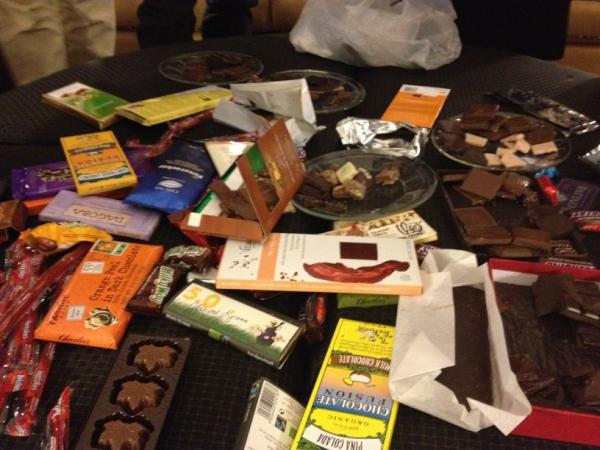
For those who attended Science Online 2012, one of the “sweetest” associated fringe events was the Scisweetup. Following a conversation on Twitter about bacon-flavoured chocolate, we decided to hold a tweet up with a twist! Attendees did not let us down and there was a huge collection of weird and wonderful sweets, providing a rare opportunity to taste some of the most unusual flavours of chocolate around.

Source: Seth Mnookin‘s picture

Options included pistachio & red pepper in dark chocolate, chocolate with chipotle and coconut curry chocolate. You can check the Scisweetup wiki for more pictures and blog posts about the event and a big thanks to everyone who participated.

Super SONYC!

Last Thursday, the eagerly awaited 8th SoNYC event took place. The topic of discussion was, “Thinking Digital: Giving your research more reach (and making sure others can find it)” and the panel included:

Mark Hahnel, the developer of Figshare

Carol Feltes, the head librarian at RockefellerUniversity

Veronique Kiermer, an Executive Editor and Head of Researcher Services at Nature, and a member of the ORCID steering committee

Cathy Nortion, the library scholar at the Biodiversity Heritage Library at Woods Hole’s Marine Biological Laboratory.

You can catch up on the discussion via the recording of the live stream or read our summary post which includes a Storify of the online conversations. Details of the next SoNYC will be released soon, so do keep an eye out on the SoNYC Twitter account for details and keep Thursday February 16th free!

Events Calendar

Today Nature Publishing Group (NPG) have launched an expanded online calendar of global scientific events. The calendar provides users with a new way to search for science events, which can also be personalized and synced to an online or mobile calendar. The calendar is hosted on nature.com and provides users with an innovative way to find important dates in science, as well as events that have been specifically selected by Nature editors. Content includes:

-Conferences

-Training courses

-Careers events

-Journal publication dates

-International observances

-Congress

-Historical anniversaries

-Astronomical events

-Webinars/virtual events

You can find our more about the calendar in the official press release, or check it out for yourself.

Twitter

This week has seen the launch of more NPG Twitter accounts. So make sure you follow the latest accounts:

You can also find a full Twitter list of NPG journals and products here.

Communities Happenings – 28th November

Scientific events in Boston

Boston blogger, Tinker Ready, has been alerting those in the area to a jam-packed week of scientific events and you can keep updated on the latest events by checking out her calendar. This week, she will be focusing her blogging efforts on viruses and she’ll be heading over to the AIDS @ 30 event. Do let us know if you plan to attend any of these events, or if there is anything missing from the calendar.

Don’t forget that we’ve also created Google Calendars for some of the other major science cities: Paris, London and Cambridge in the UK and DC, NYC and San Francisco in the US. Below you can find links to all of the Google Calendars we have put together:

Please do let us know if you can see any important omissions, or if you would like to contribute to any of the calendars.

SONYC!

Join us on Thursday December 8th, in person at Rockefeller University from 7pm EST, or online via our Livestream channel for the seventh SONYC! The topic for discussion will be, Matching medium and messengers to meet the masses.

Reaching an audience that’s already interested in science is relatively straightforward; however, reaching a broader audience can be challenging. Attracting and maintaining an audience outside the core of science enthusiasts requires a carefully crafted match of the medium and messenger. This SONYC will consider when and how scientists and science communicators should seek to highlight science issues to the general public? Should we be ready to respond and correct public misunderstandings or attempt to influence science policy? What material can be handled through social media and what requires a more involved form of engagement, such as a science festival?

The event is free to attend with an opportunity to meet the panellists and other attendees afterwards. If you’d like to follow the vocal online discussion, keep an eye on the #sonyc hashtag or check back here for our write-up and Storify of the online conversations. Do continue to check the official Twitter account for more information.

FameLab

FameLab, set up in 2005 by Cheltenham Science Festival, is the international competition for science communicators and this week the London heats have begun! Kings College London is the venue for the heats, with a winner and a wildcard from each heat making the final next Wednesday. Over the next few days, Nature Network London will feature interviews with the winners and wildcards. First up is wildcard and Imperial PhD student, Edward Yoxall:

How did you become interested in communication and have you ever done anything like this before?

I’ve never done anything like FameLab, but I guess I’ve always enjoyed being on stage. Gives you such a rush! I’ve been working for the BBC on the ‘Bang Goes the Theory’ roadshow as a science demonstrator, so that’s been pretty good practice for speaking in front of crowds. It’s also been good at making me pitch at the right level – finding the balance between complexity and simplicity is definitely one of the hardest parts of the job.

Do keep an eye on the London blog for the remaining interviews.

Nature Outlook: Allergies

The increased prevalence of allergies and asthma, especially in the developed world, has raised the stakes in the quest for prevention and cure. In light of this, the latest Nature Outlook supplement is all about allergies. Nature Network blogger Paige Brown features in the supplement with her article, Atopy: Marching with allergies, where she details her lifelong struggles with allergic disorders and hyper-reactivity:

My mother, herself allergy-prone, remembers my inflamed and itchy skin lesions in infancy. These are classic symptoms of atopic eczema, better known in the United States as atopic dermatitis. Then, in my toddler years, as my father recounts, I started to show “this peculiar reaction” around animals, scratching at my throat as my eyes went red, watery and swollen. These typical symptoms of allergic rhinitis, or hay fever, owe their origins to human immune-system responses to specific protein allergens, for example those found in animal dander:

You can read the whole, free supplement here.

cover.jpg

#Scitweetups

Science Tweetups are a great way to meet local scientists and science communicators for an evening of chitchat in the pub. There are now regular tweetups in NYC ( #NYCscitweetup, ) Cambridge, UK ( #camscitweetup ) and Washington DC (#DCscitweetup. )

The sixth #NYCSciTweetup is on Thursday 1st December at the Peculier Pub. Join in from 6.30pm onwards.

On the other side of the Atlantic, there is also a pre-Xmas #ukscitweetup in London; here’s the doodle poll where you can vote for your preferred dates. To find out who else is attending, watch the #ukscitweetup hashtag on Twitter.

It is question time

This week NatureNews have been asking via their brand new Facebook page, “Who owns your lab notebook?” In response to a legal dispute about missing notebooks in Nevada, some have wondered whether most working scientists even know who technically owns their lab notebooks. So, for the working scientists out there, is it clear that the research notes you take generally belong to the institution you work for? You can respond to their FB poll here and make sure you “like” them to keep updated on the latest news.

For those interested in Nature’s other social media presences, we also have a Twitter list cataloguing all of our NPG Twitter accounts and we also have a Google + circle featuring all the NPG Google+ pages. This circle will be continuously updated as and when accounts are created.

Communities Happenings – 17th November

Welcome to the blogosphere

new blog image.jpg

We would like to wish a warm welcome to a new blog which began on the Scitable blogging network this week. The Promethean Cell will track ongoing issues and research in the regenerative medicine fields and will occasionally be interspersed with anecdotes from a fledgling postdoc’s career. Ada Ao, a postdoctoral research fellow at Vanderbilt University, explains more about her new blog:

Now that I’ve declaimed from my soapbox, what exactly will I blog about? The possibilities are endless. Recent discoveries in the stem cell field are incredibly exciting. This blog will encompass issues like basic biology, opinions and views, and where we may go next in terms of applicable therapeutics. I’m really aiming to put together the “big picture”.

We urge you to check it out and do feel free to send Ada a tweet; she’s @adaaocom on Twitter, with any feedback or suggestions.

On Nature Network we would also like to welcome post-doc student Ivana Gadjanski whose new blog, My Metacognitive Oasis began this week. Her very first post discusses how she Zigs and Zags through her scientific career:

I still remember the feeling I had immediately after obtaining my PhD degree. It was a mixture of relief, accomplishment and somehow emptiness. And one question kept popping in to my mind. What now?

You can follow her story in her blog and please feel free to join in the discussion.

Neuroblogging

Neuroscience 2011 has been this year’s major event for neuroscientists from around the globe. Organised by the Society for Neuroscience (SfN), the event took place from November 12th – 16th, in Washington, DC. To tie in with this, some of the attendees have been sharing their observations from the event in an exclusive series of guest posts on NPG’s Neuroscience blog, Action Potential.

We’ve created two round-ups of the blogging coverage; part 1 here and part 2 In addition, Action Potential’s editor, Noah Gray, has created a Google + circle listing the guest bloggers and you can also follow the hashtag #NPGsfn11 on Twitter to share in the discussion. Do let is know if you have any feedback.

SONYC!

The details of December’s Science Online NYC (#SoNYC) event were announced this week. Please join us on Thursday December 8th, in person at Rockefeller University from 7pm EST, or online via our Livestream channel to discuss, Matching medium and messengers to meet the masses.

Reaching an audience that’s already interested in science is a relatively easy thing to do. Reaching a broader audience, however, can be a serious challenge. Attracting and maintaining an audience outside the core of science enthusiasts requires a carefully crafted match of the medium and messenger. When and how should scientists and science communicators seek to highlight science issues to the general public? Should we be ready to respond and correct public misunderstandings or attempt to influence science policy? What material can be handled through social media, and what requires a more involved form of engagement, such as a science festival?

This month’s panel has experience communicating with everyone from young kids to policymakers, and will discuss what they’ve learned about using different spokespeople and platforms to get their message out. The panel includes:

Darlene Cavalier: The woman behind the Science Cheerleaders

Jamie Vernon: A science policy analyst

Molly Webster: The lead producer for live programming at the World Science Festival.

Kevin Zelnio: The webmaster for the Deep Sea News and a freelance writer.

The event is free to attend with an opportunity to meet the panellists and other attendees afterwards. If you’d like to follow the vocal online discussion (we average around 600 tweets per SoNYC event), keep an eye on the #sonyc hashtag or check back here for our write-up and Storify of the online conversations. Do also keep an eye on the official Twitter account for more details.

Tweetups

Science Tweetups provide an excellent opportunity to meet local scientists and science communicators for an evening of chatting in the pub. For those interested in the next #camscitweet, this will be held next week on Thursday 24th November in the Kingston Arms pub. Join in from 6:30pm and anyone is welcome!

For those on the other side of the Atlantic, keep an eye on the #DCscitweetup and #NYCscitweetup hashtags for information on future events.

Twitter and Google+

This week has seen the launch of another NPG journal account on Twitter, Nature Reviews Molecular Cell Biology who are tweeting as @NatRevMCB

You can also find a full Twitter list of NPG journals and products here.

Last week Google+ launched pages and several NPG journals and products have already created their own. See our circle featuring all the NPG Google+ pages. This circle will be continuously updated as and when accounts are created.

Science Calendars

Yesterday we alerted you to the latest scientific calendar in our series, Science Events in Paris. The calendar is moderated by MyScienceWork, an open access scientific research network.

There’s always an interesting science event taking place and to help with diary planning, we’ve created Google Calendars for some of the other major science cities: London and Cambridge in the UK and NYC, Boston and San Francisco in the US. Below you can find links to all of the Google Calendars we have put together:

Please do let us know if you can see any important omissions.

Science events in Paris – Calendar

For those who are interested in scientific events in France, we would like to alert you to a new public calendar detailing events in and around the Paris area.

The calendar is moderated by MyScienceWork, an open access scientific research network. As well as focusing on open access, MyScienceWork are particularly interested in Women in Science and are currently in partnership with the international program, L’Oréal-UNESCO’s For Women in Science .

To find out more about MyScienceWork, you can catch up on their latest news via their blog

The calendar will be regularly updated so that the coming month contains the events that we’re aware of.

Please get in touch if we are missing any events or if you would like to contribute to this calendar or any of the other calendars listed below.
London Science Events

Cambridge Science Events

DC Science Events

NYC Sci Comm events

Boston Science Events

San Francisco Science Events

Scientific events calendars from around the world

There’s always an interesting science event taking place, or so it seems, and as more and more events are now being live-streamed or live-tweeted, you can often also follow events in places where you don’t live.

To help with diary planning, we’ve created Google Calendars for some of the major science cities; London and Cambridge in the UK and NYC, Boston and San Francisco in the US.

Below you can find links to all of the Google Calendars we have put together:

London Science Events

Cambridge Science Events

DC Science Events

NYC Sci Comm events

Boston Science Events

San Francisco Science Events

We try to feature all the scientific events we know of in these areas including lectures, meet-ups (including #scitweetups), exhibition openings, quizzes and the events that we’re involved with organising such as the monthly Science Online NYC (#sonyc) discussion series. Please do let us know if you can see any important omissions.

We’re also happy to add anyone as a calendar admin so that you can update it with your own science events, just get in touch.

These calendars are all works in progress – more events will be added regularly and all feedback is very welcome.

Our Google Calendars

Science communication, social media and publishing events in New York- Calendar

For those who are interested in science communication and publishing, we have compiled a public calender of the latest events in New York and the surrounding areas.

This calender will be regularly updated so that the coming month contains the events that we’re aware of. Do let us know if you would like to add one to the calender, or if we are missing any events off, feel free to leave a comment.

Science communication, social media and publishing events in London – Calendar

For those who are interested in science communication and publishing, we have compiled a public calender of the latest events in London and the surrounding areas.

We’ll regularly update the calendar so that the coming month contains the events that we’re aware of. Do let us know if we are missing any events, and if you would like to add one to the calender, feel free to leave a comment.

This calendar isn’t intended to replace M@’s excellent weekly summaries of events in London on the London hub blog. Those focus more on interesting science museum exhibitions, science-themed quizes and talks, whereas the calendar is for events that are a specifically designed as an opportunity to meet and discuss science communication/blogging/social media with like-minded people.

Lou also has a Twitter list of London-based people interested in science communication – please tweet/leave a comment if you’d like to be added.