
Communities Happenings is a weekly post with news of interest to NPG’s online communities. The aim is to provide this info in one handy summary. Listings include tweetups and conferences which we’re attending and/or organising as well as new online tools, products or cool videos. We also occasionally flag up NPG special offers and competitions plus updates about NPG social media activities such as new accounts you might want to follow. Do let us know what you find most useful!
#LensesonBiology
Last week Nature included an Outlook supplement focusing on Lenses on Biology, to coincide with the launch of Nature’s Education’s Principles of Biology textbook. Featuring overviews of 5 different subject areas by 5 top scientists, we complemented the special on Of Schemes and Memes with 5 blog posts by 5 young scientists at different stages of their careers.
- From a lens on cancer, to masters student Vince Macri making it his job
First up was Vince Macri discussing productive failure and cancer research:
Part of my focus this term (Spring 2012) is on the molecular biology of cancer, a field which thrives on collaboration between various disciplines. Novel drug-delivery systems, medical devices and techniques increasingly allow us to engage with and manipulate the various environments of malignant tumors. For example, insight into molecular markers expressed frequently or exclusively by cancer cells allows for targeting of nanoparticles and drug conjugates to tumors and tumor vasculature. Such targeted therapies have the potential to increase the effectiveness and reduce the side effects of drugs to combat cancer.
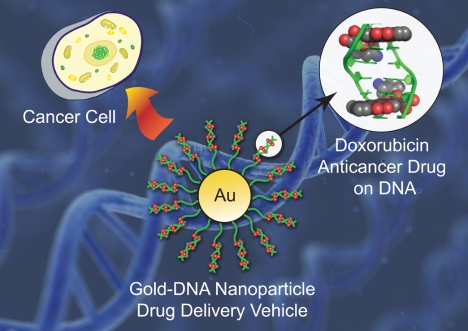
Researchers Use Gold Nanoparticles as Drug Carrier in New Cancer Treatment
- From a lens on stem cells, to Christie Wilcox on molecular biology!
Next up was PhD student Christie Wilcox revealing her route to grad school:
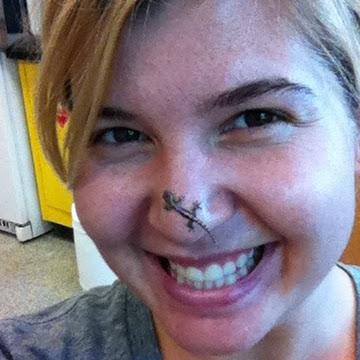
Christie Wilcox with a small gecko on her nose
I got into science for a lot of reasons. I have always loved animals of all shapes and sizes. My childhood desire to gaze upon gecko tongues was just the beginning of a life-long obsession that includes squealing each and every time I hold a baby anything, an inexplicable urge to swim towards dangerous animals instead of away, and compulsively touching the bells of jellyfish. My passion for wildlife is only trumped by my fascination with puzzles. I am excited by the adventure of science, by the idea of stepping out into the universe and discovering something no one else has ever seen or solving a mystery no one else has.
- From a lens on ocean science, to Holly Bik on marine life
Post-doc, Holly Bik, taking a slightly more alternative approach to explaining how she enjoys looking for the zen in genomes:
I realised that success requires you to define your own niche. My niche, I’m finding, lies at the intersection of tradition and innovation, using cutting-edge genomics and computational biology to answer longstanding questions about deep-sea ecosystems. The deep-sea is a vast, complicated ecosystem, we know little about the “big picture” and next to nothing about the cellular machinery which breathes life into a specialized and sometimes grotesque fauna.
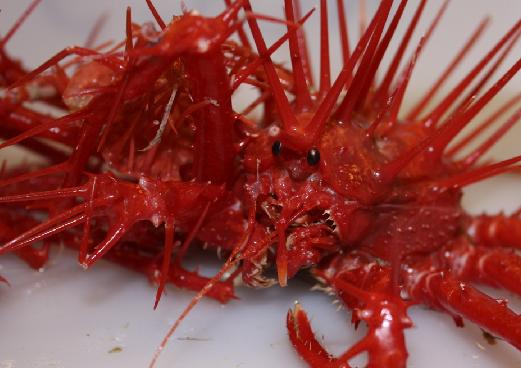
Unidentified crustacean species inhabiting the Mid-Atlantic ridge surrounding the Charlie-Gibbs Fracture zone in the North Atlantic
- From a lens on synthetic biology, to an essay from undergraduate Katy Chalmers
Undergrad, Katy Chalmers looks at how combining science and art has helped her to see details she might have otherwise missed:
The field of synthetic biology, which combines science and engineering to come up with new biological systems not found in nature, has many parallels with the relationship that I discovered between science and art. By looking at living systems in new and different ways, synthetic biologists find new ways of seeing the world. Using art to communicate science can do the same. In order to create a cohesive image, the subject material must be looked at from different perspectives. Often these different perspectives can lead to increased knowledge of the subject material, both on the part of the artist and the viewer.
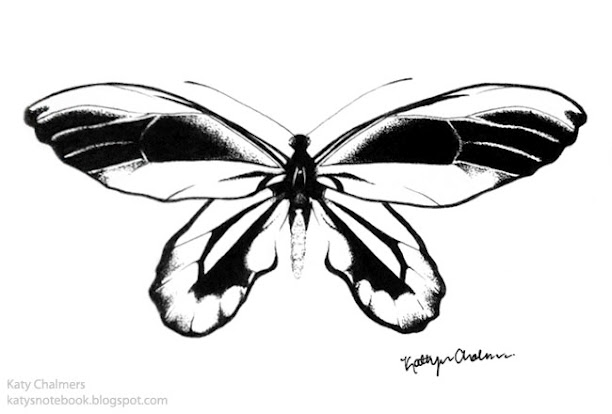
Ornithoptera alexandrae butterfly.
- From a lens on Climate Change, to high school student Naseem Syed learning biology
Finally, high-school student and Scitable blogger, Naseem Syed considers a how her experiences out of the classroom have enhanced her interest within it:
As I advance into my freshman year, I have begun to answer more of my own curiosities: Why do some male animals such as the Blue Footed Booby prance around in a seemingly silly dance? Having studied animal interactions I know their dance is part of a ritualistic mating courtship. Why don’t we look 100% like our parents? The field of genetics helps us understand that DNA is like a shuffled card deck with some probabilities dictated by the genes of our parents. Knowing more about biology helps with everyday life; having studied plant life I now know that the closet isn’t a good place to leave my potted plants and by learning more about climate change, I can understand news stories about global warming and what the consequences mean for our planet.
To continue with the Lenses On Biology discussion, follow the #lensesonbiology hashtag on Twitter, read Nature Job’s summary, or check out Scitable’s Khalil A. Cassimally‘s post, Scientists And Science Students Tell Us Why Science Matters.
UK Conference of Science Journalists
The UK conference of science journalists will take place this year on June 25th. Their website is now live and earlybird registration is open until the end of March. The keynote will be by Jay Rosen and you can follow the online discussions on the #ukcsj hashtag. Nature.com’s Lou Woodley will be helping to coordinate a session focusing on online tools for science journalists, so stay tuned for further information.
Shorty awards – final round
The Nature News team‘s Twitter account has made it to the final round of the Shorty Industry Awards in the category, ‘Best Use of Social Media for News’ for their coverage of Fukushima. This means they are now in competition with CNN, the BBC Breaking News and NBC News/MSNBC Twitter accounts. They are also up for the science shorty too – so thanks if you have voted for them!
Good luck, News team!
SoNYC
SoNYC is the monthly discussion series that the nature.com Communities team organises in collaboration with Ars Technica and RockefellerUniversity. The event is also live-streamed and archived and we create a round-up post including a Storify storyboard of all the online conversations around the event. February’s event took place on Thursday 16th in partnership with the American Museum of Natural History for Social Media Week and discussed, Beyond a trend: enhancing science communication with social media. The panel included author Carl Zimmer, BBC journalist, Matt Danzico and was moderated by Jennifer Kingson of the New York Times Science section. Write-up, including Storify of the tweets here.
March 20th’s event is a re-scheduling of last October’s event on, Setting the research record straight and features Retraction Watch blogger, Ivan Oransky, John Krueger of the Office of Research Integrity and Liz Williams, Executive Editor of The Journal of Cell Biology. As we did for February’s event, we will be posting related content on Of Schemes and Memes so stay tuned and please get in touch if you’d like to contribute anything.
Twitter, Facebook and Google +
This week has seen the revival of another NPG account on Twitter: @NatureEDU
You can also find a full Twitter list of NPG journals and products here.
Nature Reviews and Scientific American Mind now have their own Facebook pages, so make sure you “like” them.
Finally, there are now 8 NPG Google+ pages and they can all be found in this circle.
SciBarCamb tickets
April sees the return of SciBarCamb – an unconference for scientists and technologists, taking place on the evening of Friday 20th April and all day on Saturday 21st. The earlybird tickets have now sold out, but there’s another chance to reserve your place from 10am on February 29th. If you’d like to find out more about the event, read what co-organiser, Eva Amsen has to say about it.
Events elsewhere
Our scientific events calendars have been freshly updated to include the latest scientific events. Make sure you check them out. Please do get in touch if we are missing any events or if you would like to contribute to this calendar or any of the other calendars listed below.