Communities Happenings is a weekly post with news of interest to NPG’s online communities. The aim is to provide this info in one handy summary. Listings include tweetups and conferences which we’re attending and/or organising as well as new online tools, products or cool videos. We also occasionally flag up NPG special offers and competitions plus updates about NPG social media activities such as new accounts you might want to follow. Do let us know what you find most useful!
Social Media SoNYC
On Thursday, the eagerly awaited 9th SoNYC event took place, a super social media week special event at the American Museum of Natural History! The topic for discussion was, “Beyond a Trend: Enhancing Science Communication with Social Media.“ The panel included:
– American Museum of Natural History educators who are developing a “tool kit” of mobile apps, websites and more to help middle school students collect, share and present data on urban biodiversity
– Ben Lillie, the co-organizer of The Story Collider, which tells science stories by combining verbal narratives with podcasts, Twitter and an online magazine
– Matt Danzico, a BBC journalist who conducted a 365-day blog experiment called “The Time Hack” looking at how we perceive time
– Carl Zimmer, a science journalist whose latest book, Science Ink: Tattoos of the Science Obsessed, is based on feedback he received on his Discover Magazine blog when he asked the question: are scientists hiding tattoos of their science?
– Moderator: Jennifer Kingson, day assignment editor, Science Department, The New York Times
You can catch up on the discussion via the recording of the livestream or read our summary post which includes a Storify of the online conversations.
The next SoNYC takes place on Tuesday 20th March when we’ll be discussing “Keeping the research record straight” with Retraction Watch blogger, Ivan Oransky as well as John Krueger of the Office of Research Integrity and Liz Williams, Executive Editor of the Journal of Cell Biology. If you’re in NYC and would like to attend, you can sign up here or watch our livestream if you can’t make it in person.
Guest posts and interviews
To complement this month’s SoNYC event we ran a series of guest posts, recounting experiences where social media has been a key part of an education project. You can find our introductory post here, including a presentation by Christie Wilcox on Science and the Public: Why Every Lab Should Tweet.
To start the discussions, Dr Alan Cann from Leicester University gave us an academic’s viewpoint on how social media can be used as part of the curriculum. His post considers how the effects of social media usage can be measured and what the future holds for such technology. Next we heard from Ben Lillie, co-founder of The Story Collider,who discussed the ways social media can also be used to tell a science story. Finally we interviewed Allie Wilkinson, creator of the “This is what a scientist looks like” initiative:
“This is what a scientist looks like.” Developed by science writer and multimedia specialist Allie Wilkinson, the concept is simple, a Tumblr blog which collates pictures of scientists from all walks of life. Allie explains, “there is no cookie-cutter mold of what a scientist looks like. A scientist can look like you, or can look like me.”
The project aims to challenge the stereotypical view of a scientist, “there is no rule that scientists can’t be multidimensional and can’t have fun.
Continue to the post to find out how the project aims to challenge the stereotypical view of a scientist.
Social media
To tie in with our social media extravaganza, our hub bloggers also joined the discussion. Tinker Ready, our Boston blogger, interviewed Joi Ito, Internet pioneer and head of the MIT Media Lab, on science, social networking and “the shape of ideas.”
 In a conversation earlier this week, he offered a hypothetical example of how emerging tools are creating new ways to analyze information generated by online networks. Take data from the history of books, together with trends from search queries and Twitter and connect it all to scientific references, he said.
“Then we get these really rich data sets with which we can understand… the shape of ideas within the context of society.”
He also offered a very concrete example. This spring’s Research Update session – usually open only to the Media Lab’s corporate and philanthropic sponsors — will become a Tweet-up. For the first time, most of the previously private sessions will be live streamed and the lab will solicit input through Twitter.
“The more you get your ideas out there, the more likely you’ll find people to collaborate with,” Ito said.
Continue to Tinker’s post to hear more from Joi Ito.
Joanna Scott, our London blogger, interviewed Jack Ashby, Manager of the Grant Museum of Zoology at UCL, about QRator, the pioneering project the Grant Museum is working on to allow the public to engage with museum collections by contributing their own interpretations:
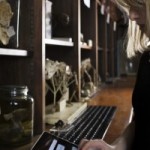 QRator is a project that allows our visitors to get involved in conversations about the way that museums like ours operate and the role of science in society today. In the Museum are ten iPads which each pose a broad question linked to a changing display of specimens. We are really interested in what our visitors think about some of the challenges that managing a natural history collection brings up, and other issues in the life sciences. They change periodically, but at the moment our current questions include “Is it ever acceptable for museums to lie?”, “Is domestication ethical?”, “Should human and animal remains be treated differently in museums like this?” and “What makes an animal British?”
Do you think social media is going to be very important to museums and outreach departments of universities in the future? Feel free to leave your thoughts in the comment thread.
Nature Education Launches Interactive Biology Textbook
Nature Education, the educational division of Nature Publishing Group, announced this week the worldwide release of Principles of Biology, a $49 interactive university-level biology textbook:

Principles of Biology is a “born digital” textbook, with all materials designed specifically for consumption by students via browsers on desktops, laptops, tablets, and smartphones. Each of the 196 modules in the text is a self-contained learning experience, integrating text, images, interactives, and continual assessment, which feeds an automatic gradebook through which instructors can track student progress. Instructors can customize Principles of Biology to meet their curriculum by rearranging modules, turning sections within modules on and off, adding their own material, and integrating the textbook into their campus learning management system. In addition to accessing all materials online, students can download a Desktop Edition for use when not connected to the internet as well as printable versions of each module.
Principles of Biology follows the successful launch by Nature Education in 2009 of Scitable, a collaborative online learning space for individual life science students now used in more than 180 countries. You can find out more about this in the official press release.
Google +
This week the Nature Blogs Google+ page reached the 1,000 circles milestone. Thanks to everyone who is circling us!
Don’t forget that you can find other NPG journals and products on Google+. See our circle featuring all the NPG Google+ pages. This circle will be continuously updated as and when accounts are created.
The AAAS meeting in Vancouver
The AAAS annual meeting has been taking place in Vancouver since last Wednesday, comprising of a mix of plenary talks, smaller discussions and exhibits. You can read Paige Brown’s Storify summary of Saturday night’s “Science is not enough” plenary featuring Hans Rosling and discussing the challenges of science communication.
Some upcoming events in Cambridge, UK.
Two dates for your calendars if you’re in or around Cambridge, UK. March 2nd is when the next #camscitweetup will take place in The Empress pub. A chance to meet others interested in science for an evening of relaxed chatting, everyone is welcome to join in.
April sees the return of SciBarCamb – an unconference for scientists and technologists, taking place on the evening of Friday 20th April and all day on Saturday 21st. The earlybird tickets have now sold out, but there’s another chance to reserve your place from 10am on February 29th. If you’d like to find out more about the event, read what co-organiser, Eva Amsen has to say about it.


